Pages

Sunday, June 8, 2014

Messier 51, the Whirlpool Galaxy, by Chandra and Hubble


Whirlpool Galaxy: A spiral galaxy located about 30 million light years from Earth.

This image contains nearly a million seconds worth of Chandra observing time (purple) along with optical data from the Hubble Space Telescope (red, green, and blue). The X-ray data reveal hundreds of point-like sources, most of which are X-ray binary systems (XRBs) containing a neutron star or black hole in orbit with a star like the Sun. Researchers are studying the XRBs in M51, a.k.a. the "Whirlpool Galaxy," to better understand the role they play in the evolution of the galaxy.

Scale: Image is 6 x 10 arcmin (About 52,000 x 87,000 light years).

Image credit: X-ray: NASA/CXC/Wesleyan Univ./R.Kilgard, et al; Optical: NASA/STScI

Note: For more information, see M51: Chandra Captures Galaxy Sparkling in X-Rays.

Saturday, June 7, 2014

The Bullet Group


This image shows the Bullet Group, a group of galaxies also known as SL2S J08544-0121.

The galaxies belonging to the group are visible in the central part of the image, embedded in the diffuse dark matter (shown in blue). Hot gas, which fills the space between galaxies and comprises the bulk of ordinary (baryonic) matter in the group, is shown in pink, as imaged by ESA's XMM-Newton X-ray observatory.

The light from galaxies and hot gas belonging to the group, which lies at a redshift of z=0.351, has been traveling for almost four billion years before reaching us. Other galaxies, either in the foreground or background of the Bullet Group, are sprinkled across the image, as well as bright foreground stars that belong to our Galaxy.

The group's components appear to be clearly separated, with the hot gas partitioned from the rest of the mass within the group. This is the smallest object ever found to show such an effect, which was caused by a merger in the group's past.

Astronomers were able to map the extent of the Bullet Group's dark matter through its gravitational lensing of background galaxies. This effect is particularly evident in the center-right part of this image, where a round, bright galaxy that belongs to the Bullet Group is circled by curious arcs of light – the distorted image of another galaxy lying much farther away.

By exploring the contents of these cosmic wrecks, astronomers can learn more about the properties of dark matter. In particular, from the split between the dark matter and the hot gas, they can constrain how much dark matter does – or does not – interact with normal matter.

This image is a composite of an X-ray image (shown in pink) from ESA's XMM-Newton observatory, a three-color (red, green, blue) optical image from the Canada-France-Hawaii Telescope (CFHT), and a dark matter overlay (indicated in blue) based on data from CFHT, the NASA/ESA Hubble Space Telescope, and the W. M. Keck Observatory.

Image credit: ESA / XMM-Newton / F. Gastaldello (INAF/IASF, Milano, Italy) / CFHTLS

Note: For more information, see Cosmic Collision in the Bullet Group and Cosmic collision in the Bullet Group.

Friday, June 6, 2014

Hubble Ultra Deep Field 2014


Astronomers using the Hubble Space Telescope have captured the most comprehensive picture ever assembled of the evolving Universe – and one of the most colorful. The study is called the Ultraviolet Coverage of the Hubble Ultra Deep Field (UVUDF) project.

Image credit: NASA, ESA, H. Teplitz and M. Rafelski (IPAC/Caltech), A. Koekemoer (STScI), R. Windhorst (Arizona State University), and Z. Levay (STScI)

Note: For more information, see Hubble Unveils a Colorful View of the Universe.

Thursday, June 5, 2014

Dust Ring Around HR 4796A


This infrared image shows the dust ring around the nearby star HR 4796A in the southern constellation of Centaurus. It was one of the first produced by the SPHERE instrument soon after it was installed on ESO’s Very Large Telescope in May 2014. It shows not only the ring itself with great clarity, but also reveals the power of SPHERE to reduce the glare from the very bright star — the key to finding and studying exoplanets in future.

Image credit: ESO/J.-L. Beuzit et al./SPHERE Consortium

Note: For more information, see First Light for SPHERE Exoplanet Imager.

Wednesday, June 4, 2014

Xi1 Canis Majoris


X-ray emission from the B-type star Xi1 Canis Majoris (Xi1 CMa) – seen in the center of this image - has been measured using ESA's XMM-Newton observatory.

Xi1 CMa was observed continuously with XMM-Newton in October 2012 for almost 29 hours. These observations resulted in the first detection of pulsed X-ray emission from a non-degenerate, massive star.

Xi1 CMa is an extremely bright star with a surface temperature of approximately 27,500K, and a mass of approximately 15 times that of the Sun. It lies some 1400 light years away in the constellation Canis Major. The star has a notably strong magnetic field, about 5000 times stronger than our Sun's.

This 3-colour image of the field was made by mapping 0.2-1.0 keV emission to red, 1.0-2.5 keV emission to green, and 2.5-10.0 keV emission to blue. The field of view of this image is 19 arcmin × 19 arcmin (approximately 7.6 light years × 7.6 light years).

Image credit: ESA/XMM-Newton/L. Oskinova (University of Potsdam)

Note: For more information, see Pulsating X-Rays Allow XMM-Newton to Unmask a Mysterious Star.

Tuesday, June 3, 2014

Kepler-10c


An artist's conception shows the Kepler-10 system, home to two rocky planets. In the foreground is Kepler-10c, a planet that weighs 17 times as much as Earth and is more than twice as large in size. Planet formation theorists are challenged to explain how such a massive world could have formed.

Image credit: Harvard-Smithsonian Center for Astrophysics/David Aguilar

Note: For more information, see Astronomers Confounded By Massive Rocky World.

Saturday, May 31, 2014

Red and Dead Elliptical Galaxies


Elliptical Galaxies: Four elliptical galaxies with very low levels of star formation.

This four-panel of images represents a sample of giant elliptical galaxies observed by Chandra and the Hershel Space Observatory in a study to investigate why these objects have such low levels of star formation. In six galaxies, Herschel detected surprisingly large amounts of cold gas – the fuel for star formation. Chandra revealed that the hot gas in the center of these galaxies appears to be much more disturbed than in the cold gas-free systems. This is a sign that material has been ejected from regions close to the central black hole. The energy from these outbursts helps to prevent the cold gas from cooling sufficiently to form stars. In two other galaxies, jets pushing against the hot gas are creating enormous cavities that are observed in the Chandra images. These jets may be heating the hot, X-ray emitting gas, preventing it from cooling and forming cold gas and stars.

Image credit: X-ray: NASA/CXC/Stanford University/N.Werner et al; Optical: DSS

Note: For more information, see Elliptical Galaxies: Chandra Helps Explain "Red and Dead Galaxies".

Friday, May 30, 2014

Artist's Conception of Cassini Observing Sunsets on Titan


Using data collected by Cassini's Visual and Infrared Mapping Spectrometer, or VIMS, while observing Titan's sunsets, researchers created simulated spectra of Titan as if it were a planet transiting across the face of a distant star. The research helps scientists to better understand observations of exoplanets with hazy atmospheres.

Image Credit: NASA/JPL-Caltech

Note: For more information, see Sunsets on Titan Reveal the Complexity of Hazy Exoplanets.

Thursday, May 29, 2014

Young Stellar Objects in the Serpens Cloud Core


Within the swaddling dust of the Serpens Cloud Core, astronomers are studying one of the youngest collections of stars ever seen in our galaxy. This infrared image combines data from NASA's Spitzer Space Telescope with shorter-wavelength observations from the Two Micron All Sky Survey (2MASS), letting us peer into the clouds of dust wrapped around this stellar nursery.

At a distance of around 750 light-years, these young stars reside within the confines of the constellation Serpens, or the "Serpent." This collection contains stars of only relatively low to moderate mass, lacking any of the massive and incredibly bright stars found in larger star-forming regions like the Orion nebula. Our sun is a star of moderate mass. Whether it formed in a low-mass stellar region like Serpens, or a high-mass stellar region like Orion, is an ongoing mystery.

The stellar "hatchlings" in the Serpens Cloud Core represent the very youngest stages of stellar development. They appear as red, orange and yellow points clustered near the center of the image. Other red features include jets of material ejected from these young stars. Some mature stars that are not in the nebula appear yellowish due to dust obscuring our view at shorter, bluer wavelengths.

This region also includes a population of prenatal stars that are so deeply enshrouded in their dusty cocoons to be completely hidden in this view. They only become detectable at much longer wavelengths of light.

The inner Serpens Cloud Core is remarkably detailed in this image, as it was assembled from 82 separate snapshots totaling a whopping 16.2 hours of Spitzer observing time. Serpens is one of several star-forming regions targeted by the Young Stellar Object Variability (YSOVAR) project, which conducted repeated observations in each area to look for changes in brightness in the baby stars. Such fluctuations can provide valuable clues to how stars gobble up gas and dust as they grow and mature.

Spitzer observations at wavelengths of 3.5 and 4.6 microns are shown in green and red, respectively. 2MASS data at 1.3 microns is displayed as blue. These observations date from Spitzer's warm mission phase, following the depletion of its liquid coolant in 2009.

Image credit: NASA/JPL-Caltech/2MASS

Note: For more information, see The 'Serpent' Star-forming Cloud Hatches New Stars.

Sunday, May 25, 2014

Black Holes and Dark Matter in the Fornax Galactic Cluster


Active, supermassive black holes at the hearts of galaxies tend to fall into two categories: those that are hidden by dust, and those that are exposed. Data from NASA's Wide-field Infrared Survey Explorer, or WISE, have shown that galaxies with hidden supermassive black holes tend to clump together in space more than the galaxies with exposed, or unobscured, black holes.

This enhanced image shows galaxies clumped together in the Fornax cluster, located 60 million light-years from Earth. The picture was taken by WISE, but has been artistically enhanced to illustrate the idea that clumped galaxies will, on average, be surrounded by larger halos of dark matter (represented in purple). Because dark matter, like normal matter, has gravity, it will pull galaxies toward it, causing them to clump.

Astronomers don't know why the hidden black holes would have larger halos of dark matter, but are intrigued by the surprising finding and are investigating further.

Image credit: NASA/JPL-Caltech

Note: For more information, see PIA18013: Unified, or 'Doughnut,' Theory of Active, Black Holes and NASA's WISE Findings Poke Hole in Black Hole 'Doughnut' Theory.

Saturday, May 24, 2014

Fresh Impact Crater Northeast of Gordii Dorsum on Mars


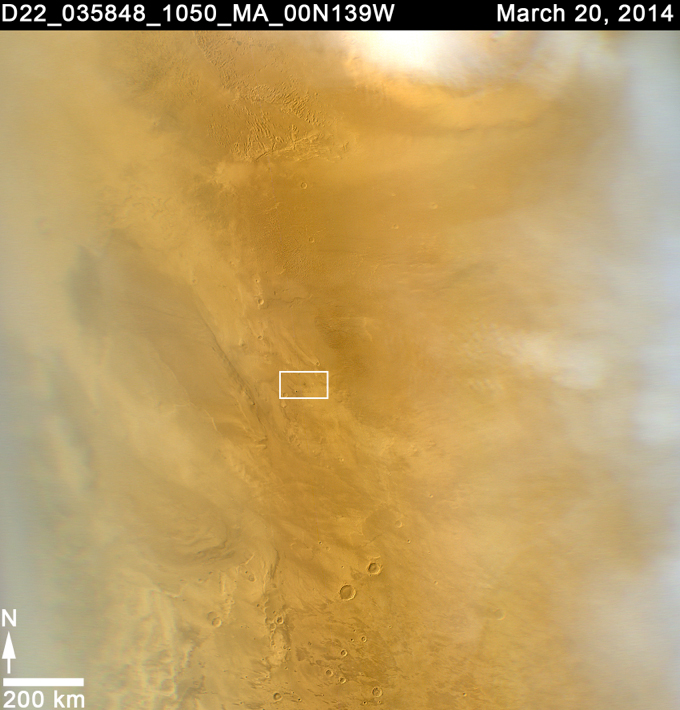
On 20 March 2014, a dark spot on the surface of Mars, about 5 miles (8 kilometers) in diameter was seen for the first time in low-resolution (approximately 1 kilometer) imaging from the Mars Color Imager (MARCI) camera on Mars Reconnaissance Orbiter (MRO). Because MARCI sees essentially the whole planet every day, the sudden appearance of a dark spot was of note.

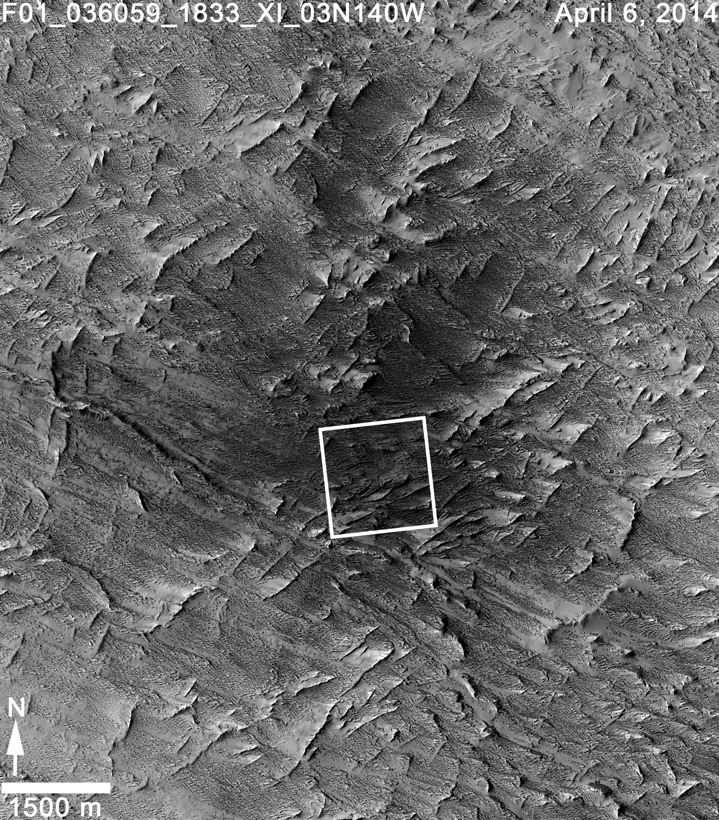
To follow up, the Context Camera (CTX) obtained a high resolution picture of the area in question in early April. Before and after imaging revealed two new large impact craters within the blast zone. At 6 meters per pixel, CTX can detect the dark blast locations but usually cannot resolve the crater that formed the blast, because most fresh impact craters are only a few meters across.

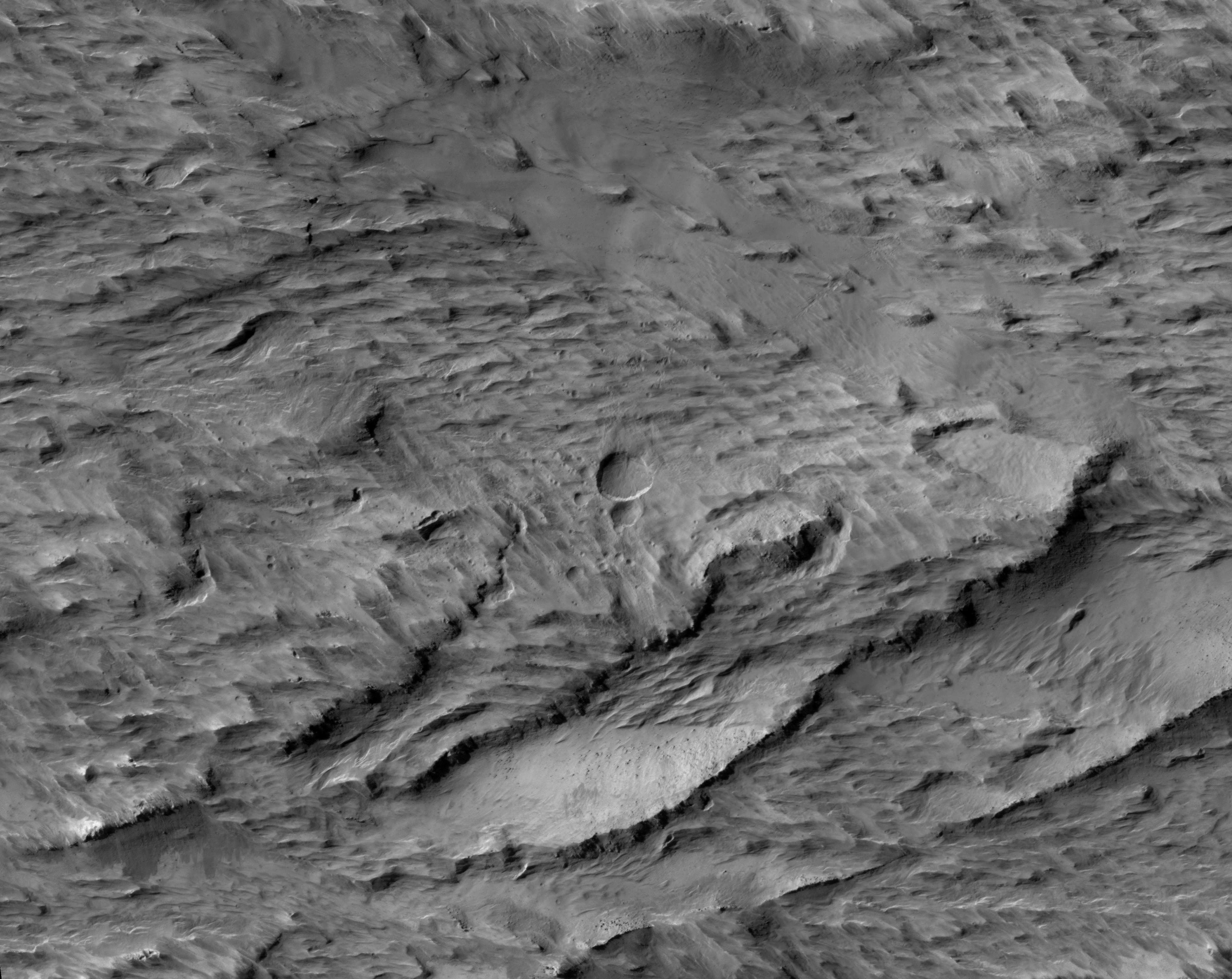
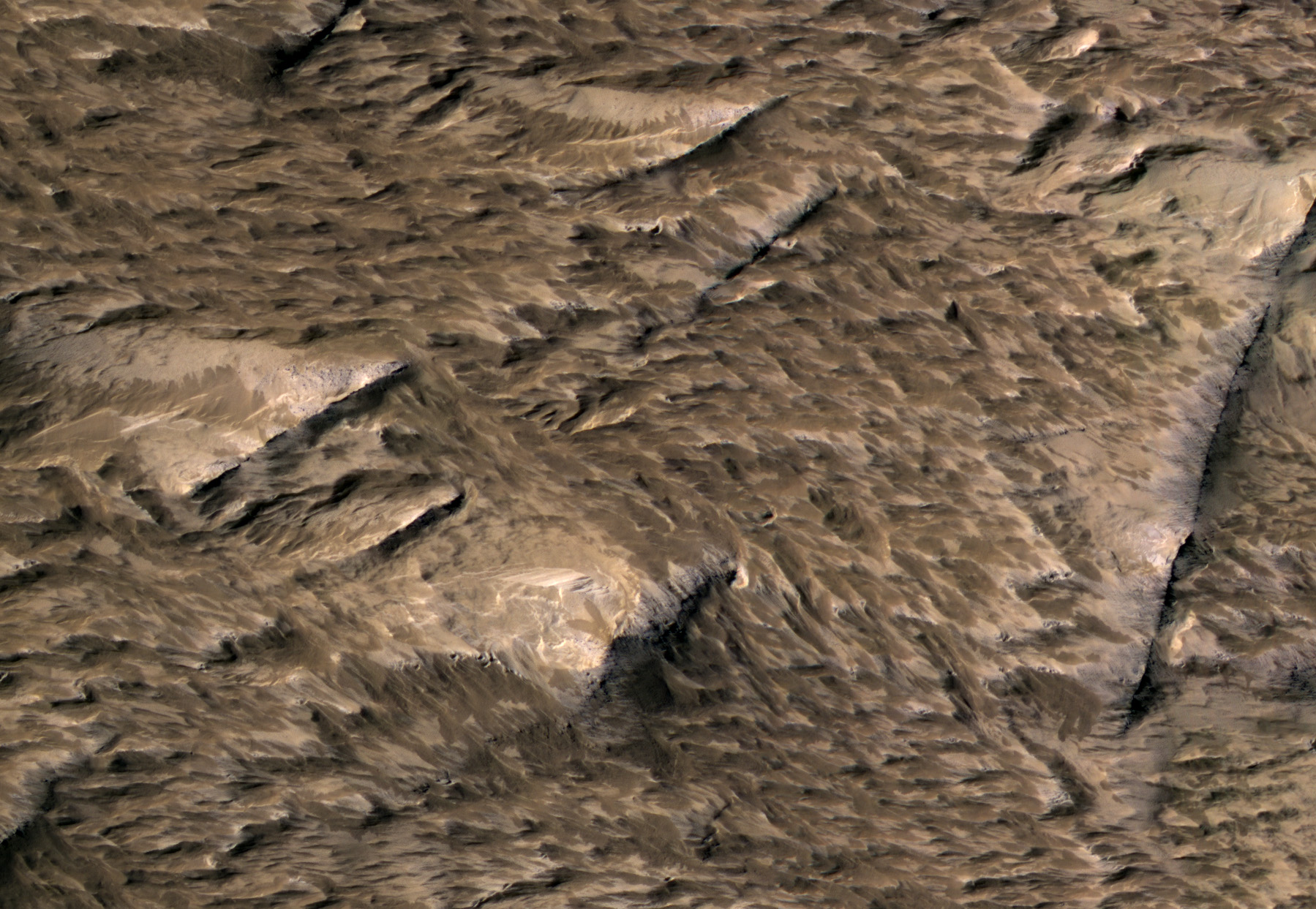
This is where the high resolution of HiRISE comes in: our camera was able to show the fine surface details within the blast zone. The largest of the new craters, appears slightly asymmetric in shape, and measures 159 x 143 feet (48.5 x 43.5 meters) in diameter, making it the largest new crater detected on Mars by MRO to date. Both HiRISE and CTX images also show numerous, new, small landslides within the blast zone.

All of these coordinated observations also demonstrate how different teams on the same spacecraft can work together to examine interesting features in greater detail.

Note: a newer image of this area, is also available and has an anaglyph.

Image credit: NASA/JPL/University of Arizona

Note: This impact crater is located just to the northeast of Gordii Dorsum. For more information, see PIA18380: Impact Scar Detected in Mars Weathercam Image, PIA18381: Best-Ever Pinning Down When a Space Rock Hit Mars, PIA18382: Fresh Mars Crater Confirmed Within Impact Scar, PIA18383: Before-and-After Views Confirm Fresh Craters, PIA18384: Large, Fresh Crater Surrounded by Smaller Craters, PIA18385: Landslides Near Fresh Crater on Mars, and NASA Mars Weathercam Helps Find Big New Crater.

Friday, May 23, 2014

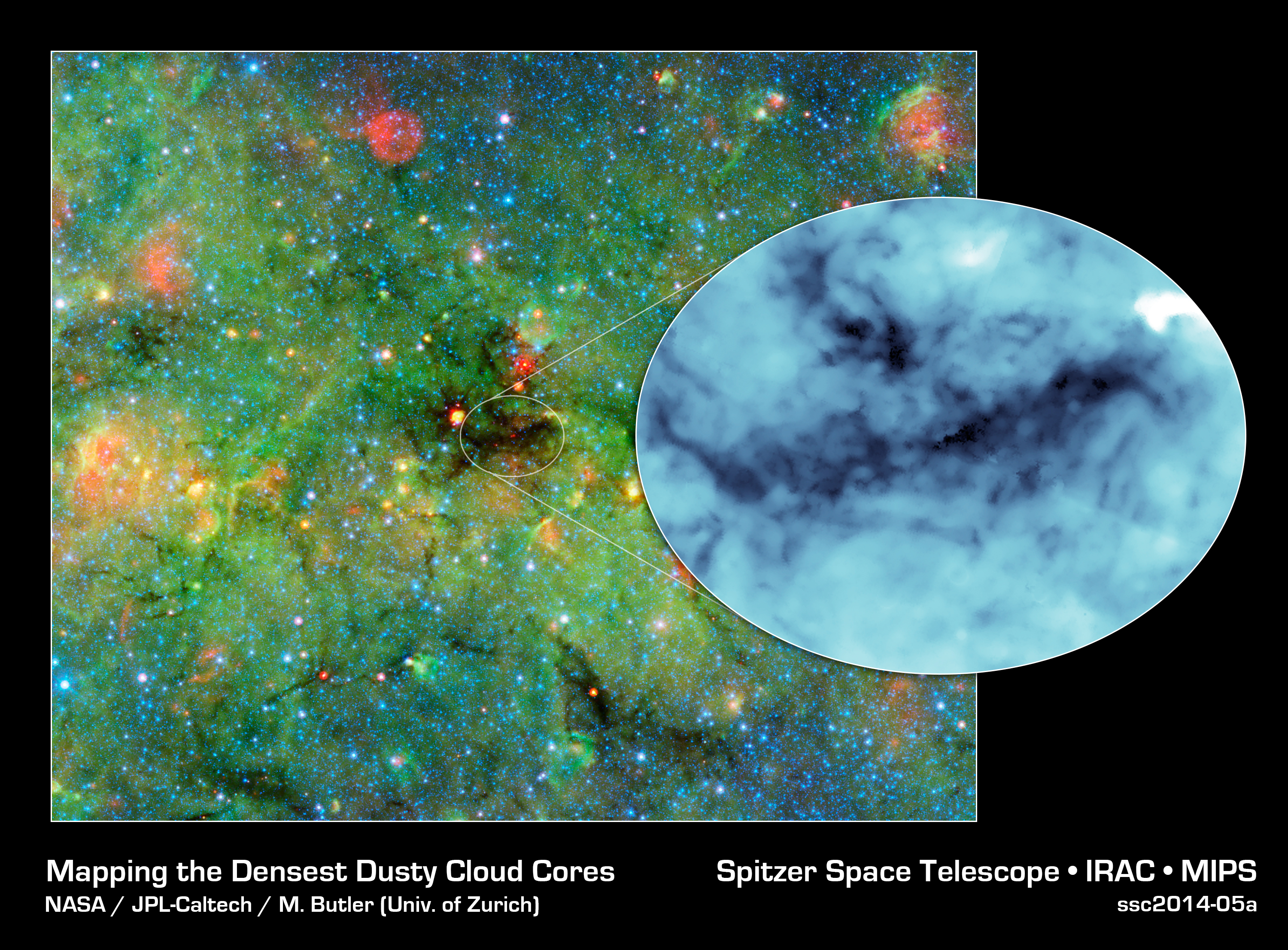
Mapping the Densest Dusty Cloud Cores


Astronomers have found cosmic clumps so dark, dense and dusty that they throw the deepest shadows ever recorded. The clumps were discovered within a huge cosmic cloud of gas and dust. Infrared observations from NASA's Spitzer Space Telescope of these blackest-of-black regions in the cloud paradoxically light the way to understanding how the brightest stars form.

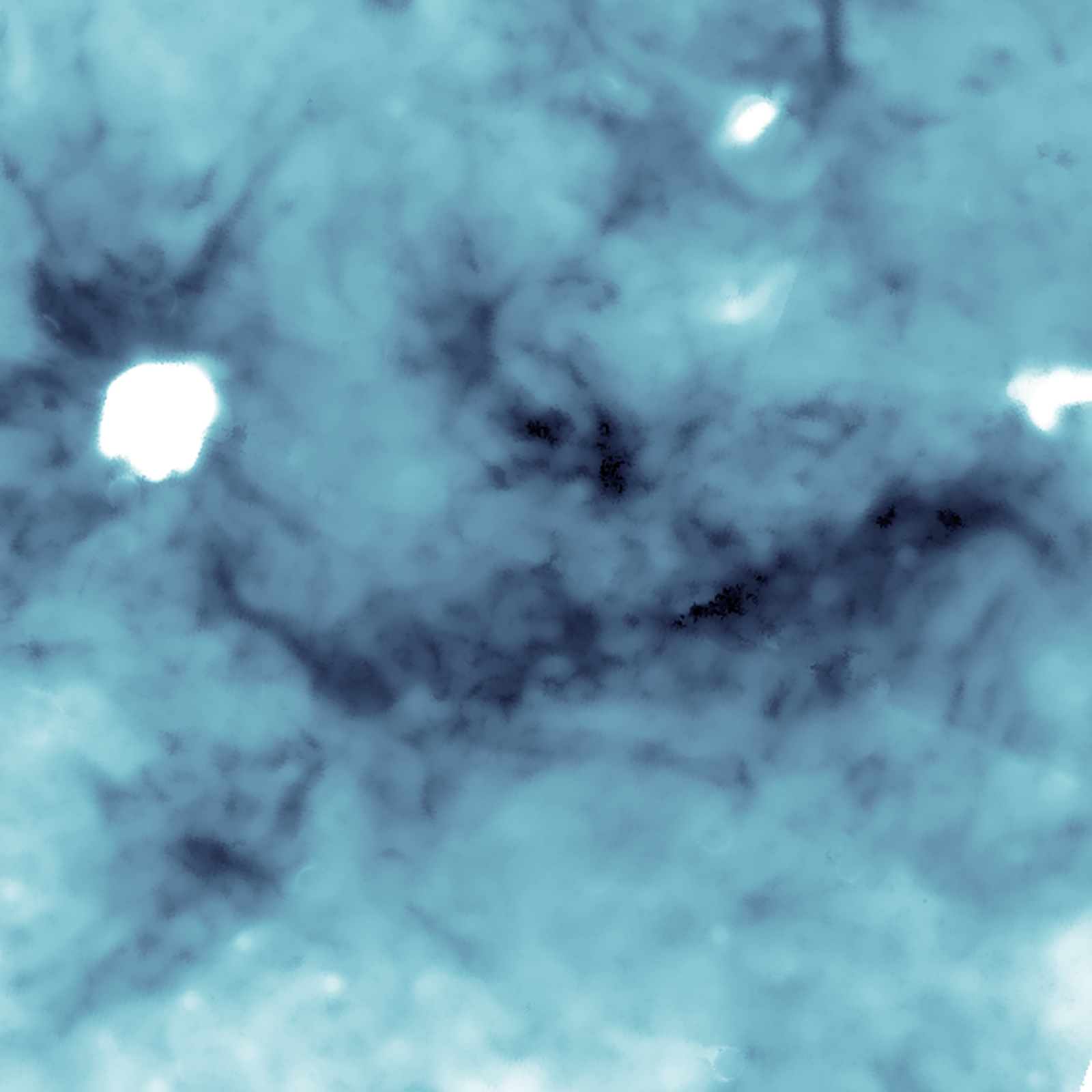
The large cloud looms in the center of this image of the galactic plane from Spitzer. The zoom in Figure 1 shows details of the cloud, revealing the dense clumps. A new study takes advantage of the shadows cast by these dark clumps to measure the cloud's overall structure and mass. These dense, clumpy pockets of star-forming material within the cloud are so thick with dust that they scatter and block not only visible light, but almost all background infrared light as well.

The dusty cloud, the results suggest, will likely evolve into one of the most massive young clusters of stars in our galaxy. The densest clumps will blossom into the cluster's biggest, most powerful stars, called O-type stars, the formation of which has long puzzled scientists. These hulking stars have major impacts on their local stellar environments while also helping to create the heavy elements needed for life.

Figure 2 reveals the overall darkness of the cloud, calculated using Spitzer's infrared observations at a wavelength of 8 microns. Artifacts left by individual stars have been removed from the data.

The background image combines data from Spitzer surveys. Blue represents 3.6-micron light and green shows light of 8 microns, both captured by Spitzer's infrared array camera. Red is 24-micron light detected by Spitzer's multiband imaging photometer. The red spot in the center of the zoom oval, unrelated to the new study's findings, is a young star whose radiating heat has lit up a surrounding cocoon of dust.

Image credit: NASA/JPL-Caltech/University of Zurich

Note: For more information, see Pitch Black: Cosmic Clumps Cast the Darkest Shadows.

Thursday, May 22, 2014

NGC 3590


This colorful new image from the MPG/ESO 2.2-meter telescope at ESO's La Silla Observatory in Chile shows the star cluster NGC 3590. These stars shine brightly in front of a dramatic landscape of dark patches of dust and richly hued clouds of glowing gas. This small stellar gathering gives astronomers clues about how these stars form and evolve — as well as giving hints about the structure of our galaxy's pinwheeling arms.

Photo credit: ESO/G. Beccari

Note: For more information, see A Star Cluster in the Wake of Carina.

Wednesday, May 21, 2014

Endeavour Crater Rim from Murray Ridge


This vista of the Endeavour Crater rim was acquired by NASA's Mars Exploration Rover Opportunity from the southern end of "Murray Ridge" on the western rim of the crater. It combines several exposures taken by the rover's panoramic camera (Pancam) on the 3,637th Martian day, or sol, of the mission (April 18, 2014).

The view extends from the east-southeast on the left to southward on the right. It encompasses the far rim of Endeavour Crater on the left and the crater's western rim on the right. Endeavour is 14 miles (22 kilometers) in diameter.

The small impact crater visible in the distance on the slopes of the far rim is about 740 feet (about 225 meters) in diameter and is 13 miles (21 kilometers) away. The high peak in the distance on the right is informally named "Cape Tribulation" and is about 1.2 miles (2 kilometers) to the south of Opportunity's position when this view was recorded. The rim curves off to the left from Cape Tribulation in a series of peaks towards the far southern crater rim.

The floor of Endeavour crater is filled with dark sand, brighter dust, and, in the distance, dusty haze. Outcrops here on the western rim are crater ejecta covered in the foreground by dark sand ripples. On Sol 3662 (May 13, 2014), Opportunity approached the dark outcrops about halfway down on the right side of the image.

The view merges exposures taken through three of the Pancam's color filters, centered on wavelengths of 753 nanometers (near-infrared), 535 nanometers (green) and 432 nanometers (violet). It is presented in approximately true color.

Image credit: NASA/JPL-Caltech/Cornell University/Arizona State University

Note: For more information, see PIA18094: Endeavour Crater Rim From 'Murray Ridge' on Mars, False Color, PIA18095: Approaching a Target Deposit on Mars Crater Rim, PIA18096: Approaching a Target Deposit on Mars Crater Rim (Stereo), PIA18098: Opportunity's Tracks Near Crater Rim Ridgeline, PIA18099: Opportunity's Tracks Near Crater Rim Ridgeline (Stereo), and NASA Rover Gains Martian Vista From Ridgeline.

Tuesday, May 20, 2014

Auroras on Saturn


Astronomers using the NASA/ESA Hubble Space Telescope have captured new images of the dancing auroral lights at Saturn’s north pole. Taken in April and May 2013 from Hubble’s perspective in orbit around Earth, these observations provide a detailed look at previously unseen dynamics in the choreography of the auroral glow.

The ultraviolet images, taken by Hubble’s super-sensitive Advanced Camera for Surveys, capture moments when Saturn’s magnetic field is affected by bursts of particles streaming from the Sun.

Saturn’s magnetosphere – the vast magnetic ‘bubble’ that surrounds the planet – is compressed on the Sunward side of the planet, and streams out into a long ‘magnetotail’ on the nightside.

It appears that when particles from the Sun hit Saturn, the magnetotail collapses and later reconfigures itself, an event that is reflected in the dynamics of its auroras.

Saturn was caught during a very dynamic light show – some of the bursts of light seen shooting around Saturn’s polar regions traveled more than three times faster than the speed of the gas giant’s roughly 10-hour rotation period!

The new observations were taken as part of a three-year Hubble observing campaign, and are presented in a paper published in the journal Geophysical Research Letters. The images complement those taken by the international Cassini spacecraft orbiting Saturn.

Image credit: NASA/ESA, Acknowledgement: J. Nichols (University of Leicester)

Saturday, May 17, 2014

Comet 67P Churyumov–Gerasimenko and M107


Comet 67P/Churyumov–Gerasimenko seen towards the constellation of Ophiuchus (note that from the vantage point of Earth, both the comet and Rosetta are presently in Sagittarius), with the globular cluster M107 also clearly visible in the field of view. The image was taken on 30 April 2014 by the OSIRIS Narrow Angle Camera and the comet is already displaying a coma, which extends over 1300 km from the nucleus.

Image credit: ESA/Rosetta/MPS for OSIRIS Team MPS/UPD/LAM/IAA/SSO/INTA/UPM/DASP/IDA

Note: For more information, see PIA18376: Rosetta's Comet Comes Alive, Rosetta Puts on the Brakes, Comet 67P/C-G on 30 April 2014, Rosetta's Target Comet is Becoming Active, and Rosetta Comet Comes Alive (NASA Science News).

Friday, May 16, 2014

Jupiter and Its Not-So-Great Red Spot


Jupiter's Great Red Spot is a churning anticyclonic storm. It shows up in images of the giant planet as a conspicuous deep red eye embedded in swirling layers of pale yellow, orange and white. Winds inside this Jovian storm rage at immense speeds, reaching several hundreds of kilometers per hour.

Historic observations as far back as the late 1800s gauged this turbulent spot to span about 41 000 kilometers at its widest point – wide enough to fit three Earths comfortably side by side. In 1979 and 1980 the NASA Voyager fly-bys measured the spot at a shrunken 23,335 kilometers across. Now, Hubble has spied this feature to be smaller than ever before.

This full-disc image of Jupiter was taken on 21 April 2014 with Hubble's Wide Field Camera 3 (WFC3).

Image credit: NASA, ESA, and A. Simon (Goddard Space Flight Center)

Note: For more information, see The Shrinking of Jupiter's Great Red Spot, Jupiter's Great Red Spot is Smaller Than Ever Measured, and Jupiter's Great Red Spot is Shrinking.

Thursday, May 15, 2014

Artist’s Impression of the Magnetar in the Star Cluster Westerlund 1


This artist’s impression shows the magnetar in the very rich and young star cluster Westerlund 1. This remarkable cluster contains hundreds of very massive stars, some shining with a brilliance of almost one million suns. European astronomers have for the first time demonstrated that this magnetar — an unusual type of neutron star with an extremely strong magnetic field — probably was formed as part of a binary star system. The discovery of the magnetar’s former companion elsewhere in the cluster helps solve the mystery of how a star that started off so massive could become a magnetar, rather than collapse into a black hole.

Illustration credit: ESO/L. Calçada

Note: For more information, see Magnetar Formation Mystery Solved?

Wednesday, May 14, 2014

Saturn Ring Spokes


The spokes in Saturn's rings continue to be active and Cassini scientists continue to study them in order to unravel their mysteries. The spokes, visible near the center of the image, appear bright against the dense core of the B ring, which is the darkest section of the rings shown here in silhouette. Conditions favorable to the production of spokes are expected to wane as Saturn approaches its northern summer solstice. Scientists are eager to monitor the transition, the timing of which could yield valuable insight into the mechanisms that form these intriguing and ethereal features.

This view looks toward the unilluminated side of the rings from about 47 degrees below the ringplane. The image was taken in visible light with the Cassini spacecraft wide-angle camera on October 19, 2013.

The view was acquired at a distance of approximately 1.2 million miles (1.9 million kilometers) from Saturn and at a Sun-Saturn-spacecraft, or phase, angle of 122 degrees. Image scale is 72 miles (115 kilometers) per pixel.

Image credit: NASA/JPL-Caltech/Space Science Institute

Tuesday, May 13, 2014

Phobos and Jupiter Conjunction


Even though it may only be a lump of porous rock, Phobos isn’t shy about hogging the limelight in this sequence taken by ESA’s Mars Express. These three images show Phobos, the larger of the two Martian moons, darting across the frame in front of Jupiter, visible as the pale dot in the center. From right to left, the frames show snapshots before, during and after the small moon’s journey in front of the gas giant.

Observed on 1 June 2011, this unusual alignment is known as a conjunction, and occurs when two Solar System bodies appear to pass close to one another on the sky. This is an optical illusion caused by our perspective–when these pictures were taken there was a distance of almost 11,400 km between the spacecraft and Phobos, and a further 529 million km to Jupiter.

These three frames are part of a set of 104 taken over a period of 68 seconds by the high-resolution stereo camera on Mars Express. Some of the images were also processed to form a video. The images and the video were originally released in June 2011.

Image credit: ESA/DLR/FU Berlin (G. Neukum)