Pages

Showing posts with label Galactic Evolution. Show all posts

Friday, November 21, 2014

Four Globular Clusters in Fornax


This NASA/ESA Hubble Space Telescope image shows four globular clusters in the dwarf galaxy Fornax.

New observations of the clusters – large balls of stars that orbit the centers of galaxies – show they are very similar to those found in our galaxy, the Milky Way. The finding is at odds with leading theories on how these clusters form – in these theories, globular clusters should be nestled among large quantities of old stars – and so the mystery of how these objects came to exist deepens.

Left to right: Fornax 1, Fornax 2, Fornax 3 and Fornax 5. Their positions within the galaxy are shown in image heic1425g.

Image credit: NASA, ESA, S. Larsen (Radboud University, the Netherlands)

Note: For more information, see The Riddle of the Missing Stars - Hubble Observations Cast Further Doubt on How Globular Clusters Formed.

Sunday, June 8, 2014

Messier 51, the Whirlpool Galaxy, by Chandra and Hubble


Whirlpool Galaxy: A spiral galaxy located about 30 million light years from Earth.

This image contains nearly a million seconds worth of Chandra observing time (purple) along with optical data from the Hubble Space Telescope (red, green, and blue). The X-ray data reveal hundreds of point-like sources, most of which are X-ray binary systems (XRBs) containing a neutron star or black hole in orbit with a star like the Sun. Researchers are studying the XRBs in M51, a.k.a. the "Whirlpool Galaxy," to better understand the role they play in the evolution of the galaxy.

Scale: Image is 6 x 10 arcmin (About 52,000 x 87,000 light years).

Image credit: X-ray: NASA/CXC/Wesleyan Univ./R.Kilgard, et al; Optical: NASA/STScI

Note: For more information, see M51: Chandra Captures Galaxy Sparkling in X-Rays.

Sunday, February 2, 2014

Development of Massive Elliptical Galaxies


This graphic shows the evolutionary sequence in the growth of massive elliptical galaxies over 13 billion years, as gleaned from space-based and ground-based telescopic observations. The growth of this class of galaxies is quickly driven by rapid star formation and mergers with other galaxies.

Astronomers using NASA's Hubble and Spitzer space telescopes, and Europe's Herschel Space Observatory, have pieced together the evolutionary sequence of compact elliptical galaxies that erupted and burned out early in the history of the universe.

Enabled by Hubble's infrared imaging capabilities, astronomers have assembled for the first time a representative spectroscopic sampling of ultra-compact, burned-out elliptical galaxies -- galaxies whose star formation was finished when the universe was only 3 billion years old, less than a quarter of its current estimated age of 13.8 billion years.

The research, supported by several ground-based telescopes, solves a 10-year-old mystery about the growth of the most massive elliptical galaxies we see today. It provides a clear picture of the formation of the most massive galaxies in the universe, from their initial burst of star formation through their development of dense stellar cores, to their ultimate reality as giant ellipticals.

"We at last show how these compact galaxies can form, how it happened, and when it happened. This basically is the missing piece in the understanding of how the most massive galaxies formed, and how they evolved into the giant ellipticals of today," said Sune Toft of the Dark Cosmology Center at the Niels Bohr Institute in Copenhagen, Denmark, who is the leader of this study.

"This had been a great mystery for many years because just 3 billion years after the big bang we see that half of the most massive galaxies have already completed their star formation."

Through the research, astronomers have determined the compact ellipticals voraciously consumed the gas available for star formation, to the point they could not create new stars, and then merged with smaller galaxies to form giant ellipticals. The stars in the burned-out galaxies were packed 10 to 100 times more densely than in equally massive elliptical galaxies seen in the nearby universe today, and that surprised astronomers, according to Toft.

To develop the evolutionary sequence for ultra-compact, burned-out galaxies, Toft's team assembled, for the first time, representative samples of two galaxy populations using the rich dataset in Hubble's COSMOS (Cosmic Evolution Survey) program.

One group of galaxies is the compact ellipticals. The other group contains galaxies that are highly obscured with dust and undergoing rapid star formation at rates thousands of times faster than observed in the Milky Way. Starbursts in these dusty galaxies likely were ignited when two gas-rich galaxies collided. These galaxies are so dusty that they are almost invisible at optical wavelengths, but they shine bright at submillimeter wavelengths, where they were first identified nearly two decades ago by the Submillimeter Common-User Bolometer Array (SCUBA) camera on the James Clerk Maxwell Telescope in Hawaii.

Toft's team started by constructing the first representative sample of compact elliptical galaxies with accurate sizes and spectroscopic redshifts, or distances, measured with Hubble's Cosmic Assembly Near-Infrared Deep Extragalactic Legacy Survey (CANDELS) and 3D-HST (3D-Hubble Space Telescope) programs. 3D-HST is a near-infrared spectroscopic survey to study the physical processes that shape galaxies in the distant universe. The astronomers combined these data with observations from the Subaru telescope in Hawaii, and Spitzer. This allowed for accurate stellar age estimates, from which they concluded compact elliptical galaxies formed in intense starbursts inside the galaxies that preceded them by as long as two billion years.

Next, the team made the first representative sample of the most distant submillimeter galaxies using COSMOS data from the Hubble, Spitzer and Herschel space telescopes, and ground-based telescopes such as Subaru, the James Clerk Maxwell Telescope, and the Submillimeter Array, all located in Hawaii. This multi-spectral information, stretching from optical light through submillimeter wavelengths, yielded a full suite of information about the sizes, stellar masses, star-formation rates, dust content, and precise distances of the dust-enshrouded galaxies that were present early in the universe.

When Toft's team compared the samples of the two galaxy populations, it discovered an evolutionary link between the compact elliptical galaxies and the submillimeter galaxies. The observations show that the violent starbursts in the dusty galaxies had the same characteristics that would have been predicted for progenitors to the compact elliptical galaxies. Toft's team also calculated the intense starburst activity inside the submillimeter galaxies lasted only about 40 million years before the interstellar gas supply was exhausted.

The results appear in the Jan. 29 online issue of The Astrophysical Journal. For related and high resolution imagery, visit: http://hubblesite.org/news/2014/10.

Image credit: NASA, ESA, S. Toft (Niels Bohr Institute), and A. Feild (STScI)

Sunday, January 12, 2014

Hubble Frontier Field Abell 2744


This long-exposure image from NASA's Hubble Space Telescope of massive galaxy cluster Abell 2744 is the deepest ever made of any cluster of galaxies. It shows some of the faintest and youngest galaxies ever detected in space. Abell 2744, located in the constellation Sculptor, appears in the foreground of this image. It contains several hundred galaxies as they looked 3.5 billion years ago. The immense gravity in Abell 2744 acts as a gravitational lens to warp space and brighten and magnify images of nearly 3,000 distant background galaxies. The more distant galaxies appear as they did longer than 12 billion years ago, not long after the big bang.

This image is part of an unprecedented long-distance view of the universe from an ambitious collaborative project among NASA's Hubble, Spitzer and Chandra space telescopes called The Frontier Fields. Over the next several years, select patches of the sky will be photographed for the purpose of better understanding galaxy evolution. This visible-light and near-infrared composite image was taken with Hubble's Wide Field Camera 3.

Image credit: NASA/ESA/STScI

Note: For more information, see Pandora's Magnifying Glass - First Image from Hubble's Frontier Fields and NASA's Hubble and Spitzer Team up to Probe Faraway Galaxies.

Tuesday, November 5, 2013

NGC 3377


New evidence from NASA's Wide-field Infrared Survey Explorer (WISE) and Galaxy Evolution Explorer (GALEX) missions provide support for the "inside-out" theory of galaxy evolution, which holds that star formation starts at the core of the galaxy and spreads outward.

In this image of a galaxy called NGC 3377, infrared light from WISE is colored red, and ultraviolet light from GALEX is green and blue. The center of the galaxy appears white, where all three wavelengths of light are present and add up. The outside of the galaxy is mostly ultraviolet light, and thus contains more blue and green. The dots in the picture are stars located in the foreground.

NGC 3377 is located 31 million light-years away in the constellation Leo. It is an older galaxy, having already exhausted its stellar fuel supply. The outer regions, while containing more young stars than the core, are bright in ultraviolet light due to a small population of older, extremely hot stars.

WISE and GALEX are both no longer operating, but scientists continue to access their bounties of data through public archives.

Image credit: NASA/JPL-Caltech

Note: For more information, see Galaxy Growth Examined Like Rings of a Tree.

Sunday, May 26, 2013

Galactic Formation - Cosmic Swirly Straws


Created with the help of supercomputers, this simulation shows the formation of a massive galaxy during the first 2 billion years of the universe. Hydrogen gas is gray, young stars appear blue, and older stars are red. The simulation reveals that gas flows into galaxies along filaments akin to cosmic bendy, or swirly, straws.

Video credit: N-Body Shop at University of Washington

Note: For more information, see Galaxies Fed by Funnels of Fuel.

Saturday, April 20, 2013

HFLS3


This artist's impression shows the "starburst" galaxy HFLS3. The galaxy appears as little more than a faint, red smudge in images from the Herschel space observatory. But appearances can be deceiving for it is making stars more than 2,000 times faster than our own Milky Way galaxy, one of the highest star-formation rates ever seen in any galaxy. Amazingly, it is seen at a time when the universe was less than a billion years old, challenging galaxy evolution theories.

Illustration credit: ESA–C. Carreau

Note: For more information, see Astronomers Discover Massive Star Factory in Early Universe and Star Factory in the Early Universe Challenges Galaxy Evolution Theory.

Thursday, November 29, 2012

Material Ejected from Quasar SDSS J1106+1939


This artist’s impression shows the material ejected from the region around the supermassive black hole in the quasar SDSS J1106+1939. This object has the most energetic outflows ever seen, at least five times more powerful than any that have been observed to date. Quasars are extremely bright galactic centers powered by supermassive black holes. Many blast huge amounts of material out into their host galaxies, and these outflows play a key role in the evolution of galaxies. But, before this object was studied, the observed outflows weren’t as powerful as predicted by theorists. The very bright quasar appears at the center of the picture and the outflow spreads about 1000 light-years out into the surrounding galaxy.

Illustration credit: ESO/L. Calçada

Note: For more information, see Biggest Black Hole Blast Discovered.

Wednesday, March 21, 2012

Gravitational Lensing by Quasars


In space, it sometimes happens that two galaxies are aligned in just the right way that the closer galaxy distorts and magnifies the appearance of the one behind it. For astronomers, finding these alignments is like coming across giant, cosmic magnifying glasses.

Now, a team of astronomers, including Daniel Stern from NASA's Jet Propulsion Laboratory in Pasadena, California, has found several rare examples of this phenomenon, called gravitational lensing, in which the foreground galaxy hosts an actively accreting supermassive black hole.

Such feeding black holes, called quasars, are among the brightest objects in the universe, far outshining the total starlight of their host galaxies. Because they are so bright, it is hard for astronomers to measure the mass of their host galaxies. However, gravitational lenses are invaluable for estimating the mass of a quasar's host galaxy. The amount of the background galaxy's distortion can be used to accurately measure the lensing galaxy's mass.

The team hopes to build an even bigger catalog of these quasar lenses, and to use these data to better understand the interplay between black hole feeding and star formation in galaxy evolution.

Photo credit: NASA, ESA, EPFL (Switzerland); text credit: NASA/JPL.

Note: For more information, see Astronomers Using NASA's Hubble Discover Quasars Acting as Gravitational Lenses; for more images, see PIA15418: Quasar Lenses.

Thursday, September 15, 2011

Artist's Impression of a Gently-Forming Galaxy


This illustration shows a galaxy which is accreting mass from rapid, narrow streams of cold gas. These filaments provide the galaxy with a continuous flow of raw material to support its star-forming activity at a rather leisurely pace.

This theoretical scenario for galaxy formation is based on the numerical simulations presented by Dekel et al., 2009 (Nature, 457, 451D). However, the actual process of stream accretion onto a galaxy has never been directly observed to date and the scenario remains only speculative.

Illustration credit: ESA/AOES Medialab

Note: For more information, see Herschel Reveals How Most Stars Formed in the Universe.

Saturday, August 27, 2011

The Eyes of the Virgin


This striking image, taken with the FORS2 instrument on the Very Large Telescope, shows a beautiful yet peculiar pair of galaxies, NGC 4438 and NGC 4435, nicknamed The Eyes. The larger of these, at the top of the picture, NGC 4438, is thought to have once been a spiral galaxy that was strongly deformed by collisions in the relatively recent past. The two galaxies belong to the Virgo Cluster and are about 50 million light-years away.

Photo credit: ESO/Gems project

Note: For more information, see VLT Looks into The Eyes of the Virgin.

Wednesday, May 25, 2011

NGC 2841


Star formation is one of the most important processes in shaping the Universe; it plays a pivotal role in the evolution of galaxies and it is also in the earliest stages of star formation that planetary systems first appear.

Yet there is still much that astronomers don't understand, such as how do the properties of stellar nurseries vary according to the composition and density of gas present, and what triggers star formation in the first place? The driving force behind star formation is particularly unclear for a type of galaxy called a flocculent spiral, such as NGC 2841 shown here, which features short spiral arms rather than prominent and well-defined galactic limbs.

Photo credit: NASA, ESA and the Hubble Heritage (STScI/AURA)-ESA/Hubble Collaboration Acknowledgment: M. Crockett and S. Kaviraj (Oxford University, UK), R. O'Connell (University of Virginia), B. Whitmore (STScI) and the WFC3 Scientific Oversight Committee

Note: For more information, see Flocculent Spiral NGC 2841 [heic1104]

Tuesday, May 24, 2011

The Lockman Hole


This false-color image shows a patch of the sky known as the "Lockman Hole," as observed by the SPIRE instrument on board Herschel.

Located in northern constellation of Ursa Major, The Great Bear, the "Lockman Hole" is a field on the sky almost devoid of foreground contamination and thus ideally suited for observations of galaxies in the distant Universe.

Almost every dot in the image is an entire galaxy, each containing billions of stars and appearing as they did 10-12 billion years ago, when the Universe was only a couple of billion years old. The blue, green and red colors represent the three far-infrared wavelengths used for Herschel's observations: 250, 350 and 500 microns, respectively. The galaxies shown in white have equal intensity in all three wavebands and are the ones forming the most stars.

Detecting these galaxies individually is particularly challenging, as they are both extremely faint and numerous, so many of them overlap in Herschel's images. This creates a fog of infrared radiation known as the Cosmic Infrared Background (CIB), which reflects the clustering pattern of the galaxies responsible for this fog. Studying the CIB and its fluctuations is thus an extremely powerful tool to explore the way galaxies tend to be grouped on both small and large scales.

The size of the field is 218 arcminutes on a side.

Photo credit: ESA & SPIRE consortium & HerMES consortium

Note: For more information, see Herschel Quantifies the Dark Matter Threshold for Starburst Galaxies

Monday, May 9, 2011

Galactic Outflows


This illustration shows an Ultra-Luminous InfraRed Galaxy (ULIRG) that exhibits massive outflows of molecular gas.

In one of the most widely accepted theories of galaxy evolution, ULIRGs are an intermediate stage in the merger-driven process that gives rise to elliptical galaxies. Within this framework, the merger of gas-rich spiral galaxies hosting supermassive black holes in their centers initially produces a galaxy with an active nucleus that is enshrouded by a mixture of gas and dust. In this phase, the object is completely obscured and can only be detected in infrared light as an ULIRG. As the system evolves, gas and dust are gradually dispersed, eventually giving rise to an exposed Active Galactic Nucleus — a quasar.

Initially, it is the merger process that triggers starbursts and the growth of the central supermassive black hole in the galaxy. Later, the starburst and accretion by the black hole generate powerful gas outflows that sweep away the galaxy's reservoir of gas. Due to these negative feedback mechanisms — that at times suppress both star formation and black hole growth — the galaxy that forms from the merger is gas-poor, populated by old stellar populations and harbors a supermassive black hole with a mass that strongly correlates with the galaxy's stellar mass, as is observed in elliptical galaxies.

The detection of outflows powerful enough to strip galaxies of their molecular gas reservoir represents solid evidence in support of the merger-driven scenario for the formation of elliptical galaxies.

Illustration credit: ESA/AOES Medialab

For more information, see Caught in the Act by Herschel: Galactic Storms Sweep Away the Gas

Tuesday, October 26, 2010

Growing Galaxies Gently


New observations from ESO’s Very Large Telescope have, for the first time, provided direct evidence that young galaxies can grow by sucking in the cool gas around them and using it as fuel for the formation of many new stars. In the first few billion years after the Big Bang the mass of a typical galaxy increased dramatically and understanding why this happened is one of the hottest problems in modern astrophysics. The results appear in the 14 October issue of the journal Nature.

The first galaxies formed well before the Universe was one billion years old and were much smaller than the giant systems — including the Milky Way — that we see today. So somehow the average galaxy size has increased as the Universe has evolved. Galaxies often collide and then merge to form larger systems and this process is certainly an important growth mechanism. However, an additional, gentler way has been proposed.

A European team of astronomers has used ESO’s Very Large Telescope to test this very different idea — that young galaxies can also grow by sucking in cool streams of the hydrogen and helium gas that filled the early Universe and forming new stars from this primitive material. Just as a commercial company can expand either by merging with other companies, or by hiring more staff, young galaxies could perhaps also grow in two different ways — by merging with other galaxies or by accreting material.

The team leader, Giovanni Cresci (Osservatorio Astrofisico di Arcetri) says: “The new results from the VLT are the first direct evidence that the accretion of pristine gas really happened and was enough to fuel vigorous star formation and the growth of massive galaxies in the young Universe.” The discovery will have a major impact on our understanding of the evolution of the Universe from the Big Bang to the present day. Theories of galaxy formation and evolution may have to be re-written.

The group began by selecting three very distant galaxies to see if they could find evidence of the flow of pristine gas from the surrounding space and the associated formation of new stars. They were very careful to make sure that their specimen galaxies had not been disturbed by interactions with other galaxies. The selected galaxies were very regular, smoothly rotating discs, similar to the Milky Way, and they were seen about two billion years after the Big Bang (at a redshift of around three).

In galaxies in the modern Universe the heavy elements [1] are more abundant close to the center. But when Cresci’s team mapped their selected distant galaxies with the SINFONI spectrograph on the VLT [2] they were excited to see that in all three cases there was a patch of the galaxy, close to the center, with fewer heavy elements, but hosting vigorously forming stars, suggesting that the material to fuel the star formation was coming from the surrounding pristine gas that is low in heavy elements. This was the smoking gun that provided the best evidence yet of young galaxies accreting primitive gas and using it to form new generations of stars.

Notes:
[1] The gas filling the early Universe was almost all hydrogen and helium. The first generations of stars processed this primitive material to create heavier elements such as oxygen, nitrogen and carbon by nuclear fusion. When this material was subsequently spewed back into space by intense particle winds from massive young stars and supernova explosions the amounts of heavy elements in the galaxy gradually increased. Astronomers refer to elements other than hydrogen and helium as “heavy elements.”

[2] By carefully splitting up the faint light coming from a galaxy into its component colors using powerful telescopes and spectrographs, astronomers can identify the fingerprints of different chemicals in remote galaxies, and measure the amounts of heavy elements present. With the SINFONI instrument on the VLT astronomers can go one better and get a separate spectrum for each part of an object. This allows them to make a map that shows the quantity of heavy elements present in different parts of a galaxy and also determine where in the galaxy star formation is occurring most vigorously.

Illustration credit: ESO/L. Calçada

Sunday, October 10, 2010

NGC 1365


A new image taken with the powerful HAWK-I camera on ESO’s Very Large Telescope at Paranal Observatory in Chile shows the beautiful barred spiral galaxy NGC 1365 in infrared light. NGC 1365 is a member of the Fornax cluster of galaxies, and lies about 60 million light-years from Earth.

NGC 1365 is one of the best known and most studied barred spiral galaxies and is sometimes nicknamed the Great Barred Spiral Galaxy because of its strikingly perfect form, with the straight bar and two very prominent outer spiral arms. Closer to the center there is also a second spiral structure and the whole galaxy is laced with delicate dust lanes.

This galaxy is an excellent laboratory for astronomers to study how spiral galaxies form and evolve. The new infrared images from HAWK-I are less affected by the dust that obscures parts of the galaxy than images in visible light (potw1037a) and they reveal very clearly the glow from vast numbers of stars in both the bar and the spiral arms. These data were acquired to help astronomers understand the complex flow of material within the galaxy and how it affects the reservoirs of gas from which new stars can form. The huge bar disturbs the shape of the gravitational field of the galaxy and this leads to regions where gas is compressed and star formation is triggered. Many huge young star clusters trace out the main spiral arms and each contains hundreds or thousands of bright young stars that are less than ten million years old. The galaxy is too remote for single stars to be seen in this image and most of the tiny clumps visible in the picture are really star clusters. Over the whole galaxy, stars are forming at a rate of about three times the mass of our Sun per year.

While the bar of the galaxy consists mainly of older stars long past their prime, many new stars are born in stellar nurseries of gas and dust in the inner spiral close to the nucleus. The bar also funnels gas and dust gravitationally into the very center of the galaxy, where astronomers have found evidence for the presence of a super-massive black hole, well hidden among myriads of intensely bright new stars.

NGC 1365, including its two huge outer spiral arms, spreads over around 200,000 light-years. Different parts of the galaxy take different times to make a full rotation around the core of the galaxy, with the outer parts of the bar completing one circuit in about 350 million years. NGC 1365 and other galaxies of its type have come to more prominence in recent years with new observations indicating that the Milky Way could also be a barred spiral galaxy. Such galaxies are quite common — two thirds of spiral galaxies are barred according to recent estimates, and studying others can help astronomers understand our own galactic home.


Photo credit: ESO/P. Grosbøl

Friday, August 20, 2010

Galaxy Cluster CLG J02182-05102


Astronomers have found that stars are forming more rapidly in the center of a distant galaxy cluster than at its edges, which is completely reversed from galaxy clusters seen in the local universe. This cluster, designated CLG J02182-05102, is highlighted in the circle above.

The image combines infrared light from NASA's Spitzer Space Telescope with visible light from Japan's Subaru telescope atop Mauna Kea, Hawaii. This sensitive exposure captures galaxies that are relatively local along side some that date back almost 10 billion years, soon after the Big Bang. The most distant galaxies stand out clearly in the infrared, rendered here in green and red.

What is noteworthy is how many of these galaxies are particularly bright at the longest infrared wavelengths, appearing red in this image. This glow indicates these ancient galaxies are still actively forming stars, even near the core of the cluster. In our local portion of the universe, the cores of galaxy clusters are known to be galactic graveyards full of massive elliptical galaxies composed of old stars.

The group's discovery holds potentially compelling implications that could ultimately reveal more about how such massive galaxies form. Now that they have pinpointed the epoch when galaxy clusters are making the last of their stars, astronomers can focus on understanding why massive assemblies of galaxies transition from very active to passive. The galaxies here may represent a missing link between the active galaxies and the quiescent behemoths that live in the local universe.

Infrared light from Spitzer at wavelengths of 4.5 and 24 microns is rendered in green and red, respectively. Subaru observations of visible light at a wavelength of 0.7 microns are rendered in blue. These data are part of the Spitzer Wide-area InfraRed Extragalactic (SWIRE) survey.

Photo Credit: NASA/JPL-Caltech/Texas A&M

Monday, August 16, 2010

NGC 4911


A long-exposure Hubble Space Telescope image shows a majestic face-on spiral galaxy located deep within the Coma Cluster of galaxies, which lies 320 million light-years away in the northern constellation Coma Berenices.

The galaxy, known as NGC 4911, contains rich lanes of dust and gas near its center. These are silhouetted against glowing newborn star clusters and iridescent pink clouds of hydrogen, the existence of which indicates ongoing star formation. Hubble has also captured the outer spiral arms of NGC 4911, along with thousands of other galaxies of varying sizes. The high resolution of Hubble's cameras, paired with considerably long exposures, made it possible to observe these faint details.

NGC 4911 and other spirals near the center of the cluster are being transformed by the gravitational tug of their neighbors. In the case of NGC 4911, wispy arcs of the galaxy's outer spiral arms are being pulled and distorted by forces from a companion galaxy (NGC 4911A), to the upper right. The resultant stripped material will eventually be dispersed throughout the core of the Coma Cluster, where it will fuel the intergalactic populations of stars and star clusters.

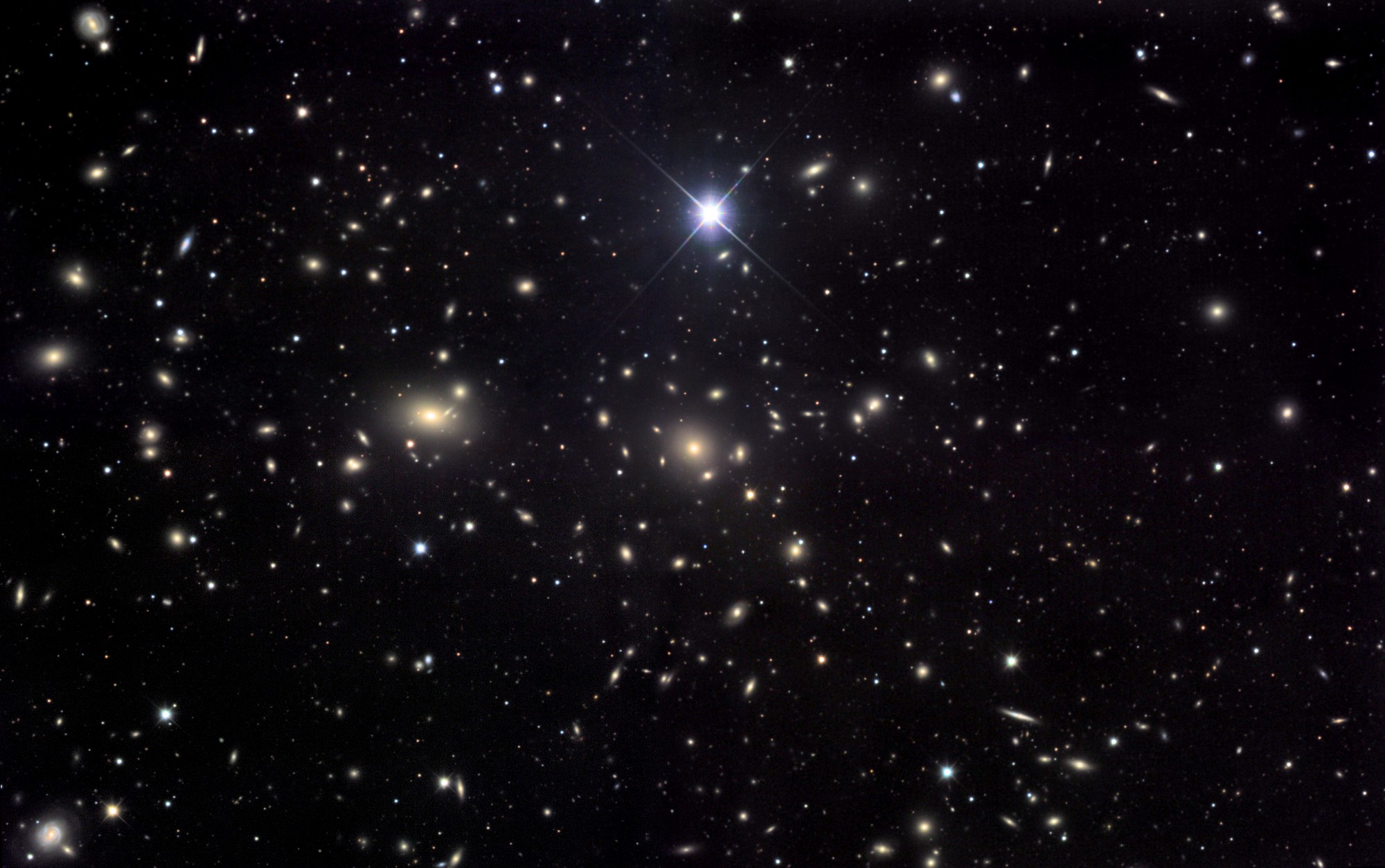
The Coma Cluster is home to almost 1,000 galaxies, making it one of the densest collections of galaxies in the nearby universe. It continues to transform galaxies at the present epoch, due to the interactions of close-proximity galaxy systems within the dense cluster. Vigorous star formation is triggered in such collisions.

Galaxies in this cluster are so densely packed that they undergo frequent interactions and collisions. When galaxies of nearly equal masses merge, they form elliptical galaxies. Merging is more likely to occur in the center of the cluster where the density of galaxies is higher, giving rise to more elliptical galaxies.

This natural-color Hubble image, which combines data obtained in 2006, 2007, and 2009 from the Wide Field Planetary Camera 2 and the Advanced Camera for Surveys, required 28 hours of exposure time.

Photo credit: NASA, ESA, and the Hubble Heritage Team (STScI/AURA)
Acknowledgment: K. Cook (Lawrence Livermore National Laboratory)

Saturday, July 3, 2010

Spiral Metamorphosis


But it seems likely that in a mere 3 billion years, our neighboring galaxy Andromeda and the Milky Way will fall together and have a close collision. They will likely merge and be reborn as a single giant elliptical galaxy over the course of another billion years or so. How might this metamorphosis play out and what might you see if you looked up at night over the next 4 billion years! The space between stars is so vast compared to their size that during a galaxy collision no individual stars actually collide with one another. So our sun and its family of planets will be taking a passive but exciting ride through the pair of coalescing galaxies and take on a spectacular view of the unfolding disaster in relative safety.

...

The view from far reveals an exquisite ballet of mutual annihilation and transformation into an elliptical galaxy. The Milky Way is seen coming in from the bottom in a face-on and edge-on view. After the interaction, long tidal tails of stars are flung out in open spiral patterns from both galaxies by the strong gravitational tides during the interaction. While separating, the two galaxies develop detailed spiral structure and then fall back for a second collision finally to merge. The mutual annihilation of the two galaxies leads to a big splash showing up as a complicated system of loops and ripples that represent turning points of stellar orbits. The two galaxies finally settle down into a single elliptical galaxy surrounded by remnant debris of their violent interaction.

Video credit: John Dubinski & John Kameel Farah; Text credit: John Dubinski

Tuesday, April 27, 2010

Evolution of the Hubble Sequence


This image created from data taken from both the NASA/ESA Hubble Space Telescope and the Sloan Digital Sky Survey demonstrates that the Hubble sequence six thousand million years ago was very different from the one that astronomers see today. The two sections show how many more peculiar shaped galaxies (marked Pec) are seen among distant galaxies, as opposed to among local galaxies. The data organization follows the Hubble tuning-fork classification scheme invented in 1926 by the same Edwin Hubble in whose honor the space telescope is named.

The top image represents the current - or local - Universe. Using their sample, researchers found that 3 percent of galaxies were elliptical (marked E), 15 percent lenticular (marked S0), 72 percent spiral (marked Sa to Sd, or SBb to SBd) and 10 percent peculiar (marked Pec).

The bottom image represents the make up of the distant galaxies (six thousand million years ago), showing a much larger fraction of peculiar galaxies. The census found 4 percent of distant galaxies were elliptical, 13 percent lenticular (S0), 31 percent spiral and 52 percent peculiar. This implies that many of the peculiar galaxies ultimately become large spirals. According to the "spiral rebuilding" hypothesis, devised by the astronomers François Hammer, Rodney Delgado-Serrano and their group, this is due to the large number of major, gas-rich galaxy mergers between galaxies that were previously labeled "peculiar" in the distant Universe. It is thought that the large Andromeda galaxy from our neighborhood formed in this manner.

In total, 116 local galaxies and 148 distant galaxies were sampled. Spiral galaxies are further classified by labels that characterize their appearance; for example, an SBd galaxy means that it is a spiral galaxy that has slightly looser "arms" than an SBa galaxy and a less prominent bulge.

These images were created from data that are part of large sky surveys undertaken by the NASA/ESA Hubble Space Telescope and the 2.5-meter telescope at Apache Point Observatory, New Mexico, USA (Sloan Digital Sky Survey).

Image credit: NASA, ESA, Sloan Digital Sky Survey, R. Delgado-Serrano and F. Hammer (Observatoire de Paris)