Pages

Showing posts with label X-Ray Binaries. Show all posts

Sunday, June 8, 2014

Messier 51, the Whirlpool Galaxy, by Chandra and Hubble


Whirlpool Galaxy: A spiral galaxy located about 30 million light years from Earth.

This image contains nearly a million seconds worth of Chandra observing time (purple) along with optical data from the Hubble Space Telescope (red, green, and blue). The X-ray data reveal hundreds of point-like sources, most of which are X-ray binary systems (XRBs) containing a neutron star or black hole in orbit with a star like the Sun. Researchers are studying the XRBs in M51, a.k.a. the "Whirlpool Galaxy," to better understand the role they play in the evolution of the galaxy.

Scale: Image is 6 x 10 arcmin (About 52,000 x 87,000 light years).

Image credit: X-ray: NASA/CXC/Wesleyan Univ./R.Kilgard, et al; Optical: NASA/STScI

Note: For more information, see M51: Chandra Captures Galaxy Sparkling in X-Rays.

Saturday, December 7, 2013

Circinus X-1


Circinus X-1: A neutron star and normal star binary pair about 26,000 light years away in the Milky Way
galaxy.

The youngest member of an important class of objects called X-ray binaries has been found using data from Chandra (blue) and the Australia Compact Telescope Array (purple). X-ray binaries consist of a dense object -- either a black hole or a neutron star -- in orbit with a star like the Sun. Researchers found that the neutron star in Circinus X-1 is less than 4,600 years old, making the X-ray binary much younger than any other known in the Milky Way. This discovery allows astronomers to study a critical phase after a supernova explosion and the birth of a neutron star.

Scale: Image is 10 arcmin across (about 76 light years).

Image credit: X-ray: NASA/CXC/Univ. of Wisconsin-Madison/S.Heinz et al; Optical: DSS; Radio: CSIRO/ATNF/ATCA

Note: For more information, see Circinus X-1: Supernova Blast Provides Clues to Age of Binary Star System.

Monday, March 11, 2013

Neutron Star in an X-Ray Binary


This image shows an artist's impression of a highly obscured high-mass X-ray binary, consisting of a neutron star that is accreting mass from its companion, a blue supergiant star.

Highly obscured high-mass X-ray binaries exhibit very faint emission at soft X-ray energies and as a result had eluded searches in this portion of the electromagnetic spectrum. They were discovered in 2003 via hard X-ray observations with INTEGRAL. Astronomers believe that the soft X-rays are absorbed by the wind released by the companion star, which embeds the neutron star.

Illustration credit: ESA/AOES Medialab

Note: For more information, see High Mass X-Ray Binaries Trace the Milky Way's Spiral Arms.

Sunday, December 16, 2012

A New ULX in Messier 31, the Andromeda Galaxy


This image shows the Andromeda galaxy (also known as M31) as seen in X-rays with ESA's XMM-Newton space observatory (shown here in red, green, blue and white, according to the energy of the different sources). This X-ray view is combined with an image of Andromeda taken with ESA's Herschel space observatory at far-infrared wavelengths (shown here in grey).

Amongst the hundreds of X-ray sources revealed by XMM-Newton in Andromeda are: novae - binary systems comprising a white dwarf accreting material from a companion star; X-ray binaries - binary systems hosting a neutron star or a black hole accreting material from a companion star; and supernova remnants.

The sequence of images at the top depict the center of Andromeda and were taken with XMM-Newton on four occasions during 2012. These images illustrate the discovery of a new source, XMMU J004243.6+412519 (highlighted with a circle).

XMMU J004243.6+412519 was first detected on 15 January 2012 within an XMM-Newton survey of Andromeda, designed to study the X-ray source population of this galaxy with particular emphasis on novae. On 21 January 2012, XMM-Newton recorded a significant brightening of this source; with a luminosity in excess of 1039 erg/s, it was classified as an ultra-luminous X-ray source, or ULX. This is only the second ULX known in the Andromeda galaxy. The source then became fainter, as shown in the last image of the sequence, taken on 8 August 2012.

XMMU J004243.6+412519 is an X-ray binary system consisting of a stellar-mass black hole that is accreting matter from a low-mass companion star. The source's dramatic boost in X-rays indicates a transition to an accretion rate close to the black hole's Eddington limit, or even above it.

Image credit: ESA/XMM-Newton/MPE

Note: For more information, see Greedy Black Hole Discovered in Andromeda.

Monday, August 23, 2010

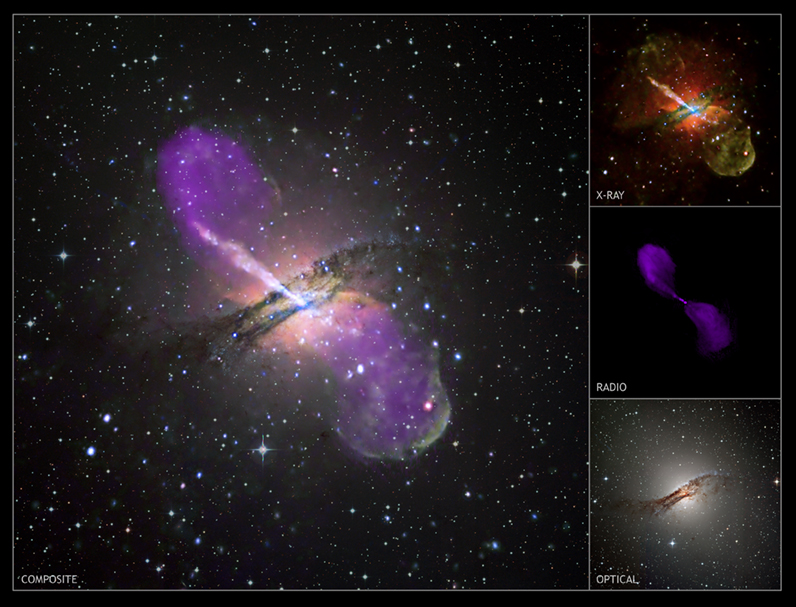
NGC 5128 - Centaurus A


A dramatic new Chandra image of the nearby galaxy Centaurus A provides one of the best views to date of the effects of an active supermassive black hole. Opposing jets of high-energy particles can be seen extending to the outer reaches of the galaxy, and numerous smaller black holes in binary star systems are also visible.

The image was made from an ultra-deep look at the galaxy Centaurus A, equivalent to more than seven days of continuous observations. Centaurus A is the nearest galaxy to Earth that contains a supermassive black hole actively powering a jet.

A prominent X-ray jet extending for 13,000 light years points to the upper left in the image, with a shorter "counterjet" aimed in the opposite direction. Astronomers think that such jets are important vehicles for transporting energy from the black hole to the much larger dimensions of a galaxy, and affecting the rate at which stars form there.

High-energy electrons spiraling around magnetic field lines produce the X-ray emission from the jet and counterjet. This emission quickly saps the energy from the electrons, so they must be continually reaccelerated or the X-rays will fade out. Knot-like features in the jets detected in the Chandra image show where the acceleration of particles to high energies is currently occurring, and provides important clues to understanding the process that accelerates the electrons to near-light speeds.

The inner part of the X-ray jet close to the black hole is dominated by these knots of X-ray emission, which probably come from shock waves -- akin to sonic booms -- caused by the jet. Farther from the black hole there is more diffuse X-ray emission in the jet. The cause of particle acceleration in this part of the jet is unknown.

Hundreds of point-like sources are also seen in the Chandra image. Many of these are X-ray binaries that contain a stellar-mass black hole and a companion star in orbit around one another. Determining the population and properties of these black holes should help scientists better understand the evolution of massive stars and the formation of black holes.

Another surprise was the detection of two particularly bright X-ray binaries. These sources may contain stellar mass black holes that are unusually massive, and this Chandra observation might have caught them gobbling up material at a high rate.

In this image, low-energy X-rays are colored red, intermediate-energy X-rays are green, and the highest-energy X-rays detected by Chandra are blue. The dark green and blue bands running almost perpendicular to the jet are dust lanes that absorb X-rays. This dust lane was created when Centaurus A merged with another galaxy perhaps 100 million years ago.


Photo credit: (Top) NASA/CXC/CfA/R.Kraft et al.
(Bottom) X-ray: NASA/CXC/CfA/R.Kraft et al; Radio: NSF/VLA/Univ. Hertfordshire/M. Hardcastle; Optical: ESO/WFI/M.Rejkuba et al.)