Pages

Showing posts with label Reflection Nebula. Show all posts

Thursday, September 4, 2014

Dark Nebula Dobashi 4173 and Reflection Nebula [B77] 63


This new NASA/ESA Hubble Space Telescope image shows a variety of intriguing cosmic phenomena.

Surrounded by bright stars, towards the upper middle of the frame we see a small young stellar object (YSO) known as SSTC2D J033038.2+303212. Located in the constellation of Perseus, this star is in the early stages of its life and is still forming into a fully grown star. In this view from Hubble’s Advanced Camera for Surveys (ACS) it appears to have a murky chimney of material emanating outwards and downwards, framed by bright bursts of gas flowing from the star itself. This fledgling star is actually surrounded by a bright disc of material swirling around it as it forms — a disc that we see edge-on from our perspective.

However, this small bright speck is dwarfed by its cosmic neighbor towards the bottom of the frame, a clump of bright, wispy gas swirling around as it appears to spew dark material out into space. The bright cloud is a reflection nebula known as [B77] 63, a cloud of interstellar gas that is reflecting light from the stars embedded within it. There are actually a number of bright stars within [B77] 63, most notably the emission-line star LkHA 326, and its very near neighbor LZK 18.

These stars are lighting up the surrounding gas and sculpting it into the wispy shape seen in this image. However, the most dramatic part of the image seems to be a dark stream of smoke piling outwards from [B77] 63 and its stars — a dark nebula called Dobashi 4173. Dark nebulae are incredibly dense clouds of pitch-dark material that obscure the patches of sky behind them, seemingly creating great rips and eerily empty chunks of sky. The stars speckled on top of this extreme blackness actually lie between us and Dobashi 4173.

Image credit: ESA

Thursday, October 10, 2013

IC 2220 - The Toby Jug Nebula


Located about 1200 light-years from Earth in the southern constellation of Carina (The Ship’s Keel), the Toby Jug Nebula, more formally known as IC 2220, is an example of a reflection nebula. It is a cloud of gas and dust illuminated from within by the central star, designated HD 65750.

Photo credit: ESO

Note: For more information, see A Close Look at the Toby Jug Nebula.

Wednesday, January 30, 2013

NGC 1999


A new image from the Atacama Pathfinder Experiment (APEX) telescope in Chile shows a beautiful view of clouds of cosmic dust in the region of Orion. While these dense interstellar clouds seem dark and obscured in visible-light observations, APEX’s LABOCA camera can detect the heat glow of the dust and reveal the hiding places where new stars are being formed. The image shows the region around the reflection nebula NGC 1999 in visible light, with the APEX observations overlaid in brilliant orange tones that seem to set the dark clouds on fire.

Image credit: ESO/APEX (MPIfR/ESO/OSO)/T. Stanke et al./Digitized Sky Survey 2

Note: For more information, see Setting the Dark on Fire.

Thursday, May 3, 2012

Friday, November 11, 2011

IC 4601 - Dusty Reflections in the Scorpion's Claws


Between the claws of the dreaded scorpion imagined by the ancient Greeks lies this giant dust cloud, imaged by the Wide-field Infrared Survey Explorer, or WISE. The constellation of Scorpius is prominent in the summer night sky in North America. In visible light, this cloud, or nebula, appears dark with a ghostly blue shine about it. These types of nebulae are called "reflection," because they are reflecting the light of nearby stars. The dust within the cloud reflects mostly blue light.

However, WISE sees infrared light invisible to the eye. In infrared light, we can see the dust itself glowing rather than simply reflecting light. The green and red colors in this image show dust at different temperatures, with the green dust being warmer than the red dust. The dust is warmed by the light of nearby stars. This interstellar dust contains the heavy elements that planets are made of, and plays a major role in the creation of new stars.

The nebula, known as IC 4601, is part of a larger complex of clouds where new stars are being born. Some of the red stars in this image may in fact be baby stars wrapped in blankets of dust. Perhaps the dreaded scorpion can be thought of as rocking the baby stars to sleep.

This image was made from observations by all four infrared detectors aboard WISE. Blue and cyan (blue-green) represent infrared light at wavelengths of 3.4 and 4.6 microns, which is primarily from stars, the hottest objects pictured. Green and red represent light at 12 and 22 microns, which is primarily from warm dust.

Photo credit: NASA/JPL-Caltech/UCLA

Monday, February 28, 2011

Reflection Nebula BFS 29


NASA's Wide-field Infrared Survey Explorer, or WISE, captured this colorful image of the nebula BFS 29 surrounding the star CE-Camelopardalis, found hovering in the band of the night sky comprising the Milky Way. Most of the gas and dust in this image cannot be seen directly in visible light, but WISE's detectors revealed exquisite new details, and even some hidden stars.

The nebulous interstellar gas and dust in this image is known as BFS 29. "BFS" stands for Blitz, Fich, and Stark -- the three astronomers who identified and cataloged 65 new star-forming regions in 1982 (the "29" simply means that it's the 29th object in their catalog). In visible light, BFS 29 can be seen, but only very slightly. This is because the dust scatters and reflects some of the light from nearby stars, hence its classification as a reflection nebula. The gas in BFS 29 also contains large amounts of ionized hydrogen -- referred to by astronomers as "H II." Hence, the nebula is also classified as an HII region. Reflection nebulae and HII regions are often associated with star formation.

Most of the illumination and energy in BFS 29 is likely provided by the star CE-Camelopardalis. The "CE" in its name comes from a complex naming system for variable stars. Camelopardalis is the name of the constellation in which it is found, and means giraffe in Latin (from a camel wearing a leopard's coat). Of the three brightest stars in this image, it is the bright pink-colored star nearest to the center of the image. The other two bright stars cannot be seen in visible light; they are hidden behind the clouds of gas and dust. In infrared light, however, they shine through brilliantly. CE-Camelopardalis is a variable supergiant star, which means it will eventually end its life in a supernova, likely leaving behind a black hole. It is near the giraffe's hind foot, making a sort of ankle bracelet, as compared to the emerald necklace featured in the November 9, 2010 image.

All four of WISE's infrared detectors were used to make this image. The colors used represent specific wavelengths of infrared radiation. Blue and blue-green (cyan) represent 3.4- and 4.6-micron light, respectively. These wavelengths are mainly emitted by stars within the Milky Way. Green represents 12-micron light, which is emitted by the warm gas of the nebulae. Red represents the longest wavelength, 22-micron light emitted by cooler dust within the nebulae.

Photo credit: NASA/JPL-Caltech/UCLA

Saturday, February 26, 2011

Messier 78


The nebula Messier 78 takes center stage in this image taken with the Wide Field Imager on the MPG/ESO 2.2-meter telescope at the La Silla Observatory in Chile, while the stars powering the bright display take a backseat. The brilliant starlight ricochets off dust particles in the nebula, illuminating it with scattered blue light. Igor Chekalin was the overall winner of ESO’s Hidden Treasures 2010 astrophotography competition with his image of this stunning object.

Messier 78 is a fine example of a reflection nebula. The ultraviolet radiation from the stars that illuminate it is not intense enough to ionize the gas to make it glow — its dust particles simply reflect the starlight that falls on them. Despite this, Messier 78 can easily be observed with a small telescope, being one of the brightest reflection nebulae in the sky. It lies about 1350 light-years away in the constellation of Orion (The Hunter) and can be found northeast of the easternmost star of Orion’s belt.

This new image of Messier 78 from the MPG/ESO 2.2-meter telescope at the La Silla Observatory is based on data selected by Igor Chekalin in his winning entry to the Hidden Treasures competition [1].

The pale blue tint seen in the nebula in this picture is an accurate representation of its dominant color. Blue hues are commonly seen in reflection nebulae because of the way the starlight is scattered by the tiny dust particles that they contain: the shorter wavelength of blue light is scattered more efficiently than the longer wavelength red light.

This image contains many other striking features apart from the glowing nebula. A thick band of obscuring dust stretches across the image from the upper left to the lower right, blocking the light from background stars. In the bottom right corner, many curious pink structures are also visible, which are created by jets of material being ejected from stars that have recently formed and are still buried deep in dust clouds.

Two bright stars, HD 38563A and HD 38563B, are the main powerhouses behind Messier 78. However, the nebula is home to many more stars, including a collection of about 45 low mass, young stars (less than 10 million years old) in which the cores are still too cool for hydrogen fusion to start, known as T Tauri stars. Studying T Tauri stars is important for understanding the early stages of star formation and how planetary systems are created.

Remarkably, this complex of nebulae has also changed significantly in the last ten years. In February 2004 the experienced amateur observer Jay McNeil took an image of this region with a 75 mm telescope and was surprised to see a bright nebula — the prominent fan shaped feature near the bottom of this picture — where nothing was seen on most earlier images. This object is now known as McNeil’s Nebula and it appears to be a highly variable reflection nebula around a young star.

This color picture was created from many monochrome exposures taken through blue, yellow/green and red filters, supplemented by exposures through an H-alpha filter that shows light from glowing hydrogen gas. The total exposure times were 9, 9, 17.5 and 15.5 minutes per filter, respectively.

Notes:

[1] Igor Chekalin from Russia uncovered the raw data for this image of Messier 78 in ESO’s archives in the competition Hidden Treasures (eso1102). He processed the raw data with great skill, claiming first prize in the contest for his final image (Flickr link). ESO’s team of in-house image processing experts then independently processed the raw data at full resolution to produce the image shown here.

Photo credit: ESO, Igor Chekalin

Saturday, December 4, 2010

Nebulae in Orion


This mosaic image taken by NASA's Wide-field Infrared Survey Explorer, or WISE, features three nebulae that are part of the giant Orion Molecular Cloud. The image covers an area of the sky about three times as high and wide as the full moon (1.5 by 1.8 degrees). Included in this view are the Flame Nebula, the Horsehead Nebula and NGC 2023.

Despite its name, there is no fire roaring in the Flame Nebula. What makes this nebula shine is the bright blue star seen to the right of the central cloud. This star, Alnitak, is the easternmost star in Orion's belt. Wind and radiation from Alnitak blasts away electrons from the gas in the Flame Nebula, causing it to become ionized and glow in visible light. The infrared glow seen by WISE is from dust warmed by Alnitak's radiation. Also known as NGC 2024 and Orion B, this nebula is classified as a molecular cloud.

The famous Horsehead Nebula appears in this image as a faint bump on the lower right side of the vertical dust ridge. In visible light, this nebula is easily recognizable as a dramatic silhouette in the shape of a horse's head. It is classified as a dark nebula because the dense cloud blocks out the visible light of the glowing gas behind it. WISE's infrared detectors can peer into the cloud to see the glow of the dust itself.

A third nebula, called NGC 2023, can be seen as a bright circle in the lower half of the image. NGC 2023 is classified as a reflection nebula, meaning that the dust is reflecting the visible light of nearby stars. But here WISE sees the infrared glow of the warmed dust itself.

Color in this image represents specific infrared wavelengths. Blue represents light emitted at 3.4-micron wavelengths, mainly from hot stars. Relatively cooler objects, such as the dust of the nebulae, appear green and red. Green represents 4.6-micron light and red represents 12-micron light.

This image was made from data collected after WISE began to run out of its supply of solid hydrogen cryogen in August 2010. Cryogen is a coolant used to make infrared detectors more sensitive. WISE mapped the entire sky by July using four infrared detectors, but during the period from August to October, 2010, while the cryogen was depleting, WISE had only three detectors operational, and the 12-micron detector was less sensitive. This turned out to be a good thing in the case of this image, because the less-sensitive detector reduced the glare of the Flame portion of the nebula enough to bring out details of the rest of the nebula.

Photo credit: NASA/JPL-Caltech/UCLA

Thursday, November 25, 2010

AE Aurigae and the Flaming Star Nebula


NASA's Wide-field Infrared Survey Explorer, or WISE, captured this view of a runaway star racing away from its original home. Seen here surrounded by a glowing cloud of gas and dust, the star AE Aurigae appears to be on fire. Appropriately, the cloud is called the Flaming Star Nebula.

A runaway star is one that is hurled into high-speed motion through a supernova explosion or encounter with nearby stars. Like an angry teenager who storms out of the house after a family fight, runaway stars are ejected from their birthplace and race off to other parts of the galaxy.

The runaway star AE Aurigae was likely born in the Trapezium cluster, which is located in the constellation Orion. It formed as a binary-star system with the star Mu Columbae. Approximately 2.5 million years ago, these two stars are thought to have collided with another binary-star system in the Trapezium Cluster. This collision sent both AE Aurigae and Mu Columbae hurtling through space in opposite directions at a speed of 100 kilometers per second (over 200,000 miles per hour). Today, AE Aurigae can be seen in the constellation Auriga hundreds of light-years to the north of its home, while its former companion Mu Columbae is located hundreds of light-years to the south in the constellation Columba.

The wind from AE Aurigae blows away electrons from the gas surrounding it. This ionized gas begins to emit light, creating what is known as an emission nebula. The star also heats up nearby dust, causing it to glow in infrared wavelengths. As seen in visible light, this dust reflects the light of nearby stars, so it is called a reflection nebula.

The colors seen in this image represent specific wavelengths of infrared light. Hot stars scattered throughout the image show up as blue and cyan. Blue represents light emitted at wavelengths of 3.4 microns, while cyan represents 4.6 microns. The gas of the emission nebula appears green, representing 12-micron wavelengths. The dust of the reflection nebula appears primarily red, representing 22-micron light.

One interesting aspect of this image is that the edges of the reflection nebula appear lavender. This is because at its edges the nebula is both emitting light at longer, 22-micron wavelengths, and scattering shorter, 3.4-micron light. Since WISE represents 22-micron light as red and 3.4-micron light as blue, the combination of the two appears in this image as lavender.

Photo credit: NASA/JPL-Caltech/UCLA

Saturday, October 30, 2010

Reflection Nebula IRAS 12116-6001 in Crux


NASA's Wide-field Infrared Survey Explorer, or WISE, captured this colorful image of the reflection nebula IRAS 12116-6001. This cloud of interstellar dust cannot be seen directly in visible light, but WISE's detectors observed the nebula at infrared wavelengths.

In images of reflection nebulae taken with visible light, clouds of dust reflect the light of nearby stars. The dust is warmed to relatively cool temperatures by the starlight and glows with infrared light, which WISE can detect. Reflection nebulae are of interest to astronomers because they are often the sites of new star formation.

The bright blue star on the right side of the image is the variable star Epsilon Crucis. In the Bayer system of stellar nomenclature, stars are given names based on their relative brightness within a constellation. The Greek alphabet is used to designate the star's apparent brightness compared to other stars in the same constellation. "Alpha" is the brightest star in the constellation, "beta" the second brightest, and so on. In this case, "epsilon" is the fifth letter of the Greek alphabet, so Epsilon Crucis is the fifth brightest star in the constellation Crux.

Crux is a well-known constellation that can be easily seen by observers in the Southern Hemisphere and from low northern latitudes. Also known as the Southern Cross, Crux is featured in many country's flags, including Australia, Brazil and New Zealand (although New Zealand's flag does not include Epsilon Crucis).

The colors used in this image represent specific wavelengths of infrared light. The blue color of Epsilon Crucis represents light emitted at 3.4 and 4.6 microns. The green-colored star seen beside Epsilon Crucis is emitting light at 12 microns. This star is IRAS 12194-6007, a carbon star that is near the end of its lifecycle. Since the infrared wavelengths emitted by this star are longer than those from Epsilon Crucis, it is cooler. The green and red colors seen in the reflection nebula represent 12- and 22-micron light coming from the nebula's dust grains warmed by nearby stars.

Photo credit: NASA/JPL-Caltech/UCLA

Wednesday, October 27, 2010

Monoceros R2


This dramatic infrared image shows the nearby star formation region Monoceros R2, located some 2,700 light-years away in the constellation of Monoceros (the Unicorn). The picture was created from exposures in the near infrared bands Y, J and Ks taken by the VISTA survey telescope at ESO’s Paranal Observatory. Monoceros R2 is an association of massive hot young stars illuminating a beautiful collection of reflection nebulae, embedded in a large molecular cloud.

Photo credit: ESO/J. Emerson/VISTA. Acknowledgment: Cambridge Astronomical Survey Unit

Note: For more information and additional photos, see VISTA Reveals the Secret of the Unicorn.

Wednesday, September 29, 2010

DG 129 - In the Grip of the Scorpion's Claw


Gripped in the claw of the constellation Scorpius sits the reflection nebula DG 129, a cloud of gas and dust that reflects light from nearby, bright stars. This infrared view of the nebula was captured by NASA's Wide-field Infrared Survey Explorer, or WISE.

Viewed in visible light, this portion of the sky seems somewhat unremarkable. But in infrared light, a lovely reflection nebula is revealed. DG 129 was first cataloged by a pair of German astronomers, named Johann Dorschner and Josef Gärtler, in 1963.

Much like gazing at Earth-bound clouds, it is fun to use your imagination when looking at images of nebulae. Some people see this nebula as an arm and hand emerging from the cosmos. If you picture the "thumb" and "forefinger" making a circle, it is as though you are seeing a celestial "okay" sign.

The bright star on the right with the greenish haze is Pi Scorpii. This star marks one of the claws of the scorpion in the constellation Scorpius. It is actually a triple-star system located some 500 light-years away. Perhaps a cross-species celestial handshake is imminent?

The colors used in this image represent different wavelengths of infrared light. The image was constructed from frames taken after WISE ran out of some of the coolant needed to chill its infrared detectors and began to warm up. The WISE detector sensitive to 22-micron light has become too warm to produce good images, but the three shorter wavelength detectors continue to crank out over 7,000 pictures of the sky every day, like the ones that make up this picture. Blue represents infrared radiation at 3.4 microns, while green represents light with a wavelength of 4.6 microns. Red represents 12-micron infrared light.

Photo credit: NASA/JPL-Caltech/UCLA

Monday, July 5, 2010

The R Coronae Australis Region


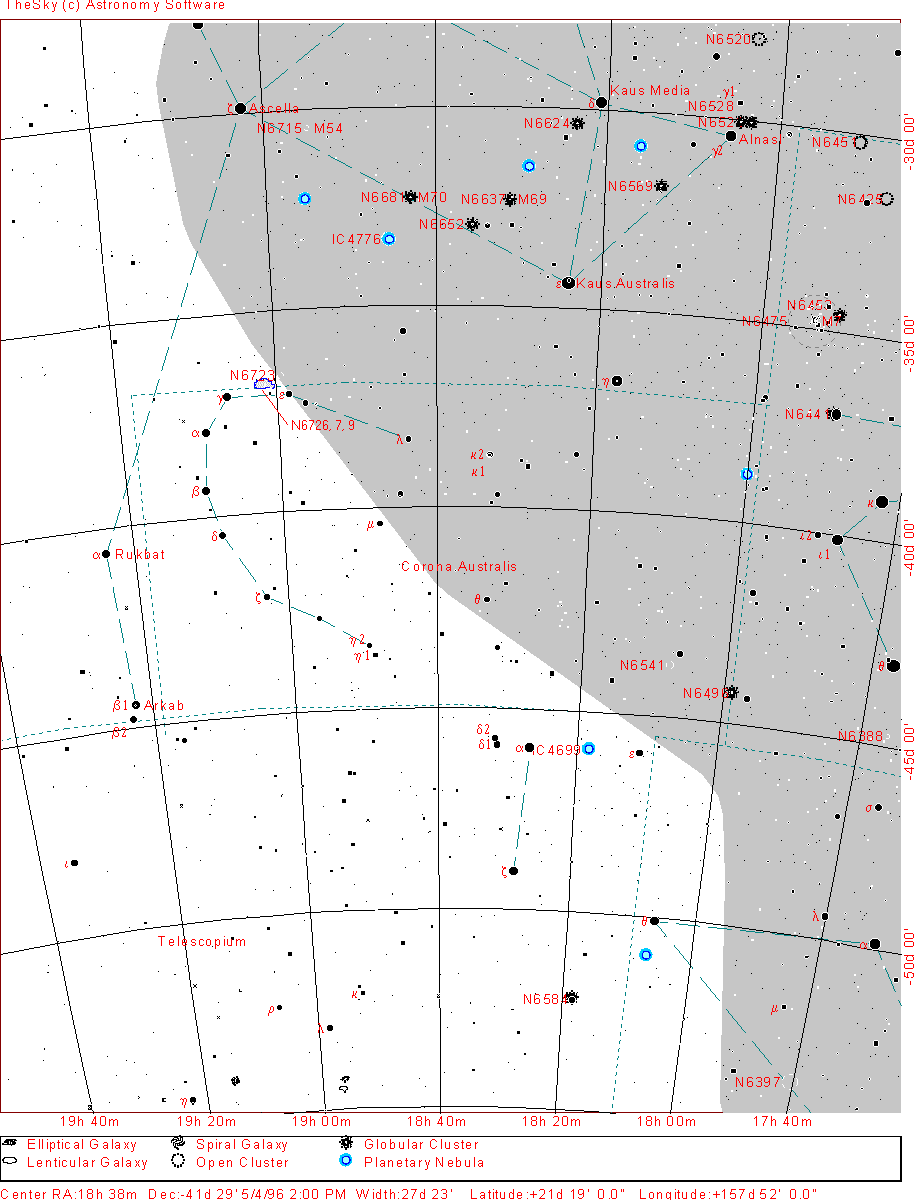
This spectacular wide field image shows the area around the star R Coronae Australis. A huge dust cloud, about eight light-years across, dominates the center of the image. The bluish reflection nebula close to R Coronae Australis is right of center and the globular cluster NGC 6723 lies to the upper-right of the nebula. Corona Australis is a tiny tiara-shaped constellation, located next to the larger constellation of Sagittarius, in the direction of the center of the Milky Way. In spite of its faintness, this southern winter constellation can be easily spotted from dark sites because of its characteristic shape and position in the sky.

Photo credit: Loke Kun Tan (StarryScapes.com); text credit: European Southern Observatory