Pages

Showing posts with label Barred Spiral Galaxies. Show all posts

Thursday, October 23, 2014

NGC 1291


This image from NASA's Spitzer Space Telescope, taken in infrared light, shows where the action is taking place in galaxy NGC 1291. The outer ring, colored red in this view, is filled with new stars that are igniting and heating up dust that glows with infrared light. The stars in the central area produce shorter-wavelength infrared light than that seen in the ring, and are colored blue. This central area is where older stars live, having long ago gobbled up the available gas supply, or fuel, for making new stars.

The galaxy is about 12 billion years old and is located in the Eridanus constellation. It is known as a barred galaxy because a central bar of stars (which looks like a blue "S" in this view) dominates its center.

When galaxies are young and gas-rich, stellar bars drive gas toward the center, feeding star formation. Over time, as the star-making fuel runs out, the central regions become quiescent and star-formation activity shifts to the outskirts of a galaxy. There, spiral density waves and resonances induced by the central bar help convert gas to stars. The outer ring, seen here in red, is one such resonance location, where gas has been trapped and ignited into a star-forming frenzy.

Image credit: NASA/JPL-Caltech

Note: For more information, see Galactic Wheel of Life Shines in Infrared.

Wednesday, July 9, 2014

NGC 201


Discovered by astronomer William Herschel in the late 1700s, NGC 201 is a barred spiral galaxy similar to our own galaxy, the Milky Way. It lies 200 million light-years from Earth in the constellation of Cetus (The Sea Monster), and is invisible to the naked eye.

This new NASA/ESA Hubble Space Telescope image of NGC 201 shows the galaxy in striking detail, capturing the bright center and the barred spiral arms — arms that do not start directly from the galactic center, but instead seem to be offset and stem from a "bar" of stars cutting through the middle of the galaxy.

Along with three of its closest galactic neighbors (outside the frame), NGC 201 belongs to a group known as the HCG 7 compact galactic group. Hickson Compact Groups (HCG) are relatively small and isolated systems containing a handful of bright, compact galaxies that lie close to one another. As the galaxies within these groups move closer together they interact strongly, dragging galactic material out into space and distorting the structure of the other group members.

Eventually, all the galaxies within one HCG will merge together. Simulations have shown that within a billion years, the galaxies within one HCG have merged to form a giant fossil galaxy. It is possible that this is the final fate of all galactic groups.

Image credit: ESA/Hubble & NASA

Saturday, June 14, 2014

NGC 3081


Taking center stage in this new NASA/ESA Hubble Space Telescope image is a galaxy known as NGC 3081, set against an assortment of glittering galaxies in the distance. Located in the constellation of Hydra (The Sea Serpent), NGC 3081 is located over 86 million light-years from us. It is known as a type II Seyfert galaxy, characterized by its dazzling nucleus.

NGC 3081 is seen here nearly face-on. Compared to other spiral galaxies, it looks a little different. The galaxy's barred spiral center is surrounded by a bright loop known as a resonance ring. This ring is full of bright clusters and bursts of new star formation, and frames the supermassive black hole thought to be lurking within NGC 3081 — which glows brightly as it hungrily gobbles up infalling material.

These rings form in particular locations known as resonances, where gravitational effects throughout a galaxy cause gas to pile up and accumulate in certain positions. These can be caused by the presence of a "bar" within the galaxy, as with NGC 3081, or by interactions with other nearby objects. It is not unusual for rings like this to be seen in barred galaxies, as the bars are very effective at gathering gas into these resonance regions, causing pile-ups which lead to active and very well-organized star formation.

Hubble snapped this magnificent face-on image of the galaxy using the Wide Field Planetary Camera 2. This image is made up of a combination of ultraviolet, optical, and infrared observations, allowing distinctive features of the galaxy to be observed across a wide range of wavelengths.

Image credit: ESA/Hubble & NASA

Saturday, May 3, 2014

NGC 3455


Shown here is a spiral galaxy known as NGC 3455, which lies some 65 million light-years away from us in the constellation of Leo (The Lion). Galaxies are classified into different types according to their structure and appearance. This classification system is known as the Hubble Sequence, named after its creator Edwin Hubble. In this sequence, NGC 3455 is known as a type SB galaxy — a barred spiral. Barred spiral galaxies account for approximately two thirds of all spirals. Galaxies of this type appear to have a bar of stars slicing through the bulge of stars at their center. The SB classification is further sub-divided by the appearance of a galaxy's pinwheeling spiral arms; SBa types have more tightly wound arms, whereas SBc types have looser ones. SBb types, such as NGC 3455, lie in between. NGC 3455 is part of a pair of galaxies — its partner, NGC 3454, lies out of frame. This cosmic duo belong to a group known as the NGC 3370 group, which is in turn one of the Leo II groups, a large collection of galaxies scattered some 30 million light-years to the right of the Virgo cluster. This new image is from Hubble's Advanced Camera for Surveys (ACS).

Image credit: ESA/Hubble & NASA; Acknowledgement: Nick Rose

Saturday, March 22, 2014

The Milky Way in Infrared


When you look up at the Milky Way on a clear, dark night, you'll see a band of bright stars arching overhead. This is the plane of our flat spiral galaxy, within which our solar system lies.

A new, zoomable panorama from NASA's Spitzer Space Telescope shows us our galaxy's plane all the way around us in infrared light. The 360-degree mosaic comes primarily from the GLIMPSE360 project, which stands for Galactic Legacy Infrared Mid-Plane Survey Extraordinaire. It consists of more than 2 million snapshots taken in infrared light over 10 years, beginning in 2003 when Spitzer launched.

This infrared view reveals much more of the galaxy than can be seen in visible-light views. Whereas visible light is blocked by dust, infrared light from stars and other objects can travel through dust to reach Spitzer's detectors. For instance, when looking up at our night skies, we see stars that are an average of 1,000 light-years away; the rest are hidden. In Spitzer's mosaic, light from stars throughout the galaxy -- which stretches 100,000 light-years across -- shines through. This picture covers only about three percent of the sky, but includes more than half of the galaxy's stars and the majority of its star formation activity.

The red color shows dusty areas of star formation. Throughout the galaxy, tendrils, bubbles and sculpted dust structures are apparent. These are the results of massive stars blasting out winds and radiation. Stellar clusters deeply embedded in gas and dust, green jets and other features related to the formation of young stars can also be seen for the first time. Looking toward the galactic center, the blue haze is made up of starlight -- the region is too far away for us to pick out individual stars, but they contribute to the glow. Dark filaments that show up in stark contrast to the bright background are areas of thick, cold dust that not even infrared light can penetrate. If you look closely, it's even possible to spot distant galaxies that lie far beyond the Milky Way.

Scientists are using these images to get to know our galaxy better. They've come up with better maps of its central bar of stars and spiral structure, discovered new remote sites of star formation and even come across new mysteries; for example, the dust grains indicate a higher abundance of carbon in the galaxy than expected. The GLIMPSE360 map will guide astronomers for generations, helping them to further chart the unexplored territories of our own Milky Way.

The image combines data from multiple surveys in addition to GLIMPSE360: GLIMPSE, GLIMPSEII, GLIMPSE3D, Vela-Carina, Deep GLIMPSE, CYGX, GALCEN and SMOG. Twelve-micron data from NASA's Wide-field Infrared Survey Explorer (WISE) was substituted for missing 8-micron data in outer galaxy regions mapped during Spitzer's post-cryogen mission.

Zoomable, full-resolution and poster versions of the image are online at http://www.spitzer.caltech.edu/glimpse360.

Image credit: NASA/JPL-Caltech/University of Wisconsin

Note: For more information, see NASA's Spitzer Telescope Brings 360-Degree View of Galaxy to Our Fingertips.

Friday, January 10, 2014

Messier 83


This new Hubble image shows the scatterings of bright stars and thick dust that make up spiral galaxy Messier 83, otherwise known as the Southern Pinwheel Galaxy. One of the largest and closest barred spirals to us, this galaxy is dramatic and mysterious; it has hosted a large number of supernova explosions, and appears to have a double nucleus lurking at its core.

Image credit: NASA, ESA, and the Hubble Heritage Team (STScI/AURA). Acknowledgement: William Blair (Johns Hopkins University)

Note: For more information, see A Galaxy With Two Hearts.

Saturday, August 24, 2013

NGC 253


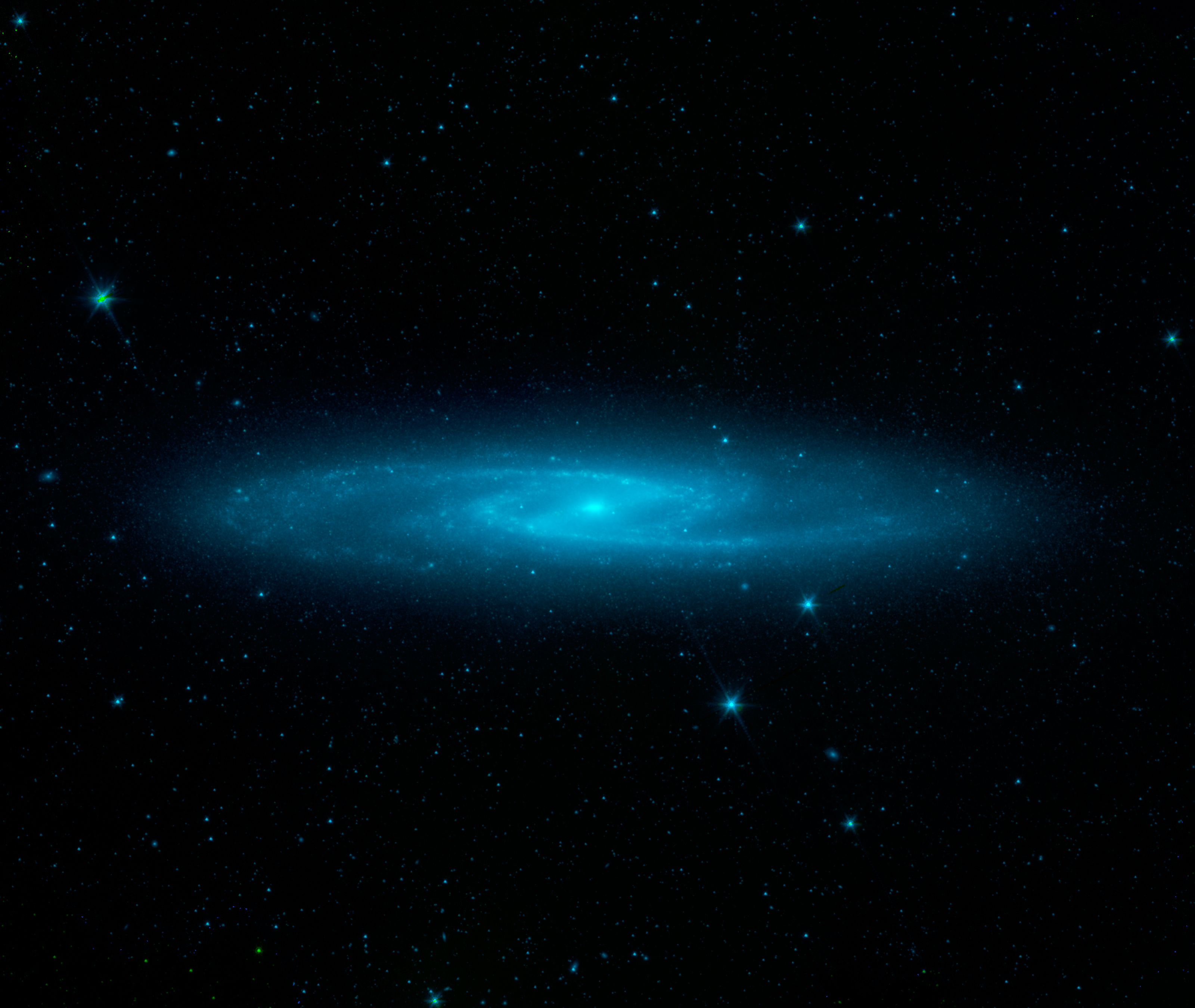
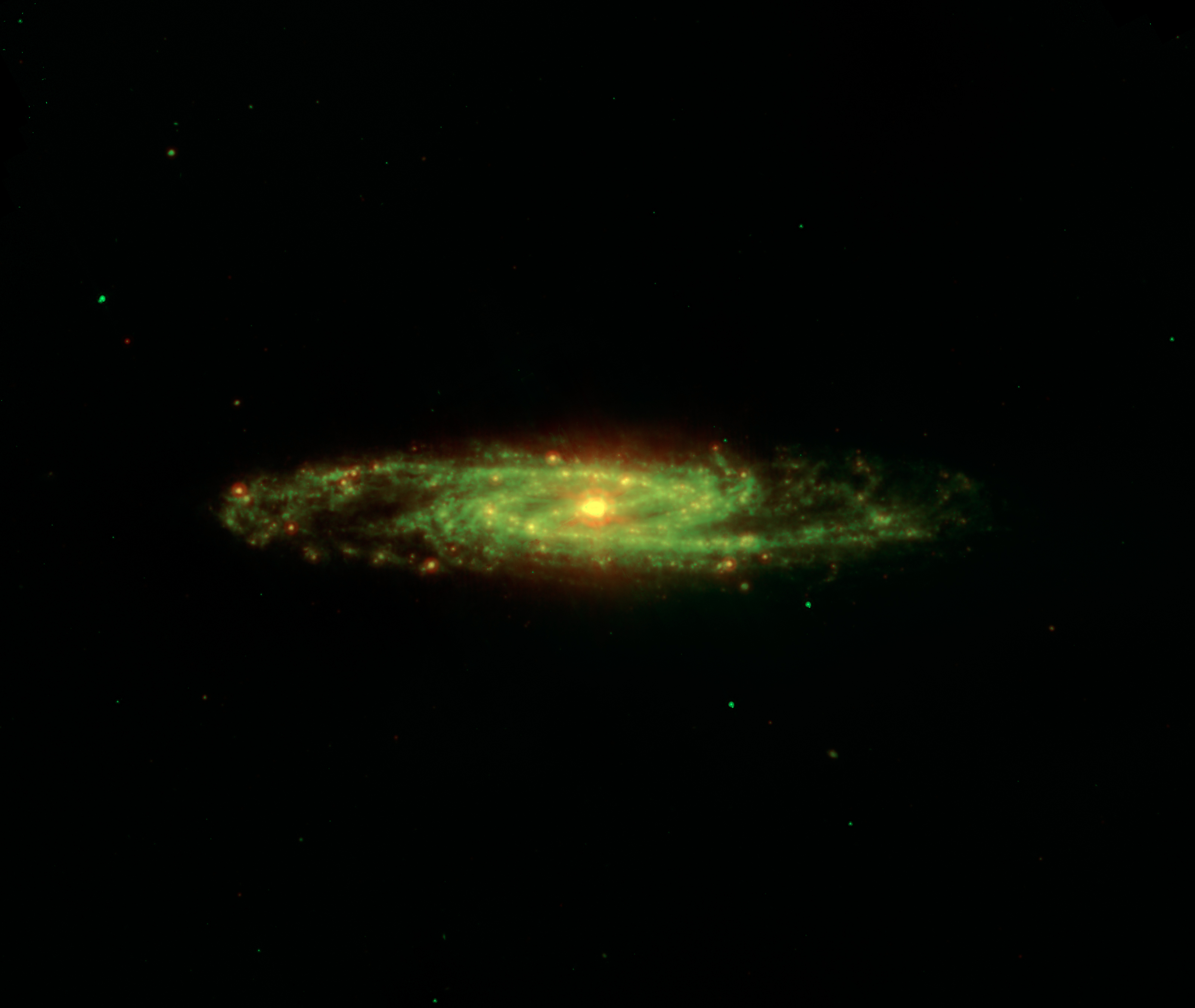
The spectacular swirling arms and central bar of the Sculptor galaxy are revealed in this new view from NASA's Spitzer Space Telescope. This image is an infrared composite combining data from two of Spitzer's detectors taken during its early cold, or cryogenic, mission.

Also known as NGC 253, the Sculptor galaxy is part of a cluster of galaxies visible to observers in the Southern hemisphere. It is known as a starburst galaxy for the extraordinarily strong star formation in its nucleus. This activity warms the surrounding dust clouds, causing the brilliant yellow-red glow in the center of this infrared image.

Figure 1 is split into two constituent parts on the right. On the top is a blue glow primarily from the light of stars as seen at the shorter wavelengths of infrared light. In this view, the disk, spiral arms and central bar are easy to see. The lower right image shows the glow of dust at longer infrared wavelengths in green and red. Regions of star formation glow especially bright at the longest wavelengths (red).

While Spitzer is now operating without any onboard cryogen, it can still operate its shorter-wavelength detectors to produce images equivalent to the star map on the upper right. Spitzer continues to be a valuable tool for studying the infrared properties of galaxies near and far.

Infrared light with wavelengths of 3.6 and 4.5 microns is shown as blue/cyan. Eight-micron light is rendered in green, and 24-micron emission is red.

Image credit: NASA/JPL-Caltech

Note: For more information, see NASA's Spitzer Telescope Celebrates 10 Years in Space.

Tuesday, March 12, 2013

Hot Blue Stars in IC 5052


This image, speckled with blue, white, and yellow light, shows part of the spiral galaxy IC 5052. Surrounded by distant stars and galaxies, it emits a bright blue-white glow which highlights its narrow, intricate structure. It is viewed side-on in the constellation of Pavo (The Peacock), in the southern sky.

When spiral galaxies are viewed from this angle, it is very difficult to fully understand their properties and how they are arranged. IC 5052 is actually a barred spiral galaxy – its pinwheeling arms do not begin from the center point but are instead attached to either end of a straight "bar" of stars that cuts through the galaxy's middle. Approximately two thirds of all spirals are barred, including the Milky Way.

Bursts of pale blue light are visible across the galaxy's length, partially blocked out by weaving lanes of darker gas and dust. These are pockets of extremely hot newborn stars. The bars present in spirals like IC 5052 are thought to help these formation processes by effectively funneling material from the swirling arms inwards towards these hot stellar nurseries.

Photo credit: ESA/Hubble & NASA, Acknowledgement: S. Meunier

Friday, January 18, 2013

NGC 6872


This composite of the giant barred spiral galaxy NGC 6872 combines visible light images from the European Southern Observatory's Very Large Telescope with far-ultraviolet (1,528 angstroms) data from NASA's GALEX and 3.6-micron infrared data acquired by NASA's Spitzer Space Telescope. A previously unsuspected tidal dwarf galaxy candidate (circled) appears only in the ultraviolet, indicating the presence of many hot young stars. IC 4970, the small disk galaxy interacting with NGC 6872, is located above the spiral's central region. The spiral is 522,000 light-years across from the tip of one outstretched arm to the tip of the other, which makes it about five times the size of our home galaxy, the Milky Way. Images of lower resolution from the Digital Sky Survey were used to fill in marginal areas not covered by the other data.

Photo credit: NASA's Goddard Space Flight Center/ESO/JPL-Caltech/DSS

Note: For more information, see NASA's Galex Reveals the Largest-Known Spiral Galaxy and PIA16613: Dwarf Galaxy Spotted.

Sunday, January 6, 2013

NGC 1097


The Hubble Space Telescope captured a spectacular image of the bright star-forming ring that surrounds the heart of the barred spiral galaxy NGC 1097. In this image, the larger-scale structure of the galaxy is barely visible: its comparatively dim spiral arms, which surround its heart in a loose embrace, reach out beyond the edges of this frame.

This face-on galaxy, lying 45 million light-years away from Earth in the southern constellation of Fornax (The Furnace), is particularly attractive for astronomers. NGC 1097 is a Seyfert galaxy. Lurking at the very center of the galaxy, a supermassive black hole 100 million times the mass of our sun is gradually sucking in the matter around it. The area immediately around the black hole shines powerfully with radiation coming from the material falling in.

The distinctive ring around the black hole is bursting with new star formation due to an inflow of material toward the central bar of the galaxy. These star-forming regions are glowing brightly thanks to emission from clouds of ionized hydrogen. The ring is around 5000 light-years across, although the spiral arms of the galaxy extend tens of thousands of light-years beyond it.

Photo credit: NASA/ESA/Hubble

Tuesday, January 1, 2013

ESO 499-G37


The Hubble Space Telescope has spotted the spiral galaxy ESO 499-G37, seen here against a backdrop of distant galaxies, scattered with nearby stars.

The galaxy is viewed from an angle, allowing Hubble to reveal its spiral nature clearly. The faint, loose spiral arms can be distinguished as bluish features swirling around the galaxy’s nucleus. This blue tinge emanates from the hot, young stars located in the spiral arms. The arms of a spiral galaxy have large amounts of gas and dust, and are often areas where new stars are constantly forming.

The galaxy’s most characteristic feature is a bright elongated nucleus. The bulging central core usually contains the highest density of stars in the galaxy, where typically a large group of comparatively cool old stars are packed in this compact, spheroidal region.

One feature common to many spiral galaxies is the presence of a bar running across the center of the galaxy. These bars are thought to act as a mechanism that channels gas from the spiral arms to the center, enhancing the star formation.

Image credit: NASA/Hubble

Monday, April 23, 2012

Messier 83 in Visible Light and Infrared


This video fades between the view of Messier 83 in visible light captured by the Wide Field Imager at ESO’s La Silla Observatory in Chile and the new HAWK-I image taken in the infrared. In the infrared, the dust that obscures many stars becomes nearly transparent, making the spiral arms less dramatic but revealing a whole host of new stars that are otherwise invisible.

Video credit: ESO/M. Gieles
Acknowledgement: Mischa Schirmer

Thursday, April 5, 2012

NGC 2683


The NASA/ESA Hubble Space Telescope has spotted the "UFO Galaxy." NGC 2683 is a spiral galaxy seen almost edge-on, giving it the shape of a classic science fiction spaceship. This is why the astronomers at the Astronaut Memorial Planetarium and Observatory, Cocoa, Florida, gave it this attention-grabbing nickname.

While a bird's eye view lets us see the detailed structure of a galaxy (such as this Hubble image of a barred spiral), a side-on view has its own perks. In particular, it gives astronomers a great opportunity to see the delicate dusty lanes of the spiral arms silhouetted against the golden haze of the galaxy’s core. In addition, brilliant clusters of young blue stars shine scattered throughout the disc, mapping the galaxy’s star-forming regions.

Perhaps surprisingly, side-on views of galaxies like this one do not prevent astronomers from deducing their structures. Studies of the properties of the light coming from NGC 2683 suggest that this is a barred spiral galaxy, even though the angle we see it at does not let us see this directly.

This image is produced from two adjacent fields observed in visible and infrared light by Hubble’s Advanced Camera for Surveys. A narrow strip which appears slightly blurred and crosses most the image horizontally is a result of a gap between Hubble’s detectors. This strip has been patched using images from observations of the galaxy made by ground-based telescopes, which show significantly less detail. The field of view is approximately 6.5 by 3.3 arcminutes.

Photo credit: ESA/Hubble & NASA

Thursday, March 15, 2012

NGC 1483


NASA's Hubble Space Telescope has produced this beautiful image of the galaxy NGC 1483. NGC 1483 is a barred spiral galaxy located in the southern constellation of Dorado — the dolphinfish (or Mahi-mahi fish) in Spanish. The nebulous galaxy features a bright central bulge and diffuse arms with distinct star-forming regions. In the background, many other distant galaxies can be seen.

The constellation Dorado is home to the Dorado Group of galaxies, a loose group comprised of an estimated 70 galaxies and located some 62 million light-years away. The Dorado group is much larger than the Local Group that includes the Milky Way (and which contains around 30 galaxies) and approaches the size of a galaxy cluster. Galaxy clusters are the largest groupings of galaxies (and indeed the largest structures of any type) in the universe to be held together by their gravity.

Barred spiral galaxies are so named because of the prominent bar-shaped structures found in their center. They form about two-thirds of all spiral galaxies, including the Milky Way. Recent studies suggest that bars may be a common stage in the formation of spiral galaxies, and may indicate that a galaxy has reached full maturity.

Photo credit: ESA/Hubble & NASA

Tuesday, February 14, 2012

NGC 1313


The central parts of the starburst galaxy NGC 1313. The very active state of this galaxy is very evident from the image, showing many star formation regions. A great number of supershell nebulae, that is, cocoon of gas inflated and etched by successive bursts of star formation, are visible. The green nebulosities are regions emitting in the ionized oxygen lines and may harbor clusters with very hot stars. This color-composite is based on images obtained with the FORS1 instrument on one of the 8.2-m Unit Telescope of ESO's Very Large Telescope, located at Cerro Paranal. The data were obtained in the night of 16 December 2003, through different broad- (R, B, and z) and narrow-band filters (H-alpha, OI, and OIII). The data were extracted from the ESO Science Archive and fully processed by Henri Boffin (ESO).

Photo credit: ESO

Saturday, February 4, 2012

Wednesday, December 14, 2011

Messier 83 - The Southern Pinwheel


This spectacular spiral galaxy is known to astronomers as Messier 83. Colloquially, it is also called the Southern Pinwheel due to its similarity to the more northerly Pinwheel galaxy Messier 101. NASA's Spitzer Space Telescope shows us, in spectacular detail, the infrared structure of what many think of as our own Milky Way galaxy's smaller cousin.

Living in the middle of the Milky Way's disk, we see our galaxy only from an obstructed vantage point that is both inside-out and edge-on. We see Messier 83 nearly face-on, giving us a chance to really map out its disk in great detail. This information helps astronomers figure out what our own galaxy would look like if we could warp out to a better vantage point.

Like the Milky Way, Messier 83 is classified as a barred spiral galaxy due to the bar-like pattern of stars that run through its center. This bar region is more interesting in the infrared since we can also see the open "s" shaped curve of dust (red) cutting through the more linear stellar bar (blue-cyan).

This arc of inner dust connects up with the more tightly wound spiral arms in the outer disk, seen here as bright green-red ridges. Between the main spiral arms we also see a complex webbing of dust that permeates the entire disk.

While Messier 83 is about 15 million light years away, it is actually one of the closest barred spiral galaxies in the sky. This gives astronomers an excellent chance to study a galaxy that, although half as big, seems very similar in structure to our own Milky Way galaxy.

Infrared light with wavelengths of 3.6 and 4.5 microns are displayed in blue and green showing primarily the glow from starlight. 8 micron light is rendered in red; the contribution from starlight at 8 microns was subtracted out from the data to better show the dust structures near the galaxy's center.

Photo credit: NASA/JPL-Caltech

Note: A similar version of this photo can be found here.

Friday, January 14, 2011

Maffei 2 - The Hidden Galaxy


Maffei 2 is the poster child for an infrared galaxy that is almost invisible to optical telescopes. Foreground dust clouds in our Milky Way galaxy block about 99.5 percent of its visible light. But this infrared image from NASA's Spitzer Space Telescope penetrates the dust to reveal the galaxy in all its glory.

The astronomer Paolo Maffei first noted the galaxy as a mysterious smudge on an infrared photographic plate in 1968. Four years later, he identified the strange object to be a galaxy, now named after him. This discovery was made in the infancy of infrared astronomy, and it would take many technological innovations in the following decades to allow astronomers to study obscured objects like this one in detail.

Most other galaxies the size of Maffei 2 had been cataloged for over a century. Because this galaxy was hidden behind dust lanes in our own galaxy, it did not become one of the entries in the famous 18th century catalog of bright deep-sky objects compiled by Charles Messier.

This Spitzer image clearly shows the unusual structure of Maffei 2. The strong central bar and asymmetric spiral arms help identify why the galaxy also harbors a "starburst" in its very core. Such dramatic bursts of star formation occur when massive amounts of dust and gas are driven into the center of a galaxy, often by gravitational interactions that create the barred spiral structures.

Photo credit: NASA/JPL-Caltech/UCLA

Note: This is MinSEx's 300th post!

Sunday, October 10, 2010

NGC 1365


A new image taken with the powerful HAWK-I camera on ESO’s Very Large Telescope at Paranal Observatory in Chile shows the beautiful barred spiral galaxy NGC 1365 in infrared light. NGC 1365 is a member of the Fornax cluster of galaxies, and lies about 60 million light-years from Earth.

NGC 1365 is one of the best known and most studied barred spiral galaxies and is sometimes nicknamed the Great Barred Spiral Galaxy because of its strikingly perfect form, with the straight bar and two very prominent outer spiral arms. Closer to the center there is also a second spiral structure and the whole galaxy is laced with delicate dust lanes.

This galaxy is an excellent laboratory for astronomers to study how spiral galaxies form and evolve. The new infrared images from HAWK-I are less affected by the dust that obscures parts of the galaxy than images in visible light (potw1037a) and they reveal very clearly the glow from vast numbers of stars in both the bar and the spiral arms. These data were acquired to help astronomers understand the complex flow of material within the galaxy and how it affects the reservoirs of gas from which new stars can form. The huge bar disturbs the shape of the gravitational field of the galaxy and this leads to regions where gas is compressed and star formation is triggered. Many huge young star clusters trace out the main spiral arms and each contains hundreds or thousands of bright young stars that are less than ten million years old. The galaxy is too remote for single stars to be seen in this image and most of the tiny clumps visible in the picture are really star clusters. Over the whole galaxy, stars are forming at a rate of about three times the mass of our Sun per year.

While the bar of the galaxy consists mainly of older stars long past their prime, many new stars are born in stellar nurseries of gas and dust in the inner spiral close to the nucleus. The bar also funnels gas and dust gravitationally into the very center of the galaxy, where astronomers have found evidence for the presence of a super-massive black hole, well hidden among myriads of intensely bright new stars.

NGC 1365, including its two huge outer spiral arms, spreads over around 200,000 light-years. Different parts of the galaxy take different times to make a full rotation around the core of the galaxy, with the outer parts of the bar completing one circuit in about 350 million years. NGC 1365 and other galaxies of its type have come to more prominence in recent years with new observations indicating that the Milky Way could also be a barred spiral galaxy. Such galaxies are quite common — two thirds of spiral galaxies are barred according to recent estimates, and studying others can help astronomers understand our own galactic home.


Photo credit: ESO/P. Grosbøl

Sunday, August 8, 2010

NGC 1097


NASA's Spitzer Space Telescope has imaged a wild creature of the dark -- a coiled galaxy with an eye-like object at its center.

The galaxy, called NGC 1097, is located 50 million light-years away. It is spiral-shaped like our Milky Way, with long, spindly arms of stars. The "eye" at the center of the galaxy is actually a monstrous black hole surrounded by a ring of stars. In this color-coded infrared view from Spitzer, the area around the invisible black hole is blue and the ring of stars, white.

The black hole is huge, about 100 million times the mass of our sun, and is feeding off gas and dust along with the occasional unlucky star. Our Milky Way's central black hole is tame in comparison, with a mass of a few million suns.

The ring around the black hole is bursting with new star formation. An inflow of material toward the central bar of the galaxy is causing the ring to light up with new stars.

The galaxy's red spiral arms and the swirling spokes seen between the arms show dust heated by newborn stars. Older populations of stars scattered through the galaxy are blue. The fuzzy blue dot to the left, which appears to fit snuggly between the arms, is a companion galaxy. Astronomers say it is unclear whether this companion poked a hole in the larger galaxy, or just happens to be aligned in a gap in the arms.

Other dots in the picture are either nearby stars in our galaxy, or distant galaxies.

This image was taken during Spitzer's cold mission, before it ran out of liquid coolant. The observatory's warm mission is ongoing, with two infrared channels operating at about 30 Kelvin (minus 406 degrees Fahrenheit).

Infrared light with a wavelength of 3.6 microns is blue; 4.5-micron light is green and 8.0-micron light is red. The contribution from starlight measured at 3.6 microns has been subtracted from the 8.0-micron image to enhance the visibility of the dust features.

Photo credit: NASA/JPL-Caltech