Pages

Showing posts with label Janus. Show all posts

Wednesday, November 13, 2013

Saturn, with Earth, Venus and Mars


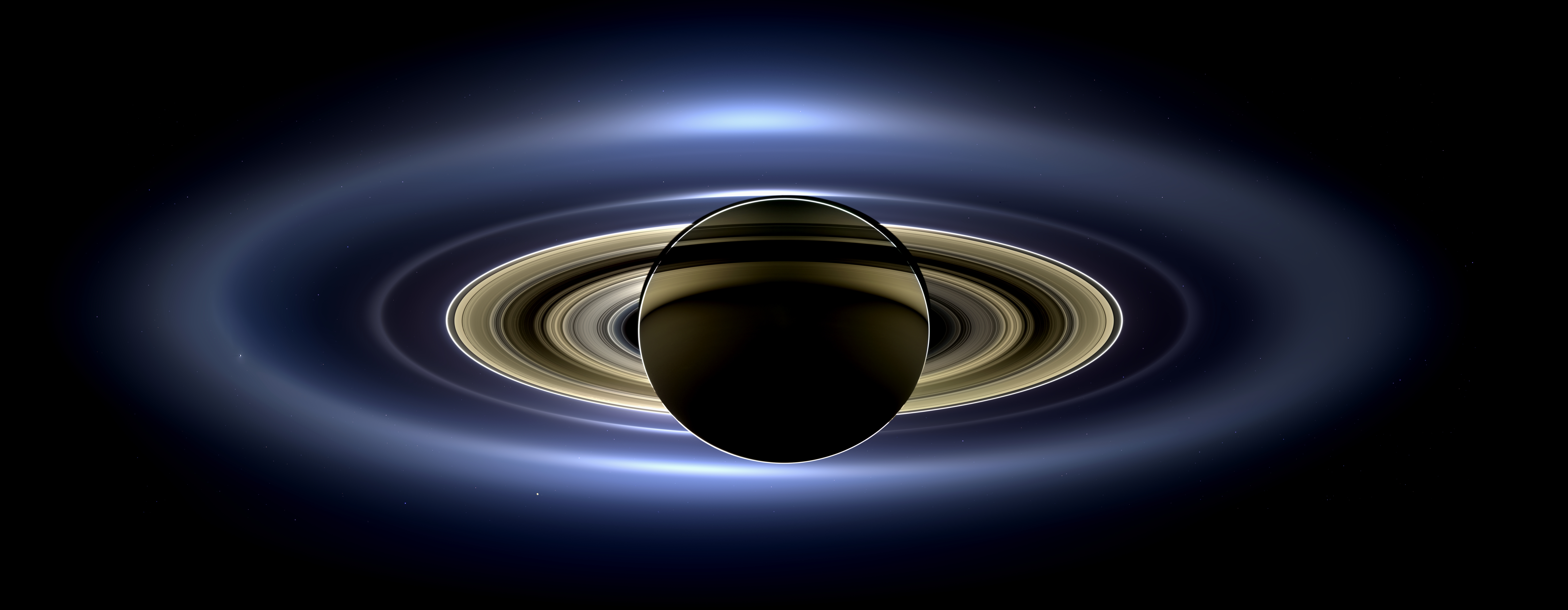
On July 19, 2013, in an event celebrated the world over, NASA's Cassini spacecraft slipped into Saturn's shadow and turned to image the planet, seven of its moons, its inner rings -- and, in the background, our home planet, Earth.

With the sun's powerful and potentially damaging rays eclipsed by Saturn itself, Cassini's onboard cameras were able to take advantage of this unique viewing geometry. They acquired a panoramic mosaic of the Saturn system that allows scientists to see details in the rings and throughout the system as they are backlit by the sun. This mosaic is special as it marks the third time our home planet was imaged from the outer solar system; the second time it was imaged by Cassini from Saturn's orbit; and the first time ever that inhabitants of Earth were made aware in advance that their photo would be taken from such a great distance.

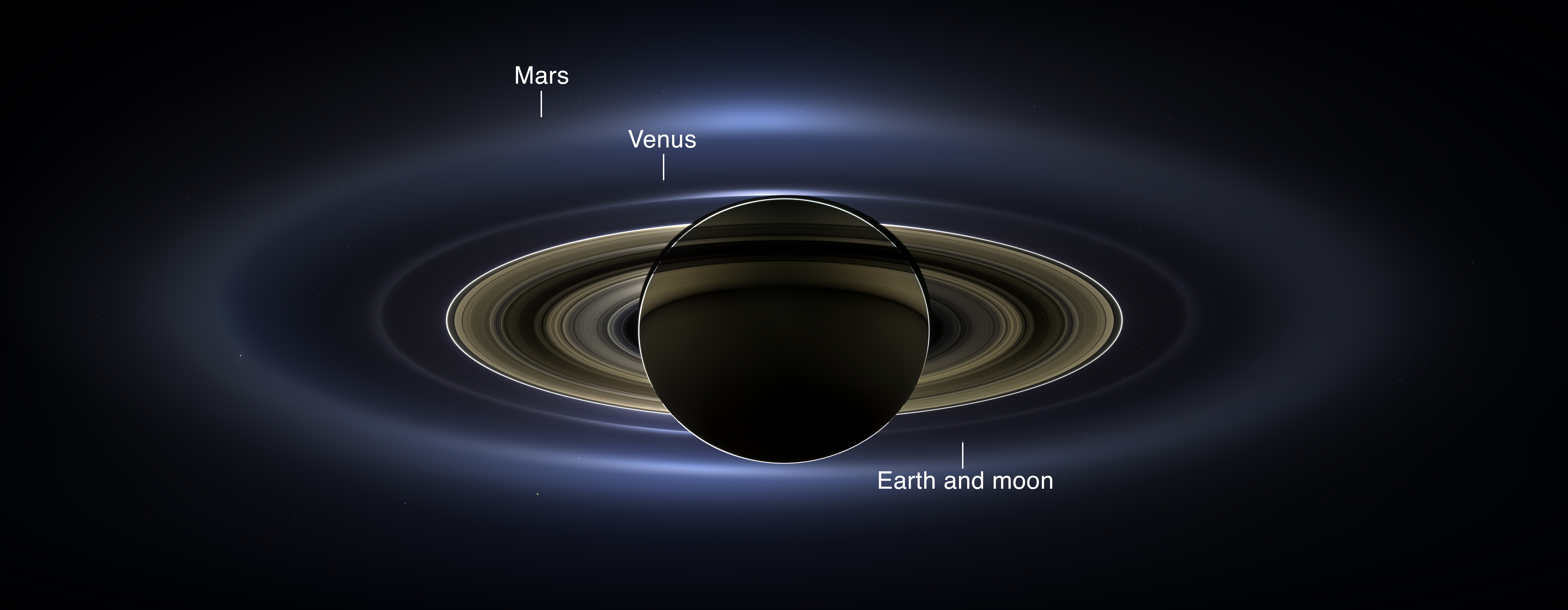
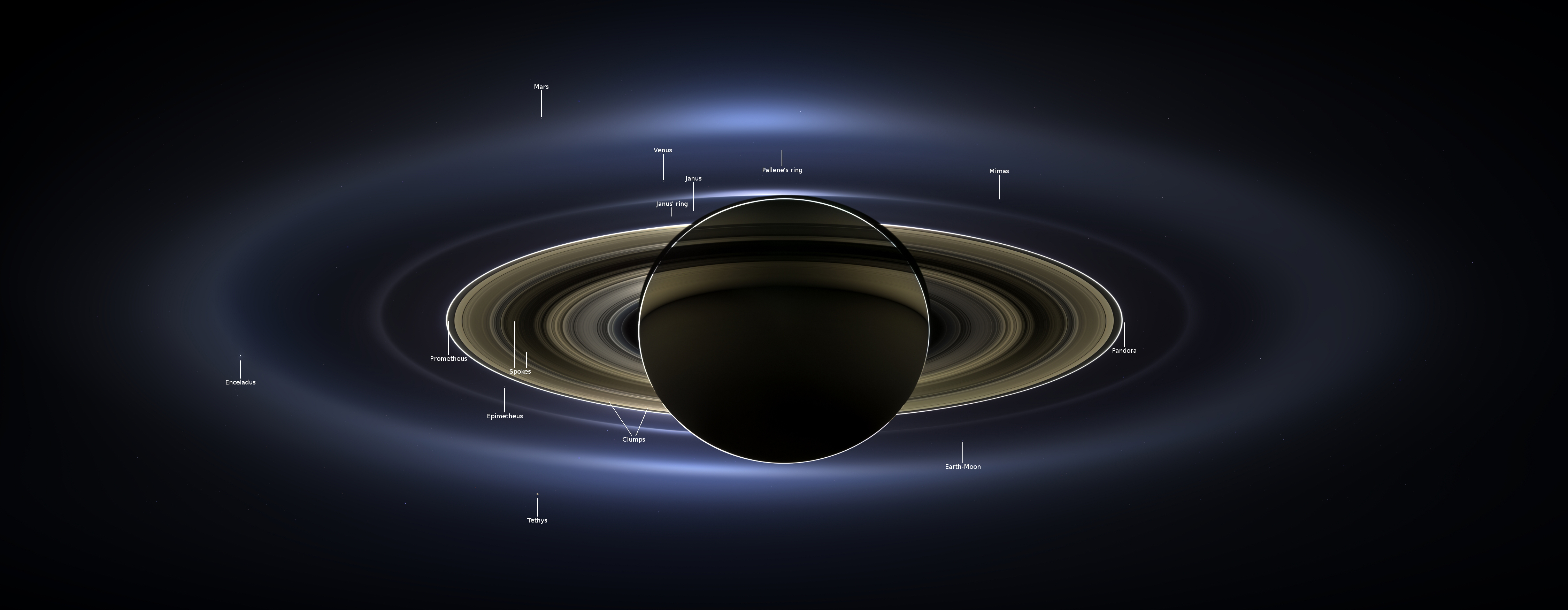
With both Cassini's wide-angle and narrow-angle cameras aimed at Saturn, Cassini was able to capture 323 images in just over four hours. This final mosaic uses 141 of those wide-angle images. Images taken using the red, green and blue spectral filters of the wide-angle camera were combined and mosaicked together to create this natural-color view. A brightened version with contrast and color enhanced (Figure 1), a version with just the planets annotated (Figure 2), and an annotated version (Figure 3) are shown above.

This image spans about 404,880 miles (651,591 kilometers) across.

The outermost ring shown here is Saturn's E ring, the core of which is situated about 149,000 miles (240,000 kilometers) from Saturn. The geysers erupting from the south polar terrain of the moon Enceladus supply the fine icy particles that comprise the E ring; diffraction by sunlight gives the ring its blue color. Enceladus (313 miles, or 504 kilometers, across) and the extended plume formed by its jets are visible, embedded in the E ring on the left side of the mosaic.

At the 12 o'clock position and a bit inward from the E ring lies the barely discernible ring created by the tiny, Cassini-discovered moon, Pallene (3 miles, or 4 kilometers, across). (For more on structures like Pallene's ring, see PIA08328). The next narrow and easily seen ring inward is the G ring. Interior to the G ring, near the 11 o'clock position, one can barely see the more diffuse ring created by the co-orbital moons, Janus (111 miles, or 179 kilometers, across) and Epimetheus (70 miles, or 113 kilometers, across). Farther inward, we see the very bright F ring closely encircling the main rings of Saturn.

Following the outermost E ring counter-clockwise from Enceladus, the moon Tethys (662 miles, or 1,066 kilometers, across) appears as a large yellow orb just outside of the E ring. Tethys is positioned on the illuminated side of Saturn; its icy surface is shining brightly from yellow sunlight reflected by Saturn. Continuing to about the 2 o'clock position is a dark pixel just outside of the G ring; this dark pixel is Saturn's Death Star moon, Mimas (246 miles, or 396 kilometers, across). Mimas appears, upon close inspection, as a very thin crescent because Cassini is looking mostly at its non-illuminated face.

The moons Prometheus, Pandora, Janus and Epimetheus are also visible in the mosaic near Saturn's bright narrow F ring. Prometheus (53 miles, or 86 kilometers, across) is visible as a faint black dot just inside the F ring and at the 9 o'clock position. On the opposite side of the rings, just outside the F ring, Pandora (50 miles, or 81 kilometers, across) can be seen as a bright white dot. Pandora and Prometheus are shepherd moons and gravitational interactions between the ring and the moons keep the F ring narrowly confined. At the 11 o'clock position in between the F ring and the G ring, Janus (111 miles, or 179 kilometers, across) appears as a faint black dot. Janus and Prometheus are dark for the same reason Mimas is mostly dark: we are looking at their non-illuminated sides in this mosaic. Midway between the F ring and the G ring, at about the 8 o'clock position, is a single bright pixel, Epimetheus. Looking more closely at Enceladus, Mimas and Tethys, especially in the brightened version of the mosaic, one can see these moons casting shadows through the E ring like a telephone pole might cast a shadow through a fog.

In the non-brightened version of the mosaic, one can see bright clumps of ring material orbiting within the Encke gap near the outer edge of the main rings and immediately to the lower left of the globe of Saturn. Also, in the dark B ring within the main rings, at the 9 o'clock position, one can see the faint outlines of two spoke features, first sighted by NASA's Voyager spacecraft in the early 1980s and extensively studied by Cassini.

Finally, in the lower right of the mosaic, in between the bright blue E ring and the faint but defined G ring, is the pale blue dot of our planet, Earth. Look closely and you can see the moon protruding from the Earth's lower right. (For a higher resolution view of the Earth and moon taken during this campaign, see PIA14949.) Earth's twin, Venus, appears as a bright white dot in the upper left quadrant of the mosaic, also between the G and E rings. Mars also appears as a faint red dot embedded in the outer edge of the E ring, above and to the left of Venus.

For ease of visibility, Earth, Venus, Mars, Enceladus, Epimetheus and Pandora were all brightened by a factor of eight and a half relative to Saturn. Tethys was brightened by a factor of four. In total, 809 background stars are visible and were brightened by a factor ranging from six, for the brightest stars, to 16, for the faintest. The faint outer rings (from the G ring to the E ring) were also brightened relative to the already bright main rings by factors ranging from two to eight, with the lower-phase-angle (and therefore fainter) regions of these rings brightened the most. The brightened version of the mosaic was further brightened and contrast-enhanced all over to accommodate print applications and a wide range of computer-screen viewing conditions.

Some ring features -- such as full rings traced out by tiny moons -- do not appear in this version of the mosaic because they require extreme computer enhancement, which would adversely affect the rest of the mosaic. This version was processed for balance and beauty.

This view looks toward the unlit side of the rings from about 17 degrees below the ring plane. Cassini was approximately 746,000 miles (1.2 million kilometers) from Saturn when the images in this mosaic were taken. Image scale on Saturn is about 45 miles (72 kilometers) per pixel.

This mosaic was made from pictures taken over a span of more than four hours while the planets, moons and stars were all moving relative to Cassini. Thus, due to spacecraft motion, these objects in the locations shown here were not in these specific places over the entire duration of the imaging campaign. Note also that Venus appears far from Earth, as does Mars, because they were on the opposite side of the sun from Earth.

Image credit: NASA/JPL-Caltech/SSI

Note: For more information, see NASA Cassini Spacecraft Provides New View of Saturn and Earth, PIA17679: The Faces of 'Wave at Saturn' and Spectacular New View of Saturn and Earth. From earlier in the year, see Cassini to Photograph Earth From Deep Space and Cassini Releases Image of Earth Waving at Saturn.

Monday, June 24, 2013

Earth as a Pale Blue Dot and Saturn's Silhouette


With giant Saturn hanging in the blackness and sheltering Cassini from the sun's blinding glare, the spacecraft viewed the rings as never before, revealing previously unknown faint rings and even glimpsing its home world.

This marvelous panoramic view was created by combining a total of 165 images taken by the Cassini wide-angle camera over nearly three hours on September 15, 2006. The full mosaic consists of three rows of nine wide-angle camera footprints; only a portion of the full mosaic is shown here. Color in the view was created by digitally compositing ultraviolet, infrared and clear filter images and was then adjusted to resemble natural color.

The mosaic images were acquired as the spacecraft drifted in the darkness of Saturn's shadow for about 12 hours, allowing a multitude of unique observations of the microscopic particles that compose Saturn's faint rings.

Ring structures containing these tiny particles brighten substantially at high phase angles: i.e., viewing angles where the sun is almost directly behind the objects being imaged.

During this period of observation Cassini detected two new faint rings: one coincident with the shared orbit of the moons Janus and Epimetheus, and another coincident with Pallene's orbit. (See PIA08322 and PIA08328 for more on the two new rings.)

The narrowly confined G ring is easily seen here, outside the bright main rings. Encircling the entire system is the much more extended E ring. The icy plumes of Enceladus, whose eruptions supply the E ring particles, betray the moon's position in the E ring's left-side edge.

Interior to the G ring and above the brighter main rings is the pale dot of Earth. Cassini views its point of origin from over a billion kilometers (and close to a billion miles) away in the icy depths of the outer solar system. See PIA08324 for a similar view of Earth taken during this observation.

Small grains are pushed about by sunlight and electromagnetic forces. Hence, their distribution tells much about the local space environment.

A second version of the mosaic view is presented here in which the color contrast is greatly exaggerated. In such views, imaging scientists have noticed color variations across the diffuse rings that imply active processes sort the particles in the ring according to their sizes.

Looking at the E ring in this color-exaggerated view, the distribution of color across and along the ring appears to be different between the right side and the left. Scientists are not sure yet how to explain these differences, though the difference in phase angle between right and left may be part of the explanation. The phase angle is about 179 degrees on Saturn.

The main rings are overexposed in a few places.

This view looks toward the unlit side of the rings from about 15 degrees above the ringplane.

Cassini was approximately 2.2 million kilometers (1.3 million miles) from Saturn when the images in this mosaic were taken. Image scale on Saturn is about 260 kilometers (162 miles) per pixel.

Image credit: NASA/JPL/Space Science Institute

Note: For more information, see Cassini Probe to Take Photo of Earth From Deep Space; also, Cassini to Photograph Earth From Deep Space.

Tuesday, December 25, 2012

Saturn Looms


Janus is spotted over Saturn's north pole in this image while Mimas' shadow glides across Saturn.

Janus is the faint dot that appears just above Saturn's north pole. Mimas' shadow can be seen in the southern hemisphere of Saturn, south of the rings' shadow. (Both objects are easier to find in higher resolution versions.)

This view looks toward the unilluminated side of the rings from about 25 degrees below the ringplane. The image was taken in visible light with the Cassini spacecraft wide-angle camera on August 24, 2012.

The view was obtained at a distance of approximately 1.6 million miles (2.6 million kilometers) from Saturn and at a Sun-Saturn-spacecraft, or phase, angle of 80 degrees. Image scale is 94 miles (152 kilometers) per pixel. Janus has been brightened by a factor of 1.3 relative to Saturn to enhance its visibility.

Photo credit: NASA/JPL-Caltech/Space Science Institute

Thursday, June 17, 2010

Pandora and Janus Amid Saturn's Rings


A pair of Saturn's small moons orbit near the planet's rings, which appear well illuminated in this Cassini spacecraft view.

Janus (179 kilometers, or 111 miles across) is near the center of the image and is farther than the rings from Cassini. Pandora (81 kilometers, or 50 miles across) is on the left. This view looks toward the northern, sunlit side of the rings from just above the ringplane.

The image was taken in visible light with the Cassini spacecraft narrow-angle camera on April 17, 2010. The view was acquired at a distance of approximately 2.7 million kilometers (1.7 million miles) from Janus and Pandora. Image scale is 16 kilometers (10 miles) per pixel.

Photo credit: NASA/JPL/Space Science Institute

Friday, May 28, 2010

Saturn's Rings, Rhea and Janus


Saturn's rings occupy the foreground of this image. The small moon Janus appears to hover above, while the far larger moon Rhea is partially obscured by the rings.

Janus appears to be located directly over the rings, but the moon is actually further away, at a range of about 1.1 million kilometers (684,000 miles) from the Cassini spacecraft. Rhea is 1.6 million kilometers (994,000 miles) from the spacecraft. This view looks toward the trailing hemisphere of Janus (179 kilometers, or 111 miles across) and the Saturn-facing side of Rhea (1,528 kilometers, or 949 miles across).

This view looks toward the northern, sunlit side of the rings from just above the ringplane.

The image was taken in visible light with the Cassini spacecraft narrow-angle camera on April 8, 2010. Image scale is 7 kilometers (4 miles) per pixel on Janus and 10 kilometers (6 miles) per pixel on Rhea.

Photo credit: NASA/JPL/Space Science Institute

Tuesday, February 5, 2008

Saturn, by Cassini

Credit: NASA/JPL/Space Science Institute

This natural color mosaic was acquired by the Cassini spacecraft as it soared 39 degrees above the unilluminated side of Saturn's rings.

Little light makes its way through the rings to be scattered in Cassini's direction in this viewing geometry, making the rings appear somewhat dark compared to the reflective planet. The view can be contrasted with earlier mosaics designed to showcase the rings rather than the planet, which were therefore given longer exposure times (see Blinding Saturn and Ring World).

Bright clouds play in the blue-gray skies of the north. The ring shadows continue to caress the planet as they slide farther south toward their momentary disappearance during equinox in 2009. The rings' reflected light illuminates the southern hemisphere on Saturn's night side.

The scene is reminiscent of the parting glance of NASA's Voyager 1 as it said goodbye to Saturn in 1981 (see PIA00335). Cassini, however, will continue to orbit Saturn for many years to come.

Three of Saturn's moons are visible in this image: Mimas (397 kilometers, or 247 miles across) at the 2 o'clock position, Janus (181 kilometers, or 113 miles across) at the 4 o'clock position and Pandora (84 kilometers, or 52 miles across) at the 8 o'clock position. Pandora is a faint speck just outside the narrow F ring.

...

The view combines 45 images -- 15 separate sets of red, green and blue images -- taken over the course of about two hours, as Cassini scanned across the entire main ring system.

The images in this view were obtained on May 9, 2007, at a distance of approximately 1.1 million kilometers (700,000 miles) from Saturn. Image scale is about 62 kilometers (39 miles) per pixel.