Pages

Showing posts with label Dark Matter. Show all posts

Thursday, November 20, 2014

Simulation of a Large Scale Structure


This very detailed simulation of large scale structure was created as part of the Illustris simulation. The distribution of dark matter is shown in blue and the gas distribution in orange. This simulation is for the current state of the Universe and is centered on a massive galaxy cluster. The region shown is about 300 million light-years across.

Illustration credit: Illustris Collaboration

Note: For more information, see Spooky Alignment of Quasars Across Billions of Light-Years.

Wednesday, June 25, 2014

Perseus Galaxy Cluster in X-Rays


A new study of the Perseus galaxy cluster, shown in this image, and others using Chandra and XMM-Newton has revealed a mysterious X-ray signal in the data. The signal is also seen in over 70 other galaxy clusters using XMM-Newton. This unidentified signal requires further investigation to confirm both its existence and nature, but one possibility is that it represents the decay of ‘sterile neutrinos’, one proposed candidate to explain dark matter.

Image credit: Chandra: NASA/CXC/SAO/E.Bulbul, et al.; XMM-Newton: ESA)

Note: For more information, see Puzzling X-Rays Point to Dark Matter, Perseus Galaxy Cluster, Perseus A: Mysterious X-ray Signal Intrigues Astronomers, and Mystery in the Perseus Cluster.

Saturday, June 7, 2014

The Bullet Group


This image shows the Bullet Group, a group of galaxies also known as SL2S J08544-0121.

The galaxies belonging to the group are visible in the central part of the image, embedded in the diffuse dark matter (shown in blue). Hot gas, which fills the space between galaxies and comprises the bulk of ordinary (baryonic) matter in the group, is shown in pink, as imaged by ESA's XMM-Newton X-ray observatory.

The light from galaxies and hot gas belonging to the group, which lies at a redshift of z=0.351, has been traveling for almost four billion years before reaching us. Other galaxies, either in the foreground or background of the Bullet Group, are sprinkled across the image, as well as bright foreground stars that belong to our Galaxy.

The group's components appear to be clearly separated, with the hot gas partitioned from the rest of the mass within the group. This is the smallest object ever found to show such an effect, which was caused by a merger in the group's past.

Astronomers were able to map the extent of the Bullet Group's dark matter through its gravitational lensing of background galaxies. This effect is particularly evident in the center-right part of this image, where a round, bright galaxy that belongs to the Bullet Group is circled by curious arcs of light – the distorted image of another galaxy lying much farther away.

By exploring the contents of these cosmic wrecks, astronomers can learn more about the properties of dark matter. In particular, from the split between the dark matter and the hot gas, they can constrain how much dark matter does – or does not – interact with normal matter.

This image is a composite of an X-ray image (shown in pink) from ESA's XMM-Newton observatory, a three-color (red, green, blue) optical image from the Canada-France-Hawaii Telescope (CFHT), and a dark matter overlay (indicated in blue) based on data from CFHT, the NASA/ESA Hubble Space Telescope, and the W. M. Keck Observatory.

Image credit: ESA / XMM-Newton / F. Gastaldello (INAF/IASF, Milano, Italy) / CFHTLS

Note: For more information, see Cosmic Collision in the Bullet Group and Cosmic collision in the Bullet Group.

Sunday, May 25, 2014

Black Holes and Dark Matter in the Fornax Galactic Cluster


Active, supermassive black holes at the hearts of galaxies tend to fall into two categories: those that are hidden by dust, and those that are exposed. Data from NASA's Wide-field Infrared Survey Explorer, or WISE, have shown that galaxies with hidden supermassive black holes tend to clump together in space more than the galaxies with exposed, or unobscured, black holes.

This enhanced image shows galaxies clumped together in the Fornax cluster, located 60 million light-years from Earth. The picture was taken by WISE, but has been artistically enhanced to illustrate the idea that clumped galaxies will, on average, be surrounded by larger halos of dark matter (represented in purple). Because dark matter, like normal matter, has gravity, it will pull galaxies toward it, causing them to clump.

Astronomers don't know why the hidden black holes would have larger halos of dark matter, but are intrigued by the surprising finding and are investigating further.

Image credit: NASA/JPL-Caltech

Note: For more information, see PIA18013: Unified, or 'Doughnut,' Theory of Active, Black Holes and NASA's WISE Findings Poke Hole in Black Hole 'Doughnut' Theory.

Monday, May 5, 2014

Caracalla Supernova in Galactic Cluster MACSJ1720+35


The heart of a vast cluster of galaxies called MACSJ1720+35 is shown in this image, taken in visible and near-infrared light by the NASA/ESA Hubble Space Telescope.

The galaxy cluster is so massive that its gravity distorts, brightens, and magnifies light from more distant objects behind it, an effect called gravitational lensing. In the top right an exploding star, located behind the cluster can just be made out. It is cataloged as SCP/SN-L2 and nicknamed Caracalla.

The supernova is a member of a special class of exploding star called Type Ia, prized by astronomers because it provides a consistent level of peak brightness that makes it reliable for making distance estimates.

Finding a gravitationally lensed Type Ia supernova gives astronomers a unique opportunity to check the optical "prescription" of the foreground lensing cluster. The supernova is one of three exploding stars discovered in the Cluster Lensing And Supernova survey with Hubble (CLASH), and was followed up as part of a Supernova Cosmology Project HST program. CLASH is a Hubble census that probed the distribution of dark matter in 25 galaxy clusters. Dark matter cannot be seen directly but is believed to make up most of the universe's matter.

The image of the galaxy cluster was taken between March and July 2012 by Hubble's Wide Field Camera 3 and Advanced Camera for Surveys.


Image credit: (top) NASA, ESA, S. Perlmutter (UC Berkeley, LBNL), A. Koekemoer (STScI), M. Postman (STScI), A. Riess (STScI/JHU), J. Nordin (LBNL, UC Berkeley), D. Rubin (Florida State), and C. McCully (Rutgers University); (bottom) NASA, ESA, S. Perlmutter (UC Berkeley, LBNL), A. Koekemoer (STScI), M. Postman (STScI), A. Riess (STScI/JHU), J. Nordin (LBNL, UC Berkeley), D. Rubin (Florida State), and C. McCully (Rutgers University)

Note: For more information, see Cosmic Lens MACS J1720+35 Helps Hubble to Find a Distant Supernova.

Sunday, April 6, 2014

El Gordo Galactic Cluster (ACT-CL J0102-4915)


El Gordo: A galaxy cluster nicknamed "El Gordo" about 7 billion light years from Earth.

When scientists first discovered this galaxy cluster in 2012 with Chandra and ground-based optical telescopes, they nicknamed it "El Gordo" (the "fat one" in Spanish) because of its gigantic mass. New data from Hubble suggest it may weigh 43 percent more - about 3 million billion Suns -- than the original estimate based on the X-ray data and dynamical studies. This composite image of El Gordo contains X-rays from Chandra (pink), a map of where the dark matter is found determined by gravitational lensing (blue), and the individual galaxies in the cluster and stars in the field of view as observed by Hubble.

Scale: Image is about 5 arcmin across (7.72 million light years)

Image credit: NASA, ESA, J. Jee (Univ. of California, Davis), J. Hughes (Rutgers Univ.), F. Menanteau (Rutgers Univ. & Univ. of Illinois, Urbana-Champaign), C. Sifon (Leiden Obs.), R. Mandelbum (Carnegie Mellon Univ.), L. Barrientos (Univ. Catolica de Chile), and K. Ng (Univ. of California, Davis)

Note: For more information, see El Gordo: Monster "El Gordo" Galaxy Cluster is Bigger than Thought.

Tuesday, December 3, 2013

NGC 660


This new Hubble image shows a peculiar galaxy known as NGC 660, located around 45 million light-years away from us.

NGC 660 is classified as a "polar ring galaxy", meaning that it has a belt of gas and stars around its center that it ripped from a near neighbor during a clash about one billion years ago. The first polar ring galaxy was observed in 1978 and only around a dozen more have been discovered since then, making them something of a cosmic rarity.

Unfortunately, NGC 660’s polar ring cannot be seen in this image, but has plenty of other features that make it of interest to astronomers – its central bulge is strangely off-kilter and, perhaps more intriguingly, it is thought to harbor exceptionally large amounts of dark matter. In addition, in late 2012 astronomers observed a massive outburst emanating from NGC 660 that was around ten times as bright as a supernova explosion. This burst was thought to be caused by a massive jet shooting out of the supermassive black hole at the center of the galaxy.

Photo credit: ESA/Hubble & NASA

Wednesday, November 27, 2013

Warped Galaxies


Can you match each galaxy in the top row of figure 1 with its warped counterpart in the bottom row? For example, is the warped version of galaxy A in box D, E, or F? Answers are below.

Such galaxy warping occurs naturally in nature in a phenomenon called strong gravitational lensing. The gravity of matter in front of a more distant galaxy, either dark or normal matter, bends and twists the galaxy's light, resulting in wacky shapes and sometimes multiple versions of the same galaxy. It's like seeing a galaxy in a funhouse mirror. Scientists use these natural lenses to make maps of dark matter, an invisible substance permeating our cosmos. The lenses also help in the study of dark energy, an even more mysterious substance thought to be pushing universe apart at increasing speeds.

This quiz demonstrates extreme cases of gravitational lensing. The warped images have been simulated from original images of galaxies taken by NASA's Hubble Space Telescope. Galaxy E shows what is called an "Einstein ring," named after Albert Einstein, who discovered that gravity bends light. In this case, the mass of one body, a lump of dark matter, has twisted the galaxy's light into a ring. In the other two cases, two lensing sources create double-ringed structures.

In reality, most lenses are not this obvious. In what is called weak gravitation lensing, the effects are subtle and hard to tease out. Scientists have created a competition called GREAT3, which stands for GRavitational lEnsing Accuracy Testing 3, to improve methods for measuring weak lensing. Data scientists from an assortment of fields, including machine learning, are invited to solve galaxy puzzles, in which tiny lensing affects have been artificially introduced by the organizers of the challenge. The goal is to figure out what the lensing affects are, and in doing so, help develop new tools for probing the dark side of our cosmos.

Image credit: NASA/JPL-Caltech/UCL

Answers to quiz: A matches F; B matches D; and C matches E.

Note: For more information, see Scientists Seek Other Scientists for Cosmology Problem

Friday, November 22, 2013

Virtual Guide to the Milky Way


This virtual journey shows the different components that make up our home galaxy, the Milky Way, which contains about a hundred billion stars.

It starts at the black hole at the center of the Milky Way and with the stars that orbit around it, before zooming out through the central Galactic Bulge, which hosts about ten billion stars.

The journey continues through a younger population of stars in the stellar disc, home to most of the Milky Way's stars, and which is embedded in a slightly larger gaseous disc. Stars in the disc are arranged in a spiral arm pattern and orbit the center of the Galaxy.

The discs and bulge are embedded in the stellar halo, a spherical structure that consists of a large number of globular clusters – the oldest population of stars in the Galaxy – as well as many isolated stars. An even larger halo of invisible dark matter is inferred by its gravitational effect on the motions of stars in the Galaxy.

Looking at a face-on view of the Galaxy we see the position of our Sun, located at a distance of about 26,000 light-years from the Galactic Center.

Finally, the extent of the stellar survey conducted by ESA’s Hipparcos mission is shown, which surveyed more than 100,000 stars up to 300 light-years away from the Sun. In comparison, ESA’s Gaia survey will study one billion stars out to 30,000 light-years away.

Video credit: ESA

Sunday, November 10, 2013

Hubble Frontier Fields


These (image above) are NASA Hubble Space Telescope natural-color images of four target galaxy clusters that are part of an ambitious new observing program called The Frontier Fields.

NASA's Hubble, Spitzer and Chandra space telescopes are teaming up to look deeper into the universe than ever before. With a boost from natural "zoom lenses" found in space, they should be able to uncover galaxies that are as much as 100 times fainter than what these three great observatories typically can see.

In an ambitious collaborative program called The Frontier Fields, astronomers will make observations over the next three years of six massive galaxy clusters, exploiting a natural phenomenon known as gravitational lensing, to learn not only what is inside the clusters but also what is beyond them. The clusters are among the most massive assemblages of matter known, and their gravitational fields can be used to brighten and magnify more distant galaxies so they can be observed.

"The Frontier Fields program is exactly what NASA's great observatories were designed to do; working together to unravel the mysteries of the Universe" said John Grunsfeld, associate administrator for NASA's Science Mission Directorate in Washington. "Each observatory collects images using different wavelengths of light with the result that we get a much deeper understanding of the underlying physics of these celestial objects."

The first object they will view is Abell 2744, commonly known as Pandora's Cluster. The giant galaxy cluster appears to be the result of a simultaneous pile-up of at least four separate, smaller galaxy clusters that took place over a span of 350 million years.

Astronomers anticipate these observations will reveal populations of galaxies that existed when the universe was only a few hundred million years old, but have not been seen before.

"The idea is to use nature's natural telescopes in combination with the great observatories to look much deeper than before and find the most distant and faint galaxies we can possibly see," said Jennifer Lotz, a principal investigator with the Space Telescope Science Institute (STScI) in Baltimore, Maryland.

Data from the Hubble and Spitzer space telescopes will be combined to measure the galaxies' distances and masses more accurately than either observatory could measure alone, demonstrating their synergy for such studies.

"We want to understand when and how the first stars and galaxies formed in the universe, and each great observatory gives us a different piece of the puzzle," said Peter Capak, the Spitzer principal investigator for the Frontier Fields program. "Hubble tells you which galaxies to look at and how many stars are being born in those systems. Spitzer tells you how old the galaxy is and how many stars have formed."

The Chandra X-ray Observatory also will peer deep into the star fields. It will image the clusters at X-ray wavelengths to help determine their mass and measure their gravitational lensing power, and identify background galaxies hosting supermassive black holes.

High-resolution Hubble data from the Frontier Fields program will be used to trace the distribution of dark matter within the six massive foreground clusters. Accounting for the bulk of the universe's mass, dark matter is the underlying invisible scaffolding attached to galaxies.

Hubble and Spitzer have studied other deep fields with great success. The Frontier Fields researchers anticipate a challenge because the distortion and magnification caused by the gravitational lensing phenomenon will make it difficult for them to understand the true properties of the background galaxies.

Image credit: NASA/ESA/J. Lotz & M. Mountain,STScI

Note: For more information, see NASA's Great Observatories Begin Deepest-Ever Probe of the Universe.

Friday, October 25, 2013

Makeup of Universe Before and After Planck Research


Planck's high-precision cosmic microwave background map has allowed scientists to extract the most refined values yet of the Universe's ingredients. Normal matter that makes up stars and galaxies contributes just 4.9% of the Universe's mass/energy inventory. Dark matter, which is detected indirectly by its gravitational influence on nearby matter, occupies 26.8%, while dark energy, a mysterious force thought to be responsible for accelerating the expansion of the Universe, accounts for 68.3%.

The 'before Planck' figure is based on the WMAP 9-year data release presented by Hinshaw et al., (2012).

Illustration credit: ESA

Note: For more information, see Last Command Sent to ESA's Planck Space Telescope; also, PIA17449: Planck and the Cosmic Microwave Background (Artist Concept) and Last Command Sent to Planck Space Telescope.

Wednesday, October 2, 2013

E-Modes and B-Modes in the CMB Polarization from SPT and Herschel Data


A small portion of the Cosmic Microwave Background (CMB) is polarized, and the pattern observed in the polarized fraction can be split in two components, called E-modes and B-modes. These carry very different and complementary information about both the early and the late Universe. This image shows the data from the National Science Foundation's South Pole Telescope (SPT) and ESA's Herschel Space Observatory that were used to achieve the first detection of B-modes in the CMB polarization.

When the CMB photons travel through the large-scale structure of the Universe, they get deflected by large concentrations of mass such as galaxies, galaxy clusters and the dark matter halos in which these are embedded. One of the effects of this distortion is a mixing of E- and B-modes: part of the signal contained in E-modes is transferred to the B-modes.

The left panel shows the E-mode component of the polarized CMB as detected by SPT. The E-modes are affected by gravitational lensing, and the effect of such distortion is encrypted in the image.

The central panel shows the projected gravitational potential of the large-scale distribution of matter present on the line of sight to the CMB in the same field as the one observed by SPT. The gravitational potential has been inferred using data from Herschel, which probed the light emitted by stars and re-radiated by cosmic dust in all galaxies across cosmic history.

Since gravitational lensing turns part of the E-modes into B-modes, it is possible to combine the observed (and distorted) E-modes with the intervening gravitational potential that distorts them, to estimate the resulting B-modes caused by the gravitational lensing effect. The right panel shows the B-modes of the CMB polarization estimated in this way.

Image credit: D. Hanson, et al., 2013, Physical Review Letters

Note: For more information, see Herschel Throws New Light on Oldest Cosmic Light.

Thursday, May 16, 2013

A Whiff of Dark Matter on the ISS


In science fiction, finding antimatter on board your spaceship is not good news. Usually, it means you're moments away from an explosion.

In real life, though, finding antimatter could lead to a Nobel Prize.

On April 3rd, researchers led by Nobel Laureate Samuel Ting of MIT announced that the Alpha Magnetic Spectrometer, a particle detector operating onboard the International Space Station since 2011, has counted more than 400,000 positrons, the antimatter equivalent of electrons. There’s no danger of an explosion, but the discovery is sending shock waves through the scientific community.

"These data show the existence of a new physical phenomenon," wrote Ting and colleagues in an article published in the Physical Review Letters. "It could be a sign of dark matter."

The Alpha Magnetic Spectrometer (“AMS” for short) was delivered to the ISS by the space shuttle Endeavour on its final flight in May 2011. In its first 18 months of operations, from May 19, 2011 to December 10, 2012, the AMS analyzed 25 billion cosmic ray events. Of these, an unprecedented number were unambiguously identified as positrons.

Cosmic rays are subatomic particles such as protons and helium nuclei accelerated to near-light speed by supernova explosions and other violent events in the cosmos. Researchers have long known that cosmic rays contain a sprinkling of antimatter. Italy's PAMELA satellite detected high-energy positrons in 2009, and NASA's Fermi gamma-ray observatory confirmed the find two years later.

But where do the positrons come from? The Universe is almost completely devoid of antimatter, so the positron fraction of cosmic ray electrons--as much as 10%--is a little surprising.

One idea is dark matter. Astronomers know that the vast majority of the material Universe is actually made of dark matter rather than ordinary matter. They just don't know what dark matter is. It exerts gravity, but emits no light, which makes it devilishly difficult to study.


The Alpha Magnetic Spectrometer mounted outside the International Space Station.

A leading theory holds that dark matter is made of a particle called the neutralino. Collisions between neutralinos should produce a large number of high-energy positrons, which the AMS should be able to detect with unprecedented sensitivity.

"The accuracy of our measurements is 1%, which is excellent, and we have statistics unmatched by any other spacecraft," says Ting.

"So far the evidence supports the hypothesis of dark matter. But," he cautions," it does not rule out another possibility--pulsars."

Pulsars are strongly-magnetized neutron stars formed in the aftermath of supernova explosions. They can spin on their axes thousands of times a second, flinging particles into space with fantastic energies that accelerators on Earth can't match. Among these particles are pairs of electrons and positrons.

AMS can distinguish between pulsars and dark matter--but not yet. "We need more data at higher energies to decide which is the correct explanation," says Ting. "It is only a matter of time, perhaps months or a few years."

Built by scientists from 16 countries with support from the US Department of Energy, the Alpha Magnetic Spectrometer will continue operating for the rest of the life of the space station ­ at least until 2020. Between now and then, the mystery of dark matter could be solved, once and for all.

Video credit: NASA

Saturday, April 6, 2013

All-Sky Map of Dark Matter Distribution in the Universe


This all-sky image shows the distribution of dark matter across the entire history of the Universe as seen projected on the sky. It is based on data collected with ESA's Planck satellite during its first 15.5 months of observations. Dark blue areas represent regions that are denser than the surroundings, and bright areas represent less dense regions. The gray portions of the image correspond to patches of the sky where foreground emission, mainly from the Milky Way but also from nearby galaxies, is too bright, preventing cosmologists from fully exploiting the data in those areas.

The image was compiled by analyzing the tiny distortions imprinted on the photons of the Cosmic Microwave Background (CMB) by the gravitational lensing effect of massive cosmic structures. As photons traveled through these structures, which consist primarily of dark matter, their paths were bent, slightly changing the pattern of the CMB.

The reconstruction technique used to compile this image relies on deviations of the shapes of hot and cold spots in the CMB from their 'typical' shape, and it is impossible to avoid the introduction of statistical 'noise' in the reconstruction; approximately half of the modes in this image are due to this noise.

This image is the first measurement performed over almost the entire sky of the gravitational potential that distorts the CMB, and is one of the highlights of Planck's cosmological results. With these unique data, cosmologists can investigate 13 billion years of the formation of structure in the Universe. The data agree very well with the expectations from the leading cosmological model that describes the origin and evolution of cosmic structure in the Universe.

Image credit: ESA and the Planck Collaboration

Note: For more information, see Planck Sees a Cosmic Journey 13 Billion Years in the Making.

Sunday, March 10, 2013

Abell 68


Abell 68, pictured here in infrared light, is a galaxy cluster. The effect of its gravity on light means it boosts Hubble's power, extending the telescope's ability to observe distant and faint objects. The fuzzy collection of blobs in the middle and upper left of the image is a swarm of galaxies, each with hundreds of billions of stars and vast amounts of dark matter. Distorted shapes visible throughout the field of view are distant galaxies whose light has been bent and amplified by the cluster.

Annotations:

1 and 2: This galaxy is visible twice, thanks to its light following two separate paths around an elliptical galaxy before reaching us. The image marked 2 is heavily distorted into the shape of an alien from the cult 1970s video game Space Invaders. The lensed galaxy lies at a redshift of around 1.6. The lensing galaxy significantly closer, at a redshift of around 0.26.

3: This galaxy appears to be melting, with purple liquid dripping from it. In fact, the purple droplets are clouds of gas being stripped out of the galaxy and heated up. This phenomenon, called ram pressure stripping, occurs when a galaxy passes through a denser patch of intergalactic gas, which strips out the gas from within the galaxy.

4: The series of long, light streaks here are background galaxies, the images of which have been heavily distorted by the lensing effects of the cluster in the foreground. These lie at a range of redshifts between around 2 and 6.

The unannotated version of the above image:


Photo credit: NASA & ESA. Acknowledgement: N. Rose

Note: For more information, see Gravitational Telescope Creates Space Invader Mirage.

Saturday, July 14, 2012

A Swarm of Dark Matter Around the Milky Way


These illustrations, taken from computer simulations, show a swarm of dark matter clumps around our Milky Way galaxy. Some of the dark-matter concentrations are massive enough to spark star formation. Dark matter is an invisible substance that accounts for most of the universe's mass.

In the first panel, thousands of clumps of dark matter coexist with our Milky Way galaxy, shown in the center.

The green blobs in the second panel are those dark-matter chunks massive enough to obtain gas from the intergalactic medium and trigger ongoing star formation, eventually creating dwarf galaxies.

In the third panel, the red blobs are ultra-faint dwarf galaxies that stopped forming stars long ago. New Hubble Space Telescope observations of three of the puny galaxies reveal that star-making in these faint galaxies shut down more than 13 billion years ago.

The synchronized shutdown is evidence that a global event, such as reionization, swept through the early universe. Reionization is a transitional phase in the early universe when the first stars burned off a fog of cold hydrogen.

Popular theory predicts that most of the Milky Way's satellites contain few, if any, stars and are instead dominated by dark matter. More than a dozen small-fry galaxies have been found so far, all by the Sloan Digital Sky Survey, which scanned just a quarter of the sky.

Illustration credit: J. Tumlinson (STScI)

Note: For more information, see Hubble Unmasks Ghost Galaxies.

Thursday, June 14, 2012

NGC 4342 & NGC 4291


NGC 4342 & NGC 4291: Two galaxies, located about 75 million and 85 million light years away respectively, with unusually large central black holes.

Two objects that challenge the prevailing idea of how supermassive black holes grow in the centers of galaxies are shown here. In these composite images, X-rays from Chandra (blue) have been combined with infrared data from 2MASS (red). Both of the black holes at the centers of these galaxies have much larger masses than expected when compared to the galaxies' central bulges of stars. The Chandra data revealed the presence of massive envelopes of dark matter around each galaxy. The new study suggests that the growth of the black holes is closely tied to the amount and distribution of the dark matter in each galaxy, rather than the mass of stars contained in their bulges as previously thought.

Scale: NGC 4342, 6 arcmin across, NGC 4291, 8.4 arcmin across.

Photo credit: X-ray: NASA/CXC/SAO/A.Bogdan et al; Infrared: 2MASS/UMass/IPAC-Caltech/NASA/NSF

Note: For more information, see NGC 4342 and NGC 4291: Black Hole Growth Found to be Out of Synch

Sunday, April 22, 2012

Expected Dark Matter Distribution Around the Milky Way


This annotated artist’s impression shows the Milky Way galaxy. The blue halo of material surrounding the galaxy indicates the expected distribution of the mysterious dark matter. New measurements based on the movements of stars show that the amount of dark matter in this region around the Sun is far smaller than predicted and have indicated that there is no significant dark matter at all in our neighborhood. The blue sphere centered on the Sun’s position shows the approximate size of the newly surveyed volume, but not its precise shape.

Illustration credit: ESO/L. Calçada

Note: For more information, see Serious Blow to Dark Matter Theories?

Tuesday, April 17, 2012

DLSCL J0916.2+2951: The Musketball Cluster


DLSCL J0916.2+2951: A merger of galaxy clusters about 5.2 billion light years from Earth.

This composite image shows Chandra (red) and Hubble (yellow and white) data of the galaxy cluster system that has been nicknamed the "Musket Ball" cluster. Astronomers call it this because the newly discovered cluster is older and slower than the Bullet Cluster, a famous system in which "normal" matter has been wrenched apart from dark matter. Chandra detects the normal matter as hot gas, while optical emission reveals the presence of dark matter through the effect of gravitational lensing (blue). DLSCL J0916.2+2951 is further along in its evolution than the Bullet Cluster, giving scientists valuable insight into a different phase of how galaxy clusters -- the largest known objects held together by gravity -- grow and change after major collisions.

Scale: Image is 6.4 arcmin across. (8 million light years across.)

Photo credit: X-ray: NASA/CXC/UCDavis/W.Dawson et al; Optical: NASA/STScI/UCDavis/W.Dawson et al.

Note: For more information, see DLSCL J0916.2+2951: Discovery of the Musket Ball Cluster.

Saturday, March 24, 2012

Abell 383


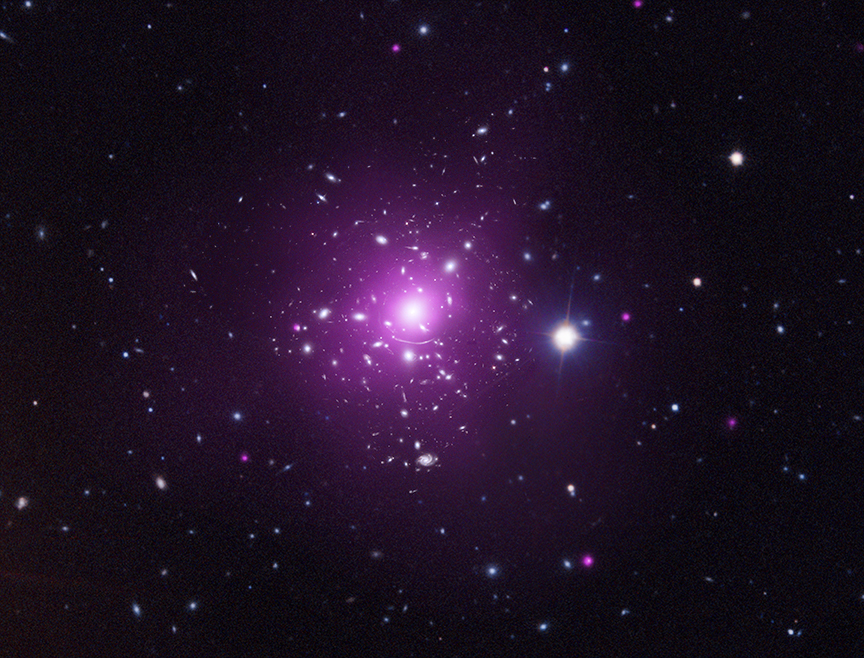
Abell 383: A cluster of galaxies located about 2.3 billion light years from Earth.

Two teams of astronomers have used data from Chandra and other telescopes to map the distribution of dark matter in three dimensions in the galaxy cluster Abell 383. The dark matter in Abell 383 is stretched out like a gigantic football with the point of the football aligned close to the line of sight. The X-ray data (purple) from Chandra in the composite image show the hot gas, which is by far the dominant type of normal matter in the cluster. Galaxies are shown with the optical data from the Hubble, the Very Large Telescope, and the Sloan Digital Sky Survey, colored in blue and white.

Scale: Image is 7.26 arcmin across. (4.84 million light years across.)

Photo credit: X-ray: NASA/CXC/Caltech/A.Newman et al/Tel Aviv/A.Morandi & M.Limousin; Optical: NASA/STScI, ESO/VLT, SDSS

Note: For more information, see Abell 383: Getting a Full Picture of an Elusive Subject.