Pages

Showing posts with label Spitzer Space Telescope. Show all posts

Saturday, December 20, 2014

The Horsehead Nebula in Infrared


Sometimes a horse of a different color hardly seems to be a horse at all, as, for example, in this newly released image from NASA's Spitzer Space Telescope. The famous Horsehead nebula makes a ghostly appearance on the far right side of the image, but is almost unrecognizable in this infrared view. In visible-light images, the nebula has a distinctively dark and dusty horse-shaped silhouette, but when viewed in infrared light, dust becomes transparent and the nebula appears as a wispy arc.

The Horsehead is only one small feature in the Orion Molecular Cloud Complex, dominated in the center of this view by the brilliant Flame nebula (NGC 2024). The smaller, glowing cavity falling between the Flame nebula and the Horsehead is called NGC 2023. These regions are about 1,200 light-years away.

The two carved-out cavities of the Flame nebula and NGC 2023 were created by the destructive glare of recently formed massive stars within their confines. They can be seen tracing a spine of glowing dust that runs through the image.

The Flame nebula sits adjacent to the star Alnitak, the westernmost star in Orion's belt, seen here as the bright blue dot near the top of the nebula.

In this infrared image from Spitzer, blue represents light emitted at a wavelength of 3.6-microns, and cyan (blue-green) represents 4.5-microns, both of which come mainly from hot stars. Green represents 8-micron light and red represents 24-micron light. Relatively cooler objects, such as the dust of the nebulae, appear green and red. Some regions along the top and bottom of the image extending beyond Spitzer's observations were filled in using data from NASA's Wide-field Infrared Survey Explorer, or WISE, which covered similar wavelengths across the whole sky.

Image credit: NASA/JPL-Caltech

Note: For more information, see Horsehead of a Different Color.

Friday, December 12, 2014

NGC 2207 and IC 2163


NGC 2207: NGC 2207 and IC 2163 are two spiral galaxies in the process of merging.

X-ray data from Chandra have revealed that NGC 2207 and IC 2163, currently in the process of colliding with one another, have produced one of the most bountiful collections of super bright X-ray lights called "ultraluminous X-ray sources" (ULXs). The true nature of ULXs is still debated, but they are likely a peculiar type of X-ray binary. In this composite image, X-ray data from Chandra are pink, optical light data from Hubble are red, green, and blue (appearing as blue, white, orange and brown), and infrared data from Spitzer are in red.

Scale: Image is 5 arcmin across (about 180,000 light years).

Image credit: X-ray: NASA/CXC/SAO/S.Mineo et al, Optical: NASA/STScI, Infrared: NASA/JPL-Caltech

Note: For more information, see NGC 2207 and IC 2163: Galactic Get-Together has Impressive Light Display, PIA18903: Galactic Gathering Gives Impressive Light Display, and Galactic Gathering Gives Sparkling Light Display.

Thursday, October 23, 2014

NGC 1291


This image from NASA's Spitzer Space Telescope, taken in infrared light, shows where the action is taking place in galaxy NGC 1291. The outer ring, colored red in this view, is filled with new stars that are igniting and heating up dust that glows with infrared light. The stars in the central area produce shorter-wavelength infrared light than that seen in the ring, and are colored blue. This central area is where older stars live, having long ago gobbled up the available gas supply, or fuel, for making new stars.

The galaxy is about 12 billion years old and is located in the Eridanus constellation. It is known as a barred galaxy because a central bar of stars (which looks like a blue "S" in this view) dominates its center.

When galaxies are young and gas-rich, stellar bars drive gas toward the center, feeding star formation. Over time, as the star-making fuel runs out, the central regions become quiescent and star-formation activity shifts to the outskirts of a galaxy. There, spiral density waves and resonances induced by the central bar help convert gas to stars. The outer ring, seen here in red, is one such resonance location, where gas has been trapped and ignited into a star-forming frenzy.

Image credit: NASA/JPL-Caltech

Note: For more information, see Galactic Wheel of Life Shines in Infrared.

Thursday, September 25, 2014

Clear Skies on HAT-P-11b


A Neptune-size planet with a clear atmosphere is shown crossing in front of its star in this artist's depiction. Such crossings, or transits, are observed by telescopes like NASA's Hubble and Spitzer to glean information about planets' atmospheres. As starlight passes through a planet's atmosphere, atoms and molecules absorb light at certain wavelengths, blocking it from the telescope's view. The more light a planet blocks, the larger the planet appears. By analyzing the amount of light blocked by the planet at different wavelengths, researchers can determine which molecules make up the atmosphere.

The problem with this technique is that sometimes planets have thick clouds that block any light from coming through, hiding the signature of the molecules in the atmosphere. This is particularly true of the handful of Neptune-size and super-Earth planets examined to date, all of which appear to be cloudy.

As a result, astronomers were elated to find clear skies on a Neptune-size planet called HAT-P-11b, as illustrated here. Without clouds to block their view, they were able to identify water vapor molecules in the planet's atmosphere. The blue rim of the planet in this image is due to scattered light, while the orange rim on the part of the planet in front of the star indicates the region where water vapor was detected.

Image credit: NASA/JPL-Caltech

Note: For more information, see PIA18838: A Sunny Outlook for 'Weather' on Exoplanets (Artist's Concept), PIA18839: Transmission Spectrum of HAT-P-11b, NASA Telescopes Find Clear Skies and Water Vapor on Exoplanet, and Clear Skies on Exo-Neptune - Smallest Exoplanet Ever Found to Have Water Vapor.

Wednesday, September 10, 2014

COSMOS Field


Millions of galaxies populate the patch of sky known as the COSMOS field, short for Cosmic Evolution Survey, a portion of which is shown here. Even the smallest dots in this image are galaxies, some up to 12 billion light-years away. The square region in the center of bright objects is where the telescope was blinded by bright light. However, even these brightest objects in the field are more than ten thousand times fainter than what you can see with the naked eye.

The picture is a combination of infrared data from Spitzer (red) and visible-light data (blue and green) from Japan's Subaru telescope atop Mauna Kea in Hawaii. These data were taken as part of the SPLASH (Spitzer large area survey with Hyper-Suprime-Cam) project.

Image credit: NASA/JPL-Caltech

Note: For more information, see Spitzer's SPLASH Project Dives Deep for Galaxies.

Sunday, August 31, 2014

Artist's Conception of a Protoplanetary Collision


Planets, including those like our own Earth, form from epic collisions between asteroids and even bigger bodies, called proto-planets. Sometimes the colliding bodies are ground to dust, and sometimes they stick together to ultimately form larger, mature planets.

This artist's conception shows one such smash-up, the evidence for which was collected by NASA's Spitzer Space Telescope. Spitzer's infrared vision detected a huge eruption around the star NGC 2547-ID8 between August 2012 and 2013. Scientists think the dust was kicked up by a massive collision between two large asteroids. They say the smashup took place in the star's "terrestrial zone," the region around stars where rocky planets like Earth take shape.

NGC 2547-ID8 is a sun-like star located about 1,200 light-years from Earth in the constellation Vela. It is about 35 million years old, the same age our young sun was when its rocky planets were finally assembled via massive collisions -- including the giant impact on proto-Earth that led to the formation of the moon. The recent impact witnessed by Spitzer may be a sign of similar terrestrial planet building. Near-real-time studies like these help astronomers understand how the chaotic process works.

Illustration credit: NASA/JPL-Caltech

Note: For more information, see PIA18470: Witnessing a Planetary Wreckage and NASA's Spitzer Telescope Witnesses Asteroid Smashup.

Saturday, August 23, 2014

Supernova Remnant Puppis A


The destructive results of a mighty supernova explosion reveal themselves in a delicate blend of infrared and X-ray light, as seen in this image from NASA's Spitzer Space Telescope and Chandra X-Ray Observatory, and the European Space Agency's XMM-Newton.

The bubbly cloud is an irregular shock wave, generated by a supernova that would have been witnessed on Earth 3,700 years ago. The remnant itself, called Puppis A, is around 7,000 light-years away, and the shock wave is about 10 light-years across.

The pastel hues in this image reveal that the infrared and X-ray structures trace each other closely. Warm dust particles are responsible for most of the infrared light wavelengths, assigned red and green colors in this view. Material heated by the supernova's shock wave emits X-rays, which are colored blue. Regions where the infrared and X-ray emissions blend together take on brighter, more pastel tones.

The shock wave appears to light up as it slams into surrounding clouds of dust and gas that fill the interstellar space in this region.

From the infrared glow, astronomers have found a total quantity of dust in the region equal to about a quarter of the mass of our sun. Data collected from Spitzer's infrared spectrograph reveal how the shock wave is breaking apart the fragile dust grains that fill the surrounding space.

Supernova explosions forge the heavy elements that can provide the raw material from which future generations of stars and planets will form. Studying how supernova remnants expand into the galaxy and interact with other material provides critical clues into our own origins.

Infrared data from Spitzer's multiband imaging photometer (MIPS) at wavelengths of 24 and 70 microns are rendered in green and red. X-ray data from XMM-Newton spanning an energy range of 0.3 to 8 kiloelectron volts are shown in blue.

Image credit: NASA/ESA/JPL-Caltech/GSFC/IAFE

Saturday, July 26, 2014

Measuring Kepler-93b


Using data from NASA's Kepler and Spitzer Space Telescopes, scientists have made the most precise measurement ever of the size of a world outside our solar system, as illustrated in this artist's conception. The diameter of the exoplanet, dubbed Kepler-93b, is now known with an uncertainty of just one percent.

According to this new study, the diameter of Kepler-93b is about 11,700 miles (18,800 kilometers), plus or minus 150 miles (240 kilometers) -- the approximate distance between Washington, D.C., and Philadelphia, Pennsylvania. Kepler-93b is 1.481 times the width of Earth, the diameter of which is 7,918 miles (12,742 kilometers).

The results confirm that the exoplanet is a "super-Earth." Although super-Earths are common in the galaxy, none exist in our solar system. Exoplanets like Kepler-93b are therefore our only laboratories to study this major class of planet.

With good limits on super-Earths' sizes as well as their masses, scientists can now start to theorize about what makes up these weird worlds. Previous measurements, by the Keck Observatory in Hawaii, had put Kepler-93b's mass at about 3.8 times that of Earth. The density of Kepler-93b, derived from its mass and newly obtained radius, indicates the planet is in fact very likely made of iron and rock, like Earth.

Despite its newfound similarities in composition to Earth, Kepler-93b is far too hot for life. The exoplanet's orbital distance -- only about one-sixth that of Mercury's from the sun -- implies a scorching surface temperature around 1,400 degrees Fahrenheit (760 degrees Celsius).

The methods employed in the new study could help nail down the sizes of other exoplanets, and improve our understanding of alien worlds.

The Spitzer data for this study was obtained during the "warm mission" phase using its Infrared Array Camera. The lead author of the paper describing these findings is Sarah Ballard, a NASA Carl Sagan Fellow at the University of Washington in Seattle.

Illustration credit: NASA/JPL-Caltech

Note: For more information, see The Most Precise Measurement of an Alien World's Size.

Monday, July 7, 2014

Frozen Exoplanet Found Around Binary Star


This artist's rendering shows a newly discovered planet (far right) orbiting one star (right) of a binary star system. The discovery, made by a collaboration of international research teams and led by researchers at The Ohio State University, expands astronomers' notions of where to look for planets in our galaxy. The research was funded in part by NASA.

A newly discovered planet in a binary, or twin, star system located 3,000 light-years from Earth is expanding astronomers' notions of where Earth-like -- and even potentially habitable -- planets can form, and how to find them.

At twice the mass of Earth, the planet orbits one of the stars in the binary system at almost exactly the same distance at which Earth orbits the sun. However, because the planet's host star is much dimmer than the sun, the planet is much colder than Earth -- a little colder, in fact, than Jupiter's icy moon Europa.

Four international research teams, led by professor Andrew Gould of The Ohio State University in Columbus, published their discovery in the July 4 issue of the journal Science. The research is partly funded by NASA.

The study provides the first evidence that terrestrial planets can form in orbits similar to Earth's, even in a binary star system where the stars are not very far apart. Although this planet itself is too cold to be habitable, the same planet orbiting a sun-like star in such a binary system would be in the so-called "habitable zone" -- the region where conditions might be right for life.

"This greatly expands the potential locations to discover habitable planets in the future," said Scott Gaudi, professor of astronomy at Ohio State. "Half the stars in the galaxy are in binary systems. We had no idea if Earth-like planets in Earth-like orbits could even form in these systems."

Earlier evidence that planets form in binary star systems came from NASA's Kepler and Spitzer space telescopes (see http://www.nasa.gov/centers/ames/news/releases/2011/11-69AR.html and http://www.nasa.gov/mission_pages/spitzer/news/spitzer-20070329.html), but the planets and dust structures in those studies were not similar to those of Earth.

The technique astronomers use to find the planet, called OGLE-2013-BLG-0341LBb, is called gravitational microlensing. In this method, the light of a distant star is magnified by a closer star that happens to pass in front -- if a planet is also present around the foreground star, it will further alter and distort the light of the background star. The telescopes used in this study are part of several projects, including the OGLE (Optical Gravitational Lensing Experiment), MOA (Microlensing Observations in Astrophysics), MicroFUN (the Microlensing Follow Up Network), and the Wise Observatory.

Searching for planets within binary systems is tricky for most techniques, because the light from the second star complicates the interpretation of the data. "But in gravitational microlensing," Gould explained, "we don't even look at the light from the star-planet system. We just observe how its gravity affects light from a more distant, unrelated star. This gives us a new tool to search for planets in binary star systems."

NASA's proposed WFIRST-AFTA (Wide-Field Infrared Survey Telescope - Astrophysics Focused Telescope Assets) mission would use the microlensing technique to find and characterize hundreds of thousands of planets in binary systems.

Image credit: Cheongho Han, Chungbuk National University, Republic of Korea

Thursday, July 3, 2014

Messier 106's Anomalous Spiral Arms


A galaxy about 23 million light-years away is the site of impressive, ongoing, fireworks. Rather than paper, powder, and fire, this galactic light show involves a giant black hole, shock waves, and vast reservoirs of gas.

This galactic fireworks display is taking place in NGC 4258 (also known as M106), a spiral galaxy like the Milky Way. This galaxy is famous, however, for something that our galaxy doesn't have -- two extra spiral arms that glow in X-ray, optical, and radio light. These features, or anomalous arms, are not aligned with the plane of the galaxy, but instead intersect with it.

The anomalous arms are seen in this new composite image of NGC 4258, where X-rays from NASA's Chandra X-ray Observatory are blue, radio data from the NSF's Karl Jansky Very Large Array are purple, optical data from NASA's Hubble Space Telescope are yellow and blue, and infrared data from NASA's Spitzer Space Telescope are red.

A new study of these anomalous arms made with Spitzer shows that shock waves, similar to sonic booms from supersonic planes, are heating large amounts of gas -- equivalent to about 10 million suns. What is generating these shock waves? Radio data shows that the supermassive black hole at the center of NGC 4258 is producing powerful jets of high-energy particles. Researchers think that these jets strike the disk of the galaxy and generate shock waves. These shock waves, in turn, heat some of the gas -- composed mainly of hydrogen molecules -- to thousands of degrees. As shown in our additional, composite image, part of the evidence for this heating process comes from the similarity in location between the hydrogen and X-ray emission, both thought to be caused by shocks, and the radio jets.

The Chandra X-ray image reveals huge bubbles of hot gas above and below the plane of the galaxy. These bubbles indicate that much of the gas that was originally in the disk of the galaxy has been heated to millions of degrees and ejected into the outer regions by the jets from the black hole.

The ejection of gas from the disk by the jets has important implications for the fate of this galaxy. Researchers estimate that all of the remaining gas will be ejected within the next 300 million years -- very soon on cosmic time scales -- unless it is somehow replenished. Because most of the gas in the disk has already been ejected, less gas is available for new stars to form. Indeed, the researchers used Spitzer data to estimate that stars are forming in the central regions of NGC 4258, at a rate which is about ten times less than in the Milky Way galaxy.

The European Space Agency's Herschel Space Observatory, for which NASA plays an important role, was used to confirm the estimate from Spitzer data of the low star-formation rate in the central regions of NGC 4258. Herschel was also used to make an independent estimate of how much gas remains in the center of the galaxy. After allowing for the large boost in infrared emission caused by the shocks, the researchers found that the gas mass is ten times smaller than had been previously estimated.

Because NGC 4258 is relatively close to Earth, astronomers can study how this black hole is affecting its galaxy in great detail. The supermassive black hole at the center of NGC 4258 is about ten times larger than the one in the Milky Way, and is also consuming material at a faster rate, potentially increasing its impact on the evolution of its host galaxy.

Image credit: NASA/CXC/JPL-Caltech/STScI/NSF/NRAO/VLA

Note: For more information, see PIA18462: Black Hole Jets Make Shock Waves, NGC 4258 (M106): Galactic Pyrotechnics On Display and Black Hole Fireworks in Nearby Galaxy.

Thursday, June 26, 2014

Water's Early Journey in a Solar System


The building blocks of comets, and apparently Saturn's largest moon, Titan, formed under similar conditions in the disk of gas and dust that formed the sun.

NASA's Spitzer Space Telescope observed a fledgling solar system like the one depicted in this artist's concept, and discovered deep within it enough water vapor to fill the oceans on Earth five times. This water vapor starts out in the form of ice in a cloudy cocoon (not pictured) that surrounds the embryonic star, called NGC 1333-IRAS 4B (buried in center of image). Material from the cocoon, including ice, falls toward the center of the cloud. The ice then smacks down onto a dusty pre-planetary disk circling the stellar embryo (doughnut-shaped cloud) and vaporizes. Eventually, this water might make its way into developing planets.

Illustration credit: NASA/JPL-Caltech

Note: For more information, see Titan's Building Blocks Might Pre-date Saturn.

Friday, June 20, 2014

Asteroid 2011 MD by Spitzer


This image of asteroid 2011 MD was taken by NASA's Spitzer Space Telescope in February 2014, over a period of 20 hours. The long observation, taken in infrared light, was needed to pick up the faint signature of the small asteroid (center of frame). The Spitzer observations helped narrow down the size of the space rock to roughly 20 feet (6 meters), making it one of a few candidates for NASA's proposed Asteroid Redirect Mission for which sizes are approximately known.

This image was taken by Spitzer's Infrared Array Camera at a wavelength of 4.5 microns.

Image credit: NASA/JPL-Caltech/Northern Arizona University/SAO

Note: For more information, see Spitzer Spies an Odd, Tiny Asteroid. For more information on NASA's Asteroid Redirect Mission, see NASA Update on Asteroid Redirect Mission and NASA Announces Latest Progress in Hunt for Asteroids.

Monday, June 9, 2014

Supernova Remnant N103B


This infrared image from NASA's Spitzer Space Telescope shows N103B -- all that remains from a supernova that exploded a millennium ago in the Large Magellanic Cloud, a satellite galaxy 160,000 light-years away from our own Milky Way.

Spitzer's instruments pick up infrared light emitted by dust in both the remnant and the surrounding interstellar medium. The infrared light has been translated to colors we see in this image, allowing astronomers to dissect the scene. In this image, dust associated with the remnant appears red, while dust in the ambient background of the galaxy appears yellow and green. Stars in the field appear blue.

By studying the infrared light emitted from this supernova remnant, astronomers have determined that the density of the gas surrounding the supernova is much higher than is typical for a 'Type Ia' supernova, which are those that occur when dead stars called white dwarfs explode. Astronomers believe that this dense material was expelled prior to the supernova explosion, possibly by a companion to the white dwarf -- an aging star that shed the material.

Most Type Ia supernovas do not show evidence for this process occurring, making N103B an example of a rare subclass of Type Ia explosions. In fact, only one other remnant of a Type Ia explosion shows evidence for this: the remnant of Kepler's supernova in our own galaxy, the remains of the explosion of a star witnessed on Earth in 1604 A.D.

The clump of blue stars seen at the lower right is the cluster known as NGC 1850. Also a resident of the Large Magellanic Cloud, this cluster is made up of young stars yet has the appearance of globular clusters in the Milky Way, which are much older.

The red data shows infrared light with wavelengths of 16 and 24 microns, while shorter-wavelength infrared light of 3.6, 4.5, and 8 microns is shown as blue, cyan and green, respectively.


Image credit: NASA/JPL-Caltech/Goddard

Note: For more information, see New Suspect Identified in Supernova Explosion.

Thursday, May 29, 2014

Young Stellar Objects in the Serpens Cloud Core


Within the swaddling dust of the Serpens Cloud Core, astronomers are studying one of the youngest collections of stars ever seen in our galaxy. This infrared image combines data from NASA's Spitzer Space Telescope with shorter-wavelength observations from the Two Micron All Sky Survey (2MASS), letting us peer into the clouds of dust wrapped around this stellar nursery.

At a distance of around 750 light-years, these young stars reside within the confines of the constellation Serpens, or the "Serpent." This collection contains stars of only relatively low to moderate mass, lacking any of the massive and incredibly bright stars found in larger star-forming regions like the Orion nebula. Our sun is a star of moderate mass. Whether it formed in a low-mass stellar region like Serpens, or a high-mass stellar region like Orion, is an ongoing mystery.

The stellar "hatchlings" in the Serpens Cloud Core represent the very youngest stages of stellar development. They appear as red, orange and yellow points clustered near the center of the image. Other red features include jets of material ejected from these young stars. Some mature stars that are not in the nebula appear yellowish due to dust obscuring our view at shorter, bluer wavelengths.

This region also includes a population of prenatal stars that are so deeply enshrouded in their dusty cocoons to be completely hidden in this view. They only become detectable at much longer wavelengths of light.

The inner Serpens Cloud Core is remarkably detailed in this image, as it was assembled from 82 separate snapshots totaling a whopping 16.2 hours of Spitzer observing time. Serpens is one of several star-forming regions targeted by the Young Stellar Object Variability (YSOVAR) project, which conducted repeated observations in each area to look for changes in brightness in the baby stars. Such fluctuations can provide valuable clues to how stars gobble up gas and dust as they grow and mature.

Spitzer observations at wavelengths of 3.5 and 4.6 microns are shown in green and red, respectively. 2MASS data at 1.3 microns is displayed as blue. These observations date from Spitzer's warm mission phase, following the depletion of its liquid coolant in 2009.

Image credit: NASA/JPL-Caltech/2MASS

Note: For more information, see The 'Serpent' Star-forming Cloud Hatches New Stars.

Friday, May 23, 2014

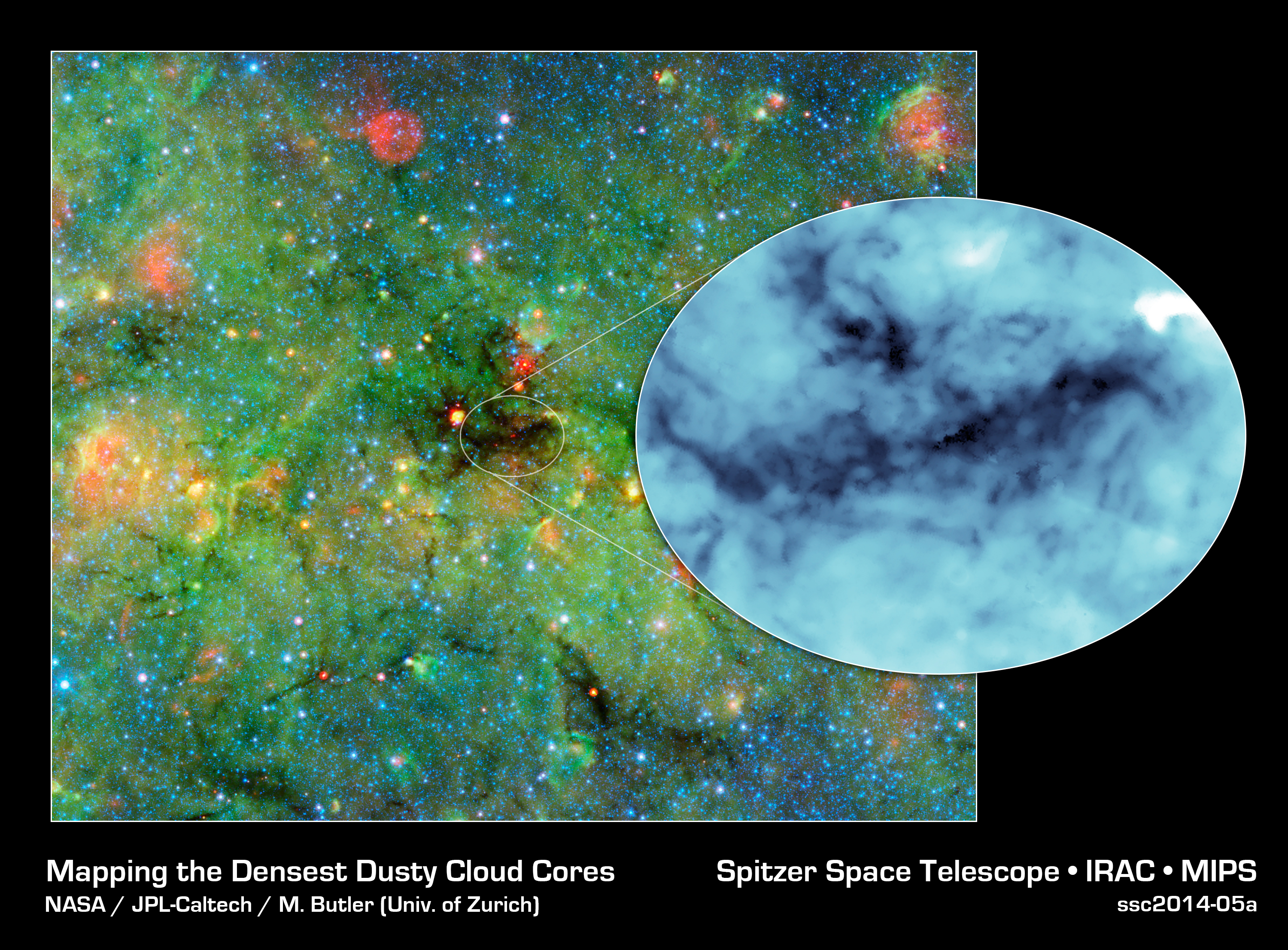
Mapping the Densest Dusty Cloud Cores


Astronomers have found cosmic clumps so dark, dense and dusty that they throw the deepest shadows ever recorded. The clumps were discovered within a huge cosmic cloud of gas and dust. Infrared observations from NASA's Spitzer Space Telescope of these blackest-of-black regions in the cloud paradoxically light the way to understanding how the brightest stars form.

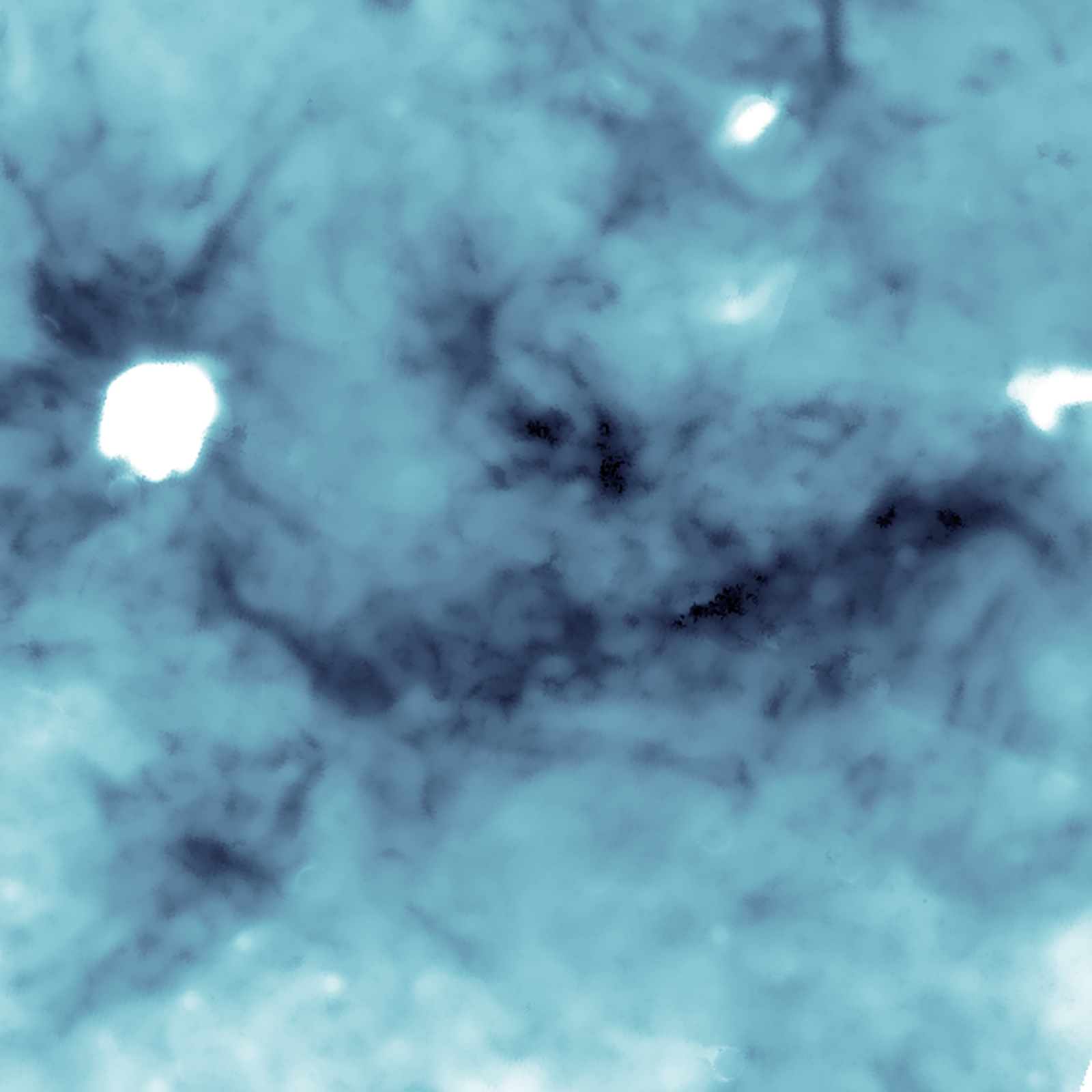
The large cloud looms in the center of this image of the galactic plane from Spitzer. The zoom in Figure 1 shows details of the cloud, revealing the dense clumps. A new study takes advantage of the shadows cast by these dark clumps to measure the cloud's overall structure and mass. These dense, clumpy pockets of star-forming material within the cloud are so thick with dust that they scatter and block not only visible light, but almost all background infrared light as well.

The dusty cloud, the results suggest, will likely evolve into one of the most massive young clusters of stars in our galaxy. The densest clumps will blossom into the cluster's biggest, most powerful stars, called O-type stars, the formation of which has long puzzled scientists. These hulking stars have major impacts on their local stellar environments while also helping to create the heavy elements needed for life.

Figure 2 reveals the overall darkness of the cloud, calculated using Spitzer's infrared observations at a wavelength of 8 microns. Artifacts left by individual stars have been removed from the data.

The background image combines data from Spitzer surveys. Blue represents 3.6-micron light and green shows light of 8 microns, both captured by Spitzer's infrared array camera. Red is 24-micron light detected by Spitzer's multiband imaging photometer. The red spot in the center of the zoom oval, unrelated to the new study's findings, is a young star whose radiating heat has lit up a surrounding cocoon of dust.

Image credit: NASA/JPL-Caltech/University of Zurich

Note: For more information, see Pitch Black: Cosmic Clumps Cast the Darkest Shadows.

Saturday, May 10, 2014

Star Cluster NGC 2024 in the Flame Nebula


Stars are often born in clusters or groups, in giant clouds of gas and dust. Astronomers have studied two star clusters using NASA's Chandra X-ray Observatory and infrared telescopes and the results show that the simplest ideas for the birth of these clusters cannot work.

This composite image shows one of the clusters, NGC 2024, which is found in the center of the so-called Flame Nebula about 1,400 light years from Earth. In this image, X-rays from Chandra are seen as purple, while infrared data from NASA's Spitzer Space Telescope are colored red, green and blue.

A study of NGC 2024 and the Orion Nebula Cluster, another region where many stars are forming, suggest that the stars on the outskirts of these clusters are older than those in the central regions. This is different from what the simplest idea of star formation predicts, where stars are born first in the center of a collapsing cloud of gas and dust when the density is large enough.

The research team developed a two-step process to make this discovery. First, they used Chandra data on the brightness of the stars in X-rays to determine their masses. Next, they found out how bright these stars were in infrared light using data from Spitzer, the 2MASS telescope and the United Kingdom Infrared Telescope. By combining this information with theoretical models, the ages of the stars throughout the two clusters could be estimated.

According to the new results, the stars at the center of NGC 2024 were about 200,000 years old while those on the outskirts were about 1.5 million years in age. In Orion, the age spread went from 1.2 million years in the middle of the cluster to nearly 2 million years for the stars toward the edges.

Explanations for the new findings can be grouped into three broad categories. The first is that star formation is continuing to occur in the inner regions. This could have happened because the gas in the outer regions of a star-forming cloud is thinner and more diffuse than in the inner regions. Over time, if the density falls below a threshold value where it can no longer collapse to form stars, star formation will cease in the outer regions, whereas stars will continue to form in the inner regions, leading to a concentration of younger stars there.

Another suggestion is that old stars have had more time to drift away from the center of the cluster, or be kicked outward by interactions with other stars. Finally, the observations could be explained if young stars are formed in massive filaments of gas that fall toward the center of the cluster.

These results will be published in two separate papers in The Astrophysical Journal and are available online (papers 1 and 2). They are part of the MYStIX (Massive Young Star-Forming Complex Study in Infrared and X-ray) project led by Penn State astronomers.

Image credit: X-ray: NASA/CXC/PSU/K.Getman, E.Feigelson, M.Kuhn and the MYStIX team; Infrared: NASA/JPL-Caltech

Note: For more information, see NASA Delivers New Insight into Star Cluster Formation and Flame Nebula: NASA's Chandra Delivers New Insight into Formation of Star Clusters.

Sunday, April 27, 2014

WISE J085510.83-071442.5


This artist's conception shows the object named WISE J085510.83-071442.5, the coldest known brown dwarf. Brown dwarfs are dim star-like bodies that lack the mass to burn nuclear fuel as stars do.

WISE J085510.83-071442.5 is as cold as the North Pole (or between minus 54 and 9 degrees Fahrenheit, which is minus 48 to minus 13 degrees Celsius). The color of the brown dwarf in this image is arbitrary; it would have different colors when viewed in different wavelength ranges.

This celestial orb is also the fourth closest to our sun, at 7.2 light-years from Earth. In this illustration, the sun is the bright star directly to the right of the brown dwarf. Our sun's closest neighboring system (not pictured) is Alpha Centauri, at 4 light-years from Earth.

Image credit: NASA/JPL-Caltech/Penn State University

Note: For more information, see PIA18002: Cold and Quick: a Fast-Moving Brown Dwarf, PIA18003: Welcome to the Sun's Neighborhood, NASA's Spitzer, WISE Find Sun's Close, Cold Neighbor, and Discovered: A Cold, Close Neighbor of the Sun.

Friday, April 25, 2014

Messier 101, Messier 81, Centaurus A, and Messier 51


Four images of galaxies that have been made using data from both amateur and professional telescopes.

This quartet of galaxies comes from a collaboration of professional and amateur astronomers that combines optical data from amateur telescopes with data from the archives of NASA missions. Starting in the upper left and moving clockwise, the galaxies are M101 (the "Pinwheel Galaxy"), M81, Centaurus A, and M51 (the "Whirlpool Galaxy"). In these images, X-rays from Chandra are in purple, infrared data from Spitzer are red, and the optical data are in red, green, and blue. The two astrophotographers who donated their images for these four images -- Detlef Hartmann and Rolf Olsen -- used their personal telescopes of 17.5 inches and 10 inches in diameter respectively.

Scale: Image is 24 arcmin on a side (about 1.5 million light years).

Image credit: X-ray: NASA/CXC/SAO; Optical: Detlef Hartmann; Infrared: NASA/JPL-Caltech

Note: For more information, see Astro Pro-Am: Professional and Amateur Astronomers Join Forces.

Sunday, April 13, 2014

Supernova Remnant G352.7-0.1


G352.7-0.1: A supernova remnant about 24,000 light years from Earth.

Supernova remnants are created when a massive star explodes and its remains are hurled into space. Astronomers have found a supernova remnant that it is sweeping up a remarkable amount of material -- equivalent to 45 times the mass of the Sun – as it expands. This supernova remnant is called G352.7-0.1 and is seen in this composite image containing X-rays from Chandra (blue), radio waves from the VLA (pink), infrared data from Spitzer (orange), and optical data from the DSS (white).

Scale: Image is about 14.5 arcmin across (1000 light years).

Image credit: X-ray: NASA/CXC/Morehead State Univ/T.Pannuti et al.; Optical: DSS; Infrared: NASA/JPLCaltech; Radio: NRAO/VLA/Argentinian Institute of Radioastronomy/G.Dubner

Note: For more information, see G352.7-0.1: Supernova Cleans Up its Surroundings.

Thursday, March 27, 2014

NGC 4395


The galaxy NGC 4395 is shown here in infrared light, captured by NASA's Spitzer Space Telescope. This dwarf galaxy is relatively small in comparison with our Milky Way galaxy, which is nearly 1,000 times more massive.

The galaxy is "bulgeless" because it lacks a large collection of stars at its center. Astronomers using NASA's Wide-field Infrared Survey Explorer, or WISE, have found more evidence that bulgeless galaxies, contrary to previous theories, do harbor supermassive black holes at their center. In this image, an actively feeding supermassive black hole resides in the galaxy's nucleus, as seen by the bright red source. The feeding supermassive black hole dominates the infrared light coming from the galaxy's center.

Image credit: NASA/JPL-Caltech

Note: For more information, see The Search for Seeds of Black Holes.