Like a comet, the solar system has a tail. NASA's Interstellar Boundary Explorer (IBEX) has for the first time mapped out the structure of this tail, which is shaped like a four-leaf clover.
Scientists describe the tail, called the heliotail, based on the first three years of IBEX imagery in a paper published in the July 10 edition of the Astrophysical Journal.
While telescopes have spotted such tails around other stars, it has been difficult to see whether our star produced one. The particles found in the tail -- and throughout the entire heliosphere, the region of space influenced by our sun -- do not shine, so they cannot be seen with conventional instruments.
"By examining the neutral atoms, IBEX has made the first observations of the heliotail," said David McComas, IBEX principal investigator at Southwest Research Institute in San Antonio, Texas, and the paper's lead author. "Many models have suggested the heliotail might look like this or like that, but we have had no observations. We always drew pictures where the tail of the solar system just trailed off the page, since we couldn't even speculate about what it really looked like."
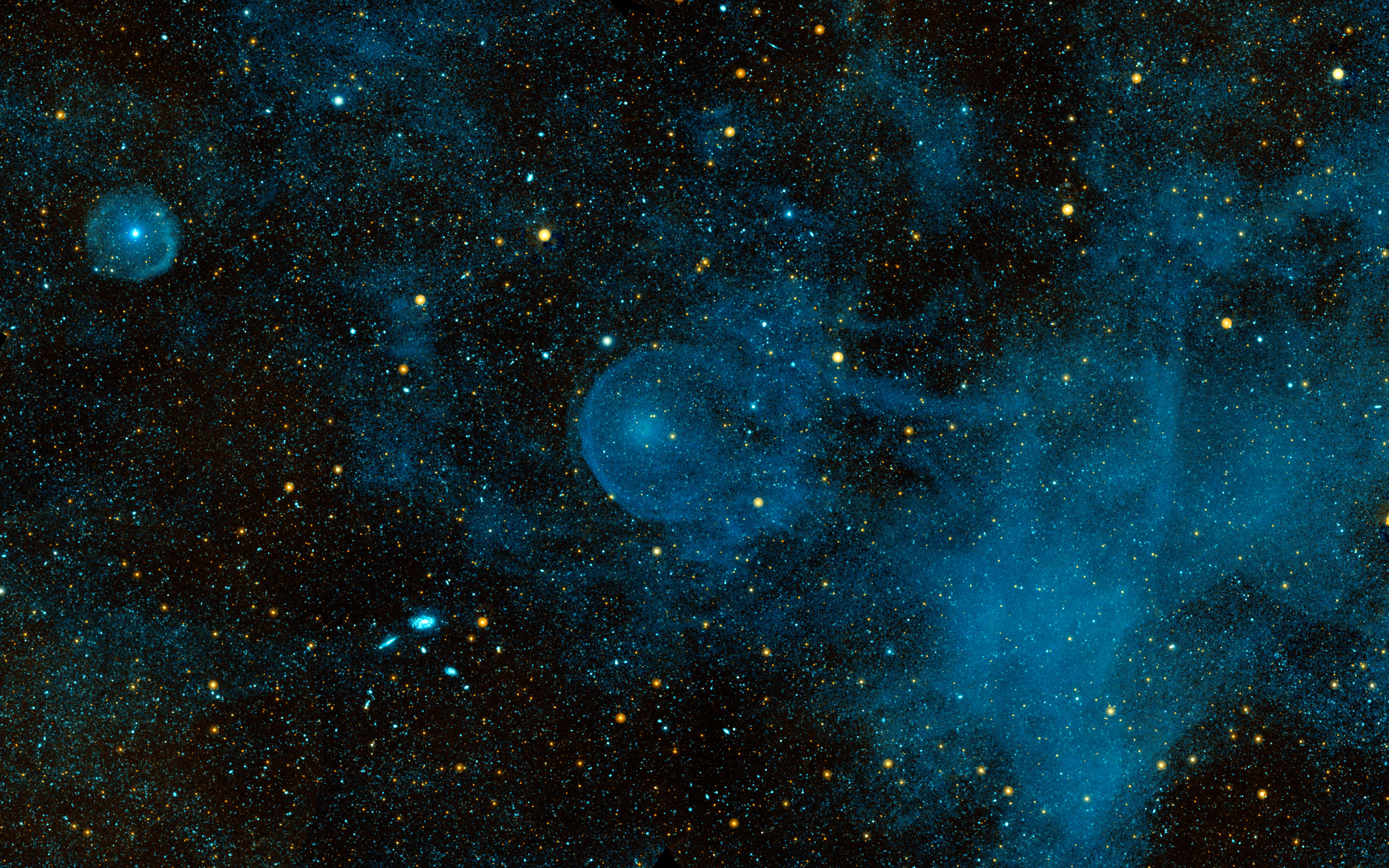
Other stars show tails that trail behind them like a comet’s tail; [pictured above is the star Mira and its tail, shown in ultraviolet light and imaged by the GALEX satellite]. Scientists used NASA’s Interstellar Boundary Explorer to confirm that our solar system has one too.
IBEX measures the neutral particles created by collisions at the solar system's boundaries. This technique, called energetic neutral atom imaging, relies on the fact that the paths of neutral particles are not affected by the solar magnetic field. Instead, the particles travel in a straight line from collision to IBEX. Consequently, observing where the neutral particles came from describes what is going on in these distant regions.
"Since first light in 2008, the IBEX mission team has amazed us with its discoveries at the interstellar boundary, including a previously unknown ribbon of energetic neutral particles stretching across it," said Arik Posner, NASA's IBEX program scientist in Washington. "The new IBEX image of the heliotail fills in a previously blank area on the map. We are first-hand witnesses of rapid progress in heliophysics science."
By combining observations from the first three years of IBEX imagery, the team showed a tail with a combination of fast and slow moving particles. There are two lobes of slower particles on the sides and faster particles above and below. This four-leaf clover shape can be attributed to the fact that the sun has been sending out fast solar wind near its poles and slower wind near its equator for the last few years. This is a common pattern in the most recent phase of the sun's 11-year activity cycle.
The clover shape does not align perfectly with the solar system, however. The entire shape is rotated slightly, indicating that as it moves further away from the sun and its magnetic influence, the charged particles begin to be nudged into a new orientation, aligning with the magnetic fields from the local galaxy.
Scientists do not know how long the tail is, but think that it eventually fades away and becomes indistinguishable from the rest of interstellar space. Scientists are testing their current computer simulations of the solar system against the new observations to improve our understanding of the comet-like tail streaming out behind us.

Video credit: NASA; image credit: NASA/JPL-Caltech/GALEX