Globular clusters are relatively common in our sky, and generally look similar. However, this image, taken using the NASA/ESA Hubble Space Telescope, shows a unique example of such a cluster — Palomar 2.
Palomar 2 is part of a group of 15 globulars known as the Palomar clusters. These clusters, as the name suggests, were discovered in survey plates from the first Palomar Observatory Sky Survey in the 1950s, a project that involved some of the most well-known astronomers of the day, including Edwin Hubble. They were discovered quite late because they are so faint — each is either extremely remote, very heavily hidden behind blankets of dust, or has a very small number of remaining stars.
This particular cluster is unique in more than one way. For one, it is the only globular cluster that we see in this part of the sky, the northern constellation of Auriga (The Charioteer). Globular clusters orbit the center of a galaxy like the Milky Way in the same way that satellites circle around the Earth. This means that they normally lie closer in to the galactic center than we do, and so we almost always see them in the same region of the sky. Palomar 2 is an exception to this, as it is around five times further away from the center of the Milky Way than other clusters. It also lies in the opposite direction — further out than Earth — and so it is classed as an “outer halo” globular.
It is also unusual due to its brightness. The cluster is veiled by a mask of dust, dampening the apparent brightness of the stars within it and making it appear as a very faint burst of stars. The stunning NASA/ESA Hubble Space Telescope image above shows Palomar 2 in a way that could not be captured from smaller or ground-based telescopes — some amateur astronomers with large telescopes attempt to observe all of the obscure and well-hidden Palomar 15 as a challenge, to see how many they can pick out from the starry sky.
Photo credit: ESA/Hubble & NASA

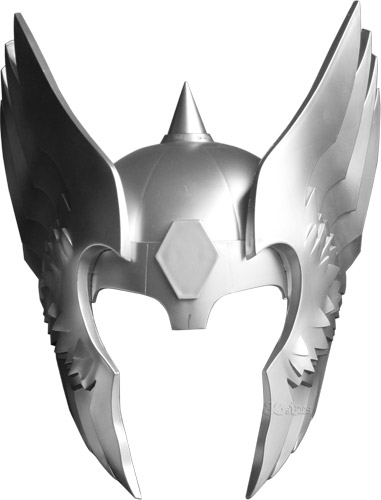
This heroic image from WISE is of a special cloud of dust and gas in the constellation Canis Major cataloged as NGC 2359. The nebula is more commonly known as Thor's Helmet due to its remarkable resemblance to depictions of the headwear donned by the famed Norse god of thunder and lightning.
Powering Thor's Helmet is HD 56925, a highly luminous "Wolf-Rayet" star (seen at the center of the helmet). These kinds of stars are massive; from 10 to 80 times the mass of our Sun. Such stars are often associated with bright nebulae, many of which appear to be spherical bubbles with the Wolf-Rayet star at the center. It is thought that the progenitors of these stars are either red supergiants or luminous blue variable stars, both of which slowly shed matter as they age. Once the star enters its Wolf-Rayet phase its strong, fast stellar wind sweeps up the surrounding debris left by the original star and even gathers up interstellar matter from its environment. It literally blows a bubble in space. These hot stars become 200,000 times more luminous than the Sun. They flood the nebula with ultraviolet light that ionizes much of the gaseous material leading to the bright emission in visible light. Interactions with a nearby large molecular cloud are thought to have contributed to the more complex shape and curved bow-shock structure of Thor's Helmet.
NGC 2359 was the first Wolf-Rayet nebula to be discovered. Between 1917 and 1919, Francis Pease studied the nebula at the Mt. Wilson observatory in southern California. He described the bright regions of the nebula as matching the descriptions of early observers such as Sir John Herschel (son of the discoverer of infrared light, William Herschel), who saw a bust rather than a helmet. The object was later found to show nitrogen emission by Edwin Hubble and listed in his 1922 paper, "A General Study of Diffuse Galactic Nebulae." The object has also been of interest to members of the WISE science team during their careers having been studied by Martin Cohen and the WISE Principal Investigator Ned Wright, who co-authored an article in the March 1980 issue of Sky & Telescope, "A Bubble in Space - The Shell of NGC 2359."
Thor's Helmet is about 30 light-years across and its distance from Earth is estimated to be about 15,000 light-years. This image covers an area of sky about 2.5 times the size of the full Moon. All four infrared detectors aboard WISE were used to make this image. Color is representational: blue and cyan represent infrared light at wavelengths of 3.4 and 4.6 microns, which is dominated by light from stars. Green and red represent light at 12 and 22 microns, which is mostly light from warm dust.
Photo credit: NASA/JPL-Caltech/UCLA

This image created from data taken from both the NASA/ESA Hubble Space Telescope and the Sloan Digital Sky Survey demonstrates that the Hubble sequence six thousand million years ago was very different from the one that astronomers see today. The two sections show how many more peculiar shaped galaxies (marked Pec) are seen among distant galaxies, as opposed to among local galaxies. The data organization follows the Hubble tuning-fork classification scheme invented in 1926 by the same Edwin Hubble in whose honor the space telescope is named.
The top image represents the current - or local - Universe. Using their sample, researchers found that 3 percent of galaxies were elliptical (marked E), 15 percent lenticular (marked S0), 72 percent spiral (marked Sa to Sd, or SBb to SBd) and 10 percent peculiar (marked Pec).
The bottom image represents the make up of the distant galaxies (six thousand million years ago), showing a much larger fraction of peculiar galaxies. The census found 4 percent of distant galaxies were elliptical, 13 percent lenticular (S0), 31 percent spiral and 52 percent peculiar. This implies that many of the peculiar galaxies ultimately become large spirals. According to the "spiral rebuilding" hypothesis, devised by the astronomers François Hammer, Rodney Delgado-Serrano and their group, this is due to the large number of major, gas-rich galaxy mergers between galaxies that were previously labeled "peculiar" in the distant Universe. It is thought that the large Andromeda galaxy from our neighborhood formed in this manner.
In total, 116 local galaxies and 148 distant galaxies were sampled. Spiral galaxies are further classified by labels that characterize their appearance; for example, an SBd galaxy means that it is a spiral galaxy that has slightly looser "arms" than an SBa galaxy and a less prominent bulge.
These images were created from data that are part of large sky surveys undertaken by the NASA/ESA Hubble Space Telescope and the 2.5-meter telescope at Apache Point Observatory, New Mexico, USA (Sloan Digital Sky Survey).
Image credit: NASA, ESA, Sloan Digital Sky Survey, R. Delgado-Serrano and F. Hammer (Observatoire de Paris)

The spiral beauty, called IC 342 and sometimes the "hidden galaxy," is shrouded behind our own galaxy, the Milky Way. Stargazers and professional astronomers have a hard time seeing the galaxy through the Milky Way's bright band of stars, dust and gas. WISE's infrared vision cuts through this veil, offering a crisp view.
In a spiral galaxy like IC 342, dust and gas are concentrated in the arms. The denser pockets of gas trigger the formation of new stars, as represented here in green and yellow. The core, shown in red, is also bursting with young stars, which are heating up dust. Stars that appear blue reside within our Milky Way, between us and IC 342.
This galaxy has been of great interest to astronomers because it is relatively close. However, determining its distance from Earth has proven difficult due to the intervening Milky Way. Astronomer Edwin Hubble first thought the galaxy might belong to our own Local Group of galaxies, but current estimates now place it farther away, at about 6.6 to 11 million light-years.
This image was made from observations by all four infrared detectors aboard WISE. Blue and cyan represent infrared light at wavelengths of 3.4 and 4.6 microns, which is primarily light from stars. Green and red represent light at 12 and 22 microns, which is primarily emission from warm dust.
Photo credit: NASA/JPL-Caltech/UCLA