Pages

Showing posts with label Stellar Evolution. Show all posts

Tuesday, June 24, 2014

Molecular Cloud W48


Just as children are sorted into age groups at school, so the seeds of new stars can also be found in ‘classes’ of others of similar ages. This is especially true when the birth of stars in a cloud of gas and dust is triggered by an external event, like the explosion of a nearby supernova.

This image from ESA’s Herschel space observatory shows a sequence of star-forming regions in the molecular cloud W48, some 10,000 light-years away in the constellation Aquila (the Eagle).

The blue, jellyfish-shaped cloud at the lower left is the oldest stellar nursery in the image. Young and massive stars embedded within it have shaped it into a bubble and heated the diffuse gas, making it shine at the longest wavelengths probed by Herschel.

To its right, another glowing cloud conceals clumps that will evolve into massive stars. These clumps, some of which are visible as bright blotches of light, are also lined up by their age: the older ones at the lower-left and the younger ones to the upper-right. The youngest in this sequence is the small cyan lump at the center of the image, harboring the seeds of future massive stars.

Astronomers believe that this sequence of stellar birth is the result of dozens of supernovas that exploded over 10 million years ago in a region called Aquila Supershell, beyond the left edge of this image. Compressing the surrounding material, these supernovas may have initiated a wave of star formation that sparked, one by one, these stellar cribs.

The image is a composite of the wavelengths of 70 microns (blue), 160 microns (green) and 250 microns (red) and spans about one degree on the long side. North is to the upper-left and east is to the lower left. The data were acquired with Herschel’s PACS and SPIRE instruments in September 2010, as part of a larger map of the W48 molecular complex in the HOBYS Key Programme. This was first published in a paper by Q. Nguyen Luong, et al. 2011. A more detailed study of the star-forming regions shown in this image is presented in a paper by K.L.J. Rygl, et al. 2014.

Image credit: ESA/Herschel/PACS/SPIRE/HOBYS Key Programme Consortium

Thursday, September 5, 2013

NGC 6537


This image shows an example of a bipolar planetary nebula known as NGC 6537 taken with the New Technology Telescope at ESO’s La Silla Observatory. The shape, reminiscent of a butterfly or an hourglass, was formed as a Sun-like star approached the end of its life and puffed its outer layers into the surrounding space. For bipolar nebulae, this material is funneled towards the poles of the aging star, creating the distinctive double-lobed structure.

Observations using the NTT and Hubble have found that bipolar planetary nebulae located towards the central bulge of our Milky Way appear to be strangely aligned in the sky — a surprising result given their varied and chaotic formation.

NGC 6537, which lies much closer to the Earth, was not part of the new study.

Image credit: ESO

Note: For more information, see Bizarre Alignment of Planetary Nebulae. See also Bizarre Alignment of Planetary Nebulae.

Thursday, August 29, 2013

The Life Cycle of a Sun-Like Star


This image tracks the life of a Sun-like star, from its birth on the left side of the frame to its evolution into a red giant star on the right. On the left the star is seen as a protostar, embedded within a dusty disc of material as it forms. It later becomes a star like our Sun. After spending the majority of its life in this stage, the star's core begins to gradually heat up, the star expands and becomes redder until it transforms into a red giant.

Following this stage, the star will push its outer layers into the surrounding space to form an object known as a planetary nebula, while the core of the star itself will cool into a small, dense remnant called a white dwarf star.

Marked on the lower timeline are where our Sun and solar twins 18 Sco and HIP 102152 are in this life cycle. The Sun is 4.6 billion years old and 18 Sco is 2.9 billion years old, while the oldest solar twin is some 8.2 billion years old — the oldest solar twin ever identified. By studying HIP 102152, we can get a glimpse of what the future holds for our Sun.

This image is illustrative; the ages, sizes, and colors are approximate (not to scale). The protostar stage, on the far left of this image, can be some 2000 times larger than our Sun. The red giant stage, on the far right of this image, can be some 100 times larger than the Sun.

Illustration credit: ESO/M. Kornmesser

Note: For more information, see Oldest Solar Twin Identified.

Monday, February 11, 2013

Smooth vs. Fragmented Stellar Winds


Artist's impression comparing a smooth stellar wind (left) with a highly fragmented stellar wind (right) of a massive star like Zeta Puppis. A decade's-worth of observations with ESA's XMM-Newton have revealed that the wind of Zeta Puppis is fragmented into hundreds of thousands of individual hot (red) and cool (blue) clumps. Studying stellar winds is vital not only to understand mass loss from the star itself and thus its expected lifetime, but also how the winds inject material and energy into the surrounding environment and influence the birth and death of other stars.

Illustration credit: ESA - C. Carreau/Nazé et al.

Notes: For more information, see Massive Stellar Winds are Made of Tiny Pieces. Also, for a much larger TIFF file of the above illustration, see New View of Stellar Winds.

Friday, November 16, 2012

Abell 30


Abell 30: The planetary nebula Abell 30, (a.k.a. A30), is located about 5500 light years from Earth.

The inset image on the right is a close-up view of A30 showing X-ray data from NASA's Chandra X-ray Observatory in purple and Hubble Space Telescope data showing optical emission from oxygen ions in orange. On the left is a larger view showing optical and X-ray data from the Kitt Peak National Observatory and ESA's XMM-Newton, respectively, where the optical data shows emission from oxygen (orange) and hydrogen (green and blue), and X-ray emission is colored purple. A planetary nebula is formed in the late stage of the evolution of a sun-like star, after it expands to become a red giant. In the case of A30, a planetary nebula formed but then the star briefly reverted to being a red giant. The evolution of the planetary nebula then restarted, making it reborn, a special phase of evolution that is rarely seen.

Scale: Inset is 37 arcsec across (1 light years), Widefield image is 3.5 arcmin across (5.6 light years).

Image credit: Inset X-ray (NASA/CXC/IAA-CSIC/M.Guerrero et al); Inset Optical (NASA/STScI); Widefield X-ray (ESA/XMM-Newton); Widefield Optical (NSF/NOAO/KPNO)

Note: For more information, see Abell 30: X-rays from a Reborn Planetary Nebula.

Friday, October 12, 2012

Planetary Nebulae


Planetary Nebula Gallery: Four planetary nebulas located less than 5000 light years from Earth.

This gallery shows four planetary nebulas from the first systematic survey of such objects in the solar neighborhood made with NASA's Chandra X-ray Observatory. The planetary nebulas shown here are NGC 6543 (aka the Cat's Eye), NGC 7662, NGC 7009 and NGC 6826. X-ray emission from Chandra is colored purple and optical emission from the Hubble Space Telescope is colored red, green and blue. A planetary nebula is a phase of stellar evolution that the sun should experience several billion years from now, when it expands to become a red giant and then sheds most of its outer layers, leaving behind a hot core that contracts to form a dense white dwarf star. A wind from the hot core rams into the ejected atmosphere, creating the shell-like filamentary structures seen with optical telescopes. The diffuse X-ray emission is caused by shock waves as the wind collides with the ejected atmosphere. The properties of the X-ray point sources in the center of about half of the planetary nebulas suggest that many central stars responsible for ejecting planetary nebulas have companion stars.

Image credit: X-ray: NASA/CXC/RIT/J.Kastner et al.; Optical: NASA/STScI

Note: For more information, see NGC 6543: A Planetary Nebula Gallery.

Wednesday, May 23, 2012

CW Leo by Galex


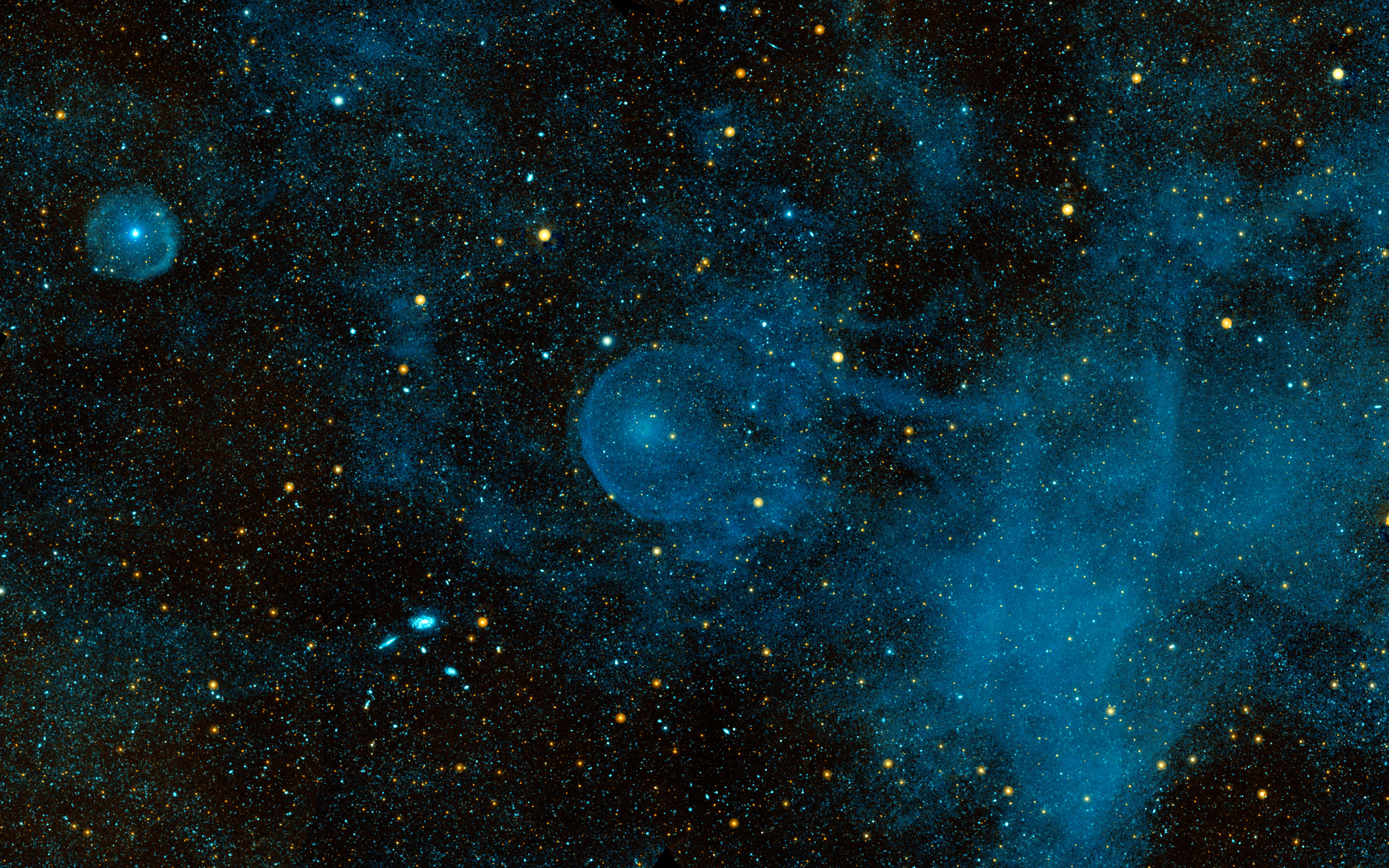
A runaway star, plowing through the depths of space and piling up interstellar material before it, can be seen in this ultraviolet image from NASA's Galaxy Evolution Explorer. The star, called CW Leo, is hurtling through space at about 204,000 miles per hour (91 kilometers per second), or roughly 265 times the speed of sound on Earth. It is shedding its own atmosphere to form a sooty shell of discarded material. This shell can be seen in the center of this image as a bright circular blob.

CW Leo is moving from right to left in this image. It is traveling so quickly through the surrounding material that it has formed a semi-circular bow shock in front of itself, like a boat moving through water. This bow shock is made of superheated gas, which flows around the star and is left behind in its turbulent wake. This blown-out bubble is 2.7 light-years across, which is more than half the distance from our Sun to the nearest star, or 2,100 times the size of Pluto's orbit.

The size of the bubble (called the "astrosheath") has allowed astronomers to estimate that CW Leo has been shedding its atmosphere for about 70,000 years. This is part of the star's natural life cycle as it runs out of hydrogen fuel and gradually throws off its outer layers to expose its bare, dying core. This core is called a white dwarf, and is the end product of all low-mass stars like our Sun.

CW Leo is the second runaway star to be observed with the Galaxy Evolution Explorer. The first, Mira, was observed by the telescope back in 2006.

This image is the combination of near-ultraviolet data, shown in yellow, and far-ultraviolet data, shown in blue.

Photo credit: NASA/JPL-Caltech

Notes: Due to the size of the jpg file (8.4 mb), the Minister has substituted a much smaller version of the image for the normal-size picture. The full-size jpg file may be found here. For more recent news about Galex, see NASA Lends Galaxy Evolution Explorer to Caltech.

Monday, May 21, 2012

NGC 7293 - The Helix Nebula - In Ultraviolet


NGC 7293, better known as the Helix nebula, displays its ultraviolet glow courtesy of NASA's Galaxy Evolution Explorer (GALEX). The Helix is the nearest example of a planetary nebula, which is the eventual fate of a star, like our own Sun, as it approaches the end of its life. As it runs out of fuel, the star expels its outer envelope of gas outward to form a nebula like the Helix. The remaining core of the star is a small, hot, dense remnant known as a white dwarf.

Photo credit: NASA/JPL-Caltech

Note: For more recent news about Galex, see NASA Lends Galaxy Evolution Explorer to Caltech.

Sunday, April 29, 2012

WISE J180956.27-330500.2


It's a dust bunny of cosmic proportions. Astronomers used images from NASA's Wide-field Infrared Survey Explorer, or WISE, to locate an aging star shedding loads of dust (orange dot at upper left). Only one other star, called Sakurai's Object, has been caught erupting with such large amounts of dust. The process is a natural part of aging for stars like our Sun. As they puff up into red giants, they shed dust that is later recycled back into other stars, planets, and in the case of our solar system, living creatures.

In this image, infrared data from WISE and a past all-sky survey mission, the Infrared Astronomical Satellite (IRAS), have been combined. Color is used to show similar observations taken almost thirty years apart; the recent WISE data are color-coded green and red, while the older IRAS data are blue.

The picture reveals that the newfound dusty star, called WISE J180956.27-330500.2, was not seen at all by IRAS, which surveyed the sky in 1983 (it is the only bright star in this field that does not have a corresponding blue halo). Astronomers say the star has brightened by a factor of 100. This appears to have been caused by a sudden eruption in the star around 15 years ago. Dust freshly created in this event is heated by starlight and glows at infrared wavelengths.

The image also demonstrates that WISE and its state-of-the-art technology produced, as expected, much crisper images than its predecessors. The blue IRAS data show both stars, and, higher up in the picture, interstellar dust.

Data from IRAS show 12-micron infrared light (blue); data from WISE show 12- and 22-micron infrared light (green and red, respectively).

Photo credit: NASA/JPL-Caltech/UCLA

Note: For more information, see NASA's WISE Catches Aging Star Erupting With Dust.

Tuesday, April 3, 2012

M2-9, The Butterfly Nebula, by SOFIA


Researchers using NASA's Stratospheric Observatory for Infrared Astronomy (SOFIA) have captured infrared images of the last exhalations of a dying sun-like star.

The object observed by SOFIA, planetary nebula Minkowski 2-9, or M2-9 for short, is seen in this three-color composite image. The SOFIA observations were made at the mid-infrared wavelengths of 20, 24, and 37 microns. The 37-micron wavelength band detects the strongest emissions from the nebula and is impossible to observe from ground-based telescopes.

Objects such as M2-9 are called planetary nebulae due to a mistake made by early astronomers who discovered these objects while sweeping the sky with small telescopes. Many of these nebulae have the color, shape and size of Uranus and Neptune, so they were dubbed planetary nebulae. The name persists despite the fact that these nebulae are now known to be distant clouds of material, far beyond our solar system, that are shed by stars about the size of our sun undergoing upheavals during their final life stages.

Although the M2-9 nebular material is flowing out from a spherical star, it is extended in one dimension, appearing as a cylinder or hourglass. Astronomers hypothesize that planetary nebulae with such shapes are produced by opposing flows of high-speed material caused by a disk of material around the dying star at the center of the nebula. SOFIA's observations of M2-9 were designed to study the outflow in detail with the goal of better understanding this stellar life cycle stage that is important in our galaxy's evolution.

"The SOFIA images provide our most complete picture of the outflowing material on its way to being recycled into the next generation of stars and planets," said Michael Werner of NASA's Jet Propulsion Laboratory (JPL) in Pasadena, California, principal investigator of these observations. "We were gratified to see the lobes so clearly using SOFIA. These early results demonstrate the scientific potential of this important new observatory."

The observations were made using the Faint Object Infrared Camera for the SOFIA Telescope (FORCAST) instrument in June 2011 by a team consisting of astronomers from JPL, the California Institute of Technology, the University of California at Los Angeles, Cornell University and Ithaca College, Ithaca, N.Y. Preliminary analyses of these data were first presented in January 2012 at the American Astronomical Society meeting in Austin, Texas.

The SOFIA observatory combines an extensively modified Boeing 747SP aircraft and a 17-metric-ton reflecting telescope with an effective diameter of 2.5 meters (100 inches) to altitudes as high as 45,000 feet (14 km), above more than 99 percent of the water vapor in Earth's atmosphere that blocks most infrared radiation from celestial sources.

Photo credit: NASA/DLR/USRA/DSI/FORCAST Team

Saturday, December 11, 2010

IC 443 - The Jellyfish Nebula


This oddly colorful nebula is the supernova remnant IC 443 as seen by NASA's Wide-field Infrared Survey Explorer, or WISE. Also known as the Jellyfish Nebula, IC 443 is particularly interesting because it provides a look into how stellar explosions interact with their environment. IC 443 can be found near the star Eta Geminorum, which lies near Castor, one of the twins in the constellation Gemini.

Just like human beings, stars have a life cycle -- they are born, mature and eventually die. The manner in which stars die depends on their mass. Stars with mass similar to the Sun typically become planetary nebulae at the end of their lives, whereas stars with many times the Sun's mass explode as supernovae. IC 443 is the remains of a star that went supernova somewhere between 5,000 and 10,000 years ago. The blast from the supernova sent out shock waves that traveled through space, sweeping up and heating the surrounding gas and dust in the interstellar medium, and creating the supernova remnant seen in this image.

What is unusual about the IC 443 is that its shell-like form has two halves that have different radii, structures and emissions. The larger northeastern shell, seen here as the violet-colored semi-circle on the top left of the supernova remnant, is composed of sheet-like filaments that are emitting light from iron, neon, silicon and oxygen gas atoms, in addition to dust particles, all heated by the blast from the supernova. The smaller southern shell, seen here in a bright cyan color on the bottom half of the image, is constructed of denser clumps and knots primarily emitting light from hydrogen gas and heated dust. These clumps are part of a molecular cloud, which can be seen in this image as the greenish cloud cutting across IC 443 from the northwest to southeast. The color differences seen in this image represent different wavelengths of infrared emission.

The differences in color are also the result of differences in the energies of the shock waves hitting the interstellar medium. The northeastern shell was probably created by a fast shock wave (100 kilometers per second or 223,700 miles per hour), whereas the southern shell was probably created by a slow shock wave (30 kilometers per second or 67,100 miles per hour).

All WISE featured images use color to represent specific infrared wavelengths. Blue represents 3.4-micron light, cyan represents 4.6-micron light, green represents 12-micron light and red represents 22-micron light. In this image, we see a mixing of blue and cyan in the southern ridge that is not often seen in other WISE images. The northeastern shell appears violet, indicating a mixture of longer infrared wavelengths from cooler dust (red) and shorter infrared wavelengths from luminescent gas (blue).

Photo credit: NASA/JPL-Caltech/UCLA

Wednesday, December 1, 2010

INTEGRAL's Study of Radioactive Aluminum in the Milky Way


Just like archaeologists, who rely on radioactive carbon to date the organic remains from past epochs, astronomers have exploited the radioactive decay of an isotope of aluminum to estimate the age of stars in the nearby Scorpius-Centaurus association, the closest group of young and massive stars to the Sun. The new observations, performed in gamma rays by ESA's INTEGRAL observatory, provide evidence for recent ejections of matter from massive stars that took place only a few million years ago in our cosmic neighborhood.

A common technique used in archaeology to establish the age of fossils and other organic samples from the past consists of measuring how much of a particular isotope of carbon, namely carbon-14 (14C), they contain. This radioactive isotope decays into the element nitrogen on a time scale of a few thousand years, hence the amount of it remaining in these ancient fossils is a strong indicator of the epoch from which they date. An analogous method, based on the radioactive decay of an unstable isotope of aluminum, has been recently exploited by astronomers to probe and assess the age of the Scorpius-Centaurus association, the closest group of very young and massive stars. Stellar age estimates can be then used to investigate how nearby massive stars have shaped our local region of the Milky Way.

This dating procedure is possible because aluminum is one of the elements synthesized by massive stars during their late evolutionary stages, and its abundance in a stellar complex such as the Scorpius-Centaurus association varies strongly with time. One isotope of this element, namely aluminum-26 (26Al), is radioactive and decays with an exponential lifetime of about one million years. The decay process results in a stable isotope of the element magnesium (26Mg) and a number of by-products, including an extremely energetic photon observable in gamma rays at an energy of about 1.8 MeV.

“Conveniently for astronomers, the decay of 26Al involves a similar time scale to that spanned by the life time of massive stars, which is of the order of a few million years. ... As its decay time is 'just right', measuring the abundance of 26Al is an excellent tool to trace the presence of young and massive stars, and it allows us to directly estimate their age,” said Roland Diehl of the Max-Planck Institute for Extraterrestrial Physics.

Earlier observations, conducted in the 1990s with the COMPTEL instrument on NASA's Compton Gamma-Ray Observatory, revealed for the first time the emission of 26Al across the entire sky. Subsequent data collected by ESA's INTEGRAL mission confirmed these results, probing the global properties of this isotope throughout the plane of the Milky Way thanks to INTEGRAL's improved spectral resolution.

“At the characteristic energy of the 26Al line, INTEGRAL has a spectral resolution over 60 times better than COMPTEL's, enabling us to study the intensity and shape of this line across the Galaxy in much greater detail,” comments Chris Winkler, INTEGRAL Project Scientist. “The data, gathered over five years, are so deep that it is now possible to isolate the contribution due to an individual, nearby stellar complex from the overall galactic 26Al emission.”

The data analyzed by Diehl's team focused on the Scorpius-Centaurus association, which is located at a distance of about 100–150 parsecs from the Sun, and revealed robust evidence for recent massive star formation therein. “The gamma-ray data show that the stars in the Upper Scorpius subgroup of the Scorpius-Centaurus association are only about 5 million years old. ... This is a direct estimate, in contrast to other procedures used to evaluate the ages of stars, which rely heavily on stellar evolution models. The very good agreement between these independent dating methods is an extremely reassuring result,” said Thomas Preibisch of the University Observatory Munich.

Via stellar winds and supernova explosions, the stars in the Scorpius-Centaurus association are currently enriching the surrounding interstellar medium with heavy elements, including aluminum, and from the shape of the emission line of 26Al it is possible to constrain the kinematics of such ejecta. “By investigating the details of these outflows of radioactive gas, streaming at velocities of about 100 km/s towards the Sun, we are starting to unravel the recent history of massive star formation in the Solar System's vicinity and its implications on our own cosmic environment,” comments Diehl.

The new INTEGRAL data also allowed the astronomers to refine the estimate of the total content of 26Al in the Milky Way, which is lower by about 20 per cent than previous estimates. This is a critical step that is required to validate our understanding of the star formation and nucleosynthesis processes in our Galaxy and to predict the expected rate of supernova explosions.

Image credit: Plüschke et al, 2001

Wednesday, November 24, 2010

ESOcast: First Planet of an Extragalactic Origin

Loading player...

An exoplanet orbiting a star that entered our galaxy, the Milky Way, from another galaxy has been detected by a European team of astronomers using the MPG/ESO 2.2-meter telescope at ESO’s La Silla Observatory in Chile. The Jupiter-like planet is particularly unusual, as it is orbiting a star nearing the end of its life and could be about to be engulfed by it, giving clues about the fate of our own planetary system in the distant future.

Video credit: ESO

Note: For more information, illustrations and videos about this story, see Planet from Another Galaxy Discovered.

Monday, September 27, 2010

LBN 114.55+00.22


Nebulae are enormous clouds of dust and gas occupying the space between the stars. Some have pretty names to match their good looks, for example the Rose Nebula, while others have much more utilitarian names. Such is the case with LBN 114.55+00.22, seen here in an image from NASA's Wide-field Infrared Survey Explorer, or WISE.

Named after the astronomer who published a catalog of nebulae in 1965, LBN stands for "Lynds Bright Nebula." The numbers 114.55+00.22 refer to nebula's coordinates in our Milky Way galaxy, serving as a sort of galactic home address.

Astronomers classify LBN 114.55+00.22 as an emission nebula. Unlike a reflection nebula, which reflects light from nearby stars, an emission nebula emits light. High-energy light blasted out from a nearby massive star strips away electrons from the nebula's hydrogen gas, causing the gas to become charged. These nebulae are also called HII regions, with the "H" standing for hydrogen and the "II" indicating that the gas is ionized. As the ionized gas begins to cool from a higher-energy state to a lower-energy state, it glows. In the case of LBN 114.55+00.22, dust blocks the view of most of this nebula in visible light. But the dust of the nebula is also warmed by the light of the young stars within, and WISE's infrared detectors see its beautiful infrared colors. Emission nebulae are usually found in the disks of spiral galaxies, and are places where new stars are forming.

In the lower left corner of the image is the bright red star IRAS 23304+6147, which is in the last phase of its life. As the hydrogen in its core burns out, the star will become a planetary nebula, ejecting material that absorbs visible light and glows in the infrared. This star's name comes from the 1983 survey mission Infrared Astronomical Satellite (IRAS).

Another bright object in this image is the supergiant variable star HIP 117078, seen above and to the right of the nebula. In this case, HIP stands for Hipparcos, a European Space Agency satellite that cataloged the positions of over 100,000 stars.

The colors used in this image represent specific wavelengths of infrared light. Blue and cyan represent light emitted at wavelengths of 3.4 and 4.6 microns, which is predominantly from stars. Green and red represent light from 12 and 22 microns, respectively, which is mostly emitted by dust.

Photo credit: NASA/JPL-Caltech/UCLA

Wednesday, September 15, 2010

BP Psc: Stellar Cannibalism


The composite image on the left shows X-ray and optical data for BP Piscium (BP Psc), a more evolved version of our Sun about 1,000 light years from Earth. Chandra X-ray Observatory data are colored in purple, and optical data from the 3-meter Shane telescope at Lick Observatory are shown in orange, green and blue. BP Psc is surrounded by a dusty and gaseous disk and has a pair of jets several light years long blasting out of the system. A close-up view is shown by the artist's impression on the right. For clarity a narrow jet is shown, but the actual jet is probably much wider, extending across the inner regions of the disk. Because of the dusty disk, the star's surface is obscured in optical and near-infrared light. Therefore, the Chandra observation is the first detection of this star in any wavelength.

The disk and the jets, seen distinctly in the optical data, provide evidence for a recent and catastrophic interaction in which BP Psc consumed a nearby star or giant planet. This happened when BP Psc ran out of nuclear fuel and expanded into its "red giant" phase.

Jets and a disk are often characteristics of very young stars, so astronomers thought BP Psc might be one as well. However, the new Chandra results argue against this interpretation, because the X-ray source is fainter than expected for a young star. Another argument previously used against the possible youth of BP Psc was that it is not located near any star-forming cloud and there are no other known young stars in its immediate vicinity. The Chandra image supports this absence of a cluster of young stars, since multiwavelength studies show that most of the X-ray sources in the composite image are likely to be rapidly growing supermassive black holes in the centers of distant galaxies.

Credits: X-ray (NASA/CXC/RIT/J.Kastner et al), Optical (UCO/Lick/STScI/M.Perrin et al); Illustration: NASA/CXC/M.Weiss

Saturday, September 4, 2010

Water Around CW Leonis


The Herschel infrared space observatory has discovered that ultraviolet starlight is the key ingredient for making water in space. It is the only explanation for why a dying star is surrounded by a gigantic cloud of hot water vapor. Herschel is a European Space Agency mission with important participation from NASA.

Every recipe needs a secret ingredient. When astronomers discovered an unexpected cloud of water vapor around the old star IRC+10216, also known as CW Leonis, using NASA's Submillimeter Wave Astronomy Satellite in 2001, they immediately began searching for the source. Stars like IRC+10216 are known as carbon stars and are thought not to make much water. Initially they suspected the star's heat must be evaporating comets or even dwarf planets to produce the water.

Now, Herschel has revealed that the secret ingredient is ultraviolet light, because the water is too hot to have come from the destruction of icy celestial bodies.

"Models predict that there should be no water in the envelopes around stars like this, so astronomers were puzzled about how it got there," said Paul Goldsmith, the NASA project scientist for Herschel at NASA's Jet Propulsion Laboratory, Pasadena, California. "These Herschel observations confirm the surprising presence of water vapor in what we thought was an astronomical desert."

This research, which was led by Leen Decin of the Katholieke Universiteit Leuven, Belgium, appears in the September 2 issue of Nature.

Photo credit: ESA/PACS/SPIRE Consortia

Note: For the ESA press release about this topic, click here: Herschel Detection Explains the Origin of Water in a Carbon Star.

Thursday, August 19, 2010

Magnetar in Star Cluster Westerlund 1


This artist’s impression shows the Magnetar in the very rich and young star cluster Westerlund 1. This remarkable cluster contains hundreds of very massive stars, some shining with a brilliance of almost one million suns. European astronomers have for the first time demonstrated that this magnetar — an unusual type of neutron star with an extremely strong magnetic field — was formed from a star with at least 40 times as much mass as the Sun. The result presents great challenges to current theories of how stars evolve, as a star as massive as this was expected to become a black hole, not a magnetar.

Illustration credit: ESO/L. Calçada


Photo credit: European Southern Observatory

Note: For more information and photographs, see How Much Mass Makes a Black Hole?