Pages

Showing posts with label Comet 103/P Hartley 2. Show all posts

Sunday, September 22, 2013

Comets Tempel 1 and Hartley 2


NASA's Deep Impact spacecraft made history flying past two of the solar system's icy nomads. On Independence Day, 2005, Deep Impact flew past comet Tempel 1. On November 4, 2010, it flew past the bowling-pin-shaped comet Hartley 2.

Launched on a clear winter day in January 2005, NASA's Deep Impact spacecraft spanned 268 million miles (431 million kilometers) of deep space in 172 days, then reached out and touched comet Tempel 1. The collision between the coffee table-sized impactor and city-sized comet occurred on July 4, 2005, at 1:52 a.m. EDT. This hyper-speed collision between spaceborne iceberg and copper-fortified, rocket-powered probe was the first of its kind. It was a boon to not only comet science, but to the study of the evolution of our solar system.

The mission of Deep Impact was supposed to conclude within weeks of this July 4 cometary smackdown. Then, NASA approved a mission extension, re-enlisting the Deep Impact spacecraft for two distinct celestial targets of opportunity. EPOXI, as the mission was renamed, was a combination of the names for the two extended mission components: the extrasolar planet observations, called Extrasolar Planet Observations and Characterization (EPOCh), and the flyby of comet Hartley 2, called the Deep Impact Extended Investigation (DIXI).

The Deep Impact spacecraft, history's most traveled deep-space comet hunter, provided many significant results for the science community. Here are the top five, according to the mission's principal investigator, Michael A'Hearn of the University of Maryland, College Park.

Studies of imagery showed that that the luminous flash created within a fraction of a second after Deep Impact's impactor was atomized by comet Tempel 1 was much fainter than expected. Comparison with experimental impacts at the Vertical Gun Range at NASA Ames Research Center in Moffett Field, California, showed that such a faint flash was consistent only with a surface layer (depth a few times the diameter of the impactor) that was more than 75 percent empty space. This surprisingly high porosity was in contrast with theories that predicted comets were armored with a stronger, solid crust that impeded outgassing.

Observations of comet Tempel 1 by Deep Impact's spectrometer instrument showed that water was arising primarily at longitudes near noon and peaking near the equator, whereas most of the carbon dioxide was arising from far southern latitudes, not too far from comet Tempel 1's south pole. This could be due to seasonal effects (southern hemisphere just going into winter darkness) or due to differences in the chemical composition in different parts of the nucleus. During the mission extension, the EPOXI observations of comet Hartley 2 showed that the comet's smooth waist was emitting pure water, while the small end was emitting excess carbon dioxide, regardless of time of day. This was a clear sign that chemical diversity was the important factor in a comet's chemical makeup.

For many years we have known that a handful of comets (fewer than 10 percent) produced more water vapor than should be possible by sublimation of nucleus of water ice, in which the sizes of the nuclei are known. The flyby of comet Hartley 2 showed a large number of icy grains in the coma are driven out of the nucleus by the outgassing of carbon dioxide. These icy grains are plausibly the source of much of the water coming from the comet.

Observations of Hartley 2 by the Deep Impact spacecraft showed the importance of carbon-dioxide ice relative to carbon-monoxide ice in comets, and led to reexamination of all previous observations of these two ices in comets. The relative abundances in short-period and long-period comets imply that the short-period comets formed under warmer conditions than did the long-period comets. Thus, the short-period comets must have formed closer to the sun than their longer-period brethren. This is contrary to popular belief in the astronomical community (for many decades) that the short-period comets formed in the Kuiper belt beyond Neptune, while the long-period comets formed in the vicinity of the giant planets. The new model fits well with measurements by other astronomers of heavy water in Hartley 2, and with the newest dynamical studies of planetary migration.

The excavation of a crater on Tempel 1 was the trigger that allowed the proposal for the Stardust NExT mission to succeed. In addition to searching for the crater formed by Deep Impact, a key goal of that Stardust-NExT mission was to measure changes in the surface of the comet over an orbital period. This second set of measurements of Tempel 1 surface features showed that much of the evolution was in discrete, large areas, i.e., there was not a small, uniform erosion of the all parts of the surface, but rather large changes in a few places. Thus, comets evolve in a manner analogous to erosion - most erosion takes place in discrete events (floods that make large, local changes) rather than as a slow, continuous process.

Image credit: NASA/JPL-Caltech/UM

Note: For more information, see NASA's Deep Space Comet Hunter Mission Comes to an End.

Saturday, October 8, 2011

Comet Hartley 2: The Same Here as There


New measurements from the Herschel Space Observatory have discovered water with the same chemical signature as our oceans in a comet called Hartley 2 (pictured at right). Previously, astronomers thought icy comets impacting on a young Earth had deposited only about 10 percent of the water comprising our oceans. The new findings, however, suggest that comets played a much bigger role.

The image of Comet Hartley 2 at top right was taken by NASA's EPOXI mission. The image at bottom right is an artist's concept of a comet.

Using the Herschel Space Observatory, astronomers have discovered that Comet Hartley 2 possesses a ratio of "heavy water" to light, or normal, water that matches what's found in Earth's oceans. In heavy water, one of the two hydrogen atoms has been replaced by the heavy hydrogen isotope known as deuterium. Hartley 2 contains half as much heavy water as other comets analyzed to date. Herschel's "Heterodyne Instrument for the Far Infrared," or HIFI, was used to obtain the spectral signatures of the water molecules, as shown here in the graphs.

The image of Comet Harley 2 was taken by NASA's EPOXI mission.

Image credit: NASA/JPL-Caltech

Note: For more information, see Herschel Finds First Evidence of Earth-Like Water in a Comet; also, PIA14737: Heavy and Light Just Right.

Monday, November 22, 2010

Anaglyph of Comet Hartley 2


This 3-D image shows the entire nucleus of Hartley 2 with jets and an icy particle cloud. Circles have been added to highlight the location of individual particles.

The images used to make this 3-D image, known as an anaglyph, were obtained by the Medium-Resolution Imager on November 4, 2010, the day the EPOXI mission spacecraft made its closest approach to the comet.

This 3-D image should be seen with blue-red glasses, where the red lens is in front of the left eye.

Photo credit: NASA/JPL-Caltech/UMD/Brown

The Many Faces of Comet Hartley 2


Infrared scans of Comet Hartley 2 by NASA's EPOXI mission spacecraft show carbon dioxide, dust, and ice being distributed in a similar way and emanating from apparently the same locations on the nucleus. Water vapor, however, has a different distribution implying a different source region and process.

These maps were made from data obtained by the High-Resolution Imager on November 4, 2010.

Photo credit: NASA/JPL-Caltech/UMD

Sunday, November 21, 2010

More on Comet 103/P Hartley 2


The Medium-Resolution Instrument on NASA's EPOXI mission spacecraft obtained these views of the icy particle cloud around Comet Hartley 2. The image on the left is the full image of Comet Hartley 2 for context, and the image on the right was enlarged and cropped.

The images confirm that the particles seen in the High-Resolution Instrument images are real and not artifacts.

This image was obtained on November 4, 2010, the day the EPOXI mission spacecraft made its closest approach to the comet.


This image from the High-Resolution Instrument on NASA's EPOXI mission spacecraft shows part of the nucleus of Comet Hartley 2. The Sun is illuminating the nucleus from the right. A distinct cloud of individual particles is visible. This image was obtained on November 4, 2010, the day the EPOXI mission spacecraft made its closest approach to the comet.


This zoomed-in image from the High-Resolution Instrument on NASA's EPOXI mission spacecraft shows the particles swirling in a "snow storm" around the nucleus of Comet Hartley 2.

Scientists estimate the size of the largest particles ranges from a golf ball to a basketball. They have determined these are icy particles rather than dust. The particles are believed to be very porous and fluffy.

The Sun is illuminating the nucleus from the right. This image was obtained on November 4, 2010, the day the EPOXI mission spacecraft made its closest approach to the comet.

Photo credits: (Top) NASA/JPL-Caltech/UMD/Brown; (Middle and Bottom) NASA/JPL-Caltech/UMD

Friday, November 12, 2010

Comet 103/P Hartley 2 by Herschel/Spire


This Herschel/SPIRE image of Comet 103P/Hartley 2 was taken on 24 October 2010 at 250 microns, and covers a region of 8 arcminutes x 5 arcminutes. At the time that this image was obtained the comet was at a distance of 17.2 million km from the Herschel Space Observatory.

Herschel has obtained unique, sensitive far-infrared continuum images constraining the size of the large dust particles, while spectra reveal the distribution of water molecules released from the nucleus as about 230 kg of ices evaporating every second. This is the first time a comet has been imaged in this region of the electromagnetic spectrum.

The Sun symbol and arrow indicate the projected direction towards the Sun.

Note:
Herschel is one of several observatories participating in a global astronomical campaign to observe and study the short period (6.46 years) Comet 103P/Hartley 2 before, during and after a flyby by the NASA EPOXI (Extrasolar Planet Observatory and Deep Impact Extended Investigation) mission on 4 November 2010.

In the period 24 October to 17 November 2010, Herschel will use its complement of state-of the-art instruments, covering the range 55-671 μm, to observe the far-infrared and submillimeter spectrum and to image the thermal dust radiation of Comet 103P/Hartley 2.

Photo credit: ESA/Herschel/HSSO Consortium

Note: For news about another satellite that has been observing Comet Hartley 2, see Odin Satellite Observes Water In Comet 103P Hartley 2.

Tuesday, November 9, 2010

Evidence for a First-of-Its-Kind Comet Jet


These three pairs of images from NASA's EPOXI mission demonstrate that a dust jet and gaseous carbon dioxide are being released from Comet Hartley 2 at the same time, and from the same location on the comet. The observations suggest that carbon dioxide is driving the jet and taking tiny grains with it as it spews out of the nucleus of the comet. This is the first time this type of jet has been observed.

The top row consists of three images showing carbon dioxide gas being released by the comet at different points in time, from when the comet was at its minimum brightness to its maximum brightness. The bottom row of images shows dust coming from a jet on the comet at the same three points in time. The observations demonstrate that the gas and the jet are coming from the same location on the comet at the same time. This, in turn, suggests that the carbon dioxide is driving the jet.

The presence of this jet tells the scientists that the comet is made of chunks rich in solid carbon dioxide, sort of like chocolate chip chunks in frozen cookie dough. What's more, this variability in the comet's composition implies that the ingredients for both comets and planets must have been mixed up early on in the formation of our solar system. Without this mixing, comets would have more homogenous composition -- in simple terms, this would be having comets made of just "dough," and comets made of just "chocolate chunks."

The top-row images show data taken by the spacecraft's infrared spectrometer, a part of the High-Resolution Instrument. The bottom row images were taken in visible light by the spacecraft's Medium-Resolution Instrument.

Photo credit: NASA/JPL-Caltech/UMD

Monday, November 8, 2010

Carbon Dioxide Fluctuations in Comet Hartley 2


The upper panel of this figure shows small images of Comet Hartley 2 taken by NASA's EPOXI mission over time. The images have been specially filtered to show only carbon dioxide, or evaporated dry ice. The brightness varies dramatically from one image to another, which means that the amount of carbon dioxide emitted by the comet is varying up and down. A close look at the images shows that the position of the carbon dioxide also varies by a small amount, up and down in the pictures, just as the brightness varies.

The lower panel is a graph showing the variation of total brightness, and thus the variation of the total amount of carbon dioxide, during the time period. The amount of carbon dioxide emitted very late on October 31 is more than four times greater than earlier on that same day. During this same period of two days, the water (not shown) varied much less than the carbon dioxide. This suggests that some chunks of the comet's nucleus have much more dry ice relative to water than do other chunks.

Carbon dioxide is a basic ingredient of comets and planets in our solar system. Scientists on the EPOXI team think that sunlight is warming the comet, causing its frozen, sub-surface carbon dioxide to bubble up into gas that is escaping in jets.

These data were collected by EPOXI's infrared spectrometer, part of its High-Resolution Instrument.

Photo credit: NASA/JPL-Caltech/UMD

Sunday, November 7, 2010

The Jets of Comet Hartley 2


This enhanced image, one of the closest taken of Comet Hartley 2 by NASA's EPOXI mission, shows jets and where they originate from the surface. There are jets outgassing from the sunward side, the night side, and along the terminator -- the line between the two sides.

The image was taken by EPOXI's Medium-Resolution Instrument on November 4, 2010. The Sun is to the right.

Photo credit: NASA/JPL-Caltech/UMD

Fab Five


This montage shows the only five comets imaged up close with spacecraft. The comets vary in shape and size. Comet Hartley 2 is by far the smallest and the most active of small comets. This jet activity can be seen extending from the comet's surface and into its outer shell of gas and dust, or coma. This is first time scientists have been able to link jets to the details of the surface.

Photo credit: NASA/JPL-Caltech/UMD

Note: The five visited comets and the spacecraft that visited them are, as shown counter-clockwise in the image, comets 9P/Tempel 1 (Deep Impact), 19P/Borrelly (Deep Space 1), 81P/Wild (Wild 2) (Stardust), 103P/Hartley 2 (Deep Impact/EPOXI), and 1P/Halley (Giotto).

Update: For another photo comparing the sizes of Comets Hartley 2 and Tempel 1, see PIA13629: Tempel 1 and Hartley 2.

Saturday, November 6, 2010

Flying Past Comet Hartley 2

There are simply too many good photos of Comet Hartley 2 to use on a day-by-day basis, so The Minister is going to do some multi-photo posts of the comet for the next day or two in addition to the regularly scheduled posts.

The Minister must say, he's rather surprised that the public reaction to the rendezvous with the comet has been so lackluster so far. The Deep Impact spacecraft has taken some excellent photos of an active comet, and the world has hardly noticed. Such a pity.


The image, one of the closest taken of Comet Hartley 2 by NASA's EPOXI mission, shows many features across the comet's surface. The length of the comet is equal to the distance between the Capitol building and the Washington Monument in Washington. There are two obvious regions of jet activity associated with rough terrain. The smooth surface in the middle is lower than the rest of the comet and may accumulate fine-grain dust.

The image was taken by EPOXI's Medium-Resolution Instrument on November 4, 2010. The Sun is to the right.


This close-up view of Comet Hartley 2 was taken as NASA's EPOXI mission approached the comet at 6:58 a.m. PDT (9:58 a.m. EDT). The spacecraft's Medium-Resolution Instrument snapped the picture from a distance of 1,417 kilometers (880 miles). The Sun is to the right.

The comet's nucleus, or main body, is approximately 2 kilometers (1.2 miles) long and .4 kilometers (.25 miles) at the "neck," or most narrow portion. Jets can be seen streaming out of the nucleus.


This close-up view of Comet Hartley 2 was taken as NASA's EPOXI mission approached the comet at 6:59 a.m. PDT (9:59 a.m. EDT). The spacecraft's Medium-Resolution Instrument snapped the picture from a distance of 816 kilometers (507 miles). The Sun is to the right.


This close-up view of Comet Hartley 2 was taken at 7:00 a.m. PDT (10 a.m. EDT), after NASA's EPOXI mission flew by. The spacecraft's Medium-Resolution Instrument snapped the picture from a distance of 849 kilometers (528 miles). The Sun is to the right.


This close-up view of Comet Hartley 2 was taken at 7:01 a.m. PDT (10:01 a.m. EDT), after NASA's EPOXI mission flew by. The spacecraft's Medium-Resolution Instrument snapped the picture from a distance of 1406 kilometers (874 miles). The Sun is to the right.

Photo credit: NASA/JPL-Caltech/UMD; Links for photos: First, Second, Third, Fourth, Fifth.

Update: NASA has released an animation of the comet as the Deep Impact spacecraft flew by Comet Hartley 2 the other day. Someone has downloaded the video on to Youtube, which I'm adding below:

Comet 103/P Hartley 2 Flyby


This image montage shows Comet Hartley 2 as NASA's EPOXI mission approached and flew under the comet. The images progress in time clockwise, starting at the top left.

The image was taken by EPOXI's Medium-Resolution Instrument on November 4, 2010. The Sun is to the right.


NASA's EPOXI mission spacecraft successfully flew past Comet Hartley 2 at 7 a.m. PDT (10 a.m. EDT) Thursday, November 4. Scientists say initial images from the flyby provide new information about the comet's volume and material spewing from its surface.

"Early observations of the comet show that, for the first time, we may be able to connect activity to individual features on the nucleus," said EPOXI Principal Investigator Michael A'Hearn of the University of Maryland, College Park. "We certainly have our hands full. The images are full of great cometary data, and that's what we hoped for."

EPOXI is an extended mission that uses the already in-flight Deep Impact spacecraft. Its encounter phase with Hartley 2 began at 1 p.m. PDT (4 p.m. EDT) on November 3, when the spacecraft began to point its two imagers at the comet's nucleus. Imaging of the nucleus began one hour later.

"The spacecraft has provided the most extensive observations of a comet in history," said Ed Weiler, associate administrator for NASA's Science Mission Directorate at the agency's headquarters in Washington. "Scientists and engineers have successfully squeezed world-class science from a re-purposed spacecraft at a fraction of the cost to taxpayers of a new science project."

Images from the EPOXI mission reveal comet Hartley 2 to have 100 times less volume than Comet Tempel 1, the first target of Deep Impact. More revelations about Hartley 2 are expected as analysis continues.

Initial estimates indicate the spacecraft was about 700 kilometers (435 miles) from the comet at the closest-approach point. That's almost the exact distance that was calculated by engineers in advance of the flyby.

...

The name EPOXI is a combination of the names for the two extended mission components: the Extrasolar Planet Observations and Characterization (EPOCh), and the flyby of Comet Hartley 2, called the Deep Impact Extended Investigation (DIXI). The spacecraft has retained the name "Deep Impact." In 2005, Deep Impact successfully released an impactor into the path of Comet Tempel 1.

Photo credit: NASA/JPL-Caltech/UMD

Thursday, November 4, 2010

Approaching Comet 103P Hartley 2


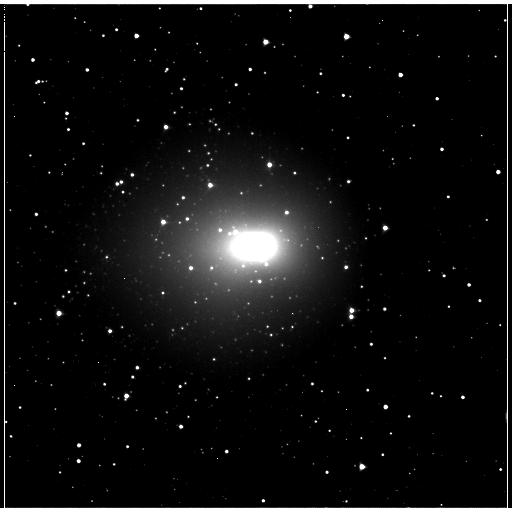
NASA's EPOXI mission took this image of Comet Hartley 2 on November 2, 2010 from a distance of 2.3 million kilometers (1.4 million miles). The spacecraft will fly by the comet on November 4, 2010. The white blob and the halo around it are the comet's outer cloud of gas and dust, called a coma. At this distance, the spacecraft is capturing images with a resolution of about 23 kilometers/pixel (14 miles/pixel).

Photo credit: NASA/JPL-Caltech/UMD

Note: Deep Impact's rendezvous with the comet will be later today; the Minister will update this post with more information and photos.

Update #1: The Arecibo Observatory has released a series of radar photos that show Comet Hartley 2 to look like "a cross between a bowling pin and a pickle." The nucleus of the comet is apparently more cylindrical than spherical, and may have two lobes. The photos can be seen here and here (the latter website suggests that Comet Hartley 2 may resemble Comet 19P/Borrelly, which may be a good guess).

JPL has released a short video from the Deep Impact Medium and High Resolution Imagers that show two jets blasting out of the comet within a 16-hour span. One can also get a sense of how the comet spins: it is not spinning along the narrow end (at least that we can see in this video), as a log would spin in water a la logrolling, but it is spinning lengthwise, as one spins a pen or pencil. The video, which the Minister cannot upload onto Blogger, can be watched here.

Wednesday, October 6, 2010

Comet 103/P Hartley 2 by WISE and Hubble


This visitor from deep space, seen here by NASA's Wide-field Infrared Survey Explorer, or WISE, is Comet Hartley 2 -- the destination for NASA's EPOXI mission.

The comet, known officially as 103P/Hartley was discovered fairly recently, in 1986, by Malcolm Hartley in Siding Spring, Australia. It probably originated from an icy orbit close to that of Jupiter's, before something knocked it on a path toward the Sun. The comet circles the Sun every 6.46 years -- its upcoming closest approach to the sun, called perihelion, will take place on October 28, 2011. EPOXI, which utilizes the already "in flight" Deep Impact flyby spacecraft, will reach the comet on November 4.

The WISE observations are helping the EPOXI team gain a more comprehensive picture of the comet's behavior over time. This image, taken on May 10, 2010, provides the most extensive look yet at the comet's dusty trail -- a path of particles, sort of like a trail of crumbs, that the comet leaves during each of its trips through the inner solar system. The extent of the trail seen in this view, behind the comet, is 1.8 million kilometers, or 1.1 million miles.

WISE's infrared vision also makes it good at studying the range of dust particle sizes in the trail, as well as the comet's tail, seen here as a fuzzy streak to the right of the comet, in line with the trail. Infrared observations are also useful for measuring the comet's nucleus and rotation rate.

Comet Hartley 2 is about 1.2 kilometers in diameter, or .8 miles. It was approximately 2.3 astronomical units away from the Sun when this picture was taken (an astronomical unit is the distance between Earth and the sun). When EPOXI reaches the comet on November 4, it will be nearly 1.1 astronomical units away from the Sun and only 0.15 astronomical units from Earth.

The fuzzy background in this picture is noise, primarily from dust in our own solar system. Stars cannot be seen because they are subtracted out during the process of averaging multiple WISE pictures together into this one view.

Infrared light of 4.6, 12 and 22 microns is colored blue, green and red, respectively.

Photo credit: NASA/JPL-Caltech/UCLA


Above is another recent photo, taken September 25, of Comet 103/P Hartley 2 by the Hubble Space Telescope. For more information on this photo, see Hubble Probes Comet 103P/Hartley 2 in Preparation for DIXI flyby.

Photo credit: NASA, ESA, and H. Weaver (The Johns Hopkins University/Applied Physics Lab)

Update: Astronomy Picture of the Day has another nice photo of Comet Hartley 2 flying near emission nebula NGC 281 (also known as the Pacman Nebula).

Update #2: NASA Science News has a short article about the upcoming EPOXI mission rendezvous with Comet Hartley 2; the article has a very nice photo of the comet taken on October 13 by an amateur astronomer.

Friday, September 10, 2010

Comet 103/P Hartley 2


This first image of Comet 103P/Hartley 2 was taken from NASA's Deep Impact spacecraft 60 days prior to the spacecraft's flyby of the comet.

Seven successive one-minute exposures taken by the spacecraft's Medium Resolution Imager were combined to make this single image. The exposures were taken on September 5th beginning at about 6:30 a.m. PDT (9:30 a.m. EDT, 13:30 UTC). The comet was 60 million kilometers (37.2 million miles) from the spacecraft when the set of images were taken.

Photo credit: NASA/JPL-Caltech/University of Maryland

Update (27 October 2010): NASA has released three videos with respect to the upcoming rendezvous with Comet Hartley 2:
PIA13546: EPOXI's Trip to Meet Comet Hartley 2 - A video showing the orbital trajectories of the Earth, Comet Hartley 2 and the Deep Impact spacecraft.
PIA13547: Hartley 2 on the Move - A time lapse animation of the comet by Deep Impact as the spacecraft gets nearer (from 21 million kilometers on October 15th to just under 12 million kilometers on October 24th).
PIA13548: Comet Hartley 2 Gets a Visitor - An artist's animation showing the flyby of Deep Impact past the comet from the spacecraft's perspective.