Pages

Showing posts with label NGC 3603. Show all posts

Thursday, August 21, 2014

Star Cluster NGC 3603 and Nebula NGC 3576


This mosaic of images from the Wide Field Imager on the MPG/ESO 2.2-meter telescope at ESO’s La Silla Observatory in Chile shows two dramatic star formation regions in the southern Milky Way. The first of these, on the left, is dominated by the star cluster NGC 3603, located about 20,000 light-years away, in the Carina–Sagittarius spiral arm of the Milky Way galaxy. The second object, on the right, is a collection of glowing gas clouds known as NGC 3576 that lies only about half as far from Earth.

Image credit: ESO/G. Beccari

Note: For more information, see A Spectacular Landscape of Star Formation.

Saturday, May 25, 2013

Fifteen Years of the Very Large Telescope


This selection of images — one per year in the life of the VLT — gives a taste of its huge scope and scientific productivity since first light in May 1998. The images are as follows: 1998: NGC 1232 (eso9845), 1999: NGC 3603 (eso9946), 2000: Messier 104, the Sombrero Galaxy (eso0007), 2001: Messier 16 in the infrared (eso0142), 2002: the Horsehead Nebula (eso0202), 2003: NGC 613 (eso0338), 2004: first candidate exoplanet image (eso0428), 2005: NGC 1097 center (eso0534), 2006: NGC 1313 (eso0643), 2007: ESO 593-IG 008 (eso0755), 2008: center of the Milky Way (eso0846), 2009: the Jewel Box cluster (eso0940), 2010: Messier 17 in the infrared (potw1044a), 2011: the Eyes galaxies (eso1131), 2012: the Carina Nebula in the infrared (eso1208) and 2013: IC 2944 (eso1322).

Image credits: ESO/P.D. Barthel/M. McCaughrean/M. Andersen/S. Gillessen et al./Y. Beletsky/R. Chini/T. Preibisch

Note: For more information, see ESO's Very Large Telescope Celebrates 15 Years of Success.

Wednesday, January 11, 2012

NGC 3603


Thousands of sparkling young stars nestled within the giant nebula NGC 3603. This stellar "jewel box" is one of the most massive young star clusters in the Milky Way Galaxy. NGC 3603 is a prominent star-forming region in the Carina spiral arm of the Milky Way, about 20,000 light-years away. This image shows a young star cluster surrounded by a vast region of dust and gas. The image reveals stages in the life cycle of stars. The nebula was first discovered by Sir John Herschel in 1834. The image spans roughly 17 light-years.

Photo credit: NASA, ESA, and the Hubble Heritage

Thursday, June 10, 2010

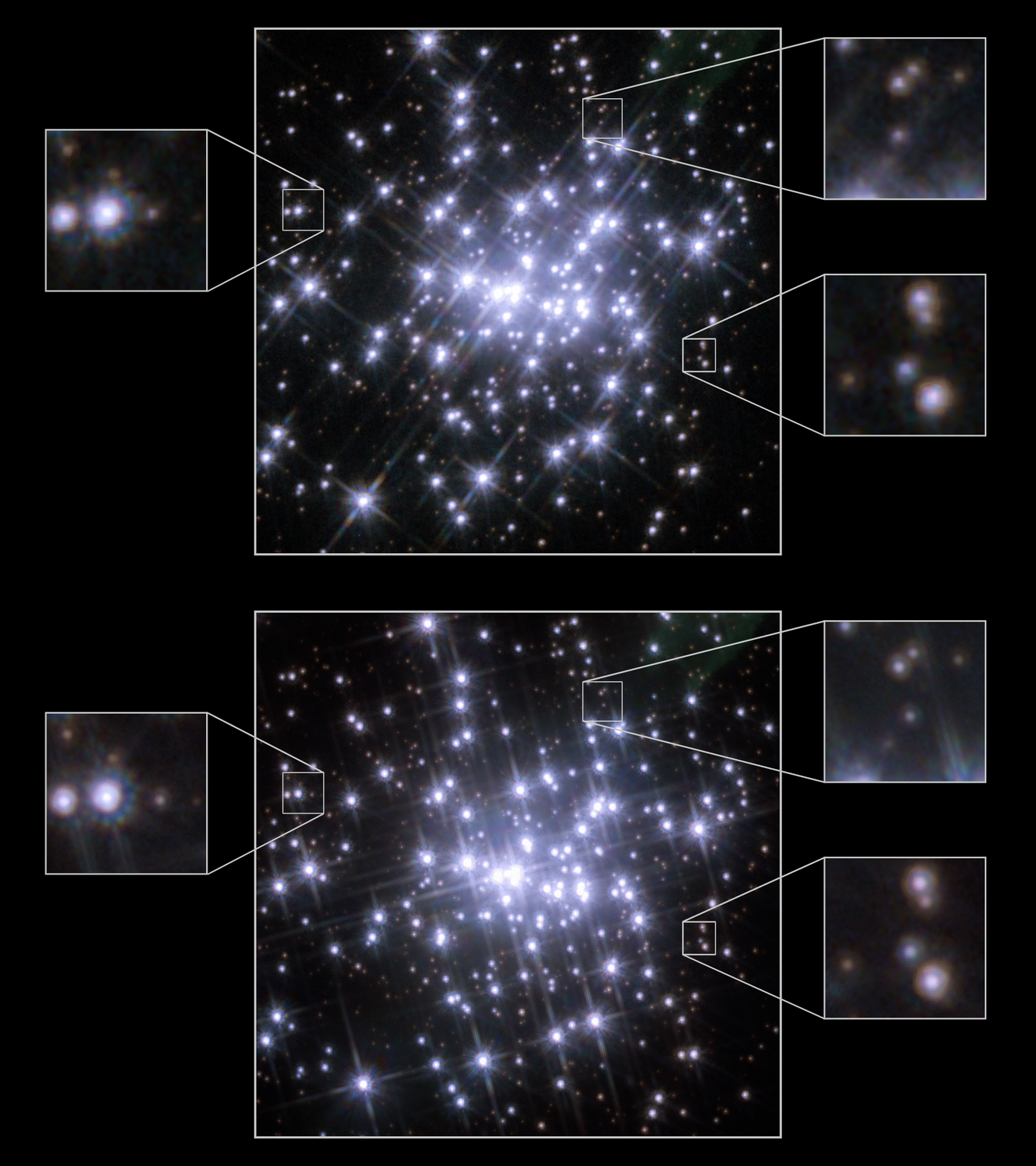
NGC 3603 in 1997 and 2007


The massive compact star cluster in NGC 3603 is shown in this image, which blinks between two images taken ten years apart. The images are a color composite of observations in the WFPC2 filters F547M (1997) respectively F555W (2007) (blue), F675W (green) and F814W (red). The field of view is about 20 arcseconds across. The boxes show a zoomed view of three foreground stars with a particularly high apparent speed relative to the cluster members. Other fast-moving stars can be spotted by closer examination of the two pictures. Most of the cluster stars move by less than 1/10 of a pixel over the ten-year period, which is not discernible by eye.

Copyright: NASA, ESA and Wolfgang Brandner (MPIA), Boyke Rochau (MPIA) and Andrea Stolte (University of Cologne)

Note: If the image above doesn't blink for you, click here.