Pages

Showing posts with label NGC 5128 - Centaurus A. Show all posts

Sunday, July 27, 2014

The Halo Around Centaurus A


This image shows the stunning elliptical galaxy Centaurus A. Recently, astronomers have used the NASA/ESA Hubble Space Telescope to probe the outskirts of this galaxy to learn more about its dim halo of stars.

The galaxy's halo of stars has been found to reach much further than expected, extending across 4 degrees in the sky – equivalent to eight times the apparent width of the Moon, or almost twice the width of this image.

This image is a composite of images from Digitized Sky Survey 2 (DSS2), the MPG/ESO 2.2-meter telescope, and the NASA/ESA Hubble Space Telescope's Advanced Camera for Surveys (ACS).

The areas probed by Hubble are identified in the annotated version of this image. Hubble's unique capabilities allowed astronomers to analyze the faint stars in the halo.

Image credit: ESA/Hubble, NASA, Digitized Sky Survey, MPG/ESO; acknowledgement: Davide de Martin

Note: For more information, see Hubble Traces the Halo of a Galaxy More Accurately Than Ever Before and Hubble Traces the Halo of a Galaxy More Accurately Than Ever Before.

Friday, April 25, 2014

Messier 101, Messier 81, Centaurus A, and Messier 51


Four images of galaxies that have been made using data from both amateur and professional telescopes.

This quartet of galaxies comes from a collaboration of professional and amateur astronomers that combines optical data from amateur telescopes with data from the archives of NASA missions. Starting in the upper left and moving clockwise, the galaxies are M101 (the "Pinwheel Galaxy"), M81, Centaurus A, and M51 (the "Whirlpool Galaxy"). In these images, X-rays from Chandra are in purple, infrared data from Spitzer are red, and the optical data are in red, green, and blue. The two astrophotographers who donated their images for these four images -- Detlef Hartmann and Rolf Olsen -- used their personal telescopes of 17.5 inches and 10 inches in diameter respectively.

Scale: Image is 24 arcmin on a side (about 1.5 million light years).

Image credit: X-ray: NASA/CXC/SAO; Optical: Detlef Hartmann; Infrared: NASA/JPL-Caltech

Note: For more information, see Astro Pro-Am: Professional and Amateur Astronomers Join Forces.

Monday, February 10, 2014

NGC 5128 - Centaurus A


Centaurus A: An active galaxy about 12 million light years from Earth.

Centaurus A is a galaxy well known for a gargantuan jet blasting away from a central supermassive black hole, which is seen in this new Chandra image. This image - where red, medium,and blue show low, medium, and high-energy X-rays respectively - has been processed with new techniques and contains data from observations equivalent to over nine and a half days worth of observing time taken between 1999 and 2012. The data housed in Chandra's extensive archive on Centaurus A provide a rich resource for a wide range of scientific investigations, including a recent study that examines the population and characteristics of black holes and neutron stars throughout the galaxy.

Scale: Image is 16.7 arcmin (about 58,000 light years)

Image credit: X-ray: NASA/CXC/U.Birmingham/M.Burke et al.

Note: For more information, see Centaurus A: A New Look at an Old Friend.

Saturday, June 2, 2012

Centaurus A by ALMA


This new image of Centaurus A combines ALMA and near-infrared observations of the massive elliptical radio galaxy. The new ALMA observations, shown in a range of green, yellow and orange colors, reveal the position and motion of the clouds of gas in the galaxy. They are the sharpest and most sensitive such observations ever made.

ALMA was tuned to detect signals with a wavelength around 1.3 millimeters, emitted by molecules of carbon monoxide gas. The motion of the gas in the galaxy causes slight changes to this wavelength, due to the Doppler effect. The motion is shown in this image as changes in color. Greener features trace gas coming towards us while more orange features depict gas moving away. We can see that the gas to the left of the center is moving towards us, while the gas to the right of the center is moving away from us, indicating that the gas is orbiting around the galaxy.

The ALMA observations are overlaid on a near-infrared image of Centaurus A obtained with the SOFI instrument attached to the ESO New Technology Telescope (NTT).

Photo credit: ALMA (ESO/NAOJ/NRAO); ESO/Y. Beletsky

Thursday, May 17, 2012

Deep Field of Centaurus A


The peculiar galaxy Centaurus A (NGC 5128) is pictured in this image taken with by the Wide Field Imager attached to the MPG/ESO 2.2-meter telescope at the La Silla Observatory in Chile. With a total exposure time of more than 50 hours this is probably the deepest view of this peculiar and spectacular object ever created.

Photo credit: ESO

Note: For more information, see A Deeper Look at Centaurus A.

Sunday, April 8, 2012

Centaurus A in Far and Infrared and X-Rays


The peculiar galaxy Centaurus A as seen in longer infrared wavelengths and X-rays. Inner structural features seen in this image are helping scientists to understand the mechanisms and interactions within the galaxy, as are the jets seen extending over thousands of light years from the black hole believed to be at its heart. Newly discovered clouds co-aligned with the jets can also be seen in the infrared data, which are colored red and orange. The X-ray image data in this combined picture are shown in blue/cyan/purple and highlight the highly energetic jet region as well as structures that co-align with the infrared and X-ray jet (top left).

Photo credit: Far-infrared: ESA/Herschel/PACS/SPIRE/C.D. Wilson, MacMaster University, Canada; X-ray: ESA/XMM-Newton/EPIC

Note: For more information, see Multi Wavelength Video of Centaurus A; also, Dark Heart of a Cosmic Collision.

Tuesday, March 13, 2012

Star Birth in Galaxy Centaurus A


Resembling looming rain clouds on a stormy day, dark lanes of dust crisscross the giant elliptical galaxy Centaurus A.

Hubble's panchromatic vision, stretching from ultraviolet through near-infrared wavelengths, reveals the vibrant glow of young, blue star clusters and a glimpse into regions normally obscured by the dust.

The warped shape of Centaurus A's disk of gas and dust is evidence for a past collision and merger with another galaxy. The resulting shockwaves cause hydrogen gas clouds to compress, triggering a firestorm of new star formation. These are visible in the red patches in this Hubble close-up.

At a distance of just over 11 million light-years, Centaurus A contains the closest active galactic nucleus to Earth. The center is home for a supermassive black hole that ejects jets of high-speed gas into space, but neither the supermassive black hole or the jets are visible in this image.

This image was taken in July 2010 with Hubble's Wide Field Camera 3.

Image Credit: NASA, ESA, and the Hubble Heritage (STScI/AURA)-ESA/Hubble

Collaboration Acknowledgment: R. O'Connell (University of Virginia) and the WFC3 Scientific Oversight Committee

Monday, February 20, 2012

Centaurus A


Color composite image of Centaurus A, revealing the lobes and jets emanating from the active galaxy’s central black hole. This is a composite of images obtained with three instruments, operating at very different wavelengths. The 870-micron submillimeter data, from LABOCA on APEX, are shown in orange. X-ray data from the Chandra X-ray Observatory are shown in blue. Visible light data from the Wide Field Imager (WFI) on the MPG/ESO 2.2 m telescope located at La Silla, Chile, show the background stars and the galaxy’s characteristic dust lane in close to "true color."

Photo credit: ESO/WFI (Optical); MPIfR/ESO/APEX/A.Weiss et al. (Submillimetre); NASA/CXC/CfA/R.Kraft et al. (X-ray)

Monday, August 23, 2010

NGC 5128 - Centaurus A


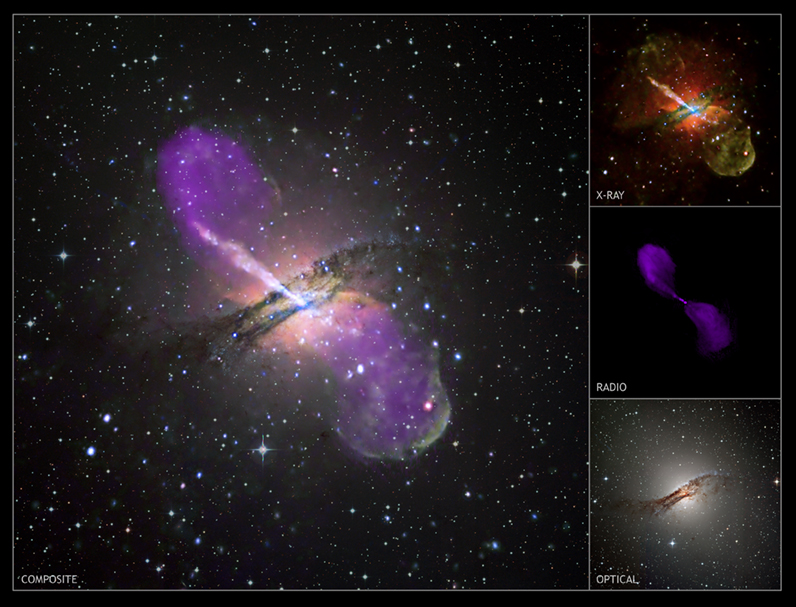
A dramatic new Chandra image of the nearby galaxy Centaurus A provides one of the best views to date of the effects of an active supermassive black hole. Opposing jets of high-energy particles can be seen extending to the outer reaches of the galaxy, and numerous smaller black holes in binary star systems are also visible.

The image was made from an ultra-deep look at the galaxy Centaurus A, equivalent to more than seven days of continuous observations. Centaurus A is the nearest galaxy to Earth that contains a supermassive black hole actively powering a jet.

A prominent X-ray jet extending for 13,000 light years points to the upper left in the image, with a shorter "counterjet" aimed in the opposite direction. Astronomers think that such jets are important vehicles for transporting energy from the black hole to the much larger dimensions of a galaxy, and affecting the rate at which stars form there.

High-energy electrons spiraling around magnetic field lines produce the X-ray emission from the jet and counterjet. This emission quickly saps the energy from the electrons, so they must be continually reaccelerated or the X-rays will fade out. Knot-like features in the jets detected in the Chandra image show where the acceleration of particles to high energies is currently occurring, and provides important clues to understanding the process that accelerates the electrons to near-light speeds.

The inner part of the X-ray jet close to the black hole is dominated by these knots of X-ray emission, which probably come from shock waves -- akin to sonic booms -- caused by the jet. Farther from the black hole there is more diffuse X-ray emission in the jet. The cause of particle acceleration in this part of the jet is unknown.

Hundreds of point-like sources are also seen in the Chandra image. Many of these are X-ray binaries that contain a stellar-mass black hole and a companion star in orbit around one another. Determining the population and properties of these black holes should help scientists better understand the evolution of massive stars and the formation of black holes.

Another surprise was the detection of two particularly bright X-ray binaries. These sources may contain stellar mass black holes that are unusually massive, and this Chandra observation might have caught them gobbling up material at a high rate.

In this image, low-energy X-rays are colored red, intermediate-energy X-rays are green, and the highest-energy X-rays detected by Chandra are blue. The dark green and blue bands running almost perpendicular to the jet are dust lanes that absorb X-rays. This dust lane was created when Centaurus A merged with another galaxy perhaps 100 million years ago.


Photo credit: (Top) NASA/CXC/CfA/R.Kraft et al.
(Bottom) X-ray: NASA/CXC/CfA/R.Kraft et al; Radio: NSF/VLA/Univ. Hertfordshire/M. Hardcastle; Optical: ESO/WFI/M.Rejkuba et al.)

Thursday, July 8, 2010

The Planck Microwave Sky with Highlighted Galaxies


Emission from gas and dust in the plane of the Milky Way dominates this multi-color all-sky image of the microwave sky, synthesized using data spanning the full frequency range of Planck, which covers the electromagnetic spectrum from 30 to 857 GHz.

Other galactic features recognizable in the image are the Galactic Center and the giant molecular clouds of Perseus and Orion, both of which are extremely active regions of star formation.

The Large Magellanic Cloud (LMC) and the Small Magellanic Cloud (SMC), two small satellite galaxies of the Milky Way which are also among our Galaxy's closest neighbors are clearly visible, as is the spiral galaxy M31, or Andromeda, the largest galactic neighbor of the Milky Way. The LMC lies at a distance of about 160,000 light-years from the Sun, the SMC at about 200,000 light-years and M31 at about 2.5 million light-years. All three objects, along with the Milky Way and several other galaxies, belong to the Local Group of galaxies.

In addition, Planck's ability to detect hundreds of extragalactic radio sources, both nearby and distant, is clearly evident in this image - two examples are highlighted in the northern hemisphere. Centaurus A, the most nearby giant elliptical galaxy, located about 12 million light-years away from us, is visible just above the Galactic Plane; this galaxy has an active galactic nucleus, with intense radio emission arising from jets of plasma and lobes of high-energy particles emanating from its central, supermassive black hole. Also, 3C 273, a bright radio source located at redshift z~0.15 (corresponding to a distance of about 2 thousand million light-years away) can be seen towards the northern Galactic Pole.

Photo credit: ESA, HFI and LFI consortia