Pages

Showing posts with label NuSTAR. Show all posts

Thursday, December 25, 2014

X-Ray Sun


X-rays stream off the sun in this image showing observations from by NASA's Nuclear Spectroscopic Telescope Array, or NuSTAR, overlaid on a picture taken by NASA's Solar Dynamics Observatory (SDO). This is the first picture of the sun taken by NuSTAR. The field of view covers the west limb of the sun.

The NuSTAR data, seen in green and blue, reveal solar high-energy emission (green shows energies between 2 and 3 kiloelectron volts, and blue shows energies between 3 and 5 kiloelectron volts). The high-energy X-rays come from gas heated to above 3 million degrees.

The red channel represents ultraviolet light captured by SDO at wavelengths of 171 angstroms, and shows the presence of lower-temperature material in the solar atmosphere at 1 million degrees.

This image shows that some of the hotter emission tracked by NuSTAR is coming from different locations in the active regions and the coronal loops than the cooler emission shown in the SDO image.

Image credit: NASA/JPL-Caltech/GSFC

Note: For more information, see Sun Sizzles in High-Energy X-Rays.

Thursday, October 9, 2014

Messier 82's Ultraluminous Pulsar


High-energy X-rays streaming from a rare and mighty pulsar (magenta), the brightest found to date, can be seen in this new image combining multi-wavelength data from three telescopes. The bulk of a galaxy called Messier 82 (M82), or the "Cigar galaxy," is seen in visible-light data captured by the National Optical Astronomy Observatory's 2.1-meter telescope at Kitt Peak in Arizona. Starlight is white, and lanes of dust appear brown. Low-energy X-ray data from NASA's Chandra X-ray Observatory are colored blue, and higher-energy X-ray data from NuSTAR are pink.

The magenta object is what's known as an ultraluminous X-ray source, or ULX -- a source of blazing X-rays. Previously, all ULXs were suspected to be massive black holes up to a few hundred times the mass of the sun. But NuSTAR spotted a pulsing of X-rays from this ULX (called M82 X-2) - a telltale sign of a pulsar, not a black hole. A pulsar is a type a neutron star -- a stellar core left over from a supernova explosion -- that sends out rotating beams of high-energy radiation. Scientists were surprised to find the pulsar at the root of the ULX because it shines with a luminosity that is more typical of heftier black holes.

NuSTAR data covers the X-ray energy range of 10 to 40 kiloelectron volts (keV), and Chandra covers the range .1 to 10 keV.


Image credit: NASA/JPL-Caltech/SAO/NOAO

Note: For more information, see:
* M82X-2: Suspected Black Hole Unmasked as Ultraluminous Pulsar
* PIA18840: Galaxy in Different Lights
* PIA18842: Mass Chart for Dead Stars and Black Holes
* PIA18843: NuSTAR Captures the Beat of a Dead Star (Animation)
* PIA18844: Ultraluminous X-ray Sources in M82 Galaxy
* PIA18845: Beacons of X-ray Light (Animation)
* NASA's NuSTAR Telescope Discovers Shockingly Bright Dead Star

Wednesday, September 17, 2014

Pulsar PSR J1640-4631


The blue dot in this image marks the spot of an energetic pulsar -- the magnetic, spinning core of star that blew up in a supernova explosion. NASA's Nuclear Spectroscopic Telescope Array, or NuSTAR, discovered the pulsar by identifying its telltale pulse -- a rotating beam of X-rays, that like a cosmic lighthouse, intersects Earth every 0.2 seconds.

The pulsar, called PSR J1640-4631, lies in our inner Milky Way galaxy about 42,000 light-years away. It was originally identified by as an intense source of gamma rays by the High Energy Stereoscopic System (H.E.S.S.) in Namibia. NuSTAR helped pin down the source of the gamma rays to a pulsar.

The other pink dots in this picture show low-energy X-rays detected by NASA's Chandra X-ray Observatory.

In this image, NuSTAR data is blue and shows high-energy X-rays with 3 to 79 kiloelectron volts; Chandra data is pink and shows X-rays with 0.5 to 10 kiloeletron volts.

Image credit: NASA/JPL-Caltech/SAO

Note: For more information, see Pulse of a Dead Star Powers Intense Gamma Rays.

Wednesday, August 13, 2014

Supermassive Black Hole


This artist's concept illustrates a supermassive black hole with millions to billions times the mass of our sun. Supermassive black holes are enormously dense objects buried at the hearts of galaxies. (Smaller black holes also exist throughout galaxies.) In this illustration, the supermassive black hole at the center is surrounded by matter flowing onto the black hole in what is termed an accretion disk. This disk forms as the dust and gas in the galaxy falls onto the hole, attracted by its gravity.

Also shown is an outflowing jet of energetic particles, believed to be powered by the black hole's spin. The regions near black holes contain compact sources of high energy X-ray radiation thought, in some scenarios, to originate from the base of these jets. This high energy X-radiation lights up the disk, which reflects it, making the disk a source of X-rays. The reflected light enables astronomers to see how fast matter is swirling in the inner region of the disk, and ultimately to measure the black hole's spin rate.

Illustration credit: NASA/JPL-Caltech

Note: For more information, see NASA's NuSTAR Sees Rare Blurring of Black Hole Light and PIA18467: Big, Spinning Black Hole Blurs Light.

Thursday, February 20, 2014

Cassiopeia A


The mystery of how Cassiopeia A exploded is unraveling thanks to new data from NASA's Nuclear Spectroscopic Telescope Array, or NuSTAR. In this image, NuSTAR data, which show high-energy X-rays from radioactive material, are colored blue. Lower-energy X-rays from non-radioactive material, imaged previously with NASA's Chandra X-ray Observatory, are shown in red, yellow and green.

The new view shows a more complete picture of Cassiopeia A, the remains of a star that blew up in a supernova event whose light reached Earth about 350 years ago, when it could have appeared to observers as a star that suddenly brightened. The remnant is located 11,000 light-years away from Earth.

NuSTAR is the first telescope capable of taking detailed pictures of the radioactive material in the Cassiopeia A supernova remnant. While other telescopes have detected radioactivity in these objects before, NuSTAR is the first capable of pinpointing the location of the radioactivity, creating maps. When massive star explode, they create many elements: non-radioactive ones like iron and calcium found in your blood and bones; and radioactive elements like titanium-44, the decay of which sends out high-energy X-ray light that NuSTAR can see.

By mapping titanium-44 in Cassiopeia A, astronomers get a direct look at what happened in the core of the star when it was blasted to smithereens. These NuSTAR data complement previous observations made by Chandra, which show elements, such as iron, that were heated by shock waves farther out from the remnant's center.

In this image, the red, yellow and green data were collected by Chandra at energies ranging from 1 to 7 kiloelectron volts (keV). The red color shows heated iron, and green represents heated silicon and magnesium. The yellow is what astronomers call continuum emission, and represents a range of X-ray energies.

The titanium-44, shown in blue, was detected by NuSTAR at energies ranging between 68 and 78 keV.

The NuSTAR observations point to a possible solution to the puzzle of how stars detonate. The fact that the titanium -- which is a direct tracer of the supernova blast -- is concentrated in clumps at the core supports a theory referred to as "mild asymmetries." In this scenario, material sloshes about at the heart of the supernova, reinvigorating a shock wave and allowing it to blow out the star's outer layers.

Image credit: NASA/JPL-Caltech/CXC/SAO

Note: For more information, see PIA17839: Adding a New "Color" to Palate of Cassiopeia A Images, PIA17840: The Creation of Titanium in Stars, PIA17841: Radioactive Core of a Dead Star, PIA17842: The Case of Missing Iron in Cassiopeia A, PIA17844: Evolution of a Supernova, PIA17846: NuSTAR Data Point to Sloshing Supernovas, PIA17845: Sloshing Star Goes Supernova, NASA's NuSTAR Untangles Mystery of How Stars Explode, and Supernovas Slosh Before Exploding.

Monday, January 13, 2014

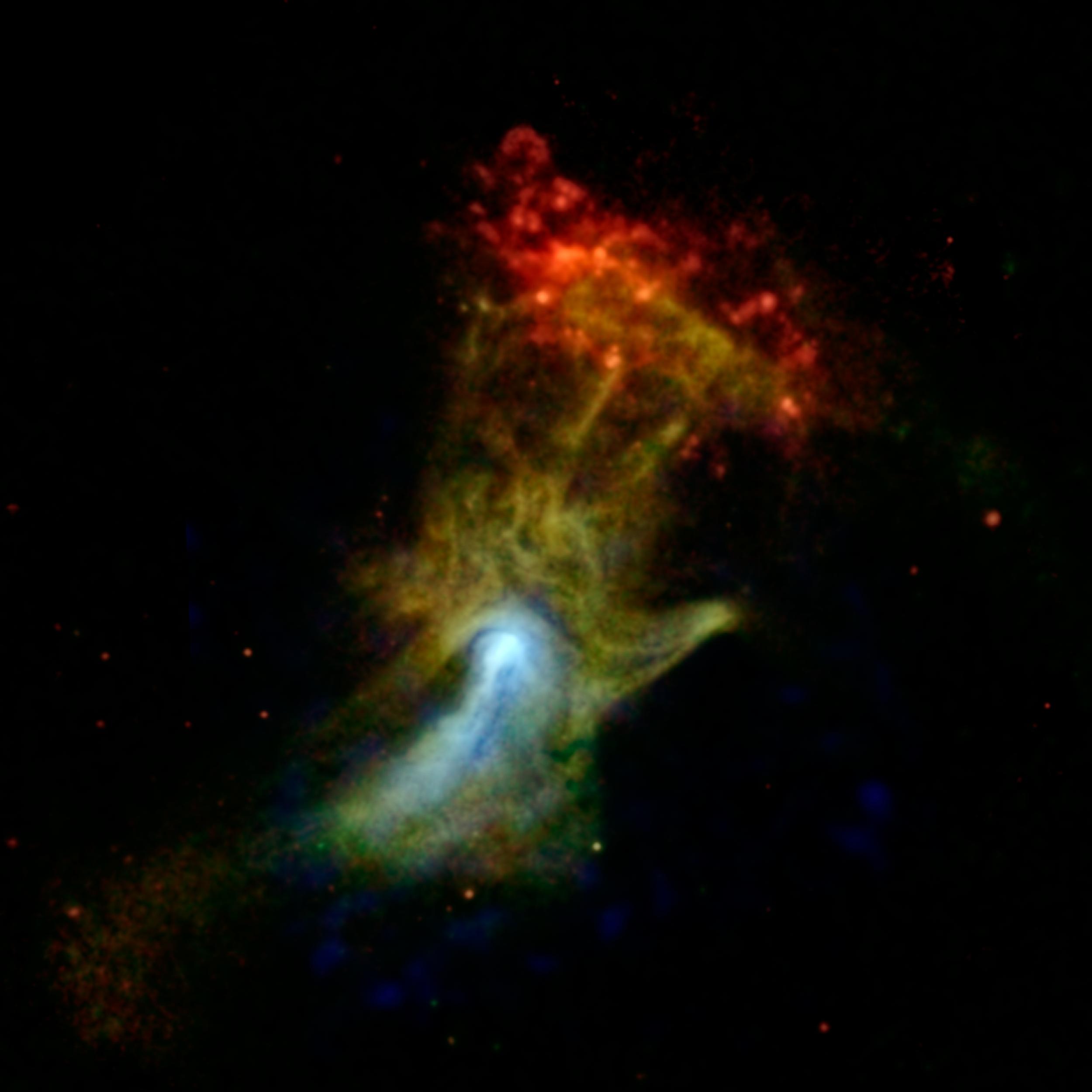
Pulsar Wind Nebula PSR B1509-58


Can you see the shape of a hand in this new X-ray image? The hand might look like an X-ray from the doctor's office, but it is actually a cloud of material ejected from a star that exploded. NASA's Nuclear Spectroscopic Telescope Array, or NuSTAR, has imaged the structure in high-energy X-rays for the first time, shown in blue. Lower-energy X-ray light previously detected by NASA's Chandra X-ray Observatory is shown in green and red.

Nicknamed the "Hand of God," this object is called a pulsar wind nebula. It's powered by the leftover, dense core of a star that blew up in a supernova explosion. The stellar corpse, called PSR B1509-58, or B1509 for short, is a pulsar: it rapidly spins around, seven times per second, firing out a particle wind into the material around it -- material that was ejected in the star's explosion. These particles are interacting with magnetic fields around the material, causing it to glow with X-rays. The result is a cloud that, in previous images, looked like an open hand. The pulsar itself can't be seen in this picture, but is located near the bright white spot.

One of the big mysteries of this object is whether the pulsar particles are interacting with the material in a specific way to make it look like a hand, or if the material is in fact shaped like a hand.

NuSTAR's view is providing new clues to the puzzle. The hand actually shrinks in the NuSTAR image, looking more like a fist, as indicated by the blue color. The northern region, where the fingers are located, shrinks more than the southern part, where a jet lies, implying the two areas are physically different.

The red cloud at the end of the finger region is a different structure, called RCW 89. Astronomers think the pulsar's wind is heating the cloud, causing it to glow with lower-energy X-ray light.

In this image, X-ray light seen by Chandra with energy ranges of 0.5 to 2 kiloelectron volts (keV) and 2 to 4 keV is shown in red and green, respectively, while X-ray light detected by NuSTAR in the higher-energy range of 7 to 25 keV is blue.

Image credit: NASA/JPL-Caltech/McGill

Note: For more information, see PIA17567: Different Flavors of Black Holes and Dead Star and Distant Black Holes Dazzle in X-Rays.

Saturday, November 30, 2013

Black Holes in NGC 1313


The magenta spots in this image show two black holes in the spiral galaxy called NGC 1313, or the Topsy Turvy galaxy. Both black holes belong to a class called ultraluminous X-ray sources, or ULXs. The magenta X-ray data come from NASA's Nuclear Spectroscopic Telescopic Array, and are overlaid on a visible image from the Digitized Sky Survey.

ULXs consist of black holes actively accreting, or feeding, off material drawn in from a partner star. Astronomers are trying to figure out why ULXs shine so brightly with X-rays.

NuSTAR's new high-energy X-ray data on NGC 1313 helped narrow down the masses of the black holes in the ULXs: the black hole closer to the center of the galaxy is about 70 to 100 times that of our sun. The other black hole is probably smaller, about 30 solar masses.

Image credit: NASA/JPL-Caltech/IRAP

Note: For more information, see Do Black Holes Come in Size Medium?

Thursday, November 28, 2013

Black Holes in Circinus Galaxy


The magenta spots in this image show two black holes in the Circinus galaxy: the supermassive black hole at its heart, and a smaller one closer to the edge that belongs to a class called ultraluminous X-ray sources, or ULXs. The magenta X-ray data come from NASA's Nuclear Spectroscopic Telescopic Array, and are overlaid on a visible/infrared image from the Digitized Sky Survey.

ULXs consist of black holes actively accreting, or feeding, off material drawn in from a partner star. Astronomers are trying to figure out why ULXs shine so brightly with X-rays.

The ULX was spotted serendipitously by NuSTAR, which sees high-energy X-ray light. Further observations with other telescopes, combined with NuSTAR's data, revealed that the black hole is about 100 times the mass of our sun.

The Circinus galaxy is located 13 million light-years from Earth in the Circinus constellation.

Image credit: NASA/JPL-Caltech

Note: For more information, see Do Black Holes Come in Size Medium?

Sunday, September 8, 2013

Massive Black Holes Near IC 751


An optical color image of galaxies is seen here overlaid with X-ray data (magenta) from NASA's Nuclear Spectroscopic Telescope Array (NuSTAR).

NuSTAR's serendipitous discovery in this field, indicated by the arrow (Figure 1), lies to the left of a galaxy, called IC751, at which the telescope originally intended to look. Both magenta blobs show X-rays from massive black holes buried at the hearts of galaxies.

The optical image is from the Sloan Digital Sky Survey and a color composite of images over three different optical wavebands (the G, R, and I bands). The NuSTAR data shows X-rays in the 3 to 24 keV energy range.

Image credit: NASA/JPL-Caltech

Note: For more information, see Catching Black Holes on the Fly.

Sunday, June 16, 2013

NGC 253, the Sculptor Galaxy


The Sculptor galaxy is seen in a new light, in this composite image from NASA's Nuclear Spectroscopic Telescope Array (NuSTAR) and the European Southern Observatory in Chile. Visible data from the European Space Observatory show the backbone of the galaxy made up of stars, while NuSTAR data, which appear as colored blobs, show high-energy X-rays. The NuSTAR observations are the sharpest ever taken of this galaxy in high-energy X-rays.

The findings, when combined with those from NASA's Chandra X-ray Observatory, suggest that the supermassive black hole at the center of the Sculptor galaxy, also known as NGC 253, has dozed off, or gone inactive, sometime in the past decade. Future observations from both telescopes should help address this mystery.

The NuSTAR data also reveals a flaring source of high-energy X-rays, called an ultraluminous X-ray source, or ULX. This object, which appears as a blue spot near the hotter, central region of the galaxy, is either a black hole or a dense, dead star, called a neutron star, feeding off a partner star. The flare is thought to be the result of a change in the object's feeding patterns.

The other orange and reddish points are likely additional X-ray-generating pairs of stars located throughout the galaxy.

In this image, red shows low-energy X-ray radiation (3 to 7 kiloelectron volts), green is medium energy (7 to 10 kiloelectron volts), and blue is high energy (10 to 20 kiloelectron volts).

Image credit: NASA/JPL-Caltech/JHU

Note: For more information, see Black Hole Naps Amidst Stellar Chaos.

Tuesday, March 5, 2013

Supermassive Black Hole in NGC 1365


ESA's XMM-Newton and NASA's NuSTAR have detected a supermassive black hole spinning at almost the speed of light in the heart of spiral galaxy NGC 1365. The rate at which a black hole spins encodes the history of its formation. An extremely rapid rotation could result from either a steady and uniform flow of matter spiraling in via an accretion disc (as shown in this artist impression) or as a result of the merger of two galaxies and their smaller black holes.

Also depicted in this image is an outflowing jet of energetic particles, believed to be powered by the black hole's spin. The regions near black holes contain compact sources of high energy X-ray radiation thought, in some scenarios, to originate from the base of these jets. The nature of the X-ray emission enables astronomers to see how fast matter is swirling in the inner region of the disc, and ultimately to measure the black hole's spin rate.

Illustration credit: NASA/JPL-Caltech

Note: For more information, see Speedy Black Hole Holds Galaxy's History. Also, PIA16695: Black Holes: Monsters in Space (Artist's Concept), PIA16696: How to Measure the Spin of a Black Hole (Artist's Concept), and PIA16697: Two Models of Black Hole Spin (Artist's Concept). Also, PIA16698: Complementary X-Ray Vision, PIA16699: NuSTAR's Improved View, and PIA16870: Two X-Ray Observatories are Better Than One. Also, NASA's NuSTAR Helps Solve Riddle of Black Hole Spin.

Thursday, January 10, 2013

IC 342


This new view of spiral galaxy IC 342, also known as Caldwell 5, includes data from NASA's Nuclear Spectroscopic Telescope Array, or NuSTAR. High-energy X-ray data from NuSTAR have been translated to the color magenta, and superimposed on a visible-light view highlighting the galaxy and its star-studded arms. NuSTAR is the first orbiting telescope to take focused pictures of the cosmos in high-energy X-ray light; previous observations of this same galaxy taken at similar wavelengths blurred the entire object into one pixel.

The two magenta spots are blazing black holes first detected at lower-energy X-ray wavelengths by NASA's Chandra X-ray Observatory. With NuSTAR's complementary data, astronomers can start to home in on the black holes' mysterious properties. The black holes appear much brighter than typical stellar-mass black holes, such as those that pepper our own galaxy, yet they cannot be supermassive black holes or they would have sunk to the galaxy's center. Instead, they may be intermediate in mass, or there may be something else going on to explain their extremely energetic state. NuSTAR will help solve this puzzle.

IC 342 lies 7 million light-years away in the Camelopardalis constellation. The outer edges of the galaxy cannot be seen in this view.

This image shows NuSTAR X-ray data taken at 10 to 35 kiloelectron volts.

The visible-light image is from the Digitized Sky Survey.

Photo credit:
NASA/JPL-Caltech/DSS

Note: For more information, see NASA's NuSTAR Catches Black Holes in Galaxy Web.

Wednesday, January 9, 2013

Cassiopeia A by NuSTAR


This new view of the historical supernova remnant Cassiopeia A, located 11,000 light-years away, was taken by NASA's Nuclear Spectroscopic Telescope Array, or NuSTAR. Blue indicates the highest energy X-ray light, where NuSTAR has made the first resolved image ever of this source. Red and green show the lower end of NuSTAR's energy range, which overlaps with NASA's high-resolution Chandra X-ray Observatory.

Light from the stellar explosion that created Cassiopeia A is thought to have reached Earth about 300 years ago, after traveling 11,000 years to get here. While the star is long dead, its remains are still bursting with action. The outer blue ring is where the shock wave from the supernova blast is slamming into surrounding material, whipping particles up to within a fraction of a percent of the speed of light. NuSTAR observations should help solve the riddle of how these particles are accelerated to such high energies

X-ray light with energies between 10 and 20 kiloelectron volts are blue; X-rays of 8 to 10 kiloelectron volts are green; and X-rays of 4.5 to 5.5 kiloelectron volts are red.

The starry background picture is from the Digitized Sky Survey.

Photo credit: NASA/JPL-Caltech/DSS

Sunday, July 1, 2012

Cygnus X-1 by NuSTAR


NASA's Nuclear Spectroscopic Telescope Array, or NuSTAR, has taken its first snapshots of the highest energy X-rays in the cosmos, the same kind used by doctors to take pictures of your bones. NuSTAR chose a black hole in the constellation Cygnus (shown on the left) as its first target due to its brightness.

The inset image on the top right was taken with the INTEGRAL high-energy telescope; the image is 1 degree across, or twice the diameter of the moon. The bottom image shows NuSTAR's snapshot of the central part of that image. While INTEGRAL studies sources over wide swaths of sky, NuSTAR zooms into selected regions with much crisper vision.

Cygnus X-1 is a black hole that is siphoning matter from a giant companion star and spitting out high-energy X-rays. It is located in our Milky Way galaxy, about 6,000 light-years from Earth.

The NuSTAR team will use this and other "first-light" images to calibrate the pointing alignment between the spacecraft and the X-ray telescope.

Image credit: NASA/JPL-Caltech

Note: For more information, see Space Telescope Opens Its X-Ray Eyes.