Pages

Showing posts with label NGC 0253 - Sculptor Galaxy. Show all posts

Saturday, August 24, 2013

NGC 253


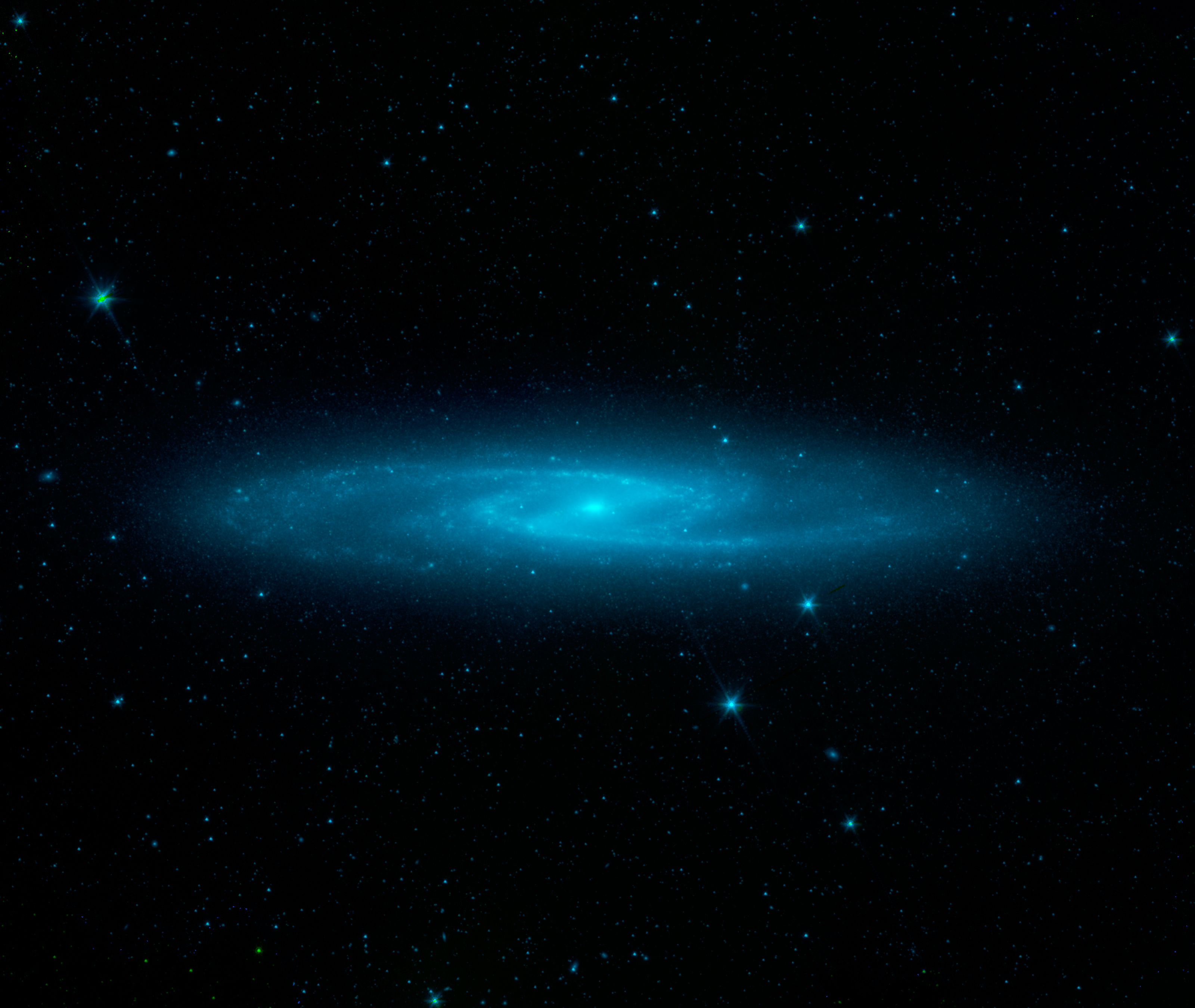
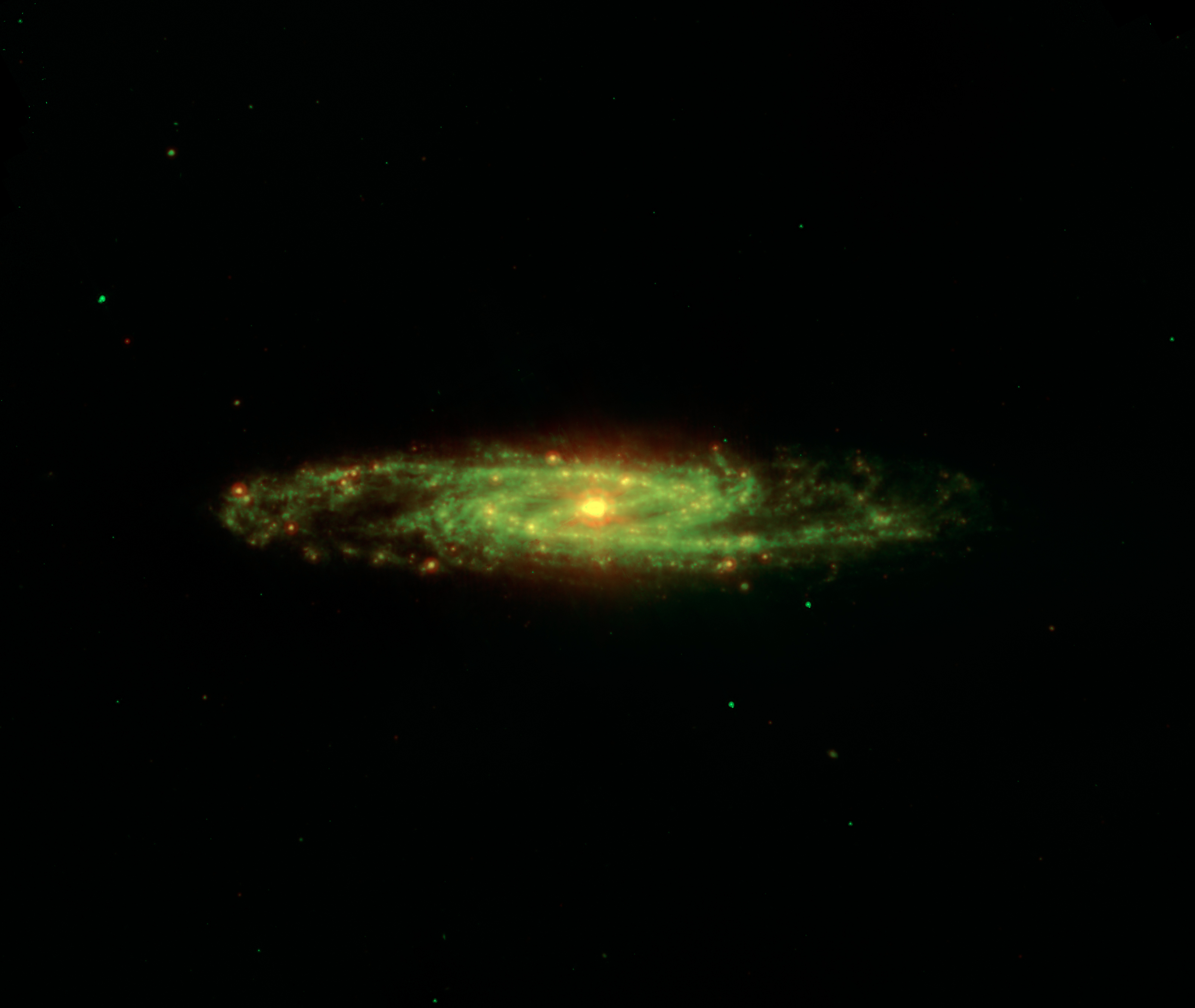
The spectacular swirling arms and central bar of the Sculptor galaxy are revealed in this new view from NASA's Spitzer Space Telescope. This image is an infrared composite combining data from two of Spitzer's detectors taken during its early cold, or cryogenic, mission.

Also known as NGC 253, the Sculptor galaxy is part of a cluster of galaxies visible to observers in the Southern hemisphere. It is known as a starburst galaxy for the extraordinarily strong star formation in its nucleus. This activity warms the surrounding dust clouds, causing the brilliant yellow-red glow in the center of this infrared image.

Figure 1 is split into two constituent parts on the right. On the top is a blue glow primarily from the light of stars as seen at the shorter wavelengths of infrared light. In this view, the disk, spiral arms and central bar are easy to see. The lower right image shows the glow of dust at longer infrared wavelengths in green and red. Regions of star formation glow especially bright at the longest wavelengths (red).

While Spitzer is now operating without any onboard cryogen, it can still operate its shorter-wavelength detectors to produce images equivalent to the star map on the upper right. Spitzer continues to be a valuable tool for studying the infrared properties of galaxies near and far.

Infrared light with wavelengths of 3.6 and 4.5 microns is shown as blue/cyan. Eight-micron light is rendered in green, and 24-micron emission is red.

Image credit: NASA/JPL-Caltech

Note: For more information, see NASA's Spitzer Telescope Celebrates 10 Years in Space.

Thursday, July 25, 2013

3D View of Carbon Monoxide Emissions in NGC 253


This picture shows a view of a three-dimensional visualization of ALMA observations of cold carbon monoxide gas in the nearby starburst galaxy NGC 253 (The Sculptor Galaxy). The vertical axis shows velocity and the horizontal axis the position across the central part of the galaxy. The colors represent the intensity of the emission detected by ALMA, with pink being the strongest and red the weakest.

These data have been used to show that huge amounts of cool gas are being ejected from the central parts of this galaxy. This will make it more difficult for the next generation of stars to form.

Image credit: ALMA (ESO/NAOJ/NRAO)/Erik Rosolowsky

Note: For more information, see Starburst to Star Bust.

Sunday, June 16, 2013

NGC 253, the Sculptor Galaxy


The Sculptor galaxy is seen in a new light, in this composite image from NASA's Nuclear Spectroscopic Telescope Array (NuSTAR) and the European Southern Observatory in Chile. Visible data from the European Space Observatory show the backbone of the galaxy made up of stars, while NuSTAR data, which appear as colored blobs, show high-energy X-rays. The NuSTAR observations are the sharpest ever taken of this galaxy in high-energy X-rays.

The findings, when combined with those from NASA's Chandra X-ray Observatory, suggest that the supermassive black hole at the center of the Sculptor galaxy, also known as NGC 253, has dozed off, or gone inactive, sometime in the past decade. Future observations from both telescopes should help address this mystery.

The NuSTAR data also reveals a flaring source of high-energy X-rays, called an ultraluminous X-ray source, or ULX. This object, which appears as a blue spot near the hotter, central region of the galaxy, is either a black hole or a dense, dead star, called a neutron star, feeding off a partner star. The flare is thought to be the result of a change in the object's feeding patterns.

The other orange and reddish points are likely additional X-ray-generating pairs of stars located throughout the galaxy.

In this image, red shows low-energy X-ray radiation (3 to 7 kiloelectron volts), green is medium energy (7 to 10 kiloelectron volts), and blue is high energy (10 to 20 kiloelectron volts).

Image credit: NASA/JPL-Caltech/JHU

Note: For more information, see Black Hole Naps Amidst Stellar Chaos.

Friday, December 16, 2011

NGC 253


The VLT Survey Telescope (VST) has captured in sharp detail the beauty of the nearby spiral galaxy NGC 253. This new portrait is probably the best wide-field view of this object and its surroundings ever taken. It demonstrates that the VST, the newest telescope at ESO's Paranal Observatory, provides broad views of the sky while also offering impressive image quality. Luminous regions of ongoing star formation are spread throughout NGC 253, which is pumping out new stars at a furious pace. The data were processed using the VST-Tube system developed by A. Grado and collaborators at the INAF-Capodimonte Observatory.

Photo credit: ESO/INAF-VST; Acknowledgement: A. Grado/L. Limatola/INAF-Capodimonte Observatory

Note: For more information, see A Galaxy Blooming with New Stars

Thursday, October 14, 2010

NGC 253 - The Sculptor Galaxy in Infrared


The Sculptor galaxy is shown in different infrared hues, in this new mosaic from NASA's Wide-field Infrared Survey Explorer, or WISE. This image is a composite of infrared light captured with all four of the space telescope's infrared detectors.

The red image shows the galaxy's active side. Infant stars are heating up their dusty cocoons, particularly in the galaxy's core, making the Sculptor galaxy burst with infrared light. This light -- color-coded red in this view -- was captured using WISE's longest-wavelength, 22-micron detector. The dusty burst of stars is so intense in the core that it generates diffraction spikes. Diffraction spikes are telescope artifacts normally seen only around very bright stars.

The green image reveals the galaxy's emerging young stars, concentrated in the core and spiral arms. Ultraviolet light from these hot stars is being absorbed by tiny dust or soot particles left over from their formation, making the particles glow with infrared light that has been color-coded green in this view. WISE can see this light with a detector designed to capture wavelengths of 12 microns.

The blue image was taken with the two shortest-wavelength detectors on WISE (3.4 and 4.6 microns). It shows stars of all ages, which can be found not just in the core and spiral arms, but throughout the galaxy.

The Sculptor galaxy, or NGC 253, was discovered in 1783 by Caroline Herschel, a sister and collaborator of the discoverer of infrared light, Sir William Herschel. It was named after the constellation in which it is found, and is part of a cluster of galaxies known as the Sculptor group. The Sculptor galaxy can be seen by observers in the southern hemisphere with a pair of good binoculars.

NGC 253 is an active galaxy, which means that a significant fraction of its energy output does not come from normal populations of stars within the galaxy. The extraordinarily high amount of star formation occurring in the nucleus of this galaxy has led astronomers to classify it as a "starburst" galaxy. At a distance of approximately 10.5 million light-years away, NGC 253 is the closest starburst galaxy to our Milky Way galaxy. However, the starburst alone cannot explain all the activity observed in the nucleus. One strong possibility is that a giant black hole lurks at the heart of it all, similar to the one that lies at the center of the Milky Way.

In late September of this year, after surveying the sky about one-and-a-half times, WISE exhausted its supply of the frozen coolant needed to chill its longest-wavelength detectors -- the 12- and 22-micron channels. The satellite is continuing to survey the sky with its two remaining detectors, focusing primarily on asteroids and comets. Read more about this survey, called the NEOWISE Post-Cryogenic mission, at:  http://www.jpl.nasa.gov/news/news.cfm?release=2010-320.

Photo credit: NASA/JPL-Caltech/UCLA

Thursday, September 9, 2010

NGC 300


ESO has released a spectacular new image of NGC 300, a spiral galaxy similar to the Milky Way, and located in the nearby Sculptor Group of galaxies. Taken with the Wide Field Imager (WFI) at ESO’s La Silla Observatory in Chile, this 50-hour exposure reveals the structure of the galaxy in exquisite detail. NGC 300 lies about six million light-years away and appears to be about two thirds the size of the full Moon on the sky.

Originally discovered from Australia by the Scottish astronomer James Dunlop early in the nineteenth century, NGC 300 is one of the closest and most prominent spiral galaxies in the southern skies and is bright enough to be seen easily in binoculars. It lies in the inconspicuous constellation of Sculptor, which has few bright stars, but is home to a collection of nearby galaxies that form the Sculptor Group. Other members that have been imaged by ESO telescopes include NGC 55 (eso0914), NGC 253 (eso1025, eso0902) and NGC 7793 (eso0914). Many galaxies have at least some slight peculiarity, but NGC 300 seems to be remarkably normal. This makes it an ideal specimen for astronomers studying the structure and content of spiral galaxies such as our own.

This picture from the Wide Field Imager (WFI) at ESO’s La Silla Observatory in Chile was assembled from many individual images taken through a large set of different filters with a total exposure time close to 50 hours. The data was acquired over many observing nights, spanning several years. The main purpose of this extensive observational campaign was to take an unusually thorough census of the stars in the galaxy, counting both the number and varieties of the stars, and marking regions, or even individual stars, that warrant deeper and more focused investigation. But such a rich data collection will also have many other uses for years to come. By observing the galaxy with filters that isolate the light coming specifically from hydrogen and oxygen, the many star-forming regions along NGC 300’s spiral arms are shown with particular clarity in this image as red and pink clouds. With its huge field of view, 34 x 34 arcminutes, similar to the apparent size of the full Moon in the sky, the WFI is an ideal tool for astronomers to study large objects such as NGC 300.

NGC 300 is also the home of many interesting astronomical phenomena that have been studied with ESO telescopes. ESO astronomers recently discovered the most distant and one of the most massive stellar-mass black holes yet found (eso1004) in this galaxy, as the partner of a hot and luminous Wolf–Rayet star in a binary system. NGC 300 and another galaxy, NGC 55, are slowly spinning around and towards each other, in the early stages of a lengthy merging process (eso0914). The current best estimate of the distance to the NCG 300 was also determined by astronomers using ESO’s Very Large Telescope at the Paranal Observatory (eso0524), among others.

Photo credit: European Southern Observatory

Thursday, August 5, 2010

NGC 253 - The Sculptor Galaxy


A spectacular new image of the Sculptor Galaxy (NGC 253) has been taken with the ESO VISTA telescope at the Paranal Observatory in Chile as part of one of its first major observational campaigns. By observing in infrared light VISTA’s view is less affected by dust and reveals a myriad of cooler stars as well as a prominent bar of stars across the central region. The VISTA image provides much new information on the history and development of the galaxy.

The Sculptor Galaxy (NGC 253) lies in the constellation of the same name and is one of the brightest galaxies in the sky. It is prominent enough to be seen with good binoculars and was discovered by Caroline Herschel from England in 1783. NGC 253 is a spiral galaxy that lies about 13 million light-years away. It is the brightest member of a small collection of galaxies called the Sculptor Group, one of the closest such groupings to our own Local Group of galaxies. Part of its visual prominence comes from its status as a starburst galaxy, one in the throes of rapid star formation. NGC 253 is also very dusty, which obscures the view of many parts of the galaxy (eso0902). Seen from Earth, the galaxy is almost edge on, with the spiral arms clearly visible in the outer parts, along with a bright core at its center.

...

As VISTA, the Visible and Infrared Survey Telescope for Astronomy, works at infrared wavelengths it can see right through most of the dust that is such a prominent feature of the Sculptor Galaxy when viewed in visible light. Huge numbers of cooler stars that are barely detectable with visible-light telescopes are now also seen. The VISTA view reveals most of what was hidden by the thick dust clouds in the central part of the disc and allows a clear view of a prominent bar of stars across the nuclear region — a feature that is not seen in visible light pictures. The majestic spiral arms now spread over the whole disc of the galaxy.

Photo credit: ESO/J. Emerson/VISTA. Acknowledgment: Cambridge Astronomical Survey Unit