Pages

Showing posts with label Cassini. Show all posts

Friday, October 31, 2014

Sunglint Off of Titan's Kraken Mare


This near-infrared, color mosaic from NASA's Cassini spacecraft shows the sun glinting off of Titan's north polar seas. While Cassini has captured, separately, views of the polar seas (see PIA17470) and the sun glinting off of them (see PIA12481 and PIA18433) in the past, this is the first time both have been seen together in the same view.

The sunglint, also called a specular reflection, is the bright area near the 11 o'clock position at upper left. This mirror-like reflection, known as the specular point, is in the south of Titan's largest sea, Kraken Mare, just north of an island archipelago separating two separate parts of the sea.

This particular sunglint was so bright as to saturate the detector of Cassini's Visual and Infrared Mapping Spectrometer (VIMS) instrument, which captures the view. It is also the sunglint seen with the highest observation elevation so far -- the sun was a full 40 degrees above the horizon as seen from Kraken Mare at this time -- much higher than the 22 degrees seen in PIA18433. Because it was so bright, this glint was visible through the haze at much lower wavelengths than before, down to 1.3 microns.

The southern portion of Kraken Mare (the area surrounding the specular feature toward upper left) displays a "bathtub ring" -- a bright margin of evaporate deposits -- which indicates that the sea was larger at some point in the past and has become smaller due to evaporation. The deposits are material left behind after the methane & ethane liquid evaporates, somewhat akin to the saline crust on a salt flat.

The highest resolution data from this flyby -- the area seen immediately to the right of the sunglint -- cover the labyrinth of channels that connect Kraken Mare to another large sea, Ligeia Mare. Ligeia Mare itself is partially covered in its northern reaches by a bright, arrow-shaped complex of clouds. The clouds are made of liquid methane droplets, and could be actively refilling the lakes with rainfall.

The view was acquired during Cassini's August 21, 2014, flyby of Titan, also referred to as "T104" by the Cassini team.

The view contains real color information, although it is not the natural color the human eye would see. Here, red in the image corresponds to 5.0 microns, green to 2.0 microns, and blue to 1.3 microns. These wavelengths correspond to atmospheric windows through which Titan's surface is visible. The unaided human eye would see nothing but haze, as in PIA12528.

Image credit: NASA/JPL-Caltech/University of Arizona/University of Idaho

Note: For more information, see PIA18433: Sunglint on a Hydrocarbon Lake and Cassini Sees Sunny Seas on Titan.

Friday, October 3, 2014

Titan's South Polar Vortex


These two views of Saturn's moon Titan show the southern polar vortex, a huge, swirling cloud that was first observed by NASA's Cassini spacecraft in 2012.

The view at left is a spectral map of Titan obtained with the Cassini Visual and Infrared Mapping Spectrometer (VIMS) on November 29, 2012. The inset image is a natural-color close-up of the polar vortex taken by Cassini's wide-angle camera (part of the view previously released as PIA14925).

Three distinct components are evident in the VIMS image, represented by different colors: the surface of Titan (orange, near center), atmospheric haze along the limb (light green, at top) and the polar vortex (blue, at lower left).

To the VIMS instrument, the spectrum of the southern polar vortex shows a remarkable difference with respect to other portions of Titan's atmosphere: a signature of frozen hydrogen cyanide molecules (HCN). This discovery has suggested to researchers that the atmosphere of Titan's southern hemisphere is cooling much faster than expected. Observing seasonal shifts like this in the moon's climate is a major goal for Cassini's current extended mission.

Image credit: NASA/JPL-Caltech/ASI/University of Arizona/SSI/Leiden Observatory and SRON

Note: For more information, see Titan's Swirling Polar Cloud is Cold and Toxic (ESA) and Swirling Cloud at Titan's Pole is Cold and Toxic (JPL).

Tuesday, September 30, 2014

Unusual Changing Feature in Titan's Ligeia Mare


These three images, created from Cassini Synthetic Aperture Radar (SAR) data, show the appearance and evolution of a mysterious feature in Ligeia Mare, one of the largest hydrocarbon seas on Saturn's moon Titan. The views, taken during three different Cassini flybys of Titan, show that this feature was not visible in earlier radar images of the same region and its appearance changed between 2013 and 2014.

In the images, the dark areas represent the sea, which is thought to be composed of mostly methane and ethane. Most of the bright areas represent land surface above or just beneath the water line. The mysterious bright feature appears off the coast below center in the middle and right images.

The mystery feature had not been seen in preceding SAR observations of the region from 2007 to 2009. After its first appearance in early July 2013, it was not visible in observations by Cassini's Visible and Infrared Mapping Spectrometer, obtained later in July and in September 2013. Low-resolution SAR images obtained in October 2013 also failed to recover the feature.

The SAR observation from Cassini's August 21, 2014 Titan flyby shows that the feature was still visible, although its appearance changed during the 11 months since it was last observed. The feature seems to have changed in size between the images from 2013 and 2014 -- doubling from about 30 square miles (about 75 square kilometers) to about 60 square miles (about 160 square kilometers). Ongoing analyses of these data may eliminate some of the explanations previously put forward, or reveal new clues as to what is happening in Titan's seas.

The Cassini radar team is investigating possible origins for the feature, including surface waves, rising bubbles, floating solids, solids that are suspended just below the surface or perhaps something more exotic. Researchers suspect that the appearance of this feature could be related to changing seasons on Titan, as summer draws near in the moon's northern hemisphere. Monitoring such changes is a major goal for Cassini's current extended mission.

The upper half of the middle image uses data from the April 26, 2007 Titan flyby. That area did not receive SAR coverage during the July 10, 2013 encounter, so the earlier data was used to fill-in the scene.

Image credit: NASA/JPL-Caltech/ASI/Cornell

Tuesday, September 23, 2014

Saturn's North Polar Hexagon


The giant planet Saturn is mostly a gigantic ball of rotating gas, completely unlike our solid home planet. But Earth and Saturn do have something in common: weather, although the gas giant is home to some of the most bizarre weather in our Solar System, such as the swirling storm shown in this Cassini view.

Known as “the hexagon”, this weather feature is an intense, six-sided jet stream at Saturn’s north pole. Spanning some 30,000 km across, it hosts howling 320 km/h winds that spiral around a massive storm rotating anticlockwise at the heart of the region.

Numerous small vortices rotate in the opposite direction to the central storm and are dragged around with the jet stream, creating a terrifically turbulent region. While a hurricane on Earth may last a week or more, the hexagon has been raging for decades, and shows no signs of letting up.

This false-color image of the hexagon was made using ultraviolet, visible and infrared filters to highlight different regions.

The dark center of the image shows the large central storm and its eye, which is up to 50 times bigger than a terrestrial hurricane eye. The small vortices show up as pink-red clumps. Towards the lower right of the frame is a white-tinted oval storm that is bigger than any of the others — this is the largest of the vortices at some 3500 km across, twice the size of the largest hurricane ever recorded on Earth.

The darker blue region within the hexagon is filled with small haze particles, whereas the paler blue region is dominated by larger particles. This divide is caused by the hexagonal jet stream acting as a shepherding barrier — large particles cannot enter the hexagon from the outside.

These large particles are created when sunlight shines onto Saturn’s atmosphere, something that only started relatively recently in the northern hemisphere with the beginning of northern spring in August 2009.

Cassini will continue to track changes in the hexagon, monitoring its contents, shape and behavior as summer reaches Saturn’s northern hemisphere in 2017.

An animated version is available here.

Image credit: NASA/JPL-Caltech/SSI/Hampton University

Friday, July 4, 2014

Titan's Ocean Perhaps as Salty as the Dead Sea


Researchers found that Titan's ice shell, which overlies a very salty ocean, varies in thickness around the moon, suggesting the crust is in the process of becoming rigid.

Scientists analyzing data from NASA's Cassini mission have firm evidence the ocean inside Saturn's largest moon, Titan, might be as salty as Earth's Dead Sea.

The new results come from a study of gravity and topography data collected during Cassini's repeated flybys of Titan during the past 10 years. Using the Cassini data, researchers presented a model structure for Titan, resulting in an improved understanding of the structure of the moon's outer ice shell. The findings are published in this week's edition of the journal Icarus.

"Titan continues to prove itself as an endlessly fascinating world, and with our long-lived Cassini spacecraft, we're unlocking new mysteries as fast as we solve old ones," said Linda Spilker, Cassini project scientist at NASA's Jet Propulsion Laboratory in Pasadena, California, who was not involved in the study.

Additional findings support previous indications the moon's icy shell is rigid and in the process of freezing solid. Researchers found that a relatively high density was required for Titan's ocean in order to explain the gravity data. This indicates the ocean is probably an extremely salty brine of water mixed with dissolved salts likely composed of sulfur, sodium and potassium. The density indicated for this brine would give the ocean a salt content roughly equal to the saltiest bodies of water on Earth.

"This is an extremely salty ocean by Earth standards," said the paper's lead author, Giuseppe Mitri of the University of Nantes in France. "Knowing this may change the way we view this ocean as a possible abode for present-day life, but conditions might have been very different there in the past."

Cassini data also indicate the thickness of Titan's ice crust varies slightly from place to place. The researchers said this can best be explained if the moon's outer shell is stiff, as would be the case if the ocean were slowly crystallizing and turning to ice. Otherwise, the moon's shape would tend to even itself out over time, like warm candle wax. This freezing process would have important implications for the habitability of Titan's ocean, as it would limit the ability of materials to exchange between the surface and the ocean.

A further consequence of a rigid ice shell, according to the study, is any outgassing of methane into Titan's atmosphere must happen at scattered "hot spots" -- like the hot spot on Earth that gave rise to the Hawaiian Island chain. Titan's methane does not appear to result from convection or plate tectonics recycling its ice shell.

How methane gets into the moon's atmosphere has long been of great interest to researchers, as molecules of this gas are broken apart by sunlight on short geological timescales. Titan's present atmosphere contains about five percent methane. This means some process, thought to be geological in nature, must be replenishing the gas. The study indicates that whatever process is responsible, the restoration of Titan's methane is localized and intermittent.

"Our work suggests looking for signs of methane outgassing will be difficult with Cassini, and may require a future mission that can find localized methane sources," said Jonathan Lunine, a scientist on the Cassini mission at Cornell University, Ithaca, New York, and one of the paper's co-authors. "As on Mars, this is a challenging task."

Image credit: NASA/JPL-Caltech/SSI/Univ. of Arizona/G. Mitri/University of Nantes

Note: For more information, see Saturn's Moon Titan Has a Very Salty Ocean.

Tuesday, July 1, 2014

Saturn's Shadows and Mimas


It may seem odd to think of planets casting shadows out in the inky blackness of space, but it is a common phenomenon. Earth’s shadow obscures the Moon during a lunar eclipse, and Jupiter’s moons cast small shadows onto their parent planet.

One of the best places in our Solar System to spot intriguing and beautiful celestial shadows is at Saturn. On 1 July, the international Cassini mission celebrates 10 years of exploring Saturn, its rings and its moons, an endeavor that has produced invaluable science but also stunning images like this.

Drifting along in the foreground, small and serene, is Saturn’s icy moon Mimas. The blue backdrop may at first appear to be the gas giant’s famous and impressive set of rings, with pale and dark regions separated by long inky black slashes, but it is actually the northern hemisphere of Saturn itself. The dark lines slicing across the frame are shadows cast by the rings onto the planet.

Although we may not associate the color blue with Saturn, when Cassini arrived at the planet the northernmost regions displayed the delicate blue palette shown in this image. As this region of Saturn is generally quite free of cloud, scattering by molecules in the atmosphere causes sunlight to take a longer path through the atmosphere. The light is scattered predominantly at shorter – bluer – wavelengths. This is similar to why the sky on Earth appears blue to our eyes.

Seasonal changes over the years since this photo was taken have turned the blue into Saturn's more familiar golden hue. The reverse is occurring in the south, which is slowly becoming bluer.

This image is composed of infrared, optical and ultraviolet observations from Cassini’s narrow-angle camera on 18 January 2005. The colors closely match what the scene would look like in true color.

This image was first published on the NASA Cassini website, in 2005.

Image credit: NASA/JPL/Space Science Institute

Tuesday, June 10, 2014

F-Ring Streamer-Channels


Prometheus is caught in the act of creating gores and streamers in the F ring. Scientists believe that Prometheus and its partner-moon Pandora are responsible for much of the structure in the F ring.

The orbit of Prometheus (53 miles, or 86 kilometers across) regularly brings it into the F ring. When this happens, it creates gores, or channels, in the ring where it entered. Prometheus then draws ring material with it as it exits the ring, leaving streamers in its wake. This process creates the pattern of structures seen in this image. This process is described in detail, along with a movie of Prometheus creating one of the streamer/channel features, in PIA08397.

This view looks toward the sunlit side of the rings from about 8.6 degrees above the ringplane. The image was taken in visible light with the Cassini spacecraft narrow-angle camera on February 11, 2014.

The view was acquired at a distance of approximately 1.3 million miles (2.1 million kilometers) from Saturn and at a Sun-Saturn-spacecraft, or phase, angle of 147 degrees. Image scale is 8 miles (13 kilometers) per pixel.

Image credit: NASA/JPL-Caltech/Space Science Institute

Friday, May 30, 2014

Artist's Conception of Cassini Observing Sunsets on Titan


Using data collected by Cassini's Visual and Infrared Mapping Spectrometer, or VIMS, while observing Titan's sunsets, researchers created simulated spectra of Titan as if it were a planet transiting across the face of a distant star. The research helps scientists to better understand observations of exoplanets with hazy atmospheres.

Image Credit: NASA/JPL-Caltech

Note: For more information, see Sunsets on Titan Reveal the Complexity of Hazy Exoplanets.

Wednesday, May 14, 2014

Saturn Ring Spokes


The spokes in Saturn's rings continue to be active and Cassini scientists continue to study them in order to unravel their mysteries. The spokes, visible near the center of the image, appear bright against the dense core of the B ring, which is the darkest section of the rings shown here in silhouette. Conditions favorable to the production of spokes are expected to wane as Saturn approaches its northern summer solstice. Scientists are eager to monitor the transition, the timing of which could yield valuable insight into the mechanisms that form these intriguing and ethereal features.

This view looks toward the unilluminated side of the rings from about 47 degrees below the ringplane. The image was taken in visible light with the Cassini spacecraft wide-angle camera on October 19, 2013.

The view was acquired at a distance of approximately 1.2 million miles (1.9 million kilometers) from Saturn and at a Sun-Saturn-spacecraft, or phase, angle of 122 degrees. Image scale is 72 miles (115 kilometers) per pixel.

Image credit: NASA/JPL-Caltech/Space Science Institute

Wednesday, May 7, 2014

Uranus from Saturn


This view from NASA's Cassini spacecraft features a blue planet, but unlike the view from July 19, 2013 (PIA17172) that featured our home planet, this blue orb is Uranus, imaged by Cassini for the first time.

Uranus is a pale blue in this natural color image because its visible atmosphere contains methane gas and few aerosols or clouds. Methane on Uranus -- and its sapphire-colored sibling, Neptune -- absorbs red wavelengths of incoming sunlight, but allows blue wavelengths to escape back into space, resulting in the predominantly bluish color seen here. Cassini imaging scientists combined red, green and blue spectral filter images to create a final image that represents what human eyes might see from the vantage point of the spacecraft.

Uranus has been brightened by a factor of 4.5 to make it more easily visible. The outer portion of Saturn's A ring, seen at bottom right, has been brightened by a factor of two. The bright ring cutting across the image center is Saturn's narrow F ring.

Uranus was approximately 28.6 astronomical units from Cassini and Saturn when this view was obtained. An astronomical unit is the average distance from Earth to the sun, equal to 93,000,000 miles (150,000,000 kilometers).

This view was acquired by the Cassini narrow-angle camera at a distance of approximately 614,300 miles (988,600 kilometers) from Saturn on April 11, 2014. Image scale at Uranus is approximately 16,000 miles (25,700 kilometers) per pixel. Image scale at Saturn's rings is approximately 4 miles (6 kilometers) per pixel. In the image, the disk of Uranus is just barely resolved. The solar phase angle at Uranus, seen from Cassini, is 11.9 degrees.

Image credit: NASA/JPL-Caltech/Space Science Institute

Note: For more information, see Cassini Spies the Ice-Giant Planet Uranus.

Tuesday, May 6, 2014

Saturn's C and B Rings in Ultraviolet Light


This colorful cosmic rainbow portrays a section of Saturn’s beautiful rings, four centuries after they were discovered by Galileo Galilei.

Saturn’s rings were first observed in 1610. Despite using his newly created telescope, Galileo was confounded by what he saw: he referred to the peculiar shapes surrounding the planet as “Saturn’s children”. Only later did Christiaan Huygens propose that the mysterious shapes were actually rings orbiting the planet. These were named in the order in which they were discovered, using the first seven letters of the alphabet: the D-ring is closest to the planet, followed by C, B, A, F, G and E.

The data for this image, which shows the portion of the C-ring closest to Saturn on the left, with the B-ring beginning just right of center, were acquired by Cassini’s Ultraviolet Imaging Spectrograph, or UVIS, as the spacecraft entered into orbit around Saturn on 30 June 2004.

UVIS, as its name suggests, carries out observations in ultraviolet wavelengths. During the Saturn orbit insertion maneuver, when Cassini flew closest to the rings, UVIS could resolve features up to 97 km across. The region shown in this image spans about 10,000 km.

The variation in the color of the rings arises from the differences in their composition. Turquoise-hued rings contain particles of nearly pure water ice, whereas reddish rings contain ice particles with more contaminants.

Saturn’s prominent and complex ensemble of rings is the best studied in the Solar System, but it is still not known how the rings formed. One suggestion is that they formed at the same time as the planet and that they are as old as the Solar System. Another idea is that they formed when icy material was pulled from another body into Saturn’s gravitational field, in which case the rings could be younger than the planet.

One thing is sure: as Cassini searches for answers it is providing amazing images of these rainbow rings.

The Cassini–Huygens mission is a cooperative project of NASA, ESA and Italy’s ASI space agency.

This image was first published at the NASA Cassini website, in 2004.

Image credit: NASA/JPL/University of Colorado

Tuesday, April 15, 2014

Possible New Moon Forming Around Saturn


The disturbance visible at the outer edge of Saturn's A ring in this image from NASA's Cassini spacecraft could be caused by an object replaying the birth process of icy moons.

The image is adapted from one in a paper in the journal Icarus, reporting the likely presence of an icy body causing gravitational effects on nearby ring particles, producing the bright feature visible at the ring's edge. The object, informally called "Peggy," is estimated to be no more than about half a mile, or one kilometer, in diameter. It may be in the process of migrating out of the ring, a process that one recent theory proposes as a step in the births of Saturn's several icy moons.

This image is a portion of an observation recorded by the narrow-angle camera of Cassini's imaging science subsystem on April 15, 2013. The bright feature at the edge of the A ring is about 750 miles (about 1,200 kilometers) long.

This view looks toward the illuminated side of the rings from about 53 degrees above the plane of the rings. It was obtained from a distance of approximately 775,000 miles (1.2 kilometers) from Saturn, with a sun-Saturn-spacecraft, or phase, angle of 31 degrees. The scale is about 4 miles (about 7 kilometers) per pixel.

Photo credit: NASA/JPL-Caltech/Space Science Institute

Note: For more information, see NASA Cassini Images May Reveal Birth of a Saturn Moon and Possible New Moon Forming Around Saturn.

Tuesday, April 8, 2014

Titan's Dunes


The moons of our Solar System are brimming with unusual landscapes. However, sometimes they look a little more familiar, as in this new radar image from the Cassini orbiter. The image shows dark streaks carved into dunes reminiscent of those we might find on a beach on Earth, or raked with flowing lines in a Japanese Zen garden — but this scene is actually taking place on Saturn’s moon Titan.

While our sand is composed of silicates, the ‘sand’ of these alien dunes is formed from grains of organic materials about the same size as particles of our beach sand. The small size and smoothness of these grains means that the flowing lines carved into the dunes show up as dark to the human eye.

These grains are shunted around by winds shifting over the moon’s surface. These winds aren’t particularly fast — only moving at around 1 m/s — but they blow in opposing directions throughout the year, causing Titan’s ‘sand’ to pile up in certain places over time.

Titan seems to be full of features and phenomena that are quite familiar to those found on Earth. Since Cassini arrived in the Saturn system in 2004, and dropped off ESA’s Huygens probe in 2005, scientists have been studying the similarities between Titan and Earth by exploring sand dunes, channels and lakes of liquid ethane and methane scattered across its surface.

While previous images have spotted these eerily familiar patterns on Titan’s dunes, this new image shows them in greater detail. The image was obtained by Cassini’s Titan radar mapper on 10 July 2013, by a team led by Steve Wall at NASA’s Jet Propulsion Laboratory in California, USA. The horizontal seam near the center is an artifact of radar image data processing.

Image credit: NASA/JPL-Caltech

Friday, April 4, 2014

Enceladus' Ocean


This diagram illustrates the possible interior of Saturn's moon Enceladus based on a gravity investigation by NASA's Cassini spacecraft and NASA's Deep Space Network, reported in April 2014. The gravity measurements suggest an ice outer shell and a low density, rocky core with a regional water ocean sandwiched in between at high southern latitudes.

Views from Cassini's imaging science subsystem were used to depict the surface geology of Enceladus and the plume of water jets gushing from fractures near the moon's south pole.

Enceladus is 313 miles (504 kilometers) in diameter.

Illustration credit: NASA/JPL-Caltech

Note: This is the big story of the day. For more information, see Inside Enceladus, Icy Moon Enceladus Has Underground Sea, NASA Space Assets Detect Ocean inside Saturn Moon, and Deep Ocean Detected Inside Saturn's Moon.

Wednesday, February 12, 2014

Saturn's Auroras


Ultraviolet and infrared images from NASA's Cassini spacecraft and Hubble Space Telescope show active and quiet auroras at Saturn's north and south poles.

Saturn's auroras glow when energetic electrons dive into the planet's atmosphere and collide with hydrogen molecules. Sometimes a blast of fast solar wind, composed of mostly electrons and protons, creates an active aurora at Saturn, as occurred on April 5 and May 20, 2013.

The first set of images, as seen in the ultraviolet part of the spectrum by Hubble, shows an active aurora dancing around Saturn's north pole on April 5. The movie then shows a relatively quiet time between April 19 to 22 and between May 18 and 19. The aurora flares up again in Hubble images from May 20. This version, shown in false-color, has been processed to show the auroras more clearly.

A second set of ultraviolet images shows a closer view of an active north polar aurora in white. This set comes from Cassini ultraviolet imaging spectrograph observations on May 20 and 21.

The last set of images, in the infrared, shows a quiet southern aurora (in green) in observations from Cassini's visual and infrared mapping spectrometer on May 17. Saturn's inner heat glows in red, with dark areas showing where high clouds block the heat.

Video credit: NASA/JPL-Caltech/University of Colorado/Central Arizona College and NASA/ESA/University of Leicester and NASA/JPL-Caltech/University of Arizona/Lancaster University

Note: For more information, see PIA17668: Saturn's Colorful Aurora and NASA Spacecraft Get a 360-Degree View of Saturn's Auroras.

Monday, December 16, 2013

Titan - Extraterrestrial Land of Lakes


This colorized flyover movie from NASA's Cassini mission shows the two largest seas on Saturn's moon Titan and nearby lakes. Titan is the only world in our solar system other than Earth that has stable liquid on its surface. The liquid in Titan's lakes and seas is mostly methane and ethane.

The flight path starts at Titan's largest sea, Kraken Mare (about 680 miles or 1,100 kilometers long), and passes over the second largest sea, Ligeia Mare. Titan seas are named after sea monsters in world mythology. Then, there is an area with no topographical data and the flight path crosses an area with smaller lakes.

Lakes in this area are about 30 miles (50 kilometers) across or less.

Data for the movie was obtained by Cassini's radar instrument from 2004 to 2013. Heights of features were exaggerated 10 times. In this color scheme, liquids appear blue and black. Land areas appear yellow to white. A haze was added to simulate the Titan atmosphere.

Straight lines in the images are artifacts of how Cassini obtained the data.

The topographic mapping of Titan using stereo radar images was performed by the U.S. Geological Survey in Flagstaff, Arizona. The animation was created at JPL.

Video credit: NASA/JPL-Caltech/ASI/USGS

Note: For more information, see PIA17655: Titan's North and NASA's Cassini Spacecraft Reveals Clues About Saturn Moon

Friday, December 6, 2013

Saturn's North Polar Hexagon


This colorful view from NASA's Cassini mission is the highest-resolution view of the unique six-sided jet stream at Saturn's north pole known as "the hexagon." This movie, made from images obtained by Cassini's imaging cameras, is the first to show the hexagon in color filters, and the first movie to show a complete view from the north pole down to about 70 degrees north latitude.

Scientists can see the motion of a wide variety of cloud structures that reside within the hexagon in this movie. There is a massive hurricane tightly centered on the north pole, with an eye about 50 times larger than the average hurricane eye on Earth. (More information about that Saturn hurricane is at PIA14947.) Numerous small vortices are also present, which appear as reddish ovals. Some of these vortices spin clockwise while the hexagon and hurricane spin counterclockwise. Some of those smaller features are swept along with the jet stream of the hexagon, as if on a racetrack. The biggest of these vortices, seen near the lower right corner of the hexagon and appearing whitish, spans about 2,200 miles (3,500 kilometers), approximately twice the size of the largest hurricane on Earth.

The differences in this version of the movie, in which different wavelengths of light from ultraviolet to visible to infrared have been assigned colors, show a distinct contrast between the types of atmospheric particles inside and outside the hexagon. Inside the hexagon there are fewer large haze particles and a concentration of small haze particles, while outside the hexagon, the opposite is true. The jet stream that makes up the hexagon seems to act like a barrier, which results in something like the "ozone hole" in the Antarctic.

This movie shows a view from directly over the north pole, keeping up with the rotation of the planet so that all the motion seen on the screen is the motion of the hexagonal jet stream or the storms inside of it, without any added motion from the spinning of the planet itself. The original images were re-projected to show this polar view.

High-resolution views of the hexagon have only recently become possible because of the changing of the seasons at Saturn and changes in the Cassini spacecraft's orbit. The north pole was dark when Cassini first arrived in July 2004. The sun really only began to illuminate the entire interior of the hexagon in August 2009, with the start of northern spring. In late 2012, Cassini began making swings over Saturn's poles, giving it better views of the hexagon.

The eight frames of the movie were captured over 10 hours on December 10, 2012. Each of the eight frames consists of 16 map-projected images (four per color filter, and four filters per frame) so the movie combines data from 128 images total.

In this color scheme, scientists assigned red to the 0.750-micron part of the light spectrum (near infrared). This part of the spectrum penetrates the high-altitude haze layer to sense the top of tropospheric cloud deck. They assigned green to the 0.727-micron part of the light spectrum that senses the upper tropospheric haze (a near-infrared wavelength corresponding to a methane absorption band). They assigned blue to the sum of blue and ultraviolet broadband filters -- combined, this blue channel covers between 0.400 and 0.500 microns (covering very near ultraviolet to blue in visible light). This part of the spectrum is sensitive to small aerosols.

To human eyes, the hexagon and north pole would appear in tones of gold and blue. See PIA14945 for a still image of the area in natural color.

Video credit: NASA/JPL-Caltech/SSI/Hampton University

Note: For more information, see PIA17653: Hexagon in Silhouette, PIA17654: Looking Down on the Hexagon in Infrared, and NASA's Cassini Spacecraft Obtains Best Views of Saturn Hexagon.

Wednesday, November 13, 2013

Saturn, with Earth, Venus and Mars


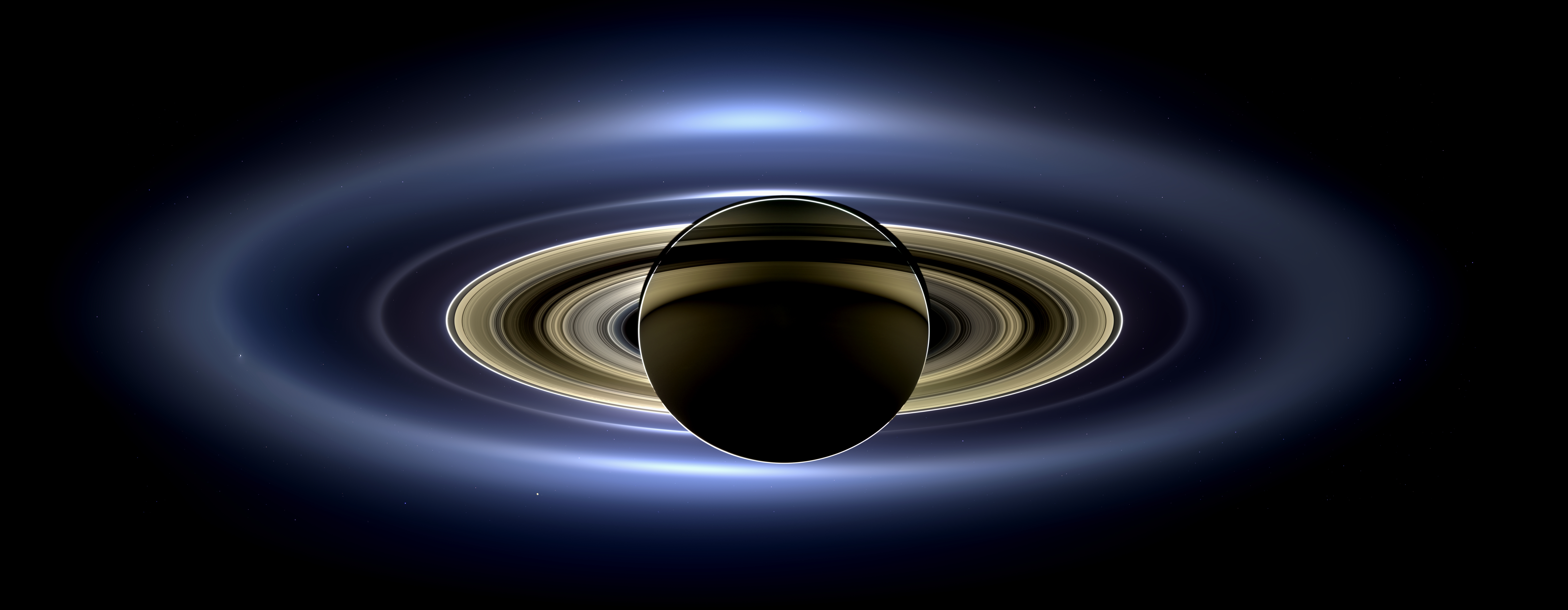
On July 19, 2013, in an event celebrated the world over, NASA's Cassini spacecraft slipped into Saturn's shadow and turned to image the planet, seven of its moons, its inner rings -- and, in the background, our home planet, Earth.

With the sun's powerful and potentially damaging rays eclipsed by Saturn itself, Cassini's onboard cameras were able to take advantage of this unique viewing geometry. They acquired a panoramic mosaic of the Saturn system that allows scientists to see details in the rings and throughout the system as they are backlit by the sun. This mosaic is special as it marks the third time our home planet was imaged from the outer solar system; the second time it was imaged by Cassini from Saturn's orbit; and the first time ever that inhabitants of Earth were made aware in advance that their photo would be taken from such a great distance.

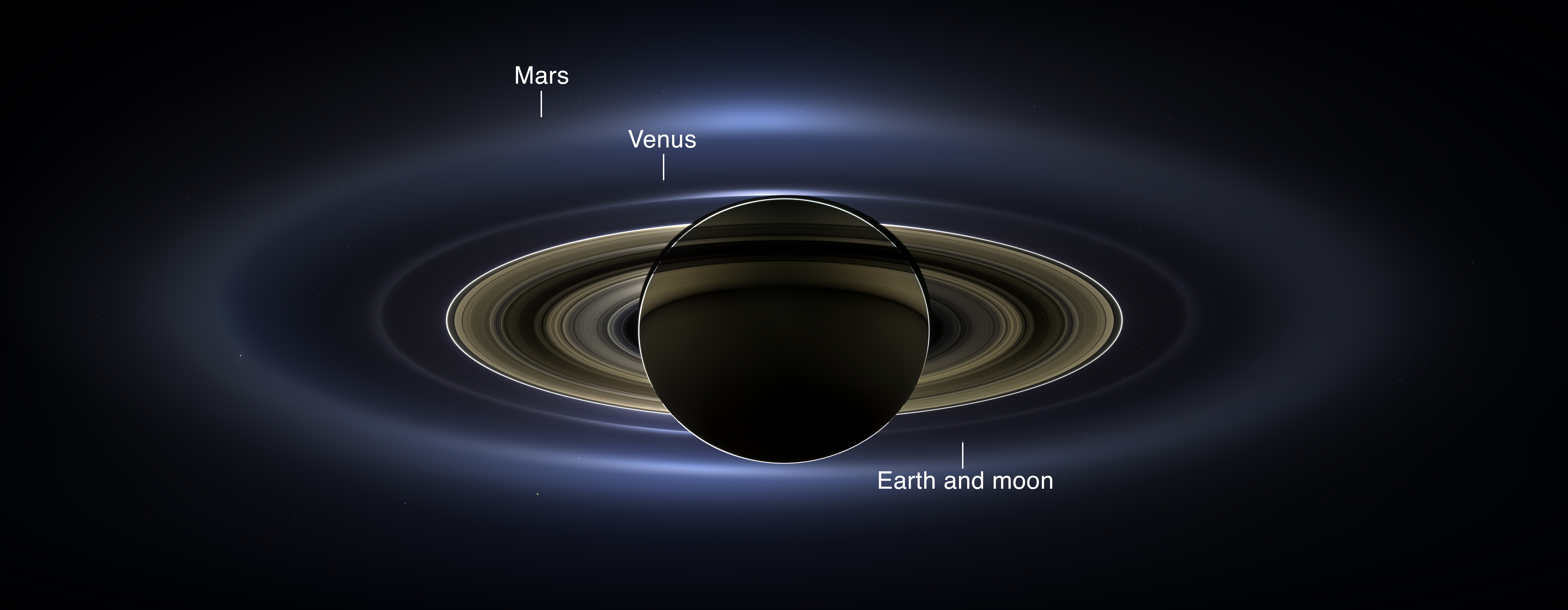
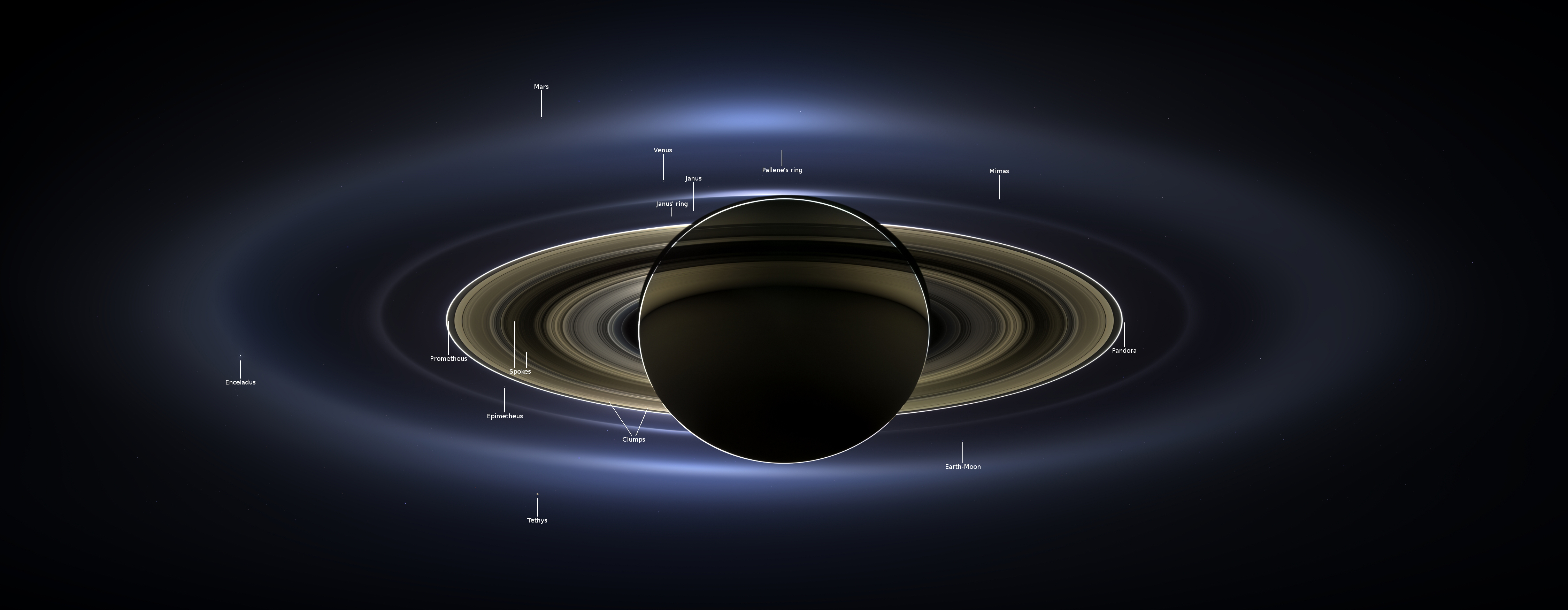
With both Cassini's wide-angle and narrow-angle cameras aimed at Saturn, Cassini was able to capture 323 images in just over four hours. This final mosaic uses 141 of those wide-angle images. Images taken using the red, green and blue spectral filters of the wide-angle camera were combined and mosaicked together to create this natural-color view. A brightened version with contrast and color enhanced (Figure 1), a version with just the planets annotated (Figure 2), and an annotated version (Figure 3) are shown above.

This image spans about 404,880 miles (651,591 kilometers) across.

The outermost ring shown here is Saturn's E ring, the core of which is situated about 149,000 miles (240,000 kilometers) from Saturn. The geysers erupting from the south polar terrain of the moon Enceladus supply the fine icy particles that comprise the E ring; diffraction by sunlight gives the ring its blue color. Enceladus (313 miles, or 504 kilometers, across) and the extended plume formed by its jets are visible, embedded in the E ring on the left side of the mosaic.

At the 12 o'clock position and a bit inward from the E ring lies the barely discernible ring created by the tiny, Cassini-discovered moon, Pallene (3 miles, or 4 kilometers, across). (For more on structures like Pallene's ring, see PIA08328). The next narrow and easily seen ring inward is the G ring. Interior to the G ring, near the 11 o'clock position, one can barely see the more diffuse ring created by the co-orbital moons, Janus (111 miles, or 179 kilometers, across) and Epimetheus (70 miles, or 113 kilometers, across). Farther inward, we see the very bright F ring closely encircling the main rings of Saturn.

Following the outermost E ring counter-clockwise from Enceladus, the moon Tethys (662 miles, or 1,066 kilometers, across) appears as a large yellow orb just outside of the E ring. Tethys is positioned on the illuminated side of Saturn; its icy surface is shining brightly from yellow sunlight reflected by Saturn. Continuing to about the 2 o'clock position is a dark pixel just outside of the G ring; this dark pixel is Saturn's Death Star moon, Mimas (246 miles, or 396 kilometers, across). Mimas appears, upon close inspection, as a very thin crescent because Cassini is looking mostly at its non-illuminated face.

The moons Prometheus, Pandora, Janus and Epimetheus are also visible in the mosaic near Saturn's bright narrow F ring. Prometheus (53 miles, or 86 kilometers, across) is visible as a faint black dot just inside the F ring and at the 9 o'clock position. On the opposite side of the rings, just outside the F ring, Pandora (50 miles, or 81 kilometers, across) can be seen as a bright white dot. Pandora and Prometheus are shepherd moons and gravitational interactions between the ring and the moons keep the F ring narrowly confined. At the 11 o'clock position in between the F ring and the G ring, Janus (111 miles, or 179 kilometers, across) appears as a faint black dot. Janus and Prometheus are dark for the same reason Mimas is mostly dark: we are looking at their non-illuminated sides in this mosaic. Midway between the F ring and the G ring, at about the 8 o'clock position, is a single bright pixel, Epimetheus. Looking more closely at Enceladus, Mimas and Tethys, especially in the brightened version of the mosaic, one can see these moons casting shadows through the E ring like a telephone pole might cast a shadow through a fog.

In the non-brightened version of the mosaic, one can see bright clumps of ring material orbiting within the Encke gap near the outer edge of the main rings and immediately to the lower left of the globe of Saturn. Also, in the dark B ring within the main rings, at the 9 o'clock position, one can see the faint outlines of two spoke features, first sighted by NASA's Voyager spacecraft in the early 1980s and extensively studied by Cassini.

Finally, in the lower right of the mosaic, in between the bright blue E ring and the faint but defined G ring, is the pale blue dot of our planet, Earth. Look closely and you can see the moon protruding from the Earth's lower right. (For a higher resolution view of the Earth and moon taken during this campaign, see PIA14949.) Earth's twin, Venus, appears as a bright white dot in the upper left quadrant of the mosaic, also between the G and E rings. Mars also appears as a faint red dot embedded in the outer edge of the E ring, above and to the left of Venus.

For ease of visibility, Earth, Venus, Mars, Enceladus, Epimetheus and Pandora were all brightened by a factor of eight and a half relative to Saturn. Tethys was brightened by a factor of four. In total, 809 background stars are visible and were brightened by a factor ranging from six, for the brightest stars, to 16, for the faintest. The faint outer rings (from the G ring to the E ring) were also brightened relative to the already bright main rings by factors ranging from two to eight, with the lower-phase-angle (and therefore fainter) regions of these rings brightened the most. The brightened version of the mosaic was further brightened and contrast-enhanced all over to accommodate print applications and a wide range of computer-screen viewing conditions.

Some ring features -- such as full rings traced out by tiny moons -- do not appear in this version of the mosaic because they require extreme computer enhancement, which would adversely affect the rest of the mosaic. This version was processed for balance and beauty.

This view looks toward the unlit side of the rings from about 17 degrees below the ring plane. Cassini was approximately 746,000 miles (1.2 million kilometers) from Saturn when the images in this mosaic were taken. Image scale on Saturn is about 45 miles (72 kilometers) per pixel.

This mosaic was made from pictures taken over a span of more than four hours while the planets, moons and stars were all moving relative to Cassini. Thus, due to spacecraft motion, these objects in the locations shown here were not in these specific places over the entire duration of the imaging campaign. Note also that Venus appears far from Earth, as does Mars, because they were on the opposite side of the sun from Earth.

Image credit: NASA/JPL-Caltech/SSI

Note: For more information, see NASA Cassini Spacecraft Provides New View of Saturn and Earth, PIA17679: The Faces of 'Wave at Saturn' and Spectacular New View of Saturn and Earth. From earlier in the year, see Cassini to Photograph Earth From Deep Space and Cassini Releases Image of Earth Waving at Saturn.

Monday, October 28, 2013

Titan's North Polar Lakes and Evaporite Deposits


This false-color mosaic, made from infrared data collected by NASA's Cassini spacecraft, reveals the differences in the composition of surface materials around hydrocarbon lakes at Titan, Saturn's largest moon. Titan is the only other place in the solar system that we know has stable liquid on its surface, though its lakes are made of liquid ethane and methane rather than liquid water. While there is one large lake and a few smaller ones near Titan's south pole, almost all of Titan's lakes appear near the moon's north pole.

Scientists mapped near-infrared colors onto the visible color spectrum. Red in this image was assigned a wavelength of 5 microns (10 times longer than visible light), green 2.0 microns (four times longer than visible light), and blue 1.3 microns (2.6 times longer than visible light).

The orange areas are thought to be evaporite -- the Titan equivalent of salt flats on Earth. The evaporated material is thought to be organic chemicals originally from Titan's haze particles that once dissolved in liquid methane. They appear orange in this image against the greenish backdrop of Titan's typical bedrock of water ice.

In this mosaic, Kraken Mare, which is Titan's largest sea and covers about the same area as Earth's Caspian Sea and Lake Superior combined, can be seen spreading out with many tendrils on the upper right,. The big dark zone up and left of Kraken is Ligeia Mare, the second largest sea. Below Ligeia, shaped similar to a sports fan's foam finger that points just up from left, is Punga Mare, the third largest Titan Sea. Numerous other smaller lakes dot the area. Titan's north pole is located in the geographic location just above the end of the "finger" of Punga Mare.

Figure 1 highlights a high-resolution strip and shows the north pole marked with a red cross. Other smaller lakes are also labeled.

The data shown here were obtained by Cassini's visual and infrared mapping spectrometer during a close flyby of Titan on September 12, 2013.

Until now, the spectrometer has only been able to capture distant, oblique or partial views of this area. The September 12, 2013, flyby provided better viewing geometry. And sunlight has begun to pierce the winter darkness that shrouded Titan's north pole at the time of Cassini's arrival in the Saturn system nine years ago. A thick cap of haze that once hung over the north pole has also dissipated as northern summer approaches. And, thankfully, Titan's beautiful, almost cloudless, rain-free weather continued during this flyby.

The resolution varies across this composite view depending on when each cube of data was acquired, but the best surface sampling is 2 miles (3 kilometers) per pixel.

Views of this area by other Cassini instruments include PIA17471, PIA17472, PIA17473 and PIA14584 from the imaging science subsystem; and PIA10008 and PIA17031 from the radar mapper. An earlier VIMS view can be seen at PIA16845.


Image credit: NASA/JPL-Caltech/University of Arizona/University of Idaho

Note: For more information, see Cassini Gets New Views of Titan's Land of Lakes.

Sunday, October 27, 2013

Saturn


A swing high above Saturn by NASA's Cassini spacecraft revealed this stately view of the golden-hued planet and its main rings. The view is in natural color, as human eyes would have seen it. This mosaic was made from 36 images in three color filters obtained by Cassini's imaging science subsystem on October 10, 2013. The observation and resulting image mosaic were planned as one of three images for Cassini's 2013 Scientist for a Day essay contest.

Saturn sports differently colored bands of weather in this image. For instance, a bright, narrow wave of clouds around 42 degrees north latitude appears to be some of the turbulent aftermath of a giant storm that reached its violent peak in early 2011. The mysterious six-sided weather pattern known as the hexagon is visible around Saturn's north pole.

When Cassini arrived in 2004, more of the northern hemisphere sported a bluish hue and it was northern winter. The golden tones dominated the southern hemisphere, where it was southern summer. But as the seasons have turned and northern spring is in full swing, the colors have begun to change in each hemisphere as well. Golden tones have started to dominate in the northern hemisphere and the bluish color in the north is now confined to a tighter circle around the north pole. The southern hemisphere has started getting bluer, too.

The rings shown here include Saturn's main rings. The innermost D ring, and the C, B and A rings are easily seen. The F ring is also there, but not easily seen without enhancing the contrast of the image. (Rings were named in order of their discovery rather than their position around Saturn.) The rings also cast a shadow on Saturn at the limb of the planet in the lower right quadrant.

Cassini is currently in a set of tilted orbits known as "inclined orbits" that allow it to swing up over the north pole and below the south pole. Much of Cassini's time is spent close to the equatorial plane, where most of Saturn's rings and moons are located.

Image credit: NASA/JPL-Caltech/SSI/Cornell

Note: For more information, see Cassini Swings Above Saturn to Compose a Portrait.