Pages

Showing posts with label Context (CTX) Camera. Show all posts

Saturday, May 24, 2014

Fresh Impact Crater Northeast of Gordii Dorsum on Mars


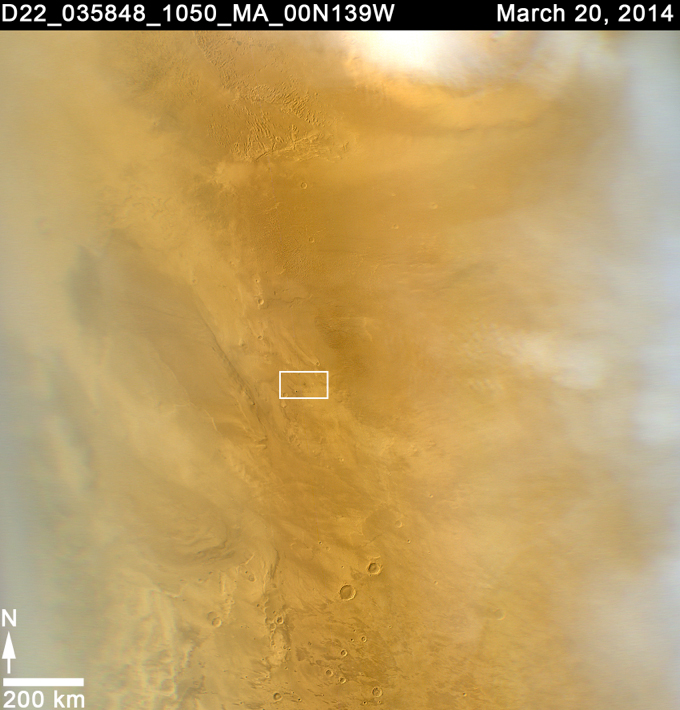
On 20 March 2014, a dark spot on the surface of Mars, about 5 miles (8 kilometers) in diameter was seen for the first time in low-resolution (approximately 1 kilometer) imaging from the Mars Color Imager (MARCI) camera on Mars Reconnaissance Orbiter (MRO). Because MARCI sees essentially the whole planet every day, the sudden appearance of a dark spot was of note.

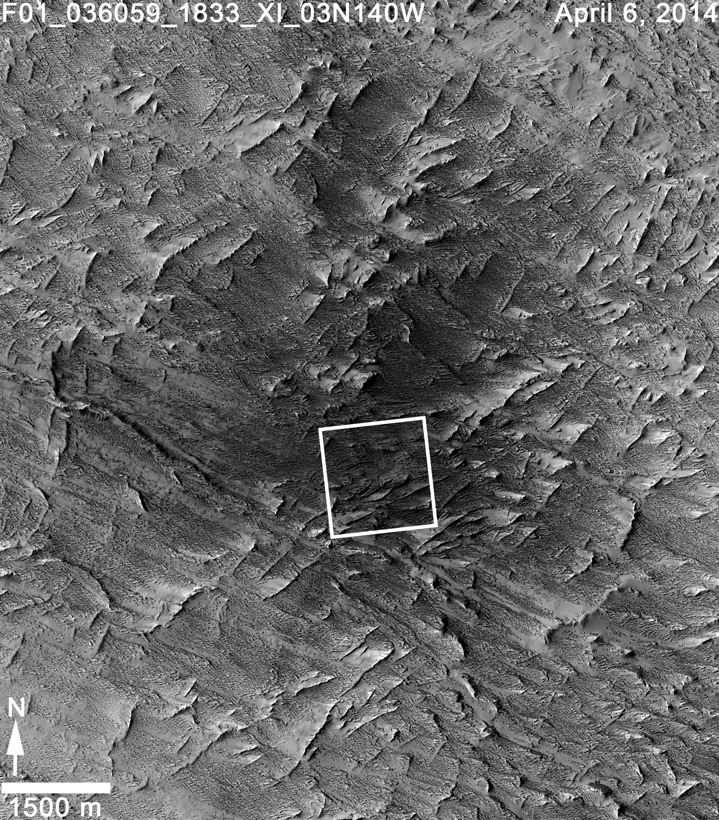
To follow up, the Context Camera (CTX) obtained a high resolution picture of the area in question in early April. Before and after imaging revealed two new large impact craters within the blast zone. At 6 meters per pixel, CTX can detect the dark blast locations but usually cannot resolve the crater that formed the blast, because most fresh impact craters are only a few meters across.

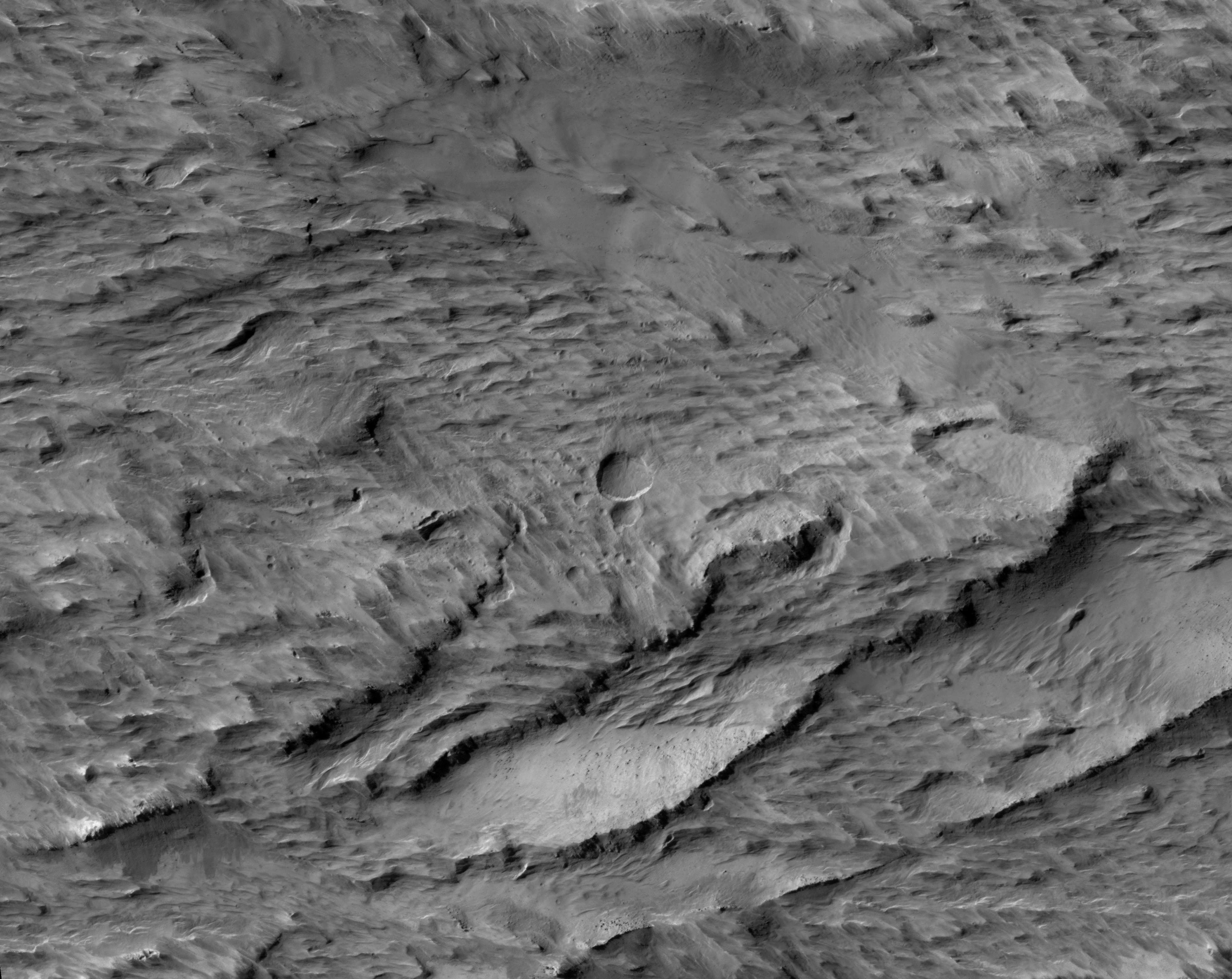
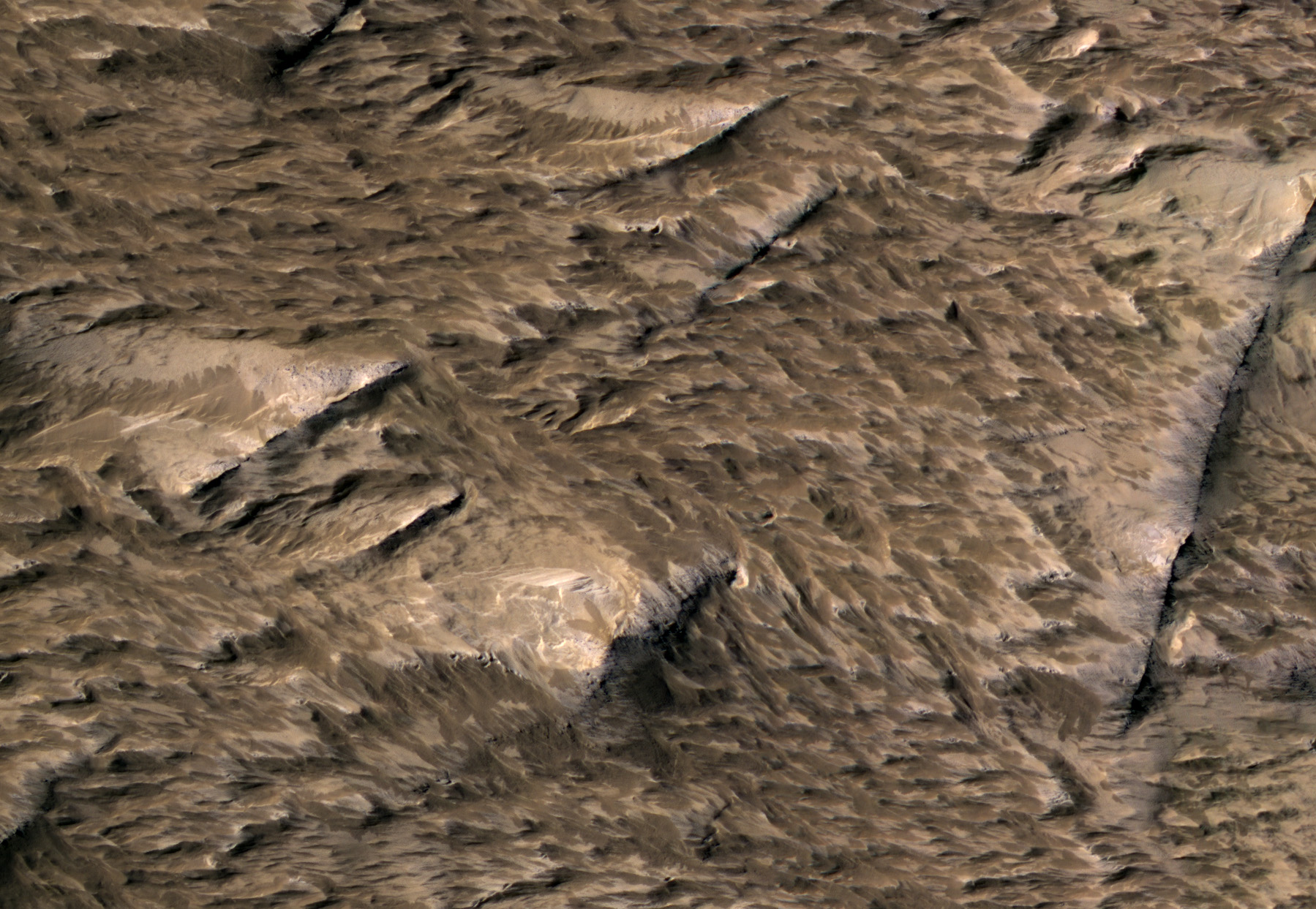
This is where the high resolution of HiRISE comes in: our camera was able to show the fine surface details within the blast zone. The largest of the new craters, appears slightly asymmetric in shape, and measures 159 x 143 feet (48.5 x 43.5 meters) in diameter, making it the largest new crater detected on Mars by MRO to date. Both HiRISE and CTX images also show numerous, new, small landslides within the blast zone.

All of these coordinated observations also demonstrate how different teams on the same spacecraft can work together to examine interesting features in greater detail.

Note: a newer image of this area, is also available and has an anaglyph.

Image credit: NASA/JPL/University of Arizona

Note: This impact crater is located just to the northeast of Gordii Dorsum. For more information, see PIA18380: Impact Scar Detected in Mars Weathercam Image, PIA18381: Best-Ever Pinning Down When a Space Rock Hit Mars, PIA18382: Fresh Mars Crater Confirmed Within Impact Scar, PIA18383: Before-and-After Views Confirm Fresh Craters, PIA18384: Large, Fresh Crater Surrounded by Smaller Craters, PIA18385: Landslides Near Fresh Crater on Mars, and NASA Mars Weathercam Helps Find Big New Crater.

Thursday, February 6, 2014

New Impact Crater in Syrtis Major Planum


A dramatic, fresh impact crater dominates this image taken by the High Resolution Imaging Science Experiment (HiRISE) camera on NASA's Mars Reconnaissance Orbiter on November 19, 2013. Researchers used HiRISE to examine this site because the orbiter's Context Camera had revealed a change in appearance here between observations in July 2010 and May 2012, bracketing the formation of the crater between those observations.

The crater spans approximately 100 feet (30 meters) in diameter and is surrounded by a large, rayed blast zone. Because the terrain where the crater formed is dusty, the fresh crater appears blue in the enhanced color of the image, due to removal of the reddish dust in that area. Debris tossed outward during the formation of the crater is called ejecta. In examining ejecta's distribution, scientists can learn more about the impact event. The explosion that excavated this crater threw ejecta as far as 9.3 miles (15 kilometers).

The crater is at 3.7 degrees north latitude, 53.4 degrees east longitude on Mars. Before-and-after imaging that brackets appearance dates of fresh craters on Mars has indicated that impacts producing craters at least 12.8 feet (3.9 meters) in diameter occur at a rate exceeding 200 per year globally. Few of the scars are as dramatic in appearance as this one.

This image is one product from the HiRISE observation cataloged as ESP_034285_1835. Other products from the same observation are available at http://uahirise.org/ESP_034285_1835.

Image credit: NASA/JPL/University of Arizona

Note: For more information, see A Spectacular New Impact Crater and Its Ejecta and NASA Mars Orbiter Examines Dramatic New Crater. This crater is located in Syrtis Major Planum to the northwest of Schroeter Crater.

Tuesday, September 18, 2012

New Impact Crater South of Echus Chasma


How exactly can we tell if an impact crater is new?

In this observation, we see a dark spot with a larger, rayed "blast zone" that was also apparent in a Context Camera image taken in 2011 (an instrument with a larger footprint than HiRISE and also on the Mars Reconnaissance Orbiter). However, a THEMIS image of the same area acquired in 2009 does not show the dark spot at all.

This is a great example of using three different instruments to view the same area not only to look for changes in the Martian landscape, but also to use the resolution of HiRISE to determine if this is indeed a new impact site.

Photo credit: NASA/JPL/University of Arizona

Note: This impact crater is located just south of Echus Chasma.

Saturday, February 18, 2012

Polar Layers in Gemini Scopuli


This is an especially pretty image due to the color variations and lighting geometry.

The color variations are due to mixtures of reddish dust with white frost and ice. The image was acquired as a "rider" with either a Context Camera or CRISM target.

One of these other MRO experiments chose this location to point at with the spacecraft, then the HiRISE science lead for this 2-week planning cycle decided to add a HiRISE image here for a high-resolution sample.

Photo credit: NASA/JPL/University of Arizona

Note: This image is located along one of the canyons in the Gemini Scopuli region of Planum Boreum.