Pages

Showing posts with label Lenticular Galaxies. Show all posts

Sunday, September 1, 2013

PGC 10922


The NASA/ESA Hubble Space Telescope has captured this image of PGC 10922, an example of a lenticular galaxy – a galaxy type that lies on the border between ellipticals and spirals.

Seen face-on, the image shows the disc and tightly-wound spiral structures of dark dust encircling the bright center of the galaxy. There is also a remarkable outer halo of faint wide arcs or shells extending outwards, covering much of the picture. These are likely to have been formed by a gravitational encounter or even a merger with another galaxy. Some dust also appears to have escaped from the central structure and has spread out across the inner shells.

An extraordinarily rich background of more remote galaxies can also be seen in the image.

Photo credit: ESA/Hubble & NASA; Acknowledgement: Judy Schmidt

Friday, August 16, 2013

The Hubble Sequence Throughout the Universe's History


This image shows "slices" of the Universe at different times throughout its history (present day, and at 4 and 11 billion years ago). Each slice goes further back in time, showing how galaxies of each type appear. The shape is that of the Hubble tuning fork diagram, which describes and separates galaxies according to their morphology into spiral (S), elliptical (E), and lenticular (S0) galaxies. On the left of this diagram are the ellipticals, with lenticulars in the middle, and the spirals branching out on the right side. The spirals on the bottom branch have bars cutting through their centers.

The present-day Universe shows big, fully formed and intricate galaxy shapes. As we go further back in time, they become smaller and less mature, as these galaxies are still in the process of forming.

This image is illustrative. the Hubble images of nearby and distant galaxies used were selected based on their appearance; their individual distances are only approximate.

Illustration credit: NASA, ESA, M. Kornmesser

Note: For more information, see Hubble Explores the Origins of Modern Galaxies - Astronomers See True Shapes of Galaxies 11 Billion Years Back in Time.

Sunday, July 21, 2013

NGC 4866


The constellation of Virgo (The Virgin) is the largest of the Zodiac constellations, and the second largest overall after Hydra (The Water Snake). Its most appealing feature, however, is the sheer number of galaxies that lie within it. In this picture, among a crowd of face- and edge-on spiral, elliptical, and irregular galaxies, lies NGC 4866, a lenticular galaxy situated about 80 million light-years from Earth. This sharp image of NGC 4866 was captured by the Advanced Camera for Surveys, an instrument on the NASA/ESA Hubble Space Telescope.

Photo credit: ESA/Hubble & NASA; Acknowledgement: Gilles Chapdelaine

Wednesday, May 29, 2013

ESO 576-69


This new image from the NASA/ESA Hubble Space Telescope captures an ongoing cosmic collision between two galaxies — a spiral galaxy is in the process of colliding with a lenticular galaxy. The collision looks almost as if it is popping out of the screen in 3D, with parts of the spiral arms clearly embracing the lenticular galaxy’s bulge.

The image also reveals further evidence of the collision. There is a bright stream of stars coming out from the merging galaxies, extending out towards the right of the image. The bright spot in the middle of the plume, known as ESO 576-69, is what makes this image unique. This spot is believed to be the nucleus of the former spiral galaxy, which was ejected from the system during the collision and is now being shredded by tidal forces to produce the visible stellar stream.

Photo credit: ESA/Hubble & NASA; Acknowledgement: Luca Limatola

Monday, August 23, 2010

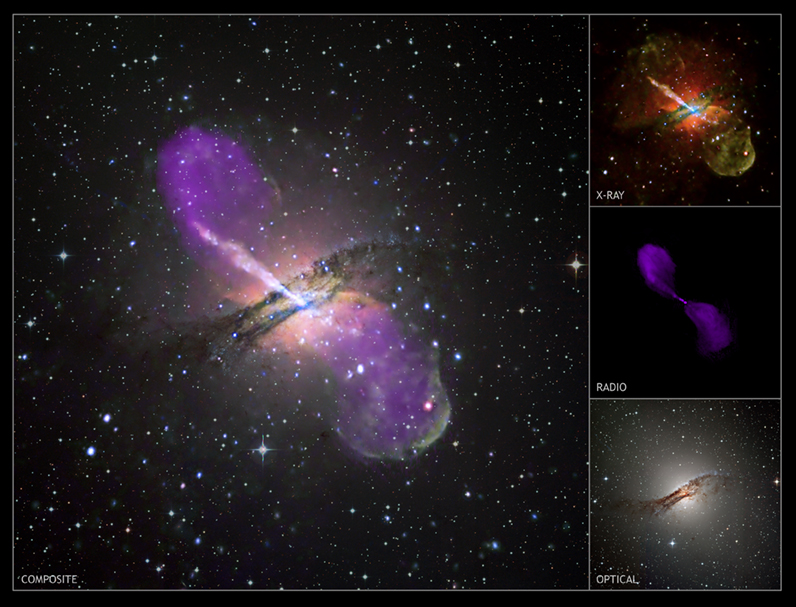
NGC 5128 - Centaurus A


A dramatic new Chandra image of the nearby galaxy Centaurus A provides one of the best views to date of the effects of an active supermassive black hole. Opposing jets of high-energy particles can be seen extending to the outer reaches of the galaxy, and numerous smaller black holes in binary star systems are also visible.

The image was made from an ultra-deep look at the galaxy Centaurus A, equivalent to more than seven days of continuous observations. Centaurus A is the nearest galaxy to Earth that contains a supermassive black hole actively powering a jet.

A prominent X-ray jet extending for 13,000 light years points to the upper left in the image, with a shorter "counterjet" aimed in the opposite direction. Astronomers think that such jets are important vehicles for transporting energy from the black hole to the much larger dimensions of a galaxy, and affecting the rate at which stars form there.

High-energy electrons spiraling around magnetic field lines produce the X-ray emission from the jet and counterjet. This emission quickly saps the energy from the electrons, so they must be continually reaccelerated or the X-rays will fade out. Knot-like features in the jets detected in the Chandra image show where the acceleration of particles to high energies is currently occurring, and provides important clues to understanding the process that accelerates the electrons to near-light speeds.

The inner part of the X-ray jet close to the black hole is dominated by these knots of X-ray emission, which probably come from shock waves -- akin to sonic booms -- caused by the jet. Farther from the black hole there is more diffuse X-ray emission in the jet. The cause of particle acceleration in this part of the jet is unknown.

Hundreds of point-like sources are also seen in the Chandra image. Many of these are X-ray binaries that contain a stellar-mass black hole and a companion star in orbit around one another. Determining the population and properties of these black holes should help scientists better understand the evolution of massive stars and the formation of black holes.

Another surprise was the detection of two particularly bright X-ray binaries. These sources may contain stellar mass black holes that are unusually massive, and this Chandra observation might have caught them gobbling up material at a high rate.

In this image, low-energy X-rays are colored red, intermediate-energy X-rays are green, and the highest-energy X-rays detected by Chandra are blue. The dark green and blue bands running almost perpendicular to the jet are dust lanes that absorb X-rays. This dust lane was created when Centaurus A merged with another galaxy perhaps 100 million years ago.


Photo credit: (Top) NASA/CXC/CfA/R.Kraft et al.
(Bottom) X-ray: NASA/CXC/CfA/R.Kraft et al; Radio: NSF/VLA/Univ. Hertfordshire/M. Hardcastle; Optical: ESO/WFI/M.Rejkuba et al.)

Friday, August 13, 2010

Ultraviolet Rings and Arcs Around Galaxies


Astronomers have found unexpected rings and arcs of ultraviolet light around a selection of galaxies, four of which are shown here as viewed by NASA's and the European Space Agency's Hubble Space Telescope.

Observations from NASA's Galaxy Evolution Explorer (GALEX) picked out 30 elliptical and lens-shaped "early-type" galaxies with puzzlingly strong ultraviolet emissions but no signs of visible star formation. Early-type galaxies, so the scientists' thinking goes, have already made their stars and now lack the cold gas necessary to build new ones.

Hubble images captured the great, shining rings of ultraviolet light, with some ripples stretching 250,000 light-years.

In these Hubble images, ultraviolet light has been rendered in blue, while green and red light from the galaxies is shown in their natural colors.

The study detailing the findings appeared in the April 21 issue of the Astrophysical Journal.

Photo credit: NASA/ESA/JPL-Caltech/STScI/UCLA

Note: For more information, see Giant Ultraviolet Rings Found in Resurrected Galaxies