Pages

Showing posts with label Ram Pressure. Show all posts

Tuesday, November 11, 2014

Ram-Pressure Stripped Galaxy ESO 137-001


The MUSE instrument on ESO’s Very Large Telescope has provided researchers with the best view yet of a spectacular cosmic crash. Observations reveal for the first time the motion of gas as it is ripped out of the galaxy ESO 137-001 as it plows at high speed into a vast galaxy cluster. The results are the key to the solution of a long-standing mystery — why star formation switches off in galaxy clusters.

In this picture the colors show the motions of the gas filaments — red means the material is moving away from Earth compared to the galaxy and blue that it is approaching.

Note that the upper-left and lower-right parts of this picture have been filled in using the Hubble image of this object.

Image credit: ESO/M. Fumagalli

Note: For more information, see MUSE Reveals True Story Behind Galactic Crash.

Wednesday, March 5, 2014

ESO 137-001


This new Hubble image shows spiral galaxy ESO 137-001, framed against a bright background as it moves through the heart of galaxy cluster Abell 3627.

This image not only captures the galaxy and its backdrop in stunning detail, but also something more dramatic – intense blue streaks streaming outwards from the galaxy, seen shining brightly in ultraviolet light.

These streaks are in fact hot, wispy streams of gas that are being torn away from the galaxy by its surroundings as it moves through space. This violent galactic disrobing is due to a process known as ram pressure stripping – a drag force felt by an object moving through a fluid.

Image credit: NASA, ESA. Acknowledgements: Ming Sun (UAH), and Serge Meunier

Note: For more information, see Spiral Galaxy Spills Blood and Guts, and ESO 137-001: Life Is Too Fast, Too Furious for This Runaway Galaxy. The "intense blue streaks" mentioned in the above article are much more apparent in the composite image produced by the Hubble Space Telescope and Chandra X-Ray Observatory; click on the second link to see that image.

Sunday, March 10, 2013

Abell 68


Abell 68, pictured here in infrared light, is a galaxy cluster. The effect of its gravity on light means it boosts Hubble's power, extending the telescope's ability to observe distant and faint objects. The fuzzy collection of blobs in the middle and upper left of the image is a swarm of galaxies, each with hundreds of billions of stars and vast amounts of dark matter. Distorted shapes visible throughout the field of view are distant galaxies whose light has been bent and amplified by the cluster.

Annotations:

1 and 2: This galaxy is visible twice, thanks to its light following two separate paths around an elliptical galaxy before reaching us. The image marked 2 is heavily distorted into the shape of an alien from the cult 1970s video game Space Invaders. The lensed galaxy lies at a redshift of around 1.6. The lensing galaxy significantly closer, at a redshift of around 0.26.

3: This galaxy appears to be melting, with purple liquid dripping from it. In fact, the purple droplets are clouds of gas being stripped out of the galaxy and heated up. This phenomenon, called ram pressure stripping, occurs when a galaxy passes through a denser patch of intergalactic gas, which strips out the gas from within the galaxy.

4: The series of long, light streaks here are background galaxies, the images of which have been heavily distorted by the lensing effects of the cluster in the foreground. These lie at a range of redshifts between around 2 and 6.

The unannotated version of the above image:


Photo credit: NASA & ESA. Acknowledgement: N. Rose

Note: For more information, see Gravitational Telescope Creates Space Invader Mirage.

Thursday, November 10, 2011

NGC 4522 Stripped


This image from NASA's Galaxy Evolution Explorer shows galaxy NGC 4522 being stripped of its star-forming material. Astronomers refer to this process as "ram-pressure stripping" - where surrounding hot-gas shoves star-forming gas out of the galaxy's outer disk. NGC 4522 is located approximately 50 million light-years away in the Virgo galaxy cluster.

In this image, the galaxy's older stellar population is marked by tints of yellow. Meanwhile, the bluish-white ridge near NGC 4522's center reveals a population of very young stars - most likely less than a million years old. The bluish-white coloration also indicates that new stars are actively forming in this area.

The light-blue haze beyond the white-ridge represents the galaxy's outer disk. This area is currently not a site of active star formation, but is still very bright in the ultraviolet, indicating that some stars in this region are very young and likely formed very recently, within the last 50-100 million years.

This image is a three color composite where yellow represents R-band visible-light data from the Kitt Peak National Observatory's 0.9-meter telescope. Green shows near-ultraviolet light data, and blue reveals far-ultraviolet light data from GALEX.

Photo credit: NASA/JPL-Caltech/Yale University/H. Crowl (Yale University)

Note: This image was used as an example in a recent Science@NASA article entitled Stellar Extremophiles.

Sunday, November 14, 2010

NGC 7252 "Atoms for Peace"


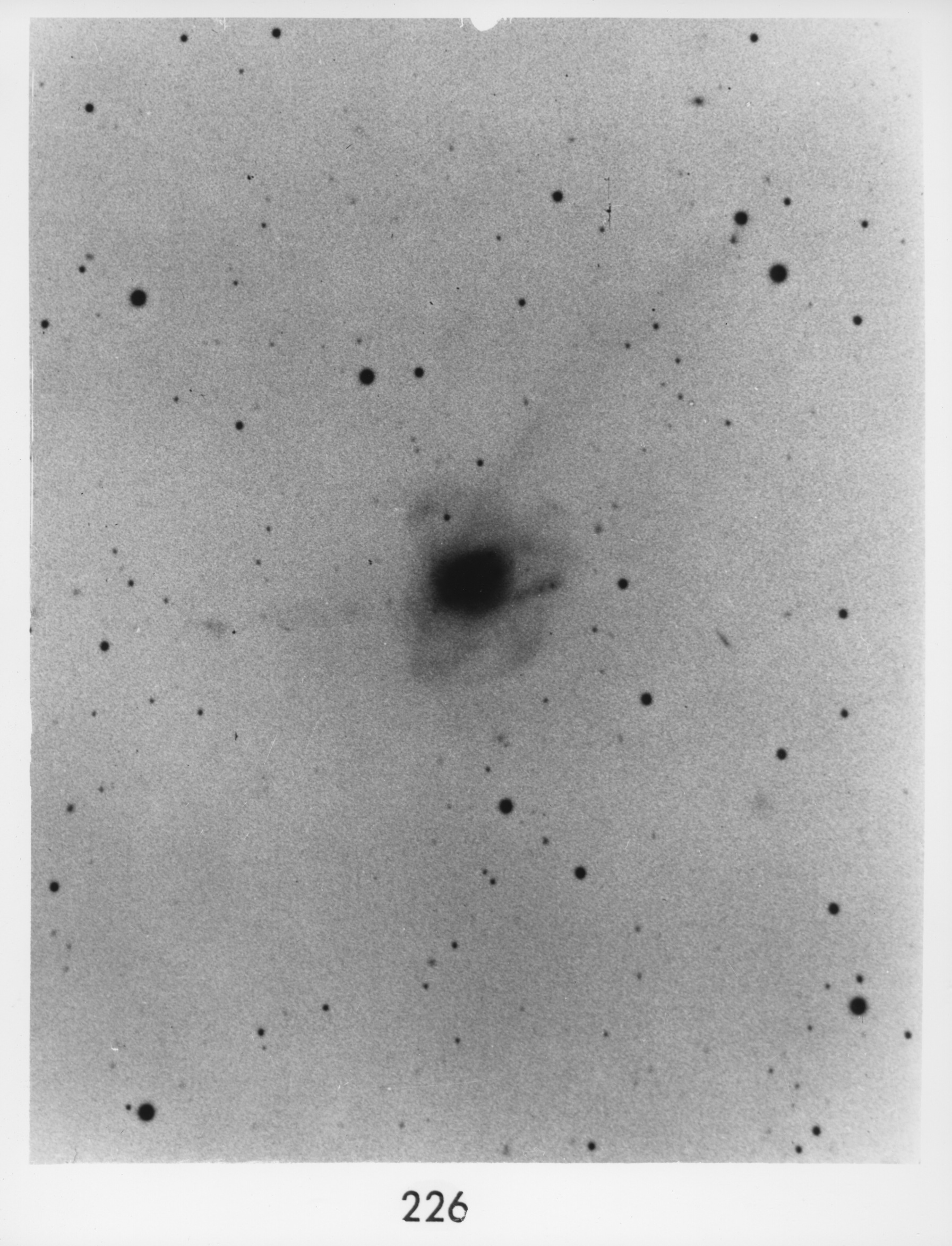
European Southern Observatory astronomers have produced a spectacular new image of the famous Atoms-for-Peace galaxy (NGC 7252). This galactic pile-up, formed by the collision of two galaxies, provides an excellent opportunity for astronomers to study how mergers affect the evolution of the Universe.

Atoms-for-Peace is the curious name given to a pair of interacting and merging galaxies that lie around 220 million light-years away in the constellation of Aquarius. It is also known as NGC 7252 and Arp 226 and is just bright enough to be seen by amateur astronomers as a very faint small fuzzy blob. This very deep image was produced by ESO’s Wide Field Imager on the MPG/ESO 2.2-meter telescope at ESO’s La Silla Observatory in Chile.

A galaxy collision is one of the most important processes influencing how our Universe evolves, and studying them reveals important clues about galactic ancestry. Luckily, such collisions are long drawn-out events that last hundreds of millions of years, giving astronomers plenty of time to observe them.

This picture of Atoms-for-Peace represents a snapshot of its collision, with the chaos in full flow, set against a rich backdrop of distant galaxies. The results of the intricate interplay of gravitational interactions can be seen in the shapes of the tails made from streams of stars, gas and dust. The image also shows the incredible shells that formed as gas and stars were ripped out of the colliding galaxies and wrapped around their joint core. While much material was ejected into space, other regions were compressed, sparking bursts of star formation. The result was the formation of hundreds of very young star clusters, around 50 to 500 million years old, which are speculated to be the progenitors of globular clusters.

Atoms-for-Peace may be a harbinger of our own galaxy’s fate. Astronomers predict that in three or four billion years the Milky Way and the Andromeda Galaxy will collide, much as has happened with Atoms-for-Peace. But don’t panic: the distance between stars within a galaxy is vast, so it is unlikely that our Sun will end up in a head-on collision with another star during the merger.

The object’s curious nickname has an interesting history. In December 1953, President Eisenhower gave a speech that was dubbed Atoms for Peace. The theme was promoting nuclear power for peaceful purposes — a particularly hot topic at the time. This speech and the associated conference made waves in the scientific community and beyond to such an extent that NGC 7252 was named the Atoms-for-Peace galaxy. In many ways, this is oddly appropriate: the curious shape that we can see is the result of two galaxies merging to produce something new and grand, a little like what occurs in nuclear fusion. Furthermore, the giant loops resemble a textbook diagram of electrons orbiting an atomic nucleus.

Photo credit: European Southern Observatory

Sunday, October 10, 2010

NGC 1365


A new image taken with the powerful HAWK-I camera on ESO’s Very Large Telescope at Paranal Observatory in Chile shows the beautiful barred spiral galaxy NGC 1365 in infrared light. NGC 1365 is a member of the Fornax cluster of galaxies, and lies about 60 million light-years from Earth.

NGC 1365 is one of the best known and most studied barred spiral galaxies and is sometimes nicknamed the Great Barred Spiral Galaxy because of its strikingly perfect form, with the straight bar and two very prominent outer spiral arms. Closer to the center there is also a second spiral structure and the whole galaxy is laced with delicate dust lanes.

This galaxy is an excellent laboratory for astronomers to study how spiral galaxies form and evolve. The new infrared images from HAWK-I are less affected by the dust that obscures parts of the galaxy than images in visible light (potw1037a) and they reveal very clearly the glow from vast numbers of stars in both the bar and the spiral arms. These data were acquired to help astronomers understand the complex flow of material within the galaxy and how it affects the reservoirs of gas from which new stars can form. The huge bar disturbs the shape of the gravitational field of the galaxy and this leads to regions where gas is compressed and star formation is triggered. Many huge young star clusters trace out the main spiral arms and each contains hundreds or thousands of bright young stars that are less than ten million years old. The galaxy is too remote for single stars to be seen in this image and most of the tiny clumps visible in the picture are really star clusters. Over the whole galaxy, stars are forming at a rate of about three times the mass of our Sun per year.

While the bar of the galaxy consists mainly of older stars long past their prime, many new stars are born in stellar nurseries of gas and dust in the inner spiral close to the nucleus. The bar also funnels gas and dust gravitationally into the very center of the galaxy, where astronomers have found evidence for the presence of a super-massive black hole, well hidden among myriads of intensely bright new stars.

NGC 1365, including its two huge outer spiral arms, spreads over around 200,000 light-years. Different parts of the galaxy take different times to make a full rotation around the core of the galaxy, with the outer parts of the bar completing one circuit in about 350 million years. NGC 1365 and other galaxies of its type have come to more prominence in recent years with new observations indicating that the Milky Way could also be a barred spiral galaxy. Such galaxies are quite common — two thirds of spiral galaxies are barred according to recent estimates, and studying others can help astronomers understand our own galactic home.


Photo credit: ESO/P. Grosbøl

Tuesday, July 13, 2010

NGC 2070 - The Tarantula Nebula


Sending chills down the spine of all arachnophobes is the Tarantula nebula, seen in this image from NASA's Wide-field Infrared Survey Explorer (WISE). Located in the southern constellation of Dorado, the Tarantula nebula is a giant star-forming region in the Large Magellanic Cloud galaxy. This irregular dwarf galaxy orbits our Milky Way galaxy. It is relatively close, in galactic terms, at about 160,000 light-years away from Earth. Its motion around the Milky Way causes compression of interstellar dust and gas at is leading edge. This has led to a huge burst of star formation, creating the Tarantula nebula.

At about 1,900 light-years across, the nebula is the largest star-forming region known in our entire Local Group of galaxies, a region encompassing over 30 galaxies, including the great Andromeda. In 1987, the closest supernova observed since the invention of the telescope was seen at the edge of the Tarantula nebula (SN1987A). It was determined to be the violent explosion of a very massive star.

All four infrared detectors aboard WISE were used to make this mosaic. The image spans an area of 1.4 x 1.2 degrees on the sky or about three times as wide as the full moon, and 2.5 times as high. Color is representational: blue and cyan represent infrared light at wavelengths of 3.4 and 4.6 microns, which is dominated by light from stars. Green and red represent light at 12 and 22 microns, which is mostly light from warm dust.

Photo credit: NASA/JPL-Caltech/UCLA