Pages

Showing posts with label Horsehead Nebula. Show all posts

Saturday, December 20, 2014

The Horsehead Nebula in Infrared


Sometimes a horse of a different color hardly seems to be a horse at all, as, for example, in this newly released image from NASA's Spitzer Space Telescope. The famous Horsehead nebula makes a ghostly appearance on the far right side of the image, but is almost unrecognizable in this infrared view. In visible-light images, the nebula has a distinctively dark and dusty horse-shaped silhouette, but when viewed in infrared light, dust becomes transparent and the nebula appears as a wispy arc.

The Horsehead is only one small feature in the Orion Molecular Cloud Complex, dominated in the center of this view by the brilliant Flame nebula (NGC 2024). The smaller, glowing cavity falling between the Flame nebula and the Horsehead is called NGC 2023. These regions are about 1,200 light-years away.

The two carved-out cavities of the Flame nebula and NGC 2023 were created by the destructive glare of recently formed massive stars within their confines. They can be seen tracing a spine of glowing dust that runs through the image.

The Flame nebula sits adjacent to the star Alnitak, the westernmost star in Orion's belt, seen here as the bright blue dot near the top of the nebula.

In this infrared image from Spitzer, blue represents light emitted at a wavelength of 3.6-microns, and cyan (blue-green) represents 4.5-microns, both of which come mainly from hot stars. Green represents 8-micron light and red represents 24-micron light. Relatively cooler objects, such as the dust of the nebulae, appear green and red. Some regions along the top and bottom of the image extending beyond Spitzer's observations were filled in using data from NASA's Wide-field Infrared Survey Explorer, or WISE, which covered similar wavelengths across the whole sky.

Image credit: NASA/JPL-Caltech

Note: For more information, see Horsehead of a Different Color.

Saturday, May 25, 2013

Fifteen Years of the Very Large Telescope


This selection of images — one per year in the life of the VLT — gives a taste of its huge scope and scientific productivity since first light in May 1998. The images are as follows: 1998: NGC 1232 (eso9845), 1999: NGC 3603 (eso9946), 2000: Messier 104, the Sombrero Galaxy (eso0007), 2001: Messier 16 in the infrared (eso0142), 2002: the Horsehead Nebula (eso0202), 2003: NGC 613 (eso0338), 2004: first candidate exoplanet image (eso0428), 2005: NGC 1097 center (eso0534), 2006: NGC 1313 (eso0643), 2007: ESO 593-IG 008 (eso0755), 2008: center of the Milky Way (eso0846), 2009: the Jewel Box cluster (eso0940), 2010: Messier 17 in the infrared (potw1044a), 2011: the Eyes galaxies (eso1131), 2012: the Carina Nebula in the infrared (eso1208) and 2013: IC 2944 (eso1322).

Image credits: ESO/P.D. Barthel/M. McCaughrean/M. Andersen/S. Gillessen et al./Y. Beletsky/R. Chini/T. Preibisch

Note: For more information, see ESO's Very Large Telescope Celebrates 15 Years of Success.

Wednesday, April 24, 2013

Orion B Molecular Cloud


This image shows the Orion B molecular cloud, a vast star-forming complex in the constellation Orion, as viewed at far-infrared wavelengths with ESA's Herschel Space Observatory. At about 1300 light-years, Orion B is one of the closest regions of star formation.

This massive stellar nursery reveals itself through the glow of cosmic dust in the interstellar material that pervades it. Heated by radiation from newborn stars, the dust shines brightly at far-infrared wavelengths, revealing a tangled network of filaments.

The bright yellow, white and pink areas in the image are the densest regions, where many protostars and newborn stars are found. Darker regions correspond to colder portions of the cloud where star formation is not as active. On the right-hand side of the image, the cloud exhibits a very sharp edge where the material in Orion B is being compressed by powerful winds blowing from clusters of massive stars located beyond the field of this image. These mighty stellar winds have sculpted the iconic Horsehead Nebula, glowing brightly on the right-hand edge of the Herschel image.

Herschel's far-infrared view of Orion B also shows other pockets of star-forming gas and dust nestled in the intricate structure of this cloud: NGC 2024, also known as the Flame Nebula, and NGC 2023 on the right-hand side of the image, to the left of the Horsehead Nebula; and NGC 2071 and NGC 2068 on the left-hand side of the image.

This false-color image combines data acquired with the PACS instrument at 70 micron (shown in blue) and 160 micron (shown in green) and with the SPIRE instrument at 250 micron (shown in red).

Image credit: ESA/Herschel/PACS, SPIRE/N. Schneider, Ph. André, V. Könyves (CEA Saclay, France) for the 'Gould Belt survey' Key Programme.

Note: For more information, see A Horsehead, A Flame and Hidden Gems in Orion B and Herschel’s View of the Horsehead Nebula.

Sunday, April 21, 2013

The Horsehead Nebula in Infrared


Astronomers have used NASA's Hubble Space Telescope to photograph the iconic Horsehead Nebula in a new, infrared light to mark the 23rd anniversary of the famous observatory's launch aboard the space shuttle Discovery on April 24, 1990.

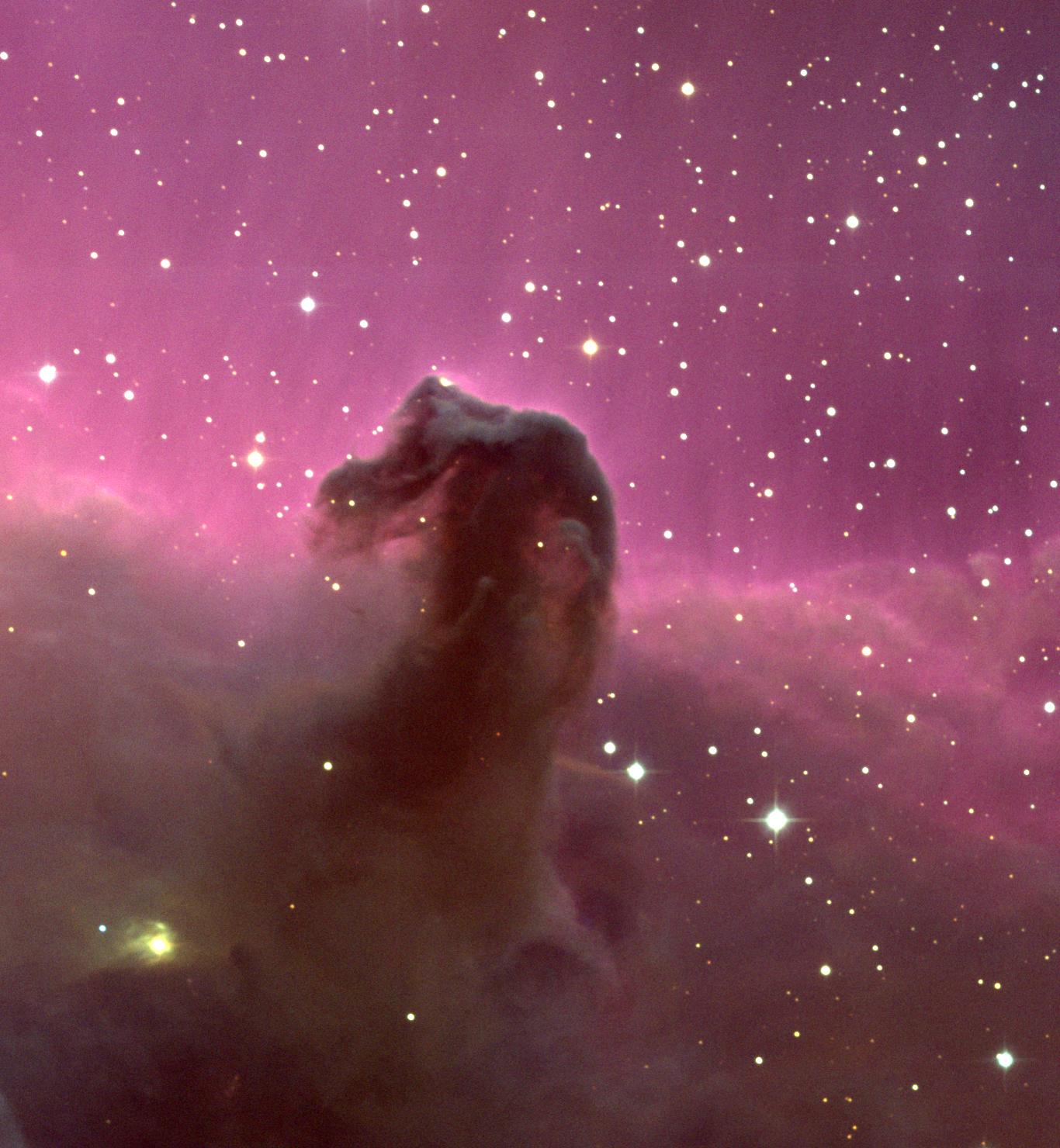
Looking like an apparition rising from whitecaps of interstellar foam, the iconic Horsehead Nebula has graced astronomy books ever since its discovery more than a century ago. The nebula is a favorite target for amateur and professional astronomers. It is shadowy in optical light. It appears transparent and ethereal when seen at infrared wavelengths. The rich tapestry of the Horsehead Nebula pops out against the backdrop of Milky Way stars and distant galaxies that easily are visible in infrared light.

Hubble has been producing ground-breaking science for two decades. During that time, it has benefited from a slew of upgrades from space shuttle missions, including the 2009 addition of a new imaging workhorse, the high-resolution Wide Field Camera 3 that took the new portrait of the Horsehead.

Image Credit: NASA/ESA/Hubble Heritage Team

Note: For more information, see A Fresh Take on the Horsehead Nebula and The Horsehead Nebula in New Light.

Sunday, July 8, 2012

The Flame Nebula in Infrared


The Flame Nebula sits on the eastern hip of Orion the Hunter, a constellation most easily visible in the northern hemisphere during winter evenings. This view of the Flame nebula from WISE, NASA's Wide-field Infrared Survey Explorer, shows an expanded view over one previously released of this enormous space cloud (PIA13448).

The previous image was made from data WISE collected after its coolant began to run out, when only three of WISE's infrared bands were in operation. The Flame Nebula is a very infrared-bright region, and the reduced sensitivity during the 3-band phase of the WISE mission worked to the advantage of astronomers interested in studying the brightest parts of this region without so much glare. This new image includes more data collected from all of WISE's four infrared bands. This view takes in a vast cloud of gas and dust where new stars are being born. Three familiar nebulae are visible in the central region: the Flame nebula, the Horsehead nebula, and NGC 2023. The Flame is the brightest and largest in the image. It is being lit up by a star inside it that is 20 times the mass of the sun and would be as bright to our eyes as the other stars in Orion's belt if it weren't for all the surrounding dust, which makes it appear 4 billion times dimmer than it really is.

NGC 2023 is the bright knot below the Flame. The famous Horsehead nebula is visible poking out of the edge of the cloud, just to the right of NGC 2023 and down a touch. It takes on a very different view in infrared compared to visible light. In visible light, the horse's head is a silhouetted dark cloud in front of glowing gas. But here, we see the dust in that dark cloud glowing in infrared light.

Two of the three stars in Orion's belt are visible in this image, but despite their prominence to our eyes in the night sky, they are somewhat unremarkable as seen by WISE. Alnitak, the far left star in Orion's belt, is a multiple blue-giant star system located 736 light-years away. In this image, it is located just to the right of the central part of the Flame nebula. Alnilam, the middle star of Orion's belt, is a variable blue supergiant, located 1,980 light-years away. Despite having a radius 24 times bigger than the sun, and luminosity 275,000 times greater than the sun, it only appears as a moderately bright star near the upper right corner of this image.

Another noteworthy feature in this image is the bright red arc at the lower right. This arc surrounds the star Sigma Orionis, the upper star in the sword of Orion, which hangs from his belt. It is a blue dwarf multiple star system, located 1,070 light-years away. It is moving through space at a breathtaking speed of 5,260,000 mph (2,400 kilometers per second). At that speed, winds from the star system crash into the gas and dust outside the system and create a bow shock, where material in front of the speeding Sigma Orionis system is piling up. The energy from the bow shock heats up dust in the region and makes it glow in infrared.

Color in this image represents specific infrared wavelengths. Blue represents light emitted at 3.4-micron wavelengths, and cyan (blue-green) represents 4.6-microns, both of which come mainly from hot stars. Relatively cooler objects, such as the dust of the nebulae, appear green and red. Green represents 12-micron light and red represents 22-micron light.

Photo credit: NASA/JPL-Caltech/UCLA

Saturday, December 4, 2010

Nebulae in Orion


This mosaic image taken by NASA's Wide-field Infrared Survey Explorer, or WISE, features three nebulae that are part of the giant Orion Molecular Cloud. The image covers an area of the sky about three times as high and wide as the full moon (1.5 by 1.8 degrees). Included in this view are the Flame Nebula, the Horsehead Nebula and NGC 2023.

Despite its name, there is no fire roaring in the Flame Nebula. What makes this nebula shine is the bright blue star seen to the right of the central cloud. This star, Alnitak, is the easternmost star in Orion's belt. Wind and radiation from Alnitak blasts away electrons from the gas in the Flame Nebula, causing it to become ionized and glow in visible light. The infrared glow seen by WISE is from dust warmed by Alnitak's radiation. Also known as NGC 2024 and Orion B, this nebula is classified as a molecular cloud.

The famous Horsehead Nebula appears in this image as a faint bump on the lower right side of the vertical dust ridge. In visible light, this nebula is easily recognizable as a dramatic silhouette in the shape of a horse's head. It is classified as a dark nebula because the dense cloud blocks out the visible light of the glowing gas behind it. WISE's infrared detectors can peer into the cloud to see the glow of the dust itself.

A third nebula, called NGC 2023, can be seen as a bright circle in the lower half of the image. NGC 2023 is classified as a reflection nebula, meaning that the dust is reflecting the visible light of nearby stars. But here WISE sees the infrared glow of the warmed dust itself.

Color in this image represents specific infrared wavelengths. Blue represents light emitted at 3.4-micron wavelengths, mainly from hot stars. Relatively cooler objects, such as the dust of the nebulae, appear green and red. Green represents 4.6-micron light and red represents 12-micron light.

This image was made from data collected after WISE began to run out of its supply of solid hydrogen cryogen in August 2010. Cryogen is a coolant used to make infrared detectors more sensitive. WISE mapped the entire sky by July using four infrared detectors, but during the period from August to October, 2010, while the cryogen was depleting, WISE had only three detectors operational, and the 12-micron detector was less sensitive. This turned out to be a good thing in the case of this image, because the less-sensitive detector reduced the glare of the Flame portion of the nebula enough to bring out details of the rest of the nebula.

Photo credit: NASA/JPL-Caltech/UCLA

Wednesday, April 28, 2010

Planck's View of Orion


The big Hunter in the sky is seen in a new light by Planck, a European Space Agency mission with significant NASA participation. The long-wavelength image shows most of the constellation Orion, highlighting turbid clouds of cold material, where new stars are being stirred into existence.

This long-wavelength image covers a square region of 13 by 13 degrees (which is equivalent to 26 by 26 full moons). It is a three-color combination constructed from three of Planck's nine frequency channels: 30, 353 and 857 gigahertz.

The Planck mission is busy surveying the whole sky at longer wavelengths of light than we can see with our eyes, ranging from infrared to even longer-wavelength microwaves. It is collecting ancient light from the very beginning of time to learn more about the birth and fate of our universe. In the process, the mission is gathering data on our Milky Way galaxy that astronomers are using to see through cold pools of gas and dust, which block visible-light views of star formation.

The image shows one such region in our Milky Way, where stars are actively bursting to life. The much-photographed Orion nebula is the bright spot to the lower center. The bright spot to the right of center is around the Horsehead Nebula, so called because at high magnifications a pillar of dust resembles a horse's head. The whole view covers a square patch of sky equivalent to 26 by 26 moons.

The giant red arc of Barnard's Loop is thought to be the blast wave from a star that blew up inside the region about two million years ago. The bubble it created is now about 300 light-years across.

Note: The below photo, from the Digitized Sky Survey, is of the same region of Orion.


Photo credits: (Planck) ESA/LFI & HFI Consortia; (Digitized Sky Survey) STScI DSS