Pages

Showing posts with label Abell 0383. Show all posts

Saturday, March 24, 2012

Abell 383


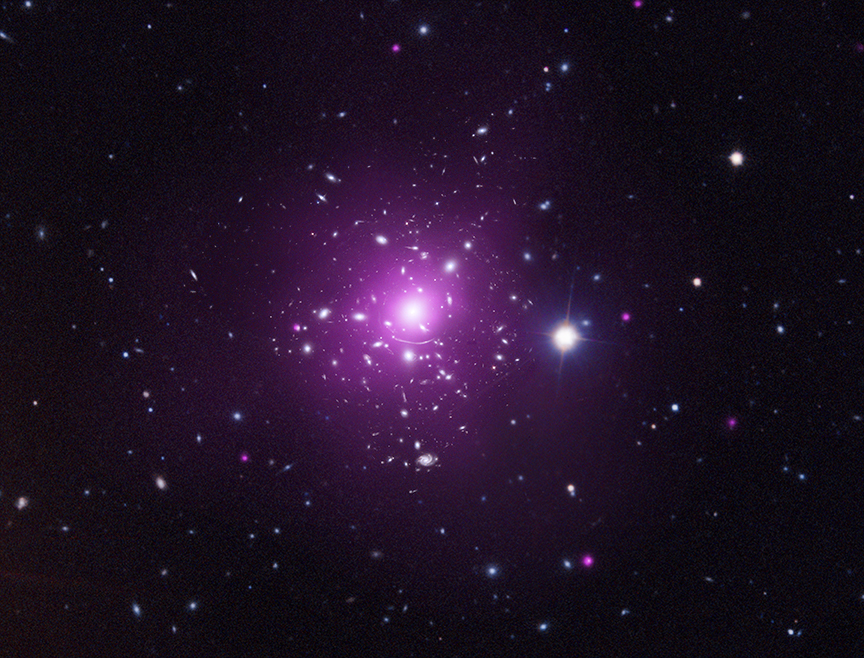
Abell 383: A cluster of galaxies located about 2.3 billion light years from Earth.

Two teams of astronomers have used data from Chandra and other telescopes to map the distribution of dark matter in three dimensions in the galaxy cluster Abell 383. The dark matter in Abell 383 is stretched out like a gigantic football with the point of the football aligned close to the line of sight. The X-ray data (purple) from Chandra in the composite image show the hot gas, which is by far the dominant type of normal matter in the cluster. Galaxies are shown with the optical data from the Hubble, the Very Large Telescope, and the Sloan Digital Sky Survey, colored in blue and white.

Scale: Image is 7.26 arcmin across. (4.84 million light years across.)

Photo credit: X-ray: NASA/CXC/Caltech/A.Newman et al/Tel Aviv/A.Morandi & M.Limousin; Optical: NASA/STScI, ESO/VLT, SDSS

Note: For more information, see Abell 383: Getting a Full Picture of an Elusive Subject.

Wednesday, May 4, 2011

Abell 383


The giant cluster of elliptical galaxies in the center of this image contains so much dark matter mass that its gravity bends light. This means that for very distant galaxies in the background, the cluster's gravitational field acts as a sort of magnifying glass, bending and concentrating the distant object's light towards Hubble. These gravitational lenses are one tool astronomers can use to extend Hubble's vision beyond what it would normally be capable of observing.

Using Abell 383, a team of astronomers have identified and studied a galaxy so far away we see it as it was less than a thousand million years after the Big Bang. Viewing this galaxy through the gravitational lens meant that the scientists were able to discern many intriguing features that would otherwise have remained hidden, including that its stars were unexpectedly old for a galaxy this close in time to the beginning of the Universe. This has profound implications for our understanding of how and when the first galaxies formed, and how the diffuse fog of neutral hydrogen that filled the early Universe was cleared.

Photo credit: NASA, ESA, J. Richard (CRAL) and J.-P. Kneib (LAM). Acknowledgement: Marc Postman (STScI)

Note: For more information, see First Galaxies Were Born Much Earlier Than Expected [heic1106]; for an annotated version of the above photo, see here.