Pages

Saturday, March 10, 2012

Messier 81


The perfectly picturesque spiral galaxy known as Messier 81, or M81, looks sharp in this new composite from NASA's Spitzer and Hubble space telescopes and NASA's Galaxy Evolution Explorer. M81 is a "grand design" spiral galaxy, which means its elegant arms curl all the way down into its center. It is located about 12 million light-years away in the Ursa Major constellation and is one of the brightest galaxies that can be seen from Earth through telescopes.

The colors in this picture represent a trio of light wavelengths: blue is ultraviolet light captured by the Galaxy Evolution Explorer; yellowish white is visible light seen by Hubble; and red is infrared light detected by Spitzer. The blue areas show the hottest, youngest stars, while the reddish-pink denotes lanes of dust that line the spiral arms. The orange center is made up of older stars.

Photo credit: NASA/JPL-Caltech/ESA/Harvard-Smithsonian CfA

Friday, March 9, 2012

The Hercules Cluster of Galaxies


This new image, taken with the VLT Survey Telescope (VST) shows a wide variety of interacting galaxies in the young Hercules galaxy cluster. The sharpness of the picture and the sheer number of objects captured — across a full square degree — in less than three hours of observations attest to the great power of the VST and its OmegaCAM camera to explore the nearby Universe. This picture has been cropped and does not cover the full VST field of view.

Photo credit: ESO/INAF-VST/OmegaCAM. Acknowledgement: OmegaCen/Astro-WISE/Kapteyn Institute

Note: For more information, see Galaxies Get Up Close and Personal.

Thursday, March 8, 2012

Beethoven Basin Elevation Map


This elevation map of the Beethoven basin is color-coded to show the height of features on Mercury's surface. Mercury lacks a "sea level," so the zero-point reference elevation is defined to be the mean planetary radius of 2440 km. Blue areas, such as within Bello crater on the floor of Beethoven, have negative elevations. The red and white areas to the southwest are more than 8 km higher than the lowest points in this area.

Center Latitude: -20°
Center Longitude: 236° E
Scale: Beethoven basin is ~650 km (404 miles) in diameter
Image information: A digital terrain model (DTM) derived from Mercury Dual Imaging System (MDIS) stereo images. The lateral spacing is 330 meters and the map is in stereographic (conformal) projection. The image is taken from abstract number 1913 submitted to the 2012 Lunar and Planetary Science Conference, by Frank Preusker and colleagues.

Image credit: NASA/Johns Hopkins University Applied Physics Laboratory/Carnegie Institution of Washington

Wednesday, March 7, 2012

Phlegra Montes


Phlegra Montes is a range of gently curving mountains and ridges on Mars. They extend from the northeastern portion of the Elysium volcanic province to the northern lowlands. The High-Resolution Stereo Camera on ESA’s Mars Express collected the data for these images on 1 June 2011 during orbit 9465. The image combines data from the nadir channel and one stereo channel to produce this 3D image. Stereoscopic glasses are required to see the 3D effect.

Photo credit: ESA/DLR/FU Berlin (G. Neukum)

Note: For more information, see Mountains and Buried Ice on Mars.

Tuesday, March 6, 2012

Dione in False Colors


This view highlights tectonic faults and craters on Dione, an icy world that has undoubtedly experienced geologic activity since its formation.

To create the enhanced-color view, ultraviolet, green and infrared images were combined into a single black and white picture that isolates and maps regional color differences. This "color map" was then superposed over a clear-filter image. The origin of the color differences is not yet understood, but may be caused by subtle differences in the surface composition or the sizes of grains making up the icy soil.

This view looks toward the leading hemisphere on Dione (1,126 kilometers, or 700 miles across). North is up and rotated 20 degrees to the right.

See PIA07690 for a similar monochrome view.

All images were acquired with the Cassini spacecraft narrow-angle camera on December 24, 2005 at a distance of approximately 151,000 kilometers (94,000 miles) from Dione and at a Sun-Dione-spacecraft, or phase, angle of 99 degrees. Image scale is 896 meters (2,940 feet) per pixel.

Photo credit: NASA/JPL/Space Science Institute

Note: For more information, see Cassini Detects Hint of Fresh Air at Dione.

Monday, March 5, 2012

Twin Jets in Herbig-Haro 34


NASA's Spitzer Space Telescope took this image of a baby star sprouting two identical jets (green lines emanating from fuzzy star). The jet on the right had been seen before in visible-light views, but the jet at left -- the identical twin to the first jet -- could only be seen in detail with Spitzer's infrared detectors. The left jet was hidden behind a dark cloud, which Spitzer can see through.

The twin jets, in a system called Herbig-Haro 34, are made of identical knots of gas and dust, ejected one after another from the area around the star. By studying the spacing of these knots, and knowing the speed of the jets from previous studies, astronomers were able to determine that the jet to the right of the star punches its material out 4.5 years later than the counter-jet.

The new data also reveal that the area from which the jets originate is contained within a sphere around the star, with a radius of 3 astronomical units. An astronomical unit is the distance between Earth and the Sun. Previous studies estimated that the maximum size of this jet-making zone was 10 times larger.

The wispy material is gas and dust. Arc-shaped bow shocks can be seen at the ends of the twin jets. The shocks consist of compressed material in front of the jets.

The Herbig-Haro 34 jets are located at approximately 1,400 light-years away in the Orion constellation.

Photo credit: NASA/JPL-Caltech

Sunday, March 4, 2012

Abell 520


This composite image shows the distribution of dark matter, galaxies, and hot gas in the core of the merging galaxy cluster Abell 520, formed from a violent collision of massive galaxy clusters.

The natural-color image of the galaxies was taken with NASA's Hubble Space Telescope and with the Canada-France-Hawaii Telescope in Hawaii.

Superimposed on the image are "false-colored" maps showing the concentration of starlight, hot gas, and dark matter in the cluster. Starlight from galaxies, derived from observations by the Canada-France-Hawaii Telescope, is colored orange. The green-tinted regions show hot gas, as detected by NASA's Chandra X-ray Observatory. The gas is evidence that a collision took place. The blue-colored areas pinpoint the location of most of the mass in the cluster, which is dominated by dark matter. Dark matter is an invisible substance that makes up most of the universe's mass. The dark-matter map was derived from the Hubble Wide Field Planetary Camera 2 observations by detecting how light from distant objects is distorted by the cluster of galaxies, an effect called gravitational lensing.

The blend of blue and green in the center of the image reveals that a clump of dark matter resides near most of the hot gas, where very few galaxies are found. This finding confirms previous observations of a dark-matter core in the cluster. The result could present a challenge to basic theories of dark matter, which predict that galaxies should be anchored to dark matter, even during the shock of a collision.

Abell 520 resides 2.4 billion light-years away.

Photo credit: NASA, ESA, CFHT, CXO, M.J. Jee (University of California, Davis), and A. Mahdavi (San Francisco State University)

Note: For more information, see Abell 520: Dark Matter and Galaxies Part Ways in Collision between Hefty Galaxy Clusters .

Saturday, March 3, 2012

Earthshine: The Moon Shining in Reflected Light From the Earth


When the Moon appears as a thin crescent in the twilight skies of Earth it is often possible to see that the rest of the disc is also faintly glowing. This phenomenon is called earthshine. It is due to sunlight reflecting off the Earth and illuminating the lunar surface. After reflection from Earth the colors in the light, shown as a rainbow in this picture, are significantly changed. By observing earthshine astronomers can study the properties of light reflected from Earth as if it were an exoplanet and search for signs of life. The reflected light is also strongly polarized and studying the polarization as well as the intensity at different colors allows for much more sensitive tests for the presence of life.


Illustration credit: ESO/L. Calçada; video credit: ESO/M. Kornmesser

Note: For more information, see VLT Rediscovers Life on Earth.

Friday, March 2, 2012

Star Formation in the Orion Nebula


This new view of the Orion Nebula shows embryonic stars within extensive gas and dust clouds. Combining far-infrared observations from the Herschel Space Observatory and mid-infrared observations from NASA's Spitzer Space Telescope, the image shows newly forming stars surrounded by remnant gas and dust in the form of discs and larger envelopes.

Data from the PACS instrument on Herschel at wavelengths of 70 and 160 microns (a micron is a millionth of a meter) are shown as green and red, respectively, and reveal emission from the disks and envelopes of the very youngest protostars. Two Spitzer instruments, IRAC and MIPS, were used to obtain images of the same region at 8 and 24 microns, which are combined here as blue. These wavelengths show emission from the hotter regions of discs around somewhat older stars.

The region shown covers roughly 25x25 arcminutes on the sky or 3x3 parsecs at the distance to Orion.

Photo credits: ESA/PACS/NASA/JPL-Caltech/IRAM

Note: For more information, see Fledgling Stars Flicker in the Heart of Orion; also, Young Stars Flicker Amidst Clouds of Gas and Dust.

Thursday, March 1, 2012

US Eastern Seaboard at Night


An Expedition 30 crew member aboard the International Space Station took this nighttime photograph of much of the Atlantic coast of the United States. Large metropolitan areas and other easily recognizable sites from the Virginia/Maryland/Washington, D.C. area are visible in the image that spans almost to Rhode Island. Boston is just out of frame at right. Long Island and the New York City area are visible in the lower right quadrant. Philadelphia and Pittsburgh are near the center. Parts of two Russian vehicles parked at the orbital outpost are seen in left foreground.

This image was taken on February 6, 2012.

Photo credit: NASA

Wednesday, February 29, 2012

Artist's Impression of Galactic Outflows and Jets


The image shows an artist's impression of a galaxy that is releasing material via two strongly collimated jets (shown in red/orange) as well as via wide-angle outflows (shown in gray/blue). Both jets and outflows are being driven by the black hole located at the galaxy's center.

The insert on the upper right shows an enlarged view of the active galactic nucleus (AGN) at the center of the galaxy, where a supermassive black hole is vigorously accreting matter from its surroundings via an accretion disc. However, the process of accretion onto the black hole is not fully efficient; it thus results in the ejection of matter via jets and outflows with wider opening angles, which arise from ionized material in the accretion disc.

The wide-angle outflows are also referred to as ultra-fast outflows, or UFOs, because their velocities are very large – between 10,000 and 100,000 kilometers per second. These UFOs have been discovered by observing blue-shifts in the absorption lines of highly ionized iron atoms in the X-ray spectra of AGN-hosting galaxies. The first systematic study of UFOs, conducted with ESA's XMM-Newton X-ray Observatory on a sample of 42 galaxies, has demonstrated that these outflows are quite common, as they are present in about 40 per cent of the sources in the sample. These results have been reported in a series of papers by Tombesi et al. (2010; 2011; 2012).

These outflows appear to be massive and powerful enough to be major agents in the feedback processes that regulate the growth of galaxies and of the black holes that reside at their cores. Furthermore, UFOs are more massive, slower and have wider opening angles than the relativistic and strongly collimated jets, and are thus bound to interact more significantly with the interstellar medium of the host galaxy. These feedback mechanisms may be able to quench star formation in the bulge and the growth of the black hole at the same time, thus contributing to establishing the well-known empirical correlations observed between the mass of a black hole and some properties of the host galaxy's bulge, such as its stellar content and the average velocities of stars in the bulge.

Illustration credit: ESA/AOES Medialab

Note: For more information, see XMM-Newton Measures the Power of Black-Hole Driven Outflows in Galaxies.

Tuesday, February 28, 2012

How Would the Solar System Look to Aliens?


Dust in the Kuiper Belt, the cold-storage zone that includes Pluto, creates a faint infrared disk potentially visible to alien astronomers looking for planets around the Sun. Neptune's gravitational imprint on the dust is detectable in new simulations of how this dust moves through the solar system. The simulations show how the distant view of the solar system might have changed over its history.

Video credit: NASA; text credit: NASA

Monday, February 27, 2012

Eta Carinae


NASA's Hubble Telescope captured an image of Eta Carinae. This image consists of ultraviolet and visible light images from the High Resolution Channel of Hubble's Advanced Camera for Surveys. The field of view is approximately 30 arcseconds across.

The larger of the two stars in the Eta Carinae system is a huge and unstable star that is nearing the end of its life, and the event that the 19th century astronomers observed was a stellar near-death experience. Scientists call these outbursts supernova impostor events, because they appear similar to supernovae but stop just short of destroying their star.

Although 19th century astronomers did not have telescopes powerful enough to see the 1843 outburst in detail, its effects can be studied today. The huge clouds of matter thrown out a century and a half ago, known as the Homunculus Nebula, have been a regular target for Hubble since its launch in 1990. This image, taken with the Advanced Camera for Surveys High Resolution Channel, is the most detailed yet, and shows how the material from the star was not thrown out in a uniform manner, but forms a huge dumbbell shape.

Eta Carinae is one of the closest stars to Earth that is likely to explode in a supernova in the relatively near future (though in astronomical timescales the "near future" could still be a million years away). When it does, expect an impressive view from Earth, far brighter still than its last outburst: SN 2006gy, the brightest supernova ever observed, came from a star of the same type, though from a galaxy over 200 million light-years away.

Photo credit: ESA/NASA

Sunday, February 26, 2012

Solar Tornado


As if it could not make up its mind ... darker, cooler plasma slid and shifted back and forth above the Sun's surface seen here for 30 hours (February 7-8, 2012) in extreme ultraviolet light (171 angstrom). An active region rotating into view provides a bright backdrop to the gyrating streams of plasma. The particles are being pulled this way and that by competing magnetic forces. They are tracking along strands of magnetic field lines. This kind of detailed solar observation with high-resolution frames and a four-minute cadence was not possible until SDO, which launched two years ago on February 11, 2010. This celebrates SDO's Second Anniversary!

Video credit: NASA/GSFC/SDO/AIA/HMI

Saturday, February 25, 2012

Earth's Clouds are Getting Lower


This image of clouds over the southern Indian Ocean was acquired on July 23, 2007 by one of the backward (northward)-viewing cameras of the Multi-angle Imaging SpectroRadiometer (MISR) instrument on NASA's polar-orbiting Terra spacecraft. The area covered by the image is 247.5 kilometers wide and 660 kilometers long, and is shown in an approximate perspective view at an angle of 60 degrees off of vertical. The solar zenith angle ranges from about 83 degrees at the top of the image to 88 degrees at the bottom, hence the lengthening of shadows cast by the clouds on the underlying ocean surface and reddening of the hues in the foreground. Stereoscopic analysis of the data from multiple MISR cameras indicates that the cloud tops visible here range in altitude from about 0.6 to 2.5 miles (1 to 4 kilometers). A new university study using MISR data revealed an overall trend of decreasing global cloud height during the last decade.

Photo credit: NASA/GSFC/METI/ERSDAC/JAROS, and U.S./Japan ASTER Science Team

Friday, February 24, 2012

The Wind from Black Hole IGR J17091-3624


This artist's impression shows a binary system containing a stellar-mass black hole known as IGR J17091 for short. Observations with Chandra have clocked the fastest wind ever seen blowing off a disk around this stellar-mass black hole at about 20 million miles per hour. The wind, which comes from a disk of gas surrounding the black hole, may be carrying away much more material than the black hole is capturing and could be variable over time. This result has important implications for understanding how this class of black hole, which typically weighs between 5 and 10 solar masses, can behave.

Image credit: NASA/CXC/M.Weiss

Note: For more information, see IGR J17091-3624: NASA'S Chandra Finds Fastest Wind From Stellar-Mass Black Hole.

Wednesday, February 22, 2012

Io


This is the highest resolution color picture taken so far [as of that date] of Jupiter's volcanic moon Io by NASA's Galileo spacecraft. At 3 kilometers (about 2 miles) per picture element, the fiery satellite is seen against a backdrop of Jupiter's cloud tops, which appear blue in this false-color composite. Among the surprises seen on the moon's surface are several small, distinctly greenish patches and subtle violet hues at the cores and margins of bright sulfur dioxide-rich regions (like the one in the lower right). Dark spots, many flagged by bright red pyroclastic deposits, (deposits from explosive ejecta), mark the sites of current volcanic activity. Most of Io's riotous color is due to the presence of sulfur compounds, but the dark materials that make up the flows and calderas are probably silicate rock.

North is to the top of the picture. The images used to construct this composite were taken in the 1-micron, green and violet filters of the solid state imaging camera system on NASA's Galileo spacecraft. The images were taken on March 29, 1998 at a range of 294,000 kilometers (about 183,000 miles).

Photo credit: NASA/JPL/University of Arizona

Tuesday, February 21, 2012

NASA's IBEX Observes Interstellar Matter


The Interstellar Boundary Explorer (IBEX) has directly sampled multiple heavy elements from the Local Interstellar Cloud for the first time. It turns out that this interstellar material is not like the Sun, but the reason for this is unknown. Also, IBEX has caught the interstellar wind that surrounds and compresses our heliosphere and has found that it travels more slowly and in a different direction than previously thought.

Video credit: NASA

Note: For more information, see Alien Matter in the Solar System: A Galactic Mismatch.

Monday, February 20, 2012

Centaurus A


Color composite image of Centaurus A, revealing the lobes and jets emanating from the active galaxy’s central black hole. This is a composite of images obtained with three instruments, operating at very different wavelengths. The 870-micron submillimeter data, from LABOCA on APEX, are shown in orange. X-ray data from the Chandra X-ray Observatory are shown in blue. Visible light data from the Wide Field Imager (WFI) on the MPG/ESO 2.2 m telescope located at La Silla, Chile, show the background stars and the galaxy’s characteristic dust lane in close to "true color."

Photo credit: ESO/WFI (Optical); MPIfR/ESO/APEX/A.Weiss et al. (Submillimetre); NASA/CXC/CfA/R.Kraft et al. (X-ray)

Sunday, February 19, 2012

Cannibal Galaxy ESO 243-49


This spectacular edge-on galaxy, called ESO 243-49, is home to an intermediate-mass black hole that may have been purloined from a cannibalized dwarf galaxy. The black hole, with an estimated mass of 50 million Suns, lies above the galactic plane. This is an unlikely place for such a massive black hole to exist, unless it belonged to a small galaxy that was gravitationally torn apart by ESO 243-49.

The circle identifies a unique X-ray source that pinpoints the black hole. The X-rays are believed to be radiation from a hot accretion disc around the black hole. The blue light not only comes from a hot accretion disc, but also from a cluster of hot young stars that formed around the black hole. The galaxy is 290 million light-years from Earth. Hubble can't resolve the stars individually because the suspected cluster is too far away. Their presence is inferred from the color and brightness of the light coming from the black hole's location.

Photo credit: NASA, ESA, and S. Farrell (University of Sydney, Australia and University of Leicester, UK)

Note: For more information, see . For another, unlabeled picture of ESO 243-49, click here.

Saturday, February 18, 2012

Polar Layers in Gemini Scopuli


This is an especially pretty image due to the color variations and lighting geometry.

The color variations are due to mixtures of reddish dust with white frost and ice. The image was acquired as a "rider" with either a Context Camera or CRISM target.

One of these other MRO experiments chose this location to point at with the spacecraft, then the HiRISE science lead for this 2-week planning cycle decided to add a HiRISE image here for a high-resolution sample.

Photo credit: NASA/JPL/University of Arizona

Note: This image is located along one of the canyons in the Gemini Scopuli region of Planum Boreum.

Friday, February 17, 2012

Taurus Molecular Cloud


This image from the APEX telescope, of part of the Taurus Molecular Cloud, shows a sinuous filament of cosmic dust more than ten light-years long. In it, newborn stars are hidden, and dense clouds of gas are on the verge of collapsing to form yet more stars. The cosmic dust grains are so cold that observations at submillimeter wavelengths, such as these made by the LABOCA camera on APEX, are needed to detect their faint glow. This image shows two regions in the cloud: the upper-right part of the filament shown here is Barnard 211, while the lower-left part is Barnard 213.

The submillimeter-wavelength observations from the LABOCA camera on APEX, which reveal the heat glow of the cosmic dust grains, are shown here in orange tones. They are superimposed on a visible-light image of the region, which shows the rich background of stars. The bright star above the filament is φ Tauri.

Photo credit: ESO/APEX (MPIfR/ESO/OSO)/A. Hacar et al./Digitized Sky Survey 2. Acknowledgment: Davide De Martin

Note: For more information, see APEX Turns its Eye to Dark Clouds in Taurus.

Thursday, February 16, 2012

Galactic Haze and Bubbles


This all-sky image shows the distribution of the Galactic Haze seen by ESA's Planck mission at microwave frequencies superimposed over the high-energy sky as seen by NASA's Fermi Gamma-ray Space Telescope.

The Planck data (shown here in red and yellow) correspond to the Haze emission at frequencies of 30 and 44 GHz, extending from and around the Galactic Center.

The Fermi data (shown here in blue) correspond to observations performed at energies between 10 and 100 GeV and reveal two bubble-shaped, gamma-ray emitting structures extending from the Galactic Center.

The two emission regions seen by Planck and Fermi at two opposite ends of the electromagnetic spectrum correlate spatially quite well and might indeed be a manifestation of the same population of electrons via different radiation processes.

Synchrotron emission associated with the Galactic Haze seen by Planck exhibits distinctly different characteristics from the synchrotron emission seen elsewhere in the Milky Way. Diffuse synchrotron emission in the Galaxy is interpreted as radiation from highly energetic electrons that have been accelerated in shocks created by supernova explosions. Compared to this well-studied emission, the Galactic Haze has a 'harder' spectrum, meaning that its emission does not decline as rapidly with increasing frequency.

Several explanations have been proposed for this unusual behavior, including enhanced supernova rates, galactic winds and even annihilation of dark-matter particles. Thus far, none of them have been confirmed and the issue remains open.

The Planck image includes the mask that has been used in the analysis of the data to exclude regions with strong foreground contamination due to the Galaxy's diffuse emission. The mask also includes strong point-like sources located over the whole sky.

Photo credit: ESA/Planck Collaboration (microwave); NASA/DOE/Fermi LAT/D. Finkbeiner et al. (gamma rays)

Note: For more information and images, see New Planck Maps Reveal Unseen Details Across the Milky Way.

Wednesday, February 15, 2012

Kuiper Crater


This high-resolution enhanced color view of Kuiper crater shows not just the bright rays that extend out from this relatively young crater but also the redder color of Kuiper's ejecta blanket. The redder color may be due to a compositionally distinct material excavated from depth by the impact that formed Kuiper.

Date acquired: September 02, 2011
Image Mission Elapsed Time (MET): 223443634, 223443638, 223443654
Image ID: 708128, 708129, 708133
Instrument: Wide Angle Camera (WAC) of the Mercury Dual Imaging System (MDIS)
WAC filter: 9 (1000 nanometers), 7 (750 nanometers), 6 (433 nanometers) as red-green-blue
Center Latitude: -11.97°
Center Longitude: 328.4° E
Resolution: 380 meters/pixel
Scale: Kuiper has a diameter of 62 kilometers (39 miles)
Incidence Angle: 33.4°
Emission Angle: 21.4°
Phase Angle: 54.8°

Photo credit: NASA/Johns Hopkins University Applied Physics Laboratory/Carnegie Institution of Washington

Tuesday, February 14, 2012

NGC 1313


The central parts of the starburst galaxy NGC 1313. The very active state of this galaxy is very evident from the image, showing many star formation regions. A great number of supershell nebulae, that is, cocoon of gas inflated and etched by successive bursts of star formation, are visible. The green nebulosities are regions emitting in the ionized oxygen lines and may harbor clusters with very hot stars. This color-composite is based on images obtained with the FORS1 instrument on one of the 8.2-m Unit Telescope of ESO's Very Large Telescope, located at Cerro Paranal. The data were obtained in the night of 16 December 2003, through different broad- (R, B, and z) and narrow-band filters (H-alpha, OI, and OIII). The data were extracted from the ESO Science Archive and fully processed by Henri Boffin (ESO).

Photo credit: ESO

Monday, February 13, 2012

Sagittarius A*


Sagittarius A*: The supermassive black hole at the center of the Milky Way galaxy, about 26,000 light years from Earth.

A new study provides a possible explanation of mysterious X-ray flares detected by Chandra over the period of several years. It suggests that there is a cloud around Sgr A* containing trillions of asteroids and comets, stripped from their parent stars. The flares occur when asteroids of six miles or larger in radius are consumed by the black hole. The panel on the left shows a very long Chandra observation of the region around the Sgr A*, while the three panels on the right are artist's impressions of the path that a doomed asteroid would take on its way to the black hole.

Scale: Image is 15 arcminutes across (20 light years)

Photo credit: X-ray: NASA/CXC/MIT/F. Baganoff et al.; Illustrations: NASA/CXC/M.Weiss

Note: For more information, see Sagittarius A*: NASA's Chandra Finds Milky Way's Black Hole May be Grazing on Asteroids

Sunday, February 12, 2012

The Alps


The snow-kissed Alps that stretch across France, Italy, Switzerland, Germany, Liechtenstein, Austria and Slovenia are captured in this Envisat image, acquired on 16 January 2012. Owing to this snow cover and a relatively low illumination angle of the Sun during this time of year, the ranges and valleys of the mountains stand out in the image.

Just south of the Alps we see the typical winter fog and clouds over the Po Valley. Stretching down the length of the Italian peninsula are the Apennine Mountains. In the lower-right corner, we can see Italy’s Lake Trasimeno. Closer to the Alps is the long Lake Garda. On the opposite side of the Alps from Garda, on the border of Switzerland, Germany and Austria, is Lake Constance. Further north in the upper-left portion of the image we can see Germany’s Black Forest.

Photo credit: ESA

Saturday, February 11, 2012

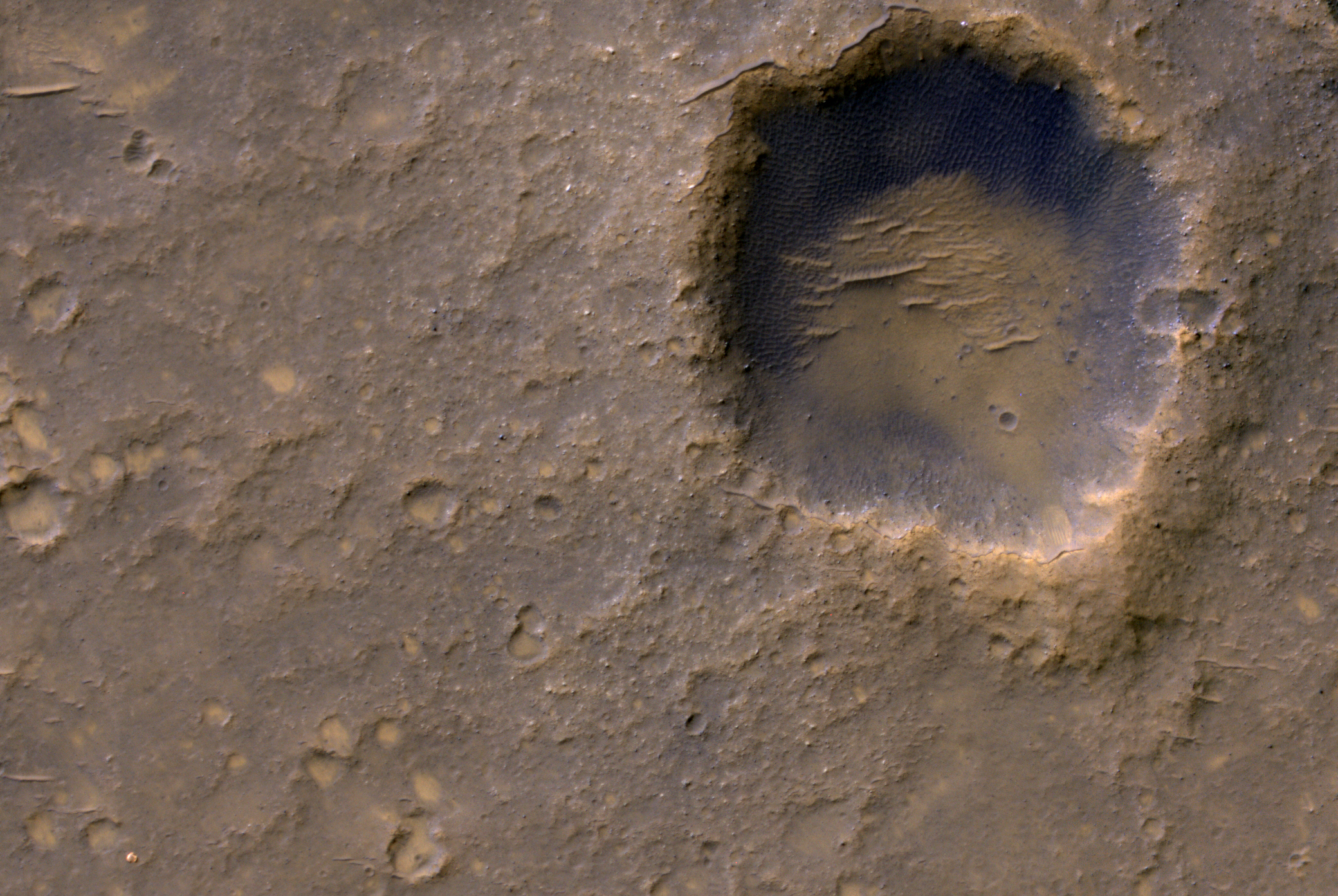
Spirit Lander and Bonneville Crater in Color


HiRISE has never before imaged the actual lander for the Spirit rover in color, on the west side of Bonneville Crater. The lander is still bright, but with a reddish color, probably due to a dust cover (lower left in the subimage).

A bright spot from a remnant of the heat shield is still visible on the north rim of Bonneville Crater. The backshell and parachute are still bright, but were not captured in the narrow color swath.

The rover itself can still be seen near "home plate" in the Columbia Hills, but there is no obvious sign of rover tracks--erased by the wind.

Photo credit: NASA/JPL/University of Arizona

Friday, February 10, 2012

Infrared/Visible-Light Comparison of the Carina Nebula


This picture of the Carina Nebula, a region of massive star formation in the southern skies, compares the view in visible light with a new picture taken in infrared light. The visible-light view (lower panel) comes from the MPG/ESO 2.2-meter telescope at the La Silla Observatory and the new infrared picture (upper) comes from the HAWK-I camera on ESO’s Very Large Telescope. Many new features that are not seen at all in visible light can be seen in great detail in the new sharp infrared image from the VLT.

An interactive comparison image can be found here.


Photo credit: ESO/T. Preibisch

Note: For more information, see VLT Takes Most Detailed Infrared Image of the Carina Nebula.

Wednesday, February 8, 2012

Galaxy Cluster RCS2 032727-132623


Thanks to the presence of a natural “zoom lens” in space, this is a close-up look at brightest distant “magnified” galaxy in the universe known to date. It is one of the most striking examples of gravitational lensing, where the gravitational field of a foreground galaxy bends and amplifies the light of a more distant background galaxy. In this image the light from a distant galaxy, nearly 10 billion light-years away, has been warped into a nearly 90-degree arc of light in the galaxy cluster RCS2 032727-132623. The galaxy cluster lies 5 billion light-years away. The background galaxy’s image is 20 times larger and over three times brighter than typically lensed galaxies. The natural color image was taken in March 2011 with the Hubble Space Telescope’s Wide Field Camera 3.

Photo credit: NASA; ESA; J. Rigby (NASA Goddard Space Flight Center); and K. Sharon (Kavli Institute for Cosmological Physics, University of Chicago)

Note: For more information, see Hubble Zooms in on a Magnified Galaxy.

Tuesday, February 7, 2012

North American East Coast at Night


This January 29 panorama of much of the East Coast, photographed by one of the Expedition 30 crew members aboard the International Space Station, provides a look generally northeastward: Philadelphia-New York City-Boston corridor (bottom-center); western Lake Ontario shoreline with Toronto (left edge); Montreal (near center). An optical illusion in the photo makes the atmospheric limb and light activity from Aurora Borealis appear "intertwined."

Photo credit: NASA

Note: This is a nice follow-up photo to the recent photo of northwestern Europe at night. The Minister can see the lights of his hometown in this photo.

Monday, February 6, 2012

Blue Marble 2012 - Africa, the Middle East and India


Responding to public demand, NASA scientists created a companion image to the wildly popular 'Blue Marble' released last week (January 25, 2012).

The new image is a composite of six separate orbits taken on January 23, 2012 by the Suomi National Polar-orbiting Partnership satellite. Both of these new 'Blue Marble' images are images taken by a new instrument flying aboard Suomi NPP, the Visible Infrared Imaging Radiometer Suite (VIIRS).

Compiled by NASA Goddard scientist Norman Kuring, this image has the perspective of a viewer looking down from 7,918 miles (about 12,742 kilometers) above the Earth's surface from a viewpoint of 10 degrees South by 45 degrees East. The four vertical lines of 'haze' visible in this image shows the reflection of sunlight off the ocean, or 'glint,' that VIIRS captured as it orbited the globe. Suomi NPP is the result of a partnership between NASA, NOAA and the Department of Defense.

Photo credit: NASA/NOAA

Note: For more information, see VIIRS Eastern Hemisphere Image - Behind the Scenes.