Pages

Monday, February 18, 2013

Habitable Planets Around Red Dwarf Stars


The artist's conception shows a hypothetical planet with two moons orbiting in the habitable zone of a red dwarf star. Using publicly available data from NASA’s Kepler space telescope, astronomers at the Harvard-Smithsonian Center for Astrophysics (CfA) estimate that six percent of red dwarf stars have an Earth-sized planet in the "habitable zone," the range of distances from a star where the surface temperature of an orbiting planet might be suitable for liquid water.

The majority of the sun's closest stellar neighbors are red dwarfs. Researchers now believe that an Earth-size planet with a moderate temperature may be just 13 light-years away.

Astronomers don't know if life could exist on a planet orbiting a red dwarf. However, this finding suggests that the most common type of the star in the galaxy may provide many more cosmic neighborhoods to search for planets that may be like our own.

Illustration credit: D. Aguilar/Harvard-Smithsonian Center for Astrophysics

Note: For more information, see Kepler Data Suggest Earth-size Planets May Be Next Door.

Sunday, February 17, 2013

Asteroid 2012 DA14


This movie shows the asteroid 2012 DA14 flying safely by Earth, as seen by the Gingin Observatory in Australia around the time of its closest approach, 11:24:42 a.m. PST (2:24:42 p.m. EST, or 19:24:24 UTC), February 15, 2013.

At that time, the asteroid was about 17,150 miles (27,600 kilometers) above Earth's surface.

The asteroid appears streaked because the telescope was focused on the stars while the asteroid passed through the field of view.

Video credit: Courtesy of Gingin Observatory/Tonello; text credit: NASA/JPL

Note: For more information, see:
* PIA16735: Approach of Asteroid 2012 DA14 from Samford Valley Observatory
* PIA16737: Asteroid 2012 DA14 as Seen from Siding Spring, Australia
* PIA16738: Outbound Near-Earth Asteroid, as Seen from Spain
* Near-Earth Asteroid Makes Preview Appearance
* NASA to Chronicle Close Earth Flyby of Asteroid
* Russia Meteor Not Linked to Asteroid Flyby
* Possible Seismic Activity on Asteroid 2012 DA14

The Chelyabinsk Meteor


Video footage purports to show fragments of a meteorite coming to Earth over Russia after it explodes in the sky. Videos show trails left by the shards across the sky in the Chelyabinsk region and the destruction left on the area's streets. This video has been obtained from Youtube and has not all been independently verified.

Video credit: The Guardian

Note: For more information, see Trace of an Alien Visitor.


The International Space Station (February 2008)


Backdropped by the blackness of space, the International Space Station is seen from Space Shuttle Atlantis as the two spacecraft begin their relative separation. Earlier the STS-122 and Expedition 16 crews concluded almost nine days of cooperative work onboard the Shuttle and Station. Undocking of the two spacecraft occurred at 10:24 CET on 18 February 2008.

Photo credit: NASA

Saturday, February 16, 2013

LRLL 54361 and its Surroundings


This infrared image from the NASA/ESA Hubble Space Telescope shows an image of protostellar object LRLL 54361 and its rich cosmic neighborhood, a region called IC 348.

The protostar, which is the bright object with fan-like beams of light coming from it, located towards the right of the image, is letting off flashes of light every 25.3 days.

Photo image: NASA, ESA, and J. Muzerolle (STScI)

Note: For more information, see Hubble Captures Strobe Flashes From a Young Star. Also, PIA16689: Artist's Impression of Pulsating Object LRLL 54361 and PIA16690: Protostar LRLL 54361. Also, NASA Telescopes Discover Strobe-Like Flashes in Young Stars.

Friday, February 15, 2013

Atget Crater


Though Mercury is not known for having an especially colorful surface, some regions show a strong local contrast in color. Like other craters in Caloris, the interior and ejecta of Atget are darker and bluer than the typical brown volcanic plains. These craters help scientists to get a look at the three-dimensional compositional variations with the Caloris basin, and provide a way to judge the thickness of the volcanic plains (over 2 km here!). North is up in this image.

Date acquired: December 09, 2012
Image Mission Elapsed Time (MET): 263555174, 263555178, 263555194
Image ID: 3108404, 3108405, 3108409
Instrument: Wide Angle Camera (WAC) of the Mercury Dual Imaging System (MDIS)
WAC filters: 9, 7, and 6 (996, 748, and 433 nanometers) in red, green, and blue
Center Latitude: 25.92°
Center Longitude: 166.2° E
Resolution: 224 meters/pixel
Scale: Atget is 100 km (62 mi.) in diameter
Incidence Angle: 25.9°
Emission Angle: 52.6°
Phase Angle: 78.5°

Photo credit: NASA/Johns Hopkins University Applied Physics Laboratory/Carnegie Institution of Washington

Thursday, February 14, 2013

Comet C/2012 S1 (ISON)


This series of images of comet C/2012 S1 (ISON) was taken by the Medium-Resolution Imager of NASA's Deep Impact spacecraft over a 36-hour period on January 17 and 18, 2013. At the time, the spacecraft was 493 million miles (793 million kilometers) from the comet.

Video credit: NASA/JPL-Caltech/UMD; text credit: NASA/JPL-Caltech

Note: For more information, see NASA's Deep Impact Spacecraft Eyes Comet ISON.

Wednesday, February 13, 2013

Sharpless 2-296


This image shows the intricate structure of part of the Seagull Nebula, known more formally as IC 2177. These wisps of gas and dust are known as Sharpless 2-296 (officially Sh 2-296) and form part of the “wings” of the celestial bird. This region of the sky is a fascinating muddle of intriguing astronomical objects — a mix of dark and glowing red clouds, weaving amongst bright stars. This new view was captured by the Wide Field Imager on the MPG/ESO 2.2-meter telescope at ESO’s La Silla Observatory in Chile.

Photo credit: ESO

Note: For more information, see The Wings of the Seagull Nebula.

Tuesday, February 12, 2013

Messier 42 - The Orion Nebula


The Orion nebula is featured in this sweeping image from NASA's Wide-field Infrared Survey Explorer, or WISE. The constellation of Orion is prominent in the evening sky throughout the world from about December through April of each year. The nebula (also cataloged as Messier 42) is located in the sword of Orion, hanging from his famous belt of three stars. The star cluster embedded in the nebula is visible to the unaided human eye as a single star, with some fuzziness apparent to the most keen-eyed observers. Because of its prominence, cultures all around the world have given special significance to Orion. The Maya of Mesoamerica envision the lower portion of Orion, his belt and feet (the stars Saiph and Rigel), as being the hearthstones of creation, similar to the triangular three-stone hearth that is at the center of all traditional Maya homes. The Orion nebula, lying at the center of the triangle, is interpreted by the Maya as the cosmic fire of creation surrounded by smoke.

This metaphor of a cosmic fire of creation is apt. The Orion nebula is an enormous cloud of dust and gas where vast numbers of new stars are being forged. It is one of the closest sites of star formation to Earth and therefore provides astronomers with the best view of stellar birth in action. Many other telescopes have been used to study the nebula in detail, finding wonders such as planet-forming disks forming around newly forming stars. WISE was an all-sky survey giving it the ability to see these sites of star formation in a larger context. This view spans more than six times the width of the full moon, covering a region nearly 100 light-years across. In it, we see the Orion nebula surrounded by large amounts of interstellar dust, colored green.

Astronomers now realize that the Orion nebula is part of the larger Orion molecular cloud complex, which also includes the Flame nebula. This complex in our Milky Way galaxy is actively making new stars. It is filled with dust warmed by the light of the new stars within, making the dust glow in infrared light.

Color in this image represents specific infrared wavelengths. Blue represents light emitted at 3.4-micron wavelengths and cyan (blue-green) represents 4.6 microns, both of which come mainly from hot stars. Relatively cooler objects, such as the dust of the nebulae, appear green and red. Green represents 12-micron light and red represents 22-micron light.

Image credit: NASA/JPL-Caltech/UCLA

Note: For more information, see WISE Feels the Heat from Orion's Sword.

Monday, February 11, 2013

Smooth vs. Fragmented Stellar Winds


Artist's impression comparing a smooth stellar wind (left) with a highly fragmented stellar wind (right) of a massive star like Zeta Puppis. A decade's-worth of observations with ESA's XMM-Newton have revealed that the wind of Zeta Puppis is fragmented into hundreds of thousands of individual hot (red) and cool (blue) clumps. Studying stellar winds is vital not only to understand mass loss from the star itself and thus its expected lifetime, but also how the winds inject material and energy into the surrounding environment and influence the birth and death of other stars.

Illustration credit: ESA - C. Carreau/Nazé et al.

Notes: For more information, see Massive Stellar Winds are Made of Tiny Pieces. Also, for a much larger TIFF file of the above illustration, see New View of Stellar Winds.

Sunday, February 10, 2013

Messier 106


This image combines Hubble observations of M 106 with additional information captured by amateur astronomers Robert Gendler and Jay GaBany. Gendler combined Hubble data with his own observations to produce this stunning color image.

M 106 is a relatively nearby spiral galaxy, a little over 20 million light-years away.

Photo credit: NASA, ESA, the Hubble Heritage Team (STScI/AURA), and R. Gendler (for the Hubble Heritage Team). Acknowledgment: J. GaBany, A. van der Hoeven

Note: For more information, see A Spiral Galaxy With a Secret. Also, Hubble view of M 106.

Saturday, February 9, 2013

ESO 121-6


This thin, glittering streak of stars is the spiral galaxy ESO 121-6, which lies in the southern constellation of Pictor (The Painter's Easel). Viewed almost exactly side-on, the intricate structure of the swirling arms is hidden, but the full length of the galaxy can be seen — including the intense glow from the central bulge, a dense region of tightly packed young stars sitting at the center of the spiral arms.

Tendrils of dark dust can be seen across the frame, partially obscuring the bright center of the galaxy and continuing out towards the smattering of stars at its edges, where the dust lanes and shapes melt into the inky background. Numerous nearby stars and galaxies are visible as small smudges in the surrounding sky, and the brightest stars are dazzlingly prominent towards the bottom left of the image.

ESO 121-6 is a galaxy with patchy, loosely wound arms and a relatively faint central bulge. It actually belongs to a group of galaxies, a clump of no more than 50 similar structures all loosely bound to one another by gravity. The Milky Way is also a member of a galactic group, known as the Local Group.

Photo credit: ESA/Hubble & NASA

Friday, February 8, 2013

Protoplanetary Disk Around TW Hydrae


This illustration depicts the protoplanetary disc around the nearby young star TW Hydrae. With an age of about ten million years, TW Hydrae is located about 180 light-years away, towards the constellation Hydra, or the Sea Serpent.

Protoplanetary discs form around young stars from leftover material from the stellar formation process, which consists mainly of molecular hydrogen gas. This material orbits the star in a protoplanetary disc for several millions of years before it condenses into planets or is dispersed away by winds driven by the radiation of the star. In addition, trace amounts of cosmic dust and other gas species are present in the disc.

Astronomers using ESA's Herschel Space Observatory detected heavy molecular hydrogen in the protoplanetary disc around TW Hydrae, and have used this molecule as a tracer of the disc's main constituent – molecular hydrogen. This study has yielded the first accurate determination of the mass of a protoplanetary disc. With a mass equivalent to 50 times that of Jupiter, the disc around TW Hydrae is several times more massive than the primordial disc that gave birth to our Solar System.

At about ten million years, TW Hydrae is a relatively young star, but quite old to have retained a massive protoplanetary disc. The extremely accurate estimate of the disc's mass will benefit future observations of TW Hydrae and its environment, as astronomers investigate the various scenarios that could eventually lead to the formation of planets around this star.

Illustration credit: ESA/C. Carreau

Note: For more information, see Herschel Sizes Up Massive Protoplanetary Disc. Also, see PIA16683: Weighing Planetary Disks and Herschel Finds Past-Prime Star May Be Making Planets. Another post about TW Hydrae can be found here: Misty Star in the Sea Serpent.

Thursday, February 7, 2013

Curiosity on Sol 157


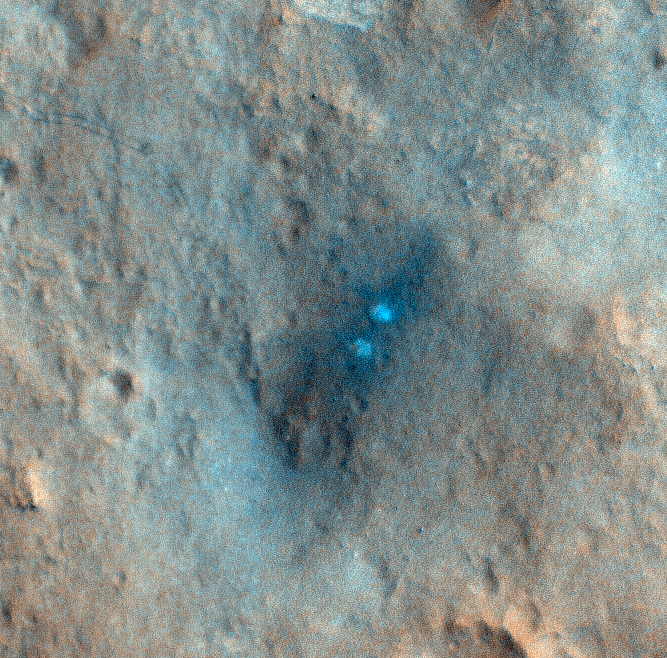
This HiRISE observation was performed in conjunction with a CRISM observation so that they could get good spectral data on the scour zone created by the MSL descent rockets.

Our higher resolution HiRISE image will allow the CRISM team to compare their data with ours. The scour zone is where MSL touched down. The pair of bright white spots in the HiRISE image show the area immediately below where sky crane's rockets were pointed. Those areas were "blasted clean" and therefore show brightest. The larger dark scour zone is dark because the fine dust has been blown away from the area leaving darker materials.

However, we also captured Curiosity on its 157th Sol as it was exploring Yellowknife Bay and about to drill its first rock.

This is the first time that we've captured the rover tracks in color, and they show up as a pair of dark lines moving across the landscape.

Note: the above image is non map-projected, so approximate north is down.

Photo credit: NASA/JPL/University of Arizona

Wednesday, February 6, 2013

The Ionosphere of Venus Under Different Solar Wind Conditions


A comparison of the ionosphere of Venus under different solar wind conditions. The yellow lines indicate the solar magnetic field lines as they interact with the ionosphere.

When the solar wind's dynamic pressure is normal (left image) the ionosphere is confined to a region 150-300 km above the planet's day side. Positively charged particles (ions) travel quite quickly across the day-night terminator to create a similar ionosphere on the planet's night side.

When the solar wind pressure drops to a very low level (right image), the ionosphere expands to a higher altitude above the day side of Venus and weaker magnetic fields are created above the terminator. As a result, the region across which ions are able to travel from the day side to the night side becomes larger. This makes it easier for ions to flow across the terminator. Although the weaker pressure of the solar wind reduces the speed at which the ions travel toward the night side, the first effect outweighs the second, enabling the ionosphere to expand in the planet's wake. Observations from Venus Express show that the night-side ionosphere moved outward to at least 15,000 km from Venus' center over a period of only a few hours, creating a long, comet-like tail.

Illustration credit: ESA/Wei et al (2012)

Note: For more information, see The Tail of Venus and the Weak Solar Wind and Comet-Like Ionosphere at Venus.

Tuesday, February 5, 2013

Apollo 16 Lunar Rover Grand Prix


Apollo 16 astronauts John Young and Charlie Duke take the lunar rover for a spin on the surface of the moon in this film footage of what became known as the "lunar rover Grand Prix". This footage was shot on 16mm film and is silent.

Video credit: NASA

Monday, February 4, 2013

DEM L50


DEM L50: A superbubble located in the Large Magellanic Cloud about 160,000 light years from Earth.

DEM L50 (a.k.a. N186) is what astronomers call a superbubble. These objects are found in regions where massive stars have formed, raced through their evolution, and exploded as supernovas. The winds and shock waves from the supernovas carve out huge cavities in the gas and dust around them, creating superbubbles. This composite contains X-rays from Chandra (pink) and optical data from ground-based telescopes (red, green, and blue). The superbubble in DEM L50 is giving off about 20 times more X-rays than expected by standard models. Researchers think supernova shock waves striking the walls of the cavities and hot material evaporating from the cavity walls may be responsible for this additional X-ray emission.

Scale: Image is 20.5 arcmin (950 light years)

Image credit: X-ray: NASA/CXC/Univ of Michigan/A.E.Jaskot, Optical: NOAO/CTIO/MCELS

Note: For more information, see DEM L50: Stellar Effervescence on Display

Sunday, February 3, 2013

Galaxy 2MASX J09442693+0429569


Galaxy 2MASX J09442693+0429569 imaged by Hubble. This elliptical galaxy has entered a transitional phase from a young, star-forming galaxy to an older, larger, "red and dead" galaxy. Here, two galaxies have collided, exhausting the gases in the surrounding area and stopping the process of star birth. By contrast, as Hubble looks deeper into the Universe, galaxies show much more vigorous star birth. A merger is also predicted to happen between our own Milky Way Galaxy and neighboring Andromeda in about four billion years.

Photo credit: ESA/Hubble & NASA, Acknowledgement: A. Zabludoff, N. Rose

Saturday, February 2, 2013

Two New Views of the Andromeda Galaxy


In this new view of the Andromeda galaxy from the Herschel space observatory, cool lanes of forming stars are revealed in the finest detail yet. Herschel is a European Space Agency mission with important NASA participation.

Andromeda, also known as M31, is the nearest major galaxy to our own Milky Way at a distance of 2.5 million light-years, making it an ideal natural laboratory to study star formation and galaxy evolution.

Sensitive to the far-infrared light from cool dust mixed in with the gas, Herschel seeks out clouds of gas where stars are born. The new image reveals some of the very coldest dust in the galaxy -- only a few tens of degrees above absolute zero -- colored red in this image.

By comparison, warmer regions such as the densely populated central bulge, home to older stars, take on a blue appearance.

Intricate structure is present throughout the 200,000-light-year-wide galaxy with star-formation zones organized in spiral arms and at least five concentric rings, interspersed with dark gaps where star formation is absent.

Andromeda is host to several hundred billion stars. This new image of it clearly shows that many more stars will soon to spark into existence.


The ring-like swirls of dust filling the Andromeda galaxy stand out colorfully in this new image from the Herschel Space Observatory, a European Space Agency mission with important NASA participation.

The glow seen here comes from the longer-wavelength, or far, end of the infrared spectrum, giving astronomers the chance to identify the very coldest dust in our galactic neighbor. These light wavelengths span from 250 to 500 microns, which are a quarter to half of a millimeter in size. Herschel's ability to detect the light allows astronomers to see clouds of dust at temperatures of only a few tens of degrees above absolute zero. These clouds are dark and opaque at shorter wavelengths. The Herschel view also highlights spokes of dust between the concentric rings.

The colors in this image have been enhanced to make them easier to see, but they do reflect real variations in the data. The very coldest clouds are brightest in the longest wavelengths, and colored red here, while the warmer ones take on a bluish tinge.

These data, together with those from other observatories, reveal that other dust properties, beyond just temperature, are affecting the infrared color of the image. Clumping of dust grains, or growth of icy mantles on the grains towards the outskirts of the galaxy, appear to contribute to these subtle color variations.

These observations were made by Herschel's spectral and photometric imaging receiver (SPIRE) instrument. The data were processed as part of a project to improve methods for assembling mosaics from SPIRE observations. Light with a wavelength of 250 microns is rendered as blue, 350-micron is green, and 500-micron light is red. Color saturation has been enhanced to bring out the small differences at these wavelengths.

Top Image Credit: ESA/Herschel/PACS & SPIRE Consortium, O. Krause, HSC, H. Linz
Bottom Image Credit: ESA/NASA/JPL-Caltech/NHSC

Note: For more information, see Cool Andromeda, PIA16681: Andromeda's Colorful Rings and Cool, New Views of Andromeda Galaxy.

Friday, February 1, 2013

Venus


False-color image of cloud features seen on Venus by the Venus Monitoring Camera (VMC) on Venus Express. The image was captured from a distance of 30,000 km on 8 December 2011.

Photo credit: ESA/MPS/DLR/IDA

Thursday, January 31, 2013

Two States of Pulsar PSR B0943+10


This illustration shows the two states of emission observed from pulsar PSR B0943+10, which is well known for switching between a 'bright' and 'quiet' mode at radio wavelengths. Observations of PSR B0943+10, performed simultaneously with ESA's XMM-Newton X-ray observatory and ground-based radio telescopes, revealed that this source exhibits variations in its X-ray emission that mimic in reverse the changes seen in radio waves. No current model is able to predict what could cause such sudden and drastic changes to the pulsar's entire magnetosphere and result in such a curious emission.

In the upper part of the illustration, the artist's impression on the left shows the pulsar with glowing cones of radiation stemming from its magnetic poles – a state referred to as 'radio-bright' mode. Radio emission from pulsars is known to arise from these cones, and we see it pulsate because the pulsar's rotation and magnetic axes are misaligned. The graphs on the right side show data from X-ray observations, performed with XMM-Newton (upper graph), and from radio observations, performed with the Low Frequency Array (LOFAR; lower graph). The upper graph shows that, in the 'radio-bright' mode, the pulsar does not shine brightly in X-rays. The lower graph shows a bright and pulsating emission at radio wavelengths.

In the lower part of the illustration, the artist's impression on the left shows the pulsar in a different state, with glowing 'hot-spots' that are located at its magnetic poles. In particular, the illustration shows the pulsar in a state characterized by bright X-ray emission, arising from the polar caps, and relatively low radio emission from the cones that stem from the pulsar's magnetic poles ('X-ray-bright/radio-quiet' mode). The graphs on the right side show how, in this mode, the pulsar exhibits a brighter and pulsating X-ray emission, whereas the radio emission is fainter but still pulsating.

Illustration credit: ESA/ATG medialab; ESA/XMM-Newton; ASTRON/LOFAR

Note: For more information, see Baffling Pulsar Leaves Astronomers in the Dark.

Wednesday, January 30, 2013

NGC 1999


A new image from the Atacama Pathfinder Experiment (APEX) telescope in Chile shows a beautiful view of clouds of cosmic dust in the region of Orion. While these dense interstellar clouds seem dark and obscured in visible-light observations, APEX’s LABOCA camera can detect the heat glow of the dust and reveal the hiding places where new stars are being formed. The image shows the region around the reflection nebula NGC 1999 in visible light, with the APEX observations overlaid in brilliant orange tones that seem to set the dark clouds on fire.

Image credit: ESO/APEX (MPIfR/ESO/OSO)/T. Stanke et al./Digitized Sky Survey 2

Note: For more information, see Setting the Dark on Fire.

Tuesday, January 29, 2013

Arctic Sea Ice: 1978-2010

Loading...


Time series of Arctic sea ice concentration in September from 1978 to 2010.

Video credit: ESA/DLR

Monday, January 28, 2013

Dark Materials in Vesta's Southern Hemisphere


This map shows the distribution of dark materials throughout the southern hemisphere of the giant asteroid Vesta. The circles, diamonds, and stars show where the dark material appears in craters, spots and topographic highs. The dashed line depicts the rim of the Veneneia basin, the black line the rim of the younger Rheasilvia basin.

The red and white indicate high topography and blue and violet indicate low topography.

Image credit: NASA/JPL-Caltech/UCLA/MPS/DLR/IDA

Note: For more information, see Picture This: Vesta's Dark Materials in Dawn's View.

Sunday, January 27, 2013

A Day in the Life of Venus Express


The movie begins from a staggering 66,000 km above the south pole, staring down into the swirling south polar vortex. From this bird’s-eye view, half of the planet is in darkness, the ‘terminator’ marking the dividing line between the day and night sides of the planet.

The movie is based on images snapped by the Venus Monitoring Camera over a period of 18 hours during one of the spacecraft’s 24-hour orbits around the planet on 7–8 January last year. The video was compiled using public data from the Venus Express data archive and was released as an ESA space science image of the week feature.

Video credit: ESA/MPS/DLR/IDA, M. Pérez-Ayúcar & C. Wilson. Text credit: ESA (1) and ESA (2).

Saturday, January 26, 2013

Sizes of Kepler Exoplanet Candidates


Since the last Kepler catalog was released in February 2012, the number of candidates discovered in the Kepler data has increased by 20 percent and now totals 2,740 potential planets orbiting 2,036 stars. Based on observations conducted May 2009 to March 2011, the most dramatic increases are seen in the number of Earth-size and super Earth-size candidates discovered, which grew by 43 and 21 percent respectively.

Scientists analyzed more than 13,000 transit-like signals called 'threshold crossing events' to eliminate known spacecraft instrumentation and astrophysical false positives, phenomena that masquerade as planetary candidates, to identify the potential new planets.

The complete list of Kepler planet candidates is available in an interactive table at the NASA Exoplanet Archive. The archive is funded by NASA's Exoplanet Exploration Program to collect and make public data to support the search for and characterization of exoplanets and their host stars.

Illustration credit: NASA/Ames/JPL-Caltech

Note: For more information, see Billions and Billions of Planets; also, NASA's Kepler Discovers 461 New Planet Candidates.

Friday, January 25, 2013

Betelgeuse


The red supergiant star Betelgeuse is seen here in a new view from the Herschel Space Observatory, a European Space Agency mission with important NASA participation.

Betelgeuse (center) is surrounded by a clumpy envelope of material in its immediate vicinity. The arcs to the left are material ejected from the star as it evolved into a red supergiant, and were shaped by its bow shock interaction with the interstellar medium. A faint linear bar of dust is illuminated at left, and may represent a dusty filament connected to the local galactic magnetic field, or the edge of an interstellar cloud. If so, then Betelgeuse's motion across the sky implies that the arcs will hit the wall in 5,000 years time, with the star itself colliding with the wall 12,500 years later.

This image was taken by Herschel's Photodetecting Array Camera and Spectrometer (PACS).

Photo credit: ESA/Herschel/PACS/L. Decin et al.

Note: For more information, see Betelgeuse’s Enigmatic Environment and Betelgeuse Star Braces for Crash with Strange Bar.

Thursday, January 24, 2013

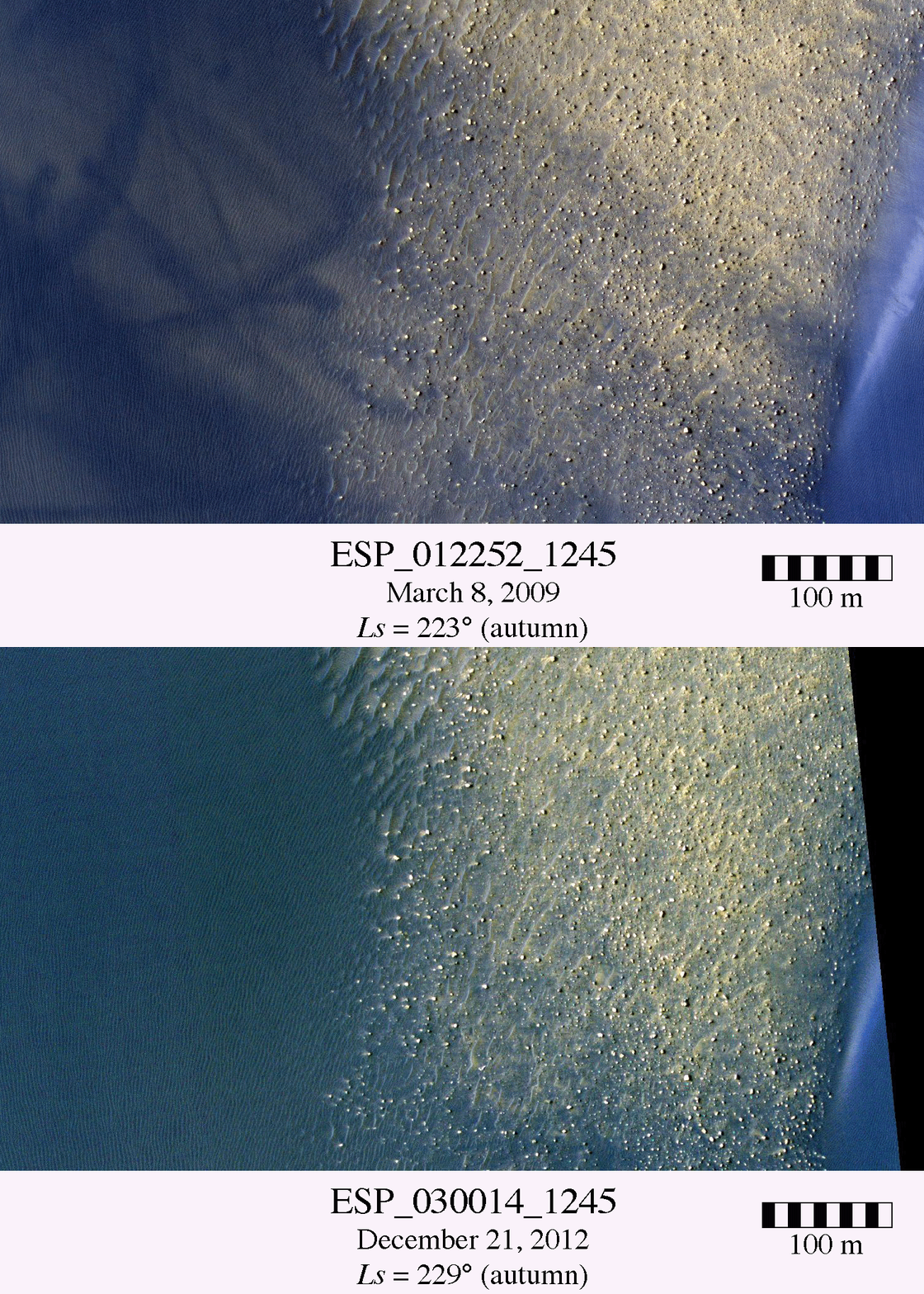
Dunes in a Noachis Terra Crater


Sand dunes on Mars are studied for many reasons. Recent investigations have focused on dune and ripples movement.

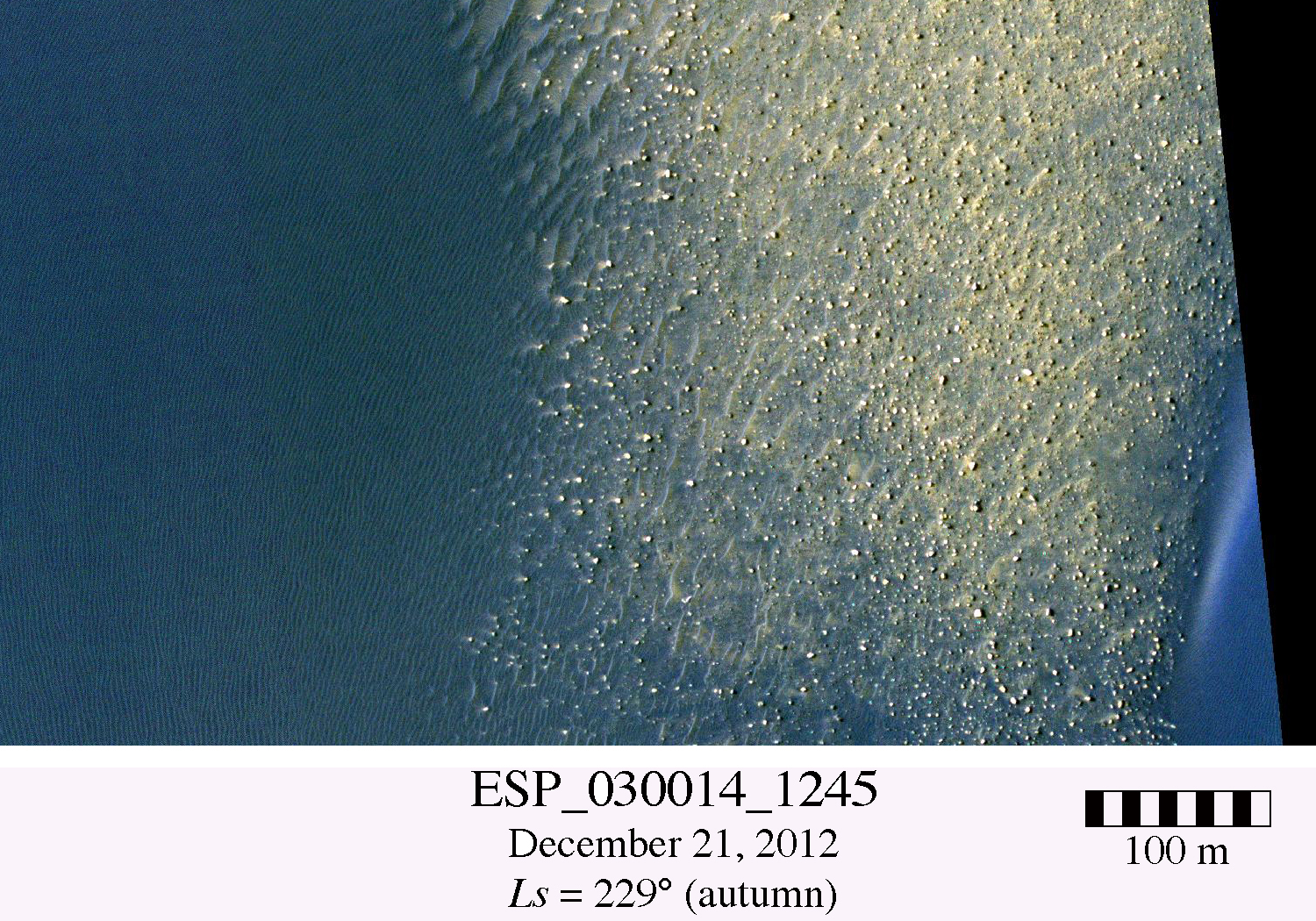
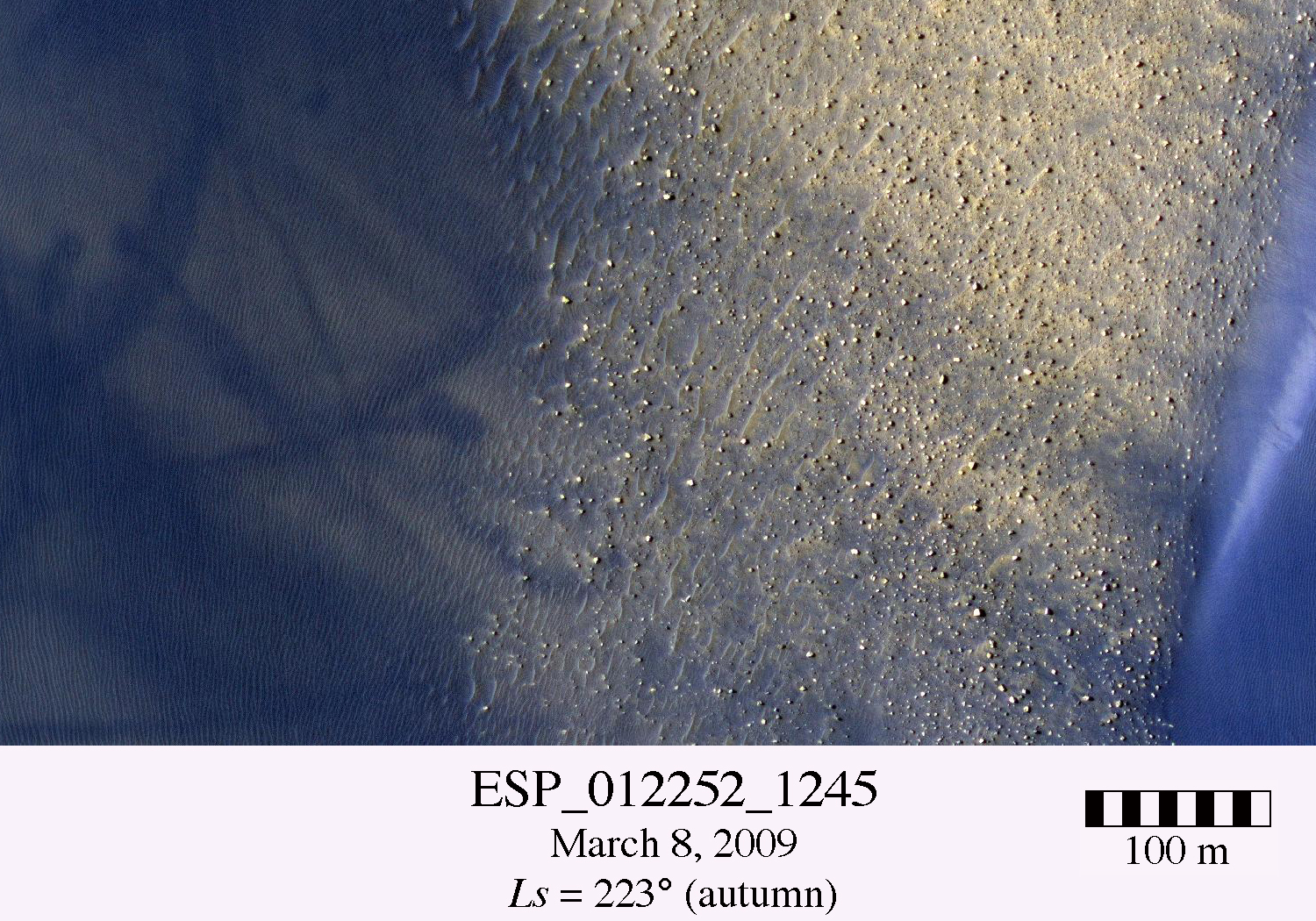
In this observation, we look at dunes within a crater in Noachis Terra. Zooming in to one of these areas (and here is the context image) we see the edges of two dunes separated by a field of ripples and rocks. We can compare this area to another image taken two Mars years ago. In the older image, there are many dark wispy features that cover the dunes. These are dust devil tracks, which formed when vortices removed a thin layer of dust off the surface, revealing a darker substrate.

In addition, there are dark sand streaks extending westward from the eastern dune. Blinking between these images shows that virtually all traces of the dust devil tracks and dark streaks have disappeared in the two Mars years. There is also little evidence for dune or ripple movement (however, these images have not yet been orthorectified for a detailed analysis).

In this region, it is likely that dust is periodically deposited and then removed off the dunes. The presence of dust may shield the dunes and ripples from significant movement, such that the observed changes are but thin layers of dust being removed and minor sand streaks that blow off the dunes.

This is a stereo pair with ESP_030080_1245.

Photo credit: NASA/JPL/University of Arizona

Note: The "blink" images, mentioned above, are well worth looking at. Here is the gif file below:

Wednesday, January 23, 2013

Orion Service Module


This artist's concept of the Orion Service Module was introduced today. When the Orion spacecraft blasts off atop NASA’s Space Launch System rocket in 2017, attached will be the ESA-provided service module – the powerhouse that fuels and propels the Orion spacecraft.

Orion will be the most advanced spacecraft ever designed and carry astronauts farther into space than ever before. It will sustain astronauts during space travel and provide safe re-entry from deep space and emergency abort capability. Orion will be launched by NASA's Space Launch System (SLS), a heavy-lift rocket that will provide an entirely new capability for human exploration beyond low Earth orbit. Designed to be flexible for launching spacecraft for crew and cargo missions, SLS will enable new missions of exploration and expand human presence across the solar system.

The service module of the Orion spacecraft will provide support to the crew module from launch through separation prior to atmospheric re-entry.

Image Credit: NASA

Note: For more information, see Orion.

Tuesday, January 22, 2013

LHA 120-N11 in the Large Magellanic Cloud


Nearly 200,000 light-years from Earth, the Large Magellanic Cloud, a satellite galaxy of the Milky Way, floats in space, in a long and slow dance around our galaxy. As the Milky Way's gravity gently tugs on its neighbor's gas clouds, they collapse to form new stars. In turn, these light up the gas clouds in a kaleidoscope of colors, visible in this image from the NASA/ESA Hubble Space Telescope.

Photo credit: NASA, ESA. Acknowledgment: Josh Lake

Note: For more information, see A Hidden Treasure in the Large Magellanic Cloud.

Monday, January 21, 2013

Curiosity's Tracks in Gale Crater


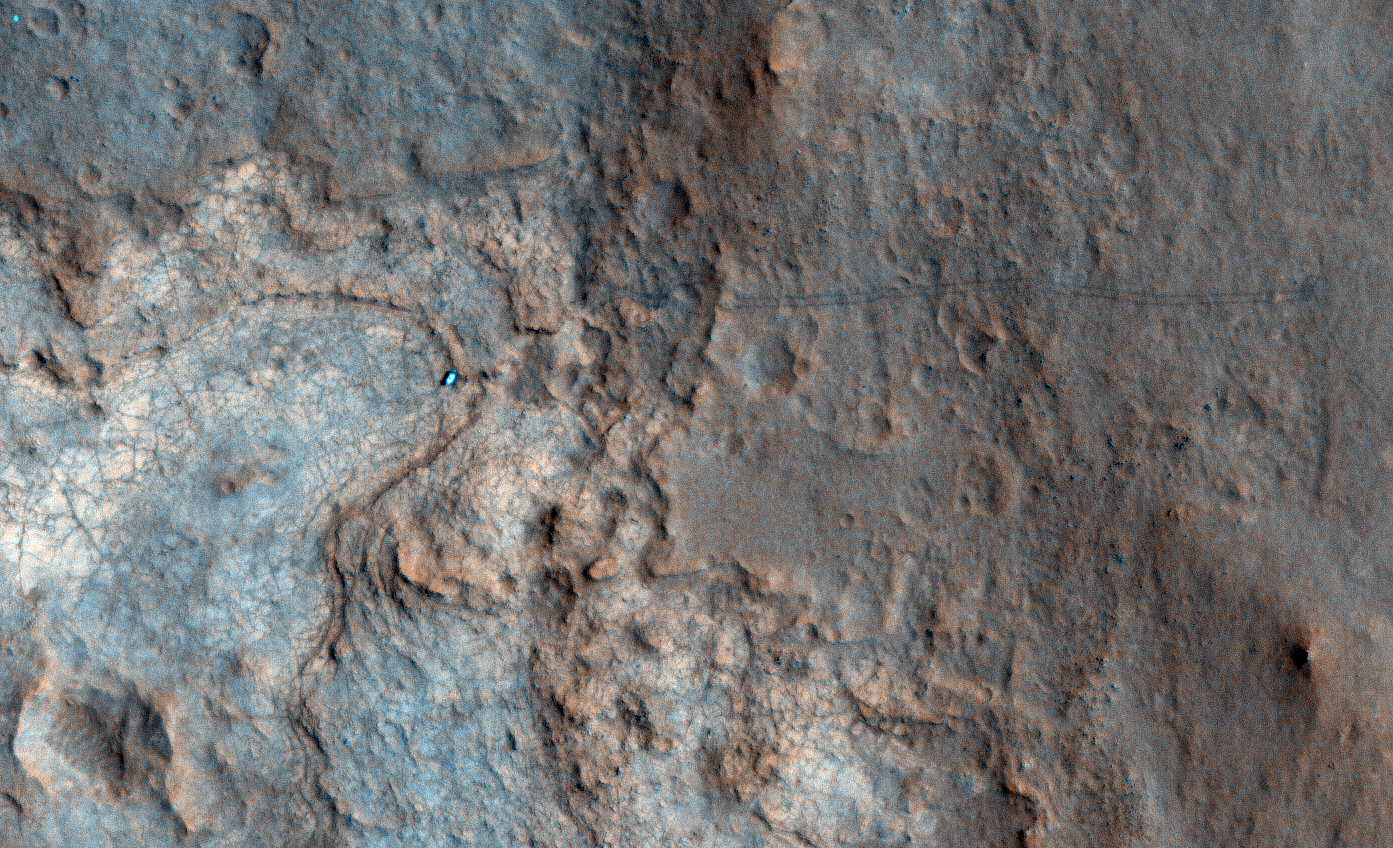
This image was acquired for color coverage of the region that the Curiosity rover may explore, but we acquired some extra RED (monochromatic) coverage of the rover tracks.

This image shows the entire distance traveled from the landing site (dark smudge at left) to its location as of 2 January 2013 (the rover is bright feature at right). The tracks are not seen where the rover has recently driven over the lighter-toned surface, which may be more indurated than the darker soil.

Photo credit: NASA/JPL/University of Arizona

Sunday, January 20, 2013

Lupus 3 Nebula and Associated Stars


This evocative image shows a dark cloud where new stars are forming along with a cluster of brilliant stars that have already emerged from their dusty stellar nursery. This cloud is known as Lupus 3 and it lies about 600 light-years from Earth in the constellation of Scorpius (The Scorpion). It is likely that the Sun formed in a similar star formation region more than four billion years ago. This picture was taken with the MPG/ESO 2.2-meter telescope at the La Silla Observatory in Chile and is the best image ever taken of this little-known object.

Photo credit: ESO/F. Comeron

Note: For more information, see Light from the Darkness.

Saturday, January 19, 2013

New Blue Impact Crater on Mercury


In the lower left portion of today's image is a small, young, rayed impact crater. The rays have a typical bluish cast in this color presentation. The relatively blue color in this case is caused partly by the extreme youth of the rays (surfaces exposed to the space environment of Mercury for long periods tend to "redden" and darken). In addition, the crater formed in a dark, bluish terrain called the "Low Reflectance Material." The tan area toward the top of the image is "intermediate terrain."

Date acquired: November 30, 2011
Image Mission Elapsed Time (MET): 231181189, 231181209, 231181193
Image ID: 1078917, 1078922, 1078918
Instrument: Wide Angle Camera (WAC) of the Mercury Dual Imaging System (MDIS)
WAC filters: 9, 7, 6 (996, 748, 433 nanometers) in red, green, and blue.
Center Latitude: -34.19°
Center Longitude: 133.6° E
Resolution: 647 meters/pixel
Scale: The small rayed crater is about 16 km (10 mi.) in diameter.
Incidence Angle: 54.9°
Emission Angle: 3.9°
Phase Angle: 58.7°

Photo credit: NASA/Johns Hopkins University Applied Physics Laboratory/Carnegie Institution of Washington

Friday, January 18, 2013

NGC 6872


This composite of the giant barred spiral galaxy NGC 6872 combines visible light images from the European Southern Observatory's Very Large Telescope with far-ultraviolet (1,528 angstroms) data from NASA's GALEX and 3.6-micron infrared data acquired by NASA's Spitzer Space Telescope. A previously unsuspected tidal dwarf galaxy candidate (circled) appears only in the ultraviolet, indicating the presence of many hot young stars. IC 4970, the small disk galaxy interacting with NGC 6872, is located above the spiral's central region. The spiral is 522,000 light-years across from the tip of one outstretched arm to the tip of the other, which makes it about five times the size of our home galaxy, the Milky Way. Images of lower resolution from the Digital Sky Survey were used to fill in marginal areas not covered by the other data.

Photo credit: NASA's Goddard Space Flight Center/ESO/JPL-Caltech/DSS

Note: For more information, see NASA's Galex Reveals the Largest-Known Spiral Galaxy and PIA16613: Dwarf Galaxy Spotted.

Thursday, January 17, 2013

The Huygens Experience


Eight years ago today [14 January 2013], ESA’s Huygens bounced, slid and wobbled its way to rest on the surface of Saturn’s moon Titan, the first time a probe had touched down on an alien world in the outer Solar System.

The animation was created using real data recorded by Huygen’s instruments, allowing us to witness this historical moment as if we had been there.

The animation takes into account Titan’s atmospheric conditions, including the Sun and wind direction, the behavior of the parachute (with some artistic interpretation only on the movement of the ropes after touchdown), and the dynamics of the landing itself.

Even the stones immediately facing Huygens were rendered to match the photograph of the landing site returned from the probe, which is revealed at the end of the animation.

Split into four sequences, the animation first shows a wide-angle view of the descent and landing followed by two close-ups of the touchdown from different angles, and finally a simulated view from Huygens itself – the true Huygens experience.

New results published last year revealed that on first contact with Titan’s surface, Huygens dug a hole 12 cm deep, before bouncing out and sliding 30–40 cm across a flat surface.

The probe then wobbled back and forth five times until coming to a standstill about 10 seconds after touchdown – this is best seen in the final two sequences.

A ‘fluffy’ dust-like material – most likely organic aerosols that are known to drizzle out of the Titan atmosphere – was thrown up and suspended for around four seconds around the probe following the impact. The dust was easily lifted, suggesting it was most likely dry and that there had not been any ‘rain’ of liquid ethane or methane for some time prior to the landing.

Huygens was released from the international Cassini spacecraft on Christmas Day 2004, arriving at Titan three weeks later. Cassini has been in orbit around Saturn since July 2004, and will continue operations until 2017.

Video credit: ESA. Text credit: ESA.

Note: For more information, see When Huygens Met Titan.

Wednesday, January 16, 2013

Cloudless British Isles


The lush landscapes of Ireland, Great Britain and northern France are pictured in this rare cloud-free view, acquired by Envisat on 28 March 2012.

To the west, thousands of lakes speckle the island of Ireland. Brown rugged cliffs along the coast frame its plush green interior. In the lower-right corner, the river Seine flows through Paris (seen here as a gray area) and snakes toward the English Channel. Following mainland Europe’s coastline north, we can see the Rhine–Meuse–Scheldt delta followed by part of the intertidal Wadden Sea in the extreme top-right corner. The green and tan-tinted swirls in the seas and channels are due to sediments being transported in the water. Sediment is particularly concentrated around Britain’s southeastern coast, carried by the River Thames through London and into the North Sea.

This image is featured on the Earth from Space video program.

Photo credit: ESA

Tuesday, January 15, 2013

Vela Pulsar Jet


Vela Pulsar Jet: A jet of high-energy particles associated with the Vela pulsar, a rapidly rotating neutron star about 1,000 light years from Earth in the constellation Vela.

This deep image from NASA's Chandra X-ray Observatory shows the Vela pulsar, a neutron star that was formed when a massive star collapsed. In the upper right is a fast moving jet of particles produced by the pulsar. The pulsar is about 1,000 light years from Earth, and makes over 11 complete rotations every second. As the pulsar spins, it spews out a jet of charged particles that race out along the pulsar’s rotation axis at about 70% of the speed of light. A movie shows dramatic changes in the jet, suggesting that the pulsar may be slowly wobbling, or precessing, as it spins. If this evidence is confirmed, it would be the first time that a neutron star has been found to be precessing. In this image the jet's shape is blurred because images at different times have been added together.

Scale: Movie is 4.8 x 3.6 arcmin (1.4 x 1.0 light years).

Video credit: NASA/CXC/Univ of Toronto/M.Durant et al.

Note: For more information, see Vela Pulsar Jet: New Chandra Movie Features Neutron Star Action.

Monday, January 14, 2013

47 Tucanae


This bright cluster of stars is 47 Tucanae (NGC 104), shown here in an image taken by ESO’s VISTA (Visible and Infrared Survey Telescope for Astronomy) from the Paranal Observatory in Chile. This cluster is located around 15,000 light-years away from us and contains millions of stars, some of which are unusual and exotic. This image was taken as part of the VISTA Magellanic Cloud survey, a project that is scanning the region of the Magellanic Clouds, two small galaxies that are very close to our Milky Way.

Credit: ESO/M.-R. Cioni/VISTA Magellanic Cloud Survey. Acknowledgment: Cambridge Astronomical Survey Unit.

Note: For more information, see A Jumble of Exotic Stars.

Sunday, January 13, 2013

Brown Dwarf 2MASSJ22282889-431026


This artist's conception illustrates the brown dwarf named 2MASSJ22282889-431026. NASA's Hubble and Spitzer space telescopes observed the object to learn more about its turbulent atmosphere. Brown dwarfs are more massive and hotter than planets but lack the mass required to become sizzling stars. Their atmospheres can be similar to the giant planet Jupiter's.

Spitzer and Hubble simultaneously observed the object as it rotated every 1.4 hours. The results suggest wind-driven, planet-size clouds.

Illustration credit: NASA/JPL-Caltech

Note: For more information, see PIA16608: Anatomy of Brown Dwarf's Atmosphere (Artist Concept), PIA16612: Probing Brown Dwarf Layers, and NASA Telescopes See Weather Patterns in Brown Dwarf.

Saturday, January 12, 2013

Possible Hydrocarbon Ice in Titan's Lakes


Lakes on Saturn's moon Titan reflect radio waves in varying ways in this image from NASA's Cassini spacecraft. Scientists think the variations in reflectivity, or brightness, have to do with the smoothness or texture of the surface. If a lake is fully liquid, it looks dark, but if it is only partially liquid, it looks brighter.

In this image taken from Titan's high northern latitudes on May 22, 2012, the lakes on the left are full of liquid hydrocarbons and the lakes on the top right are only partially filled, or represent saturated ground (i.e., a mudflat). The lakes in this image are each about 35 to 45 kilometers (22 to 30 miles) across, or about the size of Lake Tahoe on the California-Nevada border. Some of the differences in reflectivity could also be explained by the presence of floating hydrocarbon ice.

This image was obtained by Cassini's radar mapper at a scale of about 350 meters (1,100 feet) per pixel. It is presented in polar stereographic projection with a logarithmic stretch.

For perspective, a wider view of these lakes can be seen in PIA16167.

Image credit: NASA/JPL-Caltech/ASI/Cornell

Note: For more information, see PIA16634: Floating Ice on Titan Lakes? and Cassini Suggests Icing on a Lake.

Friday, January 11, 2013

Asteroid Belts in the Vega System


Astronomers have discovered what appears to be a large asteroid belt around the bright star Vega, as illustrated here at left in brown. The ring of warm, rocky debris was detected using NASA's Spitzer Space Telescope, and the European Space Agency's Herschel Space Observatory, in which NASA plays an important role.

In this diagram, the Vega system, which was already known to have a cooler outer belt of comets (orange), is compared to our solar system with its asteroid and Kuiper belts. The relative size of our solar system compared to Vega is illustrated by the small drawing in the middle. On the right, our solar system is scaled up four times.

The comparison illustrates that both systems have inner and outer belts with similar proportions. The gap between the inner and outer debris belts in both systems works out to a ratio of about 1-to-10, with the outer belt 10 times farther away from its host star than the inner belt.

Astronomers think that the gap in the Vega system may be filled with planets, as is the case in our solar system.

Image credits: Upper: NASA/JPL-Caltech; Lower: NASA/JPL-Caltech

Note: For more information, see NASA, ESA Telescopes Find Evidence for Asteroid Belt Around Vega.

Seeing this material, the Minister can't help but think of the movie Contact, which takes place (at the very end of the movie) on a planet in the Vega system. Calling Jodie Foster! :)

Thursday, January 10, 2013

IC 342


This new view of spiral galaxy IC 342, also known as Caldwell 5, includes data from NASA's Nuclear Spectroscopic Telescope Array, or NuSTAR. High-energy X-ray data from NuSTAR have been translated to the color magenta, and superimposed on a visible-light view highlighting the galaxy and its star-studded arms. NuSTAR is the first orbiting telescope to take focused pictures of the cosmos in high-energy X-ray light; previous observations of this same galaxy taken at similar wavelengths blurred the entire object into one pixel.

The two magenta spots are blazing black holes first detected at lower-energy X-ray wavelengths by NASA's Chandra X-ray Observatory. With NuSTAR's complementary data, astronomers can start to home in on the black holes' mysterious properties. The black holes appear much brighter than typical stellar-mass black holes, such as those that pepper our own galaxy, yet they cannot be supermassive black holes or they would have sunk to the galaxy's center. Instead, they may be intermediate in mass, or there may be something else going on to explain their extremely energetic state. NuSTAR will help solve this puzzle.

IC 342 lies 7 million light-years away in the Camelopardalis constellation. The outer edges of the galaxy cannot be seen in this view.

This image shows NuSTAR X-ray data taken at 10 to 35 kiloelectron volts.

The visible-light image is from the Digitized Sky Survey.

Photo credit:
NASA/JPL-Caltech/DSS

Note: For more information, see NASA's NuSTAR Catches Black Holes in Galaxy Web.

Wednesday, January 9, 2013

Cassiopeia A by NuSTAR


This new view of the historical supernova remnant Cassiopeia A, located 11,000 light-years away, was taken by NASA's Nuclear Spectroscopic Telescope Array, or NuSTAR. Blue indicates the highest energy X-ray light, where NuSTAR has made the first resolved image ever of this source. Red and green show the lower end of NuSTAR's energy range, which overlaps with NASA's high-resolution Chandra X-ray Observatory.

Light from the stellar explosion that created Cassiopeia A is thought to have reached Earth about 300 years ago, after traveling 11,000 years to get here. While the star is long dead, its remains are still bursting with action. The outer blue ring is where the shock wave from the supernova blast is slamming into surrounding material, whipping particles up to within a fraction of a percent of the speed of light. NuSTAR observations should help solve the riddle of how these particles are accelerated to such high energies

X-ray light with energies between 10 and 20 kiloelectron volts are blue; X-rays of 8 to 10 kiloelectron volts are green; and X-rays of 4.5 to 5.5 kiloelectron volts are red.

The starry background picture is from the Digitized Sky Survey.

Photo credit: NASA/JPL-Caltech/DSS

Tuesday, January 8, 2013

Sharpless 2-64 (aka W 40)


Six hundred newly forming stars are crowded into these colorful filaments of dust that form a stellar nursery seen by ESA’s Herschel space observatory.

The nebulous blue area, known as W40 or Sharpless 2-64, is roughly 1000 light-years away in the constellation Aquila, and is about 25 light-years across.

Photo credit: ESA and SPIRE & PACS consortia, Ph. André (CEA Saclay) for Gould’s Belt Key Programme Consortia

Monday, January 7, 2013

NGC 604 in Messier 33


Stars are sometimes born in the midst of chaos. About 3 million years ago in the nearby galaxy M33, a large cloud of gas spawned dense internal knots which gravitationally collapsed to form stars. NGC 604 was so large, however, it could form enough stars to make a globular cluster.

Many young stars from this cloud are visible in this image from the Hubble Space Telescope, along with what is left of the initial gas cloud. Some stars were so massive they have already evolved and exploded in a supernova. The brightest stars that are left emit light so energetic that they create one of the largest clouds of ionized hydrogen gas known, comparable to the Tarantula Nebula in our Milky Way's close neighbor, the Large Magellanic Cloud.

Photo credit: NASA

Sunday, January 6, 2013

NGC 1097


The Hubble Space Telescope captured a spectacular image of the bright star-forming ring that surrounds the heart of the barred spiral galaxy NGC 1097. In this image, the larger-scale structure of the galaxy is barely visible: its comparatively dim spiral arms, which surround its heart in a loose embrace, reach out beyond the edges of this frame.

This face-on galaxy, lying 45 million light-years away from Earth in the southern constellation of Fornax (The Furnace), is particularly attractive for astronomers. NGC 1097 is a Seyfert galaxy. Lurking at the very center of the galaxy, a supermassive black hole 100 million times the mass of our sun is gradually sucking in the matter around it. The area immediately around the black hole shines powerfully with radiation coming from the material falling in.

The distinctive ring around the black hole is bursting with new star formation due to an inflow of material toward the central bar of the galaxy. These star-forming regions are glowing brightly thanks to emission from clouds of ionized hydrogen. The ring is around 5000 light-years across, although the spiral arms of the galaxy extend tens of thousands of light-years beyond it.

Photo credit: NASA/ESA/Hubble

Saturday, January 5, 2013

Solar Eruption


A solar eruption gracefully rose up from the sun on December 31, 2012, twisting and turning. Magnetic forces drove the flow of plasma, but without sufficient force to overcome the sun’s gravity much of the plasma fell back into the sun.

The length of the eruption extends about 160,000 miles out from the Sun. With Earth about 7,900 miles in diameter, this relatively minor eruption is about 20 times the diameter of our planet.

See video and relative size of Earth to eruption on 'Solar Ballet on the Sun' feature.

Image credit: NASA/SDO

Friday, January 4, 2013

Lunar Gravity Map by Grail


This image shows the variations in the lunar gravity field as measured by NASA's Gravity Recovery and Interior Laboratory (GRAIL) during the primary mapping mission from March to May 2012. Very precise microwave measurements between two spacecraft, named Ebb and Flow, were used to map gravity with high precision and high spatial resolution. The field shown resolves blocks on the surface of about 12 miles (20 kilometers) and measurements are three to five orders of magnitude improved over previous data. Red corresponds to mass excesses and blue corresponds to mass deficiencies. The map shows more small-scale detail on the far side of the moon compared to the nearside because the far side has many more small craters.

See video

Image credit: NASA/JPL-Caltech/MIT/GSFC

Thursday, January 3, 2013

ALMA Observations of the Disc and Gas Streams Around HD 142527


Observations made with the Atacama Large Millimeter/submillimeter Array (ALMA) telescope of the disc of gas and cosmic dust around the young star HD 142527, showing vast streams of gas flowing across the gap in the disc. These are the first direct observations of these streams, which are expected to be created by giant planets guzzling gas as they grow, and which are a key stage in the birth of giant planets.

The dust in the outer disc is shown in red. Dense gas in the streams flowing across the gap, as well as in the outer disc, is shown in green. Diffuse gas in the central gap is shown in blue. The gas filaments can be seen at the three o'clock and ten o'clock positions, flowing from the outer disc towards the center. The dense gas observed is HCO+, and the diffuse gas is CO. The outer disk is roughly two light-days across. If this were our own Solar System, the Voyager 1 probe — the most distant manmade object from Earth — would be at approximately the inner edge of the outer disk.

Image credit: ALMA (ESO/NAOJ/NRAO), S. Casassus et al.

Note: For more information, see ALMA Sheds Light on Planet-Forming Gas Streams.

Wednesday, January 2, 2013

Gas Bridge Between Abell 399 and Abell 401


Planck has discovered a bridge of hot gas that connects galaxy clusters Abell 399 (lower center) and Abell 401 (top left). The galaxy pair is located about a billion light-years from Earth, and the gas bridge extends approximately 10 million light-years between them.

The image shows the two galaxy clusters as seen at optical wavelengths with ground-based telescopes and through the Sunyaev-Zel'dovich effect (in orange) with the Planck satellite.

Image credits: Sunyaev–Zel’dovich effect: ESA Planck Collaboration; optical image: STScI Digitized Sky Survey

Tuesday, January 1, 2013

ESO 499-G37


The Hubble Space Telescope has spotted the spiral galaxy ESO 499-G37, seen here against a backdrop of distant galaxies, scattered with nearby stars.

The galaxy is viewed from an angle, allowing Hubble to reveal its spiral nature clearly. The faint, loose spiral arms can be distinguished as bluish features swirling around the galaxy’s nucleus. This blue tinge emanates from the hot, young stars located in the spiral arms. The arms of a spiral galaxy have large amounts of gas and dust, and are often areas where new stars are constantly forming.

The galaxy’s most characteristic feature is a bright elongated nucleus. The bulging central core usually contains the highest density of stars in the galaxy, where typically a large group of comparatively cool old stars are packed in this compact, spheroidal region.

One feature common to many spiral galaxies is the presence of a bar running across the center of the galaxy. These bars are thought to act as a mechanism that channels gas from the spiral arms to the center, enhancing the star formation.

Image credit: NASA/Hubble