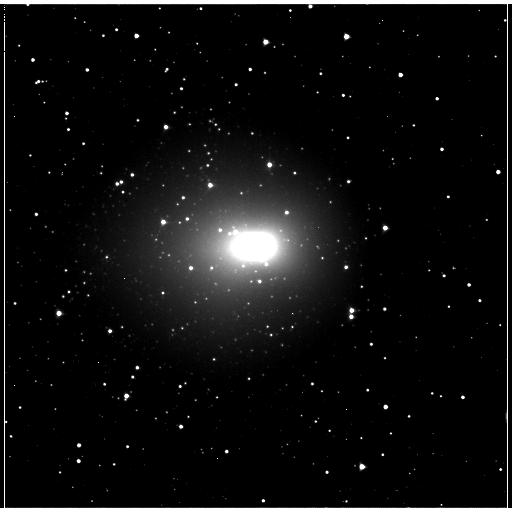
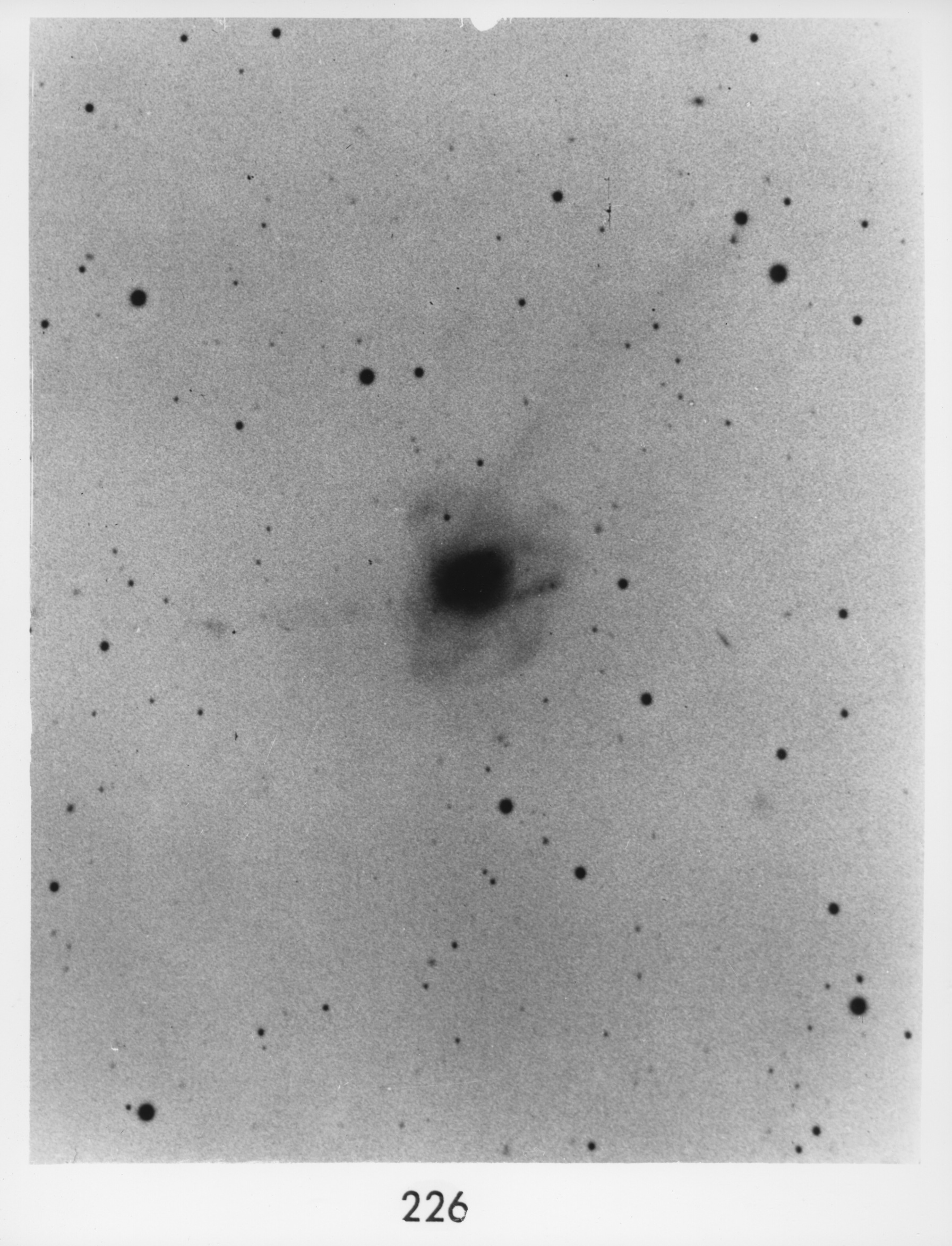
Pages

Sunday, November 21, 2010

More on Comet 103/P Hartley 2


The Medium-Resolution Instrument on NASA's EPOXI mission spacecraft obtained these views of the icy particle cloud around Comet Hartley 2. The image on the left is the full image of Comet Hartley 2 for context, and the image on the right was enlarged and cropped.

The images confirm that the particles seen in the High-Resolution Instrument images are real and not artifacts.

This image was obtained on November 4, 2010, the day the EPOXI mission spacecraft made its closest approach to the comet.


This image from the High-Resolution Instrument on NASA's EPOXI mission spacecraft shows part of the nucleus of Comet Hartley 2. The Sun is illuminating the nucleus from the right. A distinct cloud of individual particles is visible. This image was obtained on November 4, 2010, the day the EPOXI mission spacecraft made its closest approach to the comet.


This zoomed-in image from the High-Resolution Instrument on NASA's EPOXI mission spacecraft shows the particles swirling in a "snow storm" around the nucleus of Comet Hartley 2.

Scientists estimate the size of the largest particles ranges from a golf ball to a basketball. They have determined these are icy particles rather than dust. The particles are believed to be very porous and fluffy.

The Sun is illuminating the nucleus from the right. This image was obtained on November 4, 2010, the day the EPOXI mission spacecraft made its closest approach to the comet.

Photo credits: (Top) NASA/JPL-Caltech/UMD/Brown; (Middle and Bottom) NASA/JPL-Caltech/UMD

Saturday, November 20, 2010

Merging Starburst Galaxies II Zw 096


A brilliant burst of star formation is revealed in this image combining observations from NASA's Spitzer and Hubble Space Telescopes. The collision of two spiral galaxies has triggered this luminous starburst, the brightest ever seen away from the centers, or nuclei, of merging galaxies.

The merging galaxies, known collectively as II Zw 096, can be clearly seen at shorter wavelengths of light from Hubble (blue hues).

The real action in this galactic train wreck jumps out in Spitzer's infrared view, represented in red. The brightest glow is from a tiny region that may be as small as 700 light-years across -- just a small portion of the full 50,000 light-year extent of II Zw 096. This region blasts out 80 percent of the infrared light from this galactic tumult. The surrounding shroud of dust renders the stars here nearly invisible in other wavelengths of light.

Researchers were surprised to see such a brilliant infrared glow in an area so far offset from the center of the merging spiral galaxy. Starbursts are often found crammed into the very centers of merging galaxies, but this is the brightest starburst ever seen outside a galaxy's nucleus. Based on Spitzer data, researchers estimate the starburst is cranking out stars at the breakneck pace of around 100 solar masses (100 times the mass of our Sun) per year.

In this combined image, Hubble's far-ultraviolet and visible light at wavelengths of 0.15 and 0.44 microns is shown in blue, and near-infrared light at 0.9 microns is cyan. Spitzer's infrared light at 4.5 microns is represented by orange, and mid-infrared light at 8.0 and 24 microns is red.

Photo credit: NASA/JPL-Caltech/STScI

Friday, November 19, 2010

NGC 1514


This image composite shows two views of a puffy, dying star, or planetary nebula, known as NGC 1514. The view on the left is from a ground-based, visible-light telescope; the view on the right shows the object in infrared light, as seen by NASA's Wide-field Infrared Survey Explorer, or WISE.

The object is actually a pair of stars -- one star is a dying giant somewhat heavier and hotter than our Sun, and the other was an even larger star that has now contracted into a dense body called a white dwarf. As the giant star ages, it sheds some its outer layers of material to form a large bubble around the two stars. Jets of material from the white dwarf are thought to have smashed into this bubble wall. The areas where the jets hit the cavity walls appear as orange rings in the WISE image. This is because dust in the rings is being heated and glows with infrared light that WISE detects.

The green cloud seen in the WISE view is an inner shell of previously shed material. In the visible image, this shell is seen in bright, light blues. An outer shell can also be seen in the visible image in more translucent shades of blue. This outer shell is too faint to be seen by WISE.

NGC 1514 is located 800 light-years away, in the constellation Taurus.

In the WISE image, infrared light with a wavelength of 3.4 microns is blue; 4.6-micron light is cyan; 12-micron light is green; and 22-micron light is red.

The visible-light image is from the Digitized Sky Survey, based at the Space Telescope Science Institute in Baltimore, Maryland.


Photo credits: NASA/JPL-Caltech/UCLA/DSS; NASA/JPL-Caltech/UCLA

Note: For more information on the bottom photo, see PIA13445: Cosmic Ocean Dweller.

Thursday, November 18, 2010

Hydrothermal Mineral Deposits at Nili Patera


This volcanic cone in the Nili Patera caldera on Mars has hydrothermal mineral deposits on the southern flanks and nearby terrains. Two of the largest deposits are marked by arrows [see below], and the entire field of light-toned material on the left of the cone is hydrothermal deposits. The cone is about 5 kilometers (3 miles) in diameter at the base.

The deposits are evidence for a past local environment that was warm and wet or steamy, possibly hospitable to microbial life, as reported in a November 2010 Nature Geoscience paper by J.R. Skok, of Brown University, Providence, R.I., and co-authors.

This image is in false color derived from observation in infrared wavebands with the Compact Reconnaissance Imaging Spectrometer for Mars (CRISM) on NASA's Mars Reconnaissance Orbiter. The CRISM spectral data is overlaid on imagery from the Context Camera on that orbiter. A stereo pair of Context Camera images provided topographic information for a digital terrain model produced with NASA Ames Stereo Pipeline software. The image uses no vertical exaggeration.


Photo credit: NASA/JPL-Caltech/MSSS/JHU-APL/Brown University

Tuesday, November 16, 2010

Youngest Nearby Black Hole: SN 1979C in Messier 100


This composite image shows a supernova within the galaxy M100 that may contain the youngest known black hole in our cosmic neighborhood. In this image, Chandra’s X-rays are colored gold, while optical data from ESO’s Very Large Telescope are shown in red, green, and blue, and infrared data from Spitzer are red. The location of the supernova, known as SN 1979C, is labeled.

SN 1979C was first reported to be seen by an amateur astronomer in 1979. The galaxy M100 is located in the Virgo Cluster about 50 million light years from Earth. This approximately 30-year age, plus its relatively close distance, makes SN 1979C the nearest example where the birth of a black hole has been observed, if the interpretation by the scientists is correct.

Data from Chandra, as well as NASA's Swift, the European Space Agency's XMM-Newton and the German ROSAT observatory revealed a bright source of X-rays that has remained steady for the 12 years from 1995 to 2007 over which it has been observed. This behavior and the X-ray spectrum, or distribution of X-rays with energy, support the idea that the object in SN 1979C is a black hole being fed either by material falling back into the black hole after the supernova, or from a binary companion.

The scientists think that SN 1979C formed when a star about 20 times more massive than the Sun collapsed. It was a particular type of supernova where the exploded star had ejected some, but not all of its outer, hydrogen-rich envelope before the explosion, so it is unlikely to have been associated with a gamma-ray burst (GRB). Supernovas have sometimes been associated with GRBs, but only where the exploded star had completely lost its hydrogen envelope. Since most black holes should form when the core of a star collapses and a gamma-ray burst is not produced, this may be the first time that the common way of making a black hole has been observed.

The very young age of about 30 years for the black hole is the observed value, that is the age of the remnant as it appears in the image. Astronomers quote ages in this way because of the observational nature of their field, where their knowledge of the Universe is based almost entirely on the electromagnetic radiation received by telescopes.

Photo credits: X-ray: NASA/CXC/SAO/D.Patnaude et al, Optical: ESO/VLT, Infrared: NASA/JPL/Caltech


This animation shows how a black hole may have formed in SN 1979C. The collapse of a massive star is shown, after it has exhausted its fuel. A flash of light from a shock breaking through the surface of the star is then shown, followed by a powerful supernova explosion. The view then zooms into the center of the explosion.

Video credits: NASA/CXC/A.Hobart

Note: For more information, see NASA's Chandra Finds Youngest Nearby Black Hole.

Monday, November 15, 2010

Galaxy Cluster 3C 186


3C186: A galaxy cluster with a central quasar located about 8 billion light years away.

This composite image contains a new, deep image from Chandra (blue) showing emission from gas surrounding the point-like quasar near the center of the galaxy cluster known as 3C 186. Optical data from the Gemini telescope (yellow) show the stars and galaxies in the field of view. Chandra X-ray spectra reveal that the temperature of the gas drops from 80 million degrees on the outskirts of the cluster down to 30 million in the core. This drop in temperature occurs because intense X-ray emission from the gas cools it. 3C 186 is the most distant such object observed, and could provide insight into the triggering of quasars and the growth of galaxy clusters.

Scale: Image is 4.6 by 3.4 arcminutes (10.7 by 7.9 million light years).

Photo credit: X-ray: NASA/CXC/SAO/A.Siemiginowska et al, Optical: AURA/Gemini Observatory

Note: More information and photos can be found at 3C186: Precocious Galaxy Cluster Identified by Chandra.

Sunday, November 14, 2010

NGC 7252 "Atoms for Peace"


European Southern Observatory astronomers have produced a spectacular new image of the famous Atoms-for-Peace galaxy (NGC 7252). This galactic pile-up, formed by the collision of two galaxies, provides an excellent opportunity for astronomers to study how mergers affect the evolution of the Universe.

Atoms-for-Peace is the curious name given to a pair of interacting and merging galaxies that lie around 220 million light-years away in the constellation of Aquarius. It is also known as NGC 7252 and Arp 226 and is just bright enough to be seen by amateur astronomers as a very faint small fuzzy blob. This very deep image was produced by ESO’s Wide Field Imager on the MPG/ESO 2.2-meter telescope at ESO’s La Silla Observatory in Chile.

A galaxy collision is one of the most important processes influencing how our Universe evolves, and studying them reveals important clues about galactic ancestry. Luckily, such collisions are long drawn-out events that last hundreds of millions of years, giving astronomers plenty of time to observe them.

This picture of Atoms-for-Peace represents a snapshot of its collision, with the chaos in full flow, set against a rich backdrop of distant galaxies. The results of the intricate interplay of gravitational interactions can be seen in the shapes of the tails made from streams of stars, gas and dust. The image also shows the incredible shells that formed as gas and stars were ripped out of the colliding galaxies and wrapped around their joint core. While much material was ejected into space, other regions were compressed, sparking bursts of star formation. The result was the formation of hundreds of very young star clusters, around 50 to 500 million years old, which are speculated to be the progenitors of globular clusters.

Atoms-for-Peace may be a harbinger of our own galaxy’s fate. Astronomers predict that in three or four billion years the Milky Way and the Andromeda Galaxy will collide, much as has happened with Atoms-for-Peace. But don’t panic: the distance between stars within a galaxy is vast, so it is unlikely that our Sun will end up in a head-on collision with another star during the merger.

The object’s curious nickname has an interesting history. In December 1953, President Eisenhower gave a speech that was dubbed Atoms for Peace. The theme was promoting nuclear power for peaceful purposes — a particularly hot topic at the time. This speech and the associated conference made waves in the scientific community and beyond to such an extent that NGC 7252 was named the Atoms-for-Peace galaxy. In many ways, this is oddly appropriate: the curious shape that we can see is the result of two galaxies merging to produce something new and grand, a little like what occurs in nuclear fusion. Furthermore, the giant loops resemble a textbook diagram of electrons orbiting an atomic nucleus.

Photo credit: European Southern Observatory

Saturday, November 13, 2010

Dark Matter in Abell 1689


This NASA Hubble Space Telescope image shows the distribution of dark matter in the center of the giant galaxy cluster Abell 1689, containing about 1,000 galaxies and trillions of stars.

Dark matter is an invisible form of matter that accounts for most of the universe's mass. Hubble cannot see the dark matter directly. Astronomers inferred its location by analyzing the effect of gravitational lensing, where light from galaxies behind Abell 1689 is distorted by intervening matter within the cluster.

Researchers used the observed positions of 135 lensed images of 42 background galaxies to calculate the location and amount of dark matter in the cluster. They superimposed a map of these inferred dark matter concentrations, tinted blue, on an image of the cluster taken by Hubble's Advanced Camera for Surveys. If the cluster's gravity came only from the visible galaxies, the lensing distortions would be much weaker. The map reveals that the densest concentration of dark matter is in the cluster's core.

Abell 1689 resides 2.2 billion light-years from Earth. The image was taken in June 2002.

Photo credit: NASA/JPL-Caltech/ESA/Institute of Astrophysics of Andalusia, University of Basque Country/JHU

Friday, November 12, 2010

Comet 103/P Hartley 2 by Herschel/Spire


This Herschel/SPIRE image of Comet 103P/Hartley 2 was taken on 24 October 2010 at 250 microns, and covers a region of 8 arcminutes x 5 arcminutes. At the time that this image was obtained the comet was at a distance of 17.2 million km from the Herschel Space Observatory.

Herschel has obtained unique, sensitive far-infrared continuum images constraining the size of the large dust particles, while spectra reveal the distribution of water molecules released from the nucleus as about 230 kg of ices evaporating every second. This is the first time a comet has been imaged in this region of the electromagnetic spectrum.

The Sun symbol and arrow indicate the projected direction towards the Sun.

Note:
Herschel is one of several observatories participating in a global astronomical campaign to observe and study the short period (6.46 years) Comet 103P/Hartley 2 before, during and after a flyby by the NASA EPOXI (Extrasolar Planet Observatory and Deep Impact Extended Investigation) mission on 4 November 2010.

In the period 24 October to 17 November 2010, Herschel will use its complement of state-of the-art instruments, covering the range 55-671 μm, to observe the far-infrared and submillimeter spectrum and to image the thermal dust radiation of Comet 103P/Hartley 2.

Photo credit: ESA/Herschel/HSSO Consortium

Note: For news about another satellite that has been observing Comet Hartley 2, see Odin Satellite Observes Water In Comet 103P Hartley 2.

Thursday, November 11, 2010

Brown Dwarf WISEPC J045853.90+643451.9


That green dot in the middle of this image might look like an emerald amidst glittering diamonds, but it is actually a dim star belonging to a class called brown dwarfs. This particular object, named "WISEPC J045853.90+643451.9" after its location in the sky, is the first ultra-cool brown dwarf discovered by NASA's Wide-field Infrared Survey Explorer, or WISE. WISE is scanning the skies in infrared light, picking up the signatures of all sort of cosmic gems, including brown dwarfs.

The mission's infrared vision makes it particularly good at picking brown dwarfs out of a starry sky. This view shows three of WISE's four infrared channels, color-coded blue, green and red, with blue showing the shortest wavelengths of infrared light and red, the longest. The methane in the atmospheres of brown dwarfs absorbs this color-coded blue light, and the objects themselves are too faint to give off a lot of the red light. That leaves green. As can be seen in this picture, the little green dot of a brown dwarf stands out against the sparkly, hotter blue stars.

The brown dwarf is located 18 to 30 light-years away in the northern constellation of Camelopardalis, or the giraffe; in fact, the brown dwarf is positioned right on the neck of the giraffe, adorning it like an emerald necklace. This is one of the coolest brown dwarfs known, with a temperature of roughly 600 Kelvin, or 620 degrees Fahrenheit.

Photo credit: NASA/JPL-Caltech/UCLA

Wednesday, November 10, 2010

SDP 81


This image composite shows a warped and magnified view of a galaxy discovered by the Herschel Space Observatory, one of five such galaxies uncovered by the infrared telescope. The galaxy -- referred to as "SDP 81" -- is the yellow dot in the left image taken by Herschel. It can also be seen as the pink smudges in the right image, a composite of ground-based observations showing more detail.

Herschel was able to find the galaxy, which is buried in dust, because it happens to be positioned behind another galaxy (blue blob at right), which is acting like a cosmic lens to make it appear brighter. The gravity of the foreground galaxy is distorting and magnifying the distant galaxy's light, causing it to appear in multiple places, as seen as the pink smudges. The distant galaxy is so far away that its light took about 11 billion years to reach us.

Herschel couldn't detect the foreground galaxy, but astronomers were able to spot it in visible light using the W.M. Keck Observatory. Several follow-up observations by ground telescopes helped to get a better view of the distant galaxy. For example, the pink smudges at the right show wavelengths that are even longer than what Herschel sees in the submillimeter portion of the electromagnetic spectrum. Those observations were made by the Smithsonian Astrophysical Observatory's Submillimeter Array in Hawaii.

Photo credit: ESA/NASA/JPL-Caltech/Keck/SMA

Note: For more information see Herschel's Hidden Talent: Digging Up Magnified Galaxies.

Tuesday, November 9, 2010

Evidence for a First-of-Its-Kind Comet Jet


These three pairs of images from NASA's EPOXI mission demonstrate that a dust jet and gaseous carbon dioxide are being released from Comet Hartley 2 at the same time, and from the same location on the comet. The observations suggest that carbon dioxide is driving the jet and taking tiny grains with it as it spews out of the nucleus of the comet. This is the first time this type of jet has been observed.

The top row consists of three images showing carbon dioxide gas being released by the comet at different points in time, from when the comet was at its minimum brightness to its maximum brightness. The bottom row of images shows dust coming from a jet on the comet at the same three points in time. The observations demonstrate that the gas and the jet are coming from the same location on the comet at the same time. This, in turn, suggests that the carbon dioxide is driving the jet.

The presence of this jet tells the scientists that the comet is made of chunks rich in solid carbon dioxide, sort of like chocolate chip chunks in frozen cookie dough. What's more, this variability in the comet's composition implies that the ingredients for both comets and planets must have been mixed up early on in the formation of our solar system. Without this mixing, comets would have more homogenous composition -- in simple terms, this would be having comets made of just "dough," and comets made of just "chocolate chunks."

The top-row images show data taken by the spacecraft's infrared spectrometer, a part of the High-Resolution Instrument. The bottom row images were taken in visible light by the spacecraft's Medium-Resolution Instrument.

Photo credit: NASA/JPL-Caltech/UMD

Monday, November 8, 2010

Carbon Dioxide Fluctuations in Comet Hartley 2


The upper panel of this figure shows small images of Comet Hartley 2 taken by NASA's EPOXI mission over time. The images have been specially filtered to show only carbon dioxide, or evaporated dry ice. The brightness varies dramatically from one image to another, which means that the amount of carbon dioxide emitted by the comet is varying up and down. A close look at the images shows that the position of the carbon dioxide also varies by a small amount, up and down in the pictures, just as the brightness varies.

The lower panel is a graph showing the variation of total brightness, and thus the variation of the total amount of carbon dioxide, during the time period. The amount of carbon dioxide emitted very late on October 31 is more than four times greater than earlier on that same day. During this same period of two days, the water (not shown) varied much less than the carbon dioxide. This suggests that some chunks of the comet's nucleus have much more dry ice relative to water than do other chunks.

Carbon dioxide is a basic ingredient of comets and planets in our solar system. Scientists on the EPOXI team think that sunlight is warming the comet, causing its frozen, sub-surface carbon dioxide to bubble up into gas that is escaping in jets.

These data were collected by EPOXI's infrared spectrometer, part of its High-Resolution Instrument.

Photo credit: NASA/JPL-Caltech/UMD

Sunday, November 7, 2010

The Jets of Comet Hartley 2


This enhanced image, one of the closest taken of Comet Hartley 2 by NASA's EPOXI mission, shows jets and where they originate from the surface. There are jets outgassing from the sunward side, the night side, and along the terminator -- the line between the two sides.

The image was taken by EPOXI's Medium-Resolution Instrument on November 4, 2010. The Sun is to the right.

Photo credit: NASA/JPL-Caltech/UMD

Fab Five


This montage shows the only five comets imaged up close with spacecraft. The comets vary in shape and size. Comet Hartley 2 is by far the smallest and the most active of small comets. This jet activity can be seen extending from the comet's surface and into its outer shell of gas and dust, or coma. This is first time scientists have been able to link jets to the details of the surface.

Photo credit: NASA/JPL-Caltech/UMD

Note: The five visited comets and the spacecraft that visited them are, as shown counter-clockwise in the image, comets 9P/Tempel 1 (Deep Impact), 19P/Borrelly (Deep Space 1), 81P/Wild (Wild 2) (Stardust), 103P/Hartley 2 (Deep Impact/EPOXI), and 1P/Halley (Giotto).

Update: For another photo comparing the sizes of Comets Hartley 2 and Tempel 1, see PIA13629: Tempel 1 and Hartley 2.

Saturday, November 6, 2010

Flying Past Comet Hartley 2

There are simply too many good photos of Comet Hartley 2 to use on a day-by-day basis, so The Minister is going to do some multi-photo posts of the comet for the next day or two in addition to the regularly scheduled posts.

The Minister must say, he's rather surprised that the public reaction to the rendezvous with the comet has been so lackluster so far. The Deep Impact spacecraft has taken some excellent photos of an active comet, and the world has hardly noticed. Such a pity.


The image, one of the closest taken of Comet Hartley 2 by NASA's EPOXI mission, shows many features across the comet's surface. The length of the comet is equal to the distance between the Capitol building and the Washington Monument in Washington. There are two obvious regions of jet activity associated with rough terrain. The smooth surface in the middle is lower than the rest of the comet and may accumulate fine-grain dust.

The image was taken by EPOXI's Medium-Resolution Instrument on November 4, 2010. The Sun is to the right.


This close-up view of Comet Hartley 2 was taken as NASA's EPOXI mission approached the comet at 6:58 a.m. PDT (9:58 a.m. EDT). The spacecraft's Medium-Resolution Instrument snapped the picture from a distance of 1,417 kilometers (880 miles). The Sun is to the right.

The comet's nucleus, or main body, is approximately 2 kilometers (1.2 miles) long and .4 kilometers (.25 miles) at the "neck," or most narrow portion. Jets can be seen streaming out of the nucleus.


This close-up view of Comet Hartley 2 was taken as NASA's EPOXI mission approached the comet at 6:59 a.m. PDT (9:59 a.m. EDT). The spacecraft's Medium-Resolution Instrument snapped the picture from a distance of 816 kilometers (507 miles). The Sun is to the right.


This close-up view of Comet Hartley 2 was taken at 7:00 a.m. PDT (10 a.m. EDT), after NASA's EPOXI mission flew by. The spacecraft's Medium-Resolution Instrument snapped the picture from a distance of 849 kilometers (528 miles). The Sun is to the right.


This close-up view of Comet Hartley 2 was taken at 7:01 a.m. PDT (10:01 a.m. EDT), after NASA's EPOXI mission flew by. The spacecraft's Medium-Resolution Instrument snapped the picture from a distance of 1406 kilometers (874 miles). The Sun is to the right.

Photo credit: NASA/JPL-Caltech/UMD; Links for photos: First, Second, Third, Fourth, Fifth.

Update: NASA has released an animation of the comet as the Deep Impact spacecraft flew by Comet Hartley 2 the other day. Someone has downloaded the video on to Youtube, which I'm adding below:

Comet 103/P Hartley 2 Flyby


This image montage shows Comet Hartley 2 as NASA's EPOXI mission approached and flew under the comet. The images progress in time clockwise, starting at the top left.

The image was taken by EPOXI's Medium-Resolution Instrument on November 4, 2010. The Sun is to the right.


NASA's EPOXI mission spacecraft successfully flew past Comet Hartley 2 at 7 a.m. PDT (10 a.m. EDT) Thursday, November 4. Scientists say initial images from the flyby provide new information about the comet's volume and material spewing from its surface.

"Early observations of the comet show that, for the first time, we may be able to connect activity to individual features on the nucleus," said EPOXI Principal Investigator Michael A'Hearn of the University of Maryland, College Park. "We certainly have our hands full. The images are full of great cometary data, and that's what we hoped for."

EPOXI is an extended mission that uses the already in-flight Deep Impact spacecraft. Its encounter phase with Hartley 2 began at 1 p.m. PDT (4 p.m. EDT) on November 3, when the spacecraft began to point its two imagers at the comet's nucleus. Imaging of the nucleus began one hour later.

"The spacecraft has provided the most extensive observations of a comet in history," said Ed Weiler, associate administrator for NASA's Science Mission Directorate at the agency's headquarters in Washington. "Scientists and engineers have successfully squeezed world-class science from a re-purposed spacecraft at a fraction of the cost to taxpayers of a new science project."

Images from the EPOXI mission reveal comet Hartley 2 to have 100 times less volume than Comet Tempel 1, the first target of Deep Impact. More revelations about Hartley 2 are expected as analysis continues.

Initial estimates indicate the spacecraft was about 700 kilometers (435 miles) from the comet at the closest-approach point. That's almost the exact distance that was calculated by engineers in advance of the flyby.

...

The name EPOXI is a combination of the names for the two extended mission components: the Extrasolar Planet Observations and Characterization (EPOCh), and the flyby of Comet Hartley 2, called the Deep Impact Extended Investigation (DIXI). The spacecraft has retained the name "Deep Impact." In 2005, Deep Impact successfully released an impactor into the path of Comet Tempel 1.

Photo credit: NASA/JPL-Caltech/UMD

Friday, November 5, 2010

Renovation Works at Deep Space Station 14


Workers at the Deep Space Network complex in Goldstone, California, prepared to replace a set of elevation bearings on the giant "Mars antenna" on March 11, 2010. The work on the elevation bearings, which enable the antenna to tip up from the horizon and back down again, was part of a major refurbishment of the Mars antenna that lasted from March to October 2010.

The 70-meter-wide (230-foot-wide) Mars antenna got its nickname from its first task: tracking the Mariner 4 spacecraft after its historic flyby of Mars in 1966. The antenna's official name is Deep Space Station 14.

Photo credit: NASA/JPL-Caltech

Notes: The Minister blogged about Deep Space Station 14 earlier; see here for a photo of the whole antenna. What the above article doesn't say is that the renovation works finished in October and the antenna is working once more; see NASA's 'Mars Antenna' Back in Operation.

For more photos and information about the renovation work, see:
PIA13429: Removing Pads from Antenna
PIA13430: Checking on the Jacks
PIA13557: Jacking up the Antenna
PIA13558: Stringer Box Going In
PIA13559: Prepping a Support Leg
PIA13560: Mars Antenna Gets Legs
PIA13562: Old Elevation Bearings
PIA13563: A Heavy-Duty Jack for a Giant Task
PIA13564: Out with the Old Grout

Thursday, November 4, 2010

Approaching Comet 103P Hartley 2


NASA's EPOXI mission took this image of Comet Hartley 2 on November 2, 2010 from a distance of 2.3 million kilometers (1.4 million miles). The spacecraft will fly by the comet on November 4, 2010. The white blob and the halo around it are the comet's outer cloud of gas and dust, called a coma. At this distance, the spacecraft is capturing images with a resolution of about 23 kilometers/pixel (14 miles/pixel).

Photo credit: NASA/JPL-Caltech/UMD

Note: Deep Impact's rendezvous with the comet will be later today; the Minister will update this post with more information and photos.

Update #1: The Arecibo Observatory has released a series of radar photos that show Comet Hartley 2 to look like "a cross between a bowling pin and a pickle." The nucleus of the comet is apparently more cylindrical than spherical, and may have two lobes. The photos can be seen here and here (the latter website suggests that Comet Hartley 2 may resemble Comet 19P/Borrelly, which may be a good guess).

JPL has released a short video from the Deep Impact Medium and High Resolution Imagers that show two jets blasting out of the comet within a 16-hour span. One can also get a sense of how the comet spins: it is not spinning along the narrow end (at least that we can see in this video), as a log would spin in water a la logrolling, but it is spinning lengthwise, as one spins a pen or pencil. The video, which the Minister cannot upload onto Blogger, can be watched here.

Wednesday, November 3, 2010

Star Formation in the Circinus Molecular Cloud Complex


The Wide-Field Infrared Survey Explorer, or WISE, has uncovered a striking population of young stellar objects in a complex of dense, dark clouds in the southern constellation of Circinus. This mosaic from WISE covers an area on the sky so large that it could contain a grid of 11 by 7 full moons. The cloud itself is some 2,280 light-years away and spans more than 180 light-years across.

When an interstellar cloud becomes dense and cool enough, molecules can form in it, so astronomers call these molecular clouds. Molecular clouds are where stars first form, and astronomers study them hoping to learn about the earliest stages in the lives of stars. These clouds are so dense that the dust within blocks visible wavelengths of light. Telescopes that see visible light only detect ghostly dark patches in the sky, called dark nebulae. The infrared vision of WISE was able to pierce through the cloud and see the light of the dust itself and newly forming stars within.

The colors used in this image represent specific wavelengths of infrared light. Blue and cyan represent light emitted at wavelengths of 3.4 and 4.6 microns, which is predominantly from stars. Green and red represent light from 12 and 22 microns, respectively, which is mostly emitted by dust.

In the western part of the cloud (right of the image center) there is a prominent cluster of red-colored sources. This is light coming from large amounts of warm, concentrated dust. These are what astronomers call young stellar objects, stars so new that they have yet to begin nuclear fusion in their cores and are enveloped by cocoons of dust. These young stars also power large-scale outflows of gas that are detected by radio telescopes. As these young stars develop, they will emerge from their cocoons and begin to light up their surroundings, making the Circinus cloud shine in visible light.

Also in this image: the brightest star in the upper-right is IRAS 14484-6152, a giant star rich in carbon. The red object to the east (left) of the brightest nebulosity is an O-type star. It derives its red color from the surrounding dust, which is being heated by this massive star.

Photo credit: NASA/JPL-Caltech/UCLA

Tuesday, November 2, 2010

NGC 1232


NGC 1232 is a spiral galaxy some 65 million light-years away in the constellation of Eridanus (the River). The galaxy is classified as an intermediate spiral galaxy — somewhere between a barred and an unbarred spiral galaxy. An image of this galaxy and its small companion galaxy NGC 1232A in visible light was one of the first produced by ESO’s Very Large Telescope (VLT). HAWK-I has now returned to NGC 1232 to show a different view of it at near-infrared wavelengths.

HAWK-I is one of the most powerful infrared imagers in the world, and this is one of the sharpest and most detailed pictures of this galaxy ever taken from Earth. The filters used were Y (shown in blue), J (in green), H (in muddy brown), and K (in red). The field of view of the image is about 6.4 arcminutes.

Photo credit: ESO/P. Grosbøl

Note: For more information and other photos, see Spiral Galaxies Stripped Bare.

Monday, November 1, 2010

False Color Images of Spirit's Sand Trap


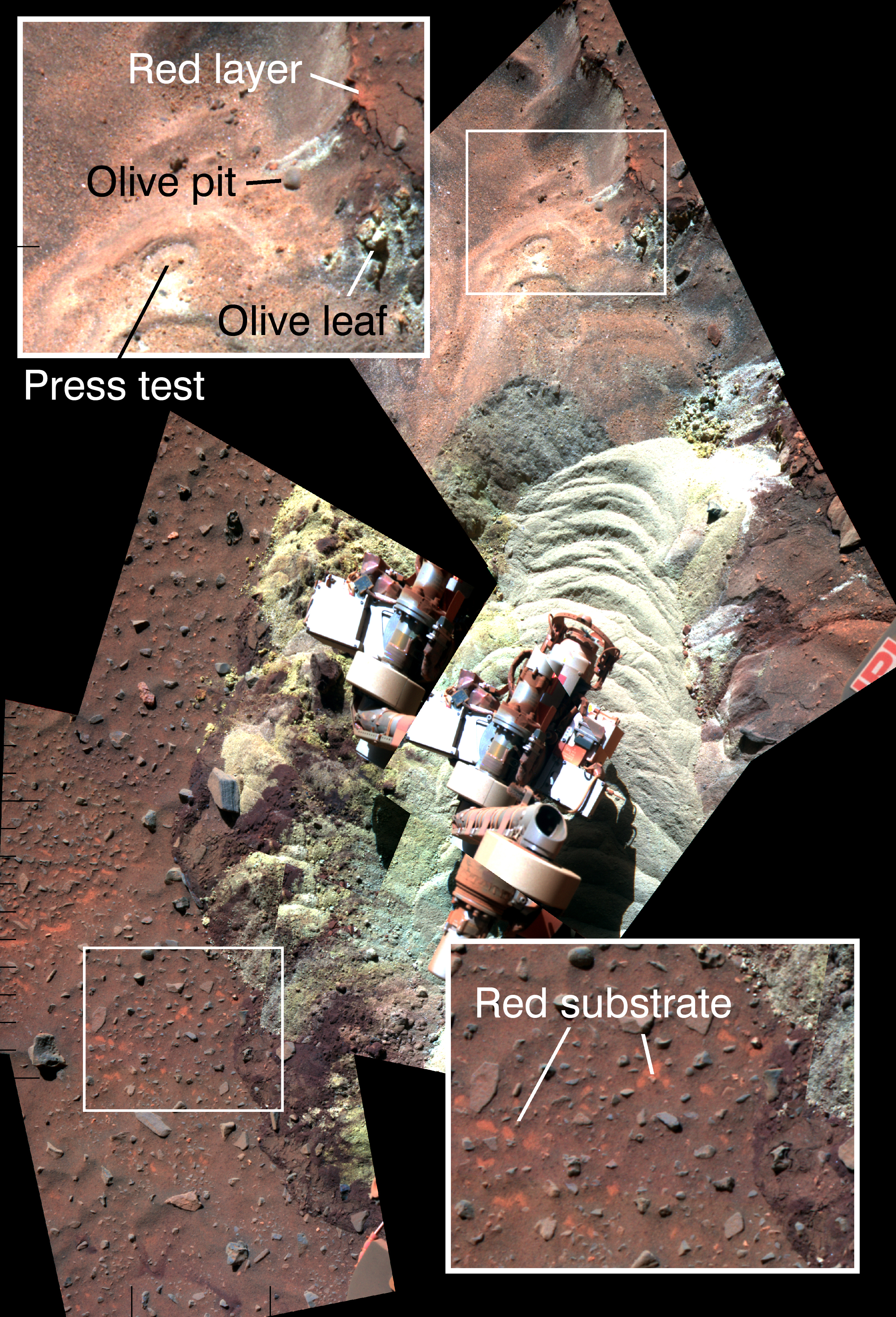
This mosaic of images shows the soil in front of NASA's Mars Exploration Rover Spirit after a series of short backward drives during attempts to extricate the rover from a sand trap in January and early February 2010. It is presented in false color to make some differences between materials easier to see. Bright-toned soil was freshly exposed by the rover's left-front wheel during the drives and can be seen with a "sand wave" shaping that resulted from the unseen wheel's action.

Spirit's panoramic camera (Pancam) took the component images during the period from the 2,163rd to 2,177th Martian days, or sols, of Spirit's mission on Mars (February 2 to February 16, 2010). The turret at the end of the rover's arm appears in two places because of movement during that period.

Insets in the upper left and lower right corners of the frame show magnified views of the nearby inscribed rectangles within the mosaic. The patch of ground within each rectangle is about 25 centimeters (10 inches) across. The top inset and upper portion of the mosaic include targets within soil layers exposed by the action of Spirit's wheels in April 2009 and examined in detail with instruments on Spirit's arm during the five subsequent months. "Olive pit" and "Olive leaf" are two of the analyzed targets. The investigations determined that, under a thin covering of windblown sand and dust, relatively insoluble minerals are concentrated near the surface and more-soluble ferric sulfates have higher concentrations below that layer. This pattern suggests water has moved downward through the soil, dissolving and carrying the ferric sulfates.

The brightness and color of the freshly disturbed soil seen in the center area of the mosaic indicates the this formerly hidden material is sulfate-rich. Before Spirit drove into this patch, the surface looked like the undisturbed ground highlighted in the lower-right inset. Flecks of red material in the surface layer resemble the appearance of the surface layer at other locations where Spirit's wheels have exposed high-sulfate, bright soils.

Photo credit: NASA/JPL-Caltech/Cornell University