Pages

Monday, August 23, 2010

NGC 5128 - Centaurus A


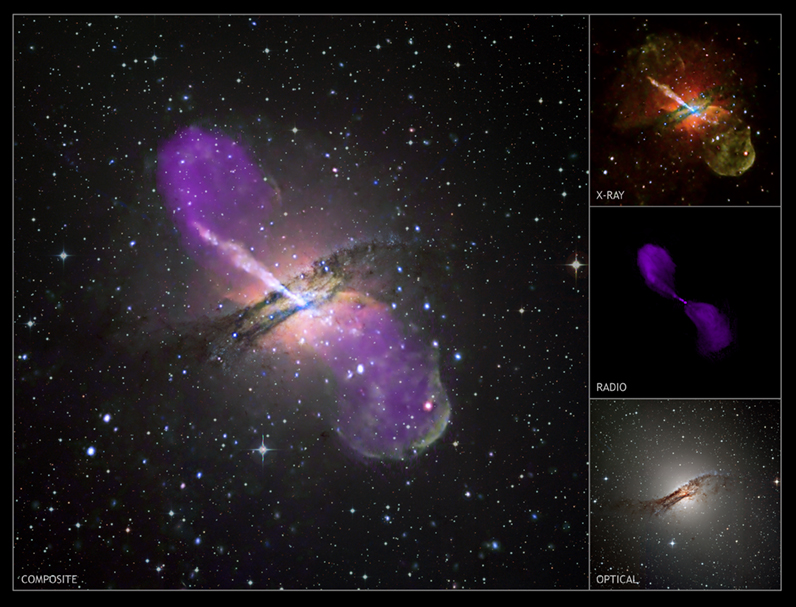
A dramatic new Chandra image of the nearby galaxy Centaurus A provides one of the best views to date of the effects of an active supermassive black hole. Opposing jets of high-energy particles can be seen extending to the outer reaches of the galaxy, and numerous smaller black holes in binary star systems are also visible.

The image was made from an ultra-deep look at the galaxy Centaurus A, equivalent to more than seven days of continuous observations. Centaurus A is the nearest galaxy to Earth that contains a supermassive black hole actively powering a jet.

A prominent X-ray jet extending for 13,000 light years points to the upper left in the image, with a shorter "counterjet" aimed in the opposite direction. Astronomers think that such jets are important vehicles for transporting energy from the black hole to the much larger dimensions of a galaxy, and affecting the rate at which stars form there.

High-energy electrons spiraling around magnetic field lines produce the X-ray emission from the jet and counterjet. This emission quickly saps the energy from the electrons, so they must be continually reaccelerated or the X-rays will fade out. Knot-like features in the jets detected in the Chandra image show where the acceleration of particles to high energies is currently occurring, and provides important clues to understanding the process that accelerates the electrons to near-light speeds.

The inner part of the X-ray jet close to the black hole is dominated by these knots of X-ray emission, which probably come from shock waves -- akin to sonic booms -- caused by the jet. Farther from the black hole there is more diffuse X-ray emission in the jet. The cause of particle acceleration in this part of the jet is unknown.

Hundreds of point-like sources are also seen in the Chandra image. Many of these are X-ray binaries that contain a stellar-mass black hole and a companion star in orbit around one another. Determining the population and properties of these black holes should help scientists better understand the evolution of massive stars and the formation of black holes.

Another surprise was the detection of two particularly bright X-ray binaries. These sources may contain stellar mass black holes that are unusually massive, and this Chandra observation might have caught them gobbling up material at a high rate.

In this image, low-energy X-rays are colored red, intermediate-energy X-rays are green, and the highest-energy X-rays detected by Chandra are blue. The dark green and blue bands running almost perpendicular to the jet are dust lanes that absorb X-rays. This dust lane was created when Centaurus A merged with another galaxy perhaps 100 million years ago.


Photo credit: (Top) NASA/CXC/CfA/R.Kraft et al.
(Bottom) X-ray: NASA/CXC/CfA/R.Kraft et al; Radio: NSF/VLA/Univ. Hertfordshire/M. Hardcastle; Optical: ESO/WFI/M.Rejkuba et al.)

Saturday, August 21, 2010

Messier 87


This image shows the eruption of a galactic "super-volcano" in the massive galaxy M87, as witnessed by NASA's Chandra X-ray Observatory and NSF's Very Large Array (VLA). At a distance of about 50 million light years, M87 is relatively close to Earth and lies at the center of the Virgo cluster, which contains thousands of galaxies.

The cluster surrounding M87 is filled with hot gas glowing in X-ray light (shown in blue) that is detected by Chandra. As this gas cools, it can fall toward the galaxy's center where it should continue to cool even faster and form new stars.

However, radio observations with the VLA (red-orange) suggest that in M87 jets of very energetic particles produced by the black hole interrupt this process. These jets lift up the relatively cool gas near the center of the galaxy and produce shock waves in the galaxy's atmosphere because of their supersonic speed.

The interaction of this cosmic "eruption" with the galaxy's environment is very similar to that of the Eyjafjallajokull volcano in Iceland that occurred in 2010. With Eyjafjallajokull, pockets of hot gas blasted through the surface of the lava, generating shock waves that can be seen passing through the grey smoke of the volcano. This hot gas then rises up in the atmosphere, dragging the dark ash with it. This process can be seen in a movie of the Eyjafjallajokull volcano where the shock waves propagating in the smoke are followed by the rise of dark ash clouds into the atmosphere.


Video: Omar Ragnarsson

In the analogy with Eyjafjallajokull, the energetic particles produced in the vicinity of the black hole rise through the X-ray emitting atmosphere of the cluster, lifting up the coolest gas near the center of M87 in their wake. This is similar to the hot volcanic gases that drag up the clouds of dark ash. And just like the volcano here on Earth, shock waves can be seen when the black hole pumps energetic particles into the cluster gas. The energetic particles, coolest gas and shock waves are shown in a labeled version.


Photo credit: X-ray (NASA/CXC/KIPAC/N. Werner, E. Million et al); Radio (NRAO/AUI/NSF/F. Owen)

Abell 1689


This image from NASA's Hubble Space Telescope shows the inner region of Abell 1689, an immense cluster of galaxies located 2.2 billion light-years away. The cluster's gravitational field is warping light from background galaxies, causing them to appear as arcs. The effect is similar to what happens when you look into a fun house mirror.

Dark matter in the cluster, which represents about 80 percent of its mass, is mapped by plotting these arcs. Dark matter cannot be photographed, but its distribution is shown in the blue overlay. The dark matter distribution is then used to better understand the nature of dark energy, a pressure that is accelerating the expansion of the universe.

The natural-color photo was taken with Hubble's Advanced Camera for Surveys.


Text Credit: NASA
Top photo credit: NASA/ESA/JPL-Caltech/Yale/CNRS
Bottom photo credit: NASA/ESA/JPL-Caltech/Yale/CNRS

Friday, August 20, 2010

Galaxy Cluster CLG J02182-05102


Astronomers have found that stars are forming more rapidly in the center of a distant galaxy cluster than at its edges, which is completely reversed from galaxy clusters seen in the local universe. This cluster, designated CLG J02182-05102, is highlighted in the circle above.

The image combines infrared light from NASA's Spitzer Space Telescope with visible light from Japan's Subaru telescope atop Mauna Kea, Hawaii. This sensitive exposure captures galaxies that are relatively local along side some that date back almost 10 billion years, soon after the Big Bang. The most distant galaxies stand out clearly in the infrared, rendered here in green and red.

What is noteworthy is how many of these galaxies are particularly bright at the longest infrared wavelengths, appearing red in this image. This glow indicates these ancient galaxies are still actively forming stars, even near the core of the cluster. In our local portion of the universe, the cores of galaxy clusters are known to be galactic graveyards full of massive elliptical galaxies composed of old stars.

The group's discovery holds potentially compelling implications that could ultimately reveal more about how such massive galaxies form. Now that they have pinpointed the epoch when galaxy clusters are making the last of their stars, astronomers can focus on understanding why massive assemblies of galaxies transition from very active to passive. The galaxies here may represent a missing link between the active galaxies and the quiescent behemoths that live in the local universe.

Infrared light from Spitzer at wavelengths of 4.5 and 24 microns is rendered in green and red, respectively. Subaru observations of visible light at a wavelength of 0.7 microns are rendered in blue. These data are part of the Spitzer Wide-area InfraRed Extragalactic (SWIRE) survey.

Photo Credit: NASA/JPL-Caltech/Texas A&M

Thursday, August 19, 2010

Magnetar in Star Cluster Westerlund 1


This artist’s impression shows the Magnetar in the very rich and young star cluster Westerlund 1. This remarkable cluster contains hundreds of very massive stars, some shining with a brilliance of almost one million suns. European astronomers have for the first time demonstrated that this magnetar — an unusual type of neutron star with an extremely strong magnetic field — was formed from a star with at least 40 times as much mass as the Sun. The result presents great challenges to current theories of how stars evolve, as a star as massive as this was expected to become a black hole, not a magnetar.

Illustration credit: ESO/L. Calçada


Photo credit: European Southern Observatory

Note: For more information and photographs, see How Much Mass Makes a Black Hole?

Wednesday, August 18, 2010

NGC 5139 - Omega Centauri


NASA's Wide-field Infrared Survey Explorer, or WISE, has captured a favorite observing target of amateur astronomers -- Omega Centauri. Also known as NGC 5139, this celestial cluster of stars can be found in the constellation Centaurus and can be seen by the naked eye to observers at low northern latitudes and in the southern hemisphere. Omega Centauri contains approximately 10 million stars and is about 16,000 light-years away. This image spans an area on the sky equivalent to a grid of about 3 by 2 full moons.

The ancient astronomer Ptolemy thought Omega Centauri was a star, and Edmond Halley identified it as a nebula in 1677. In the 1830s, John Herschel identified it as a globular star cluster orbiting our Milky Way galaxy. A globular cluster is a spherical group of stars that are bound together by gravity.

Omega Centauri has always been the black sheep of globular clusters, since it has several characteristics that mark it as different from the typical globular cluster. For example, Omega Centauri is ten times more massive than other globular clusters. It also includes stars of a variety of ages, whereas other globular clusters contain stars from only one generation.

Recent research based on observations using NASA's Hubble Space Telescope and the Gemini Observatory indicates that there is a black hole at its center. This suggests that Omega Centauri may actually be a dwarf galaxy that has been stripped of its outer stars and not a globular cluster after all.

All four infrared detectors aboard WISE were used to create this mosaic image of Omega Centauri. The colors blue and cyan represent light emitted from stars at wavelengths of 3.4 and 4.6 microns. The green halo surrounding the center represents light at 12 microns, emitted by warm dust.

Photo credit: NASA/JPL-Caltech/UCLA

Tuesday, August 17, 2010

A Path Not Taken


Mare surface in Sinus Aestuum near a lunar exploration site proposed in the late 1950s. Image width is 460 m.

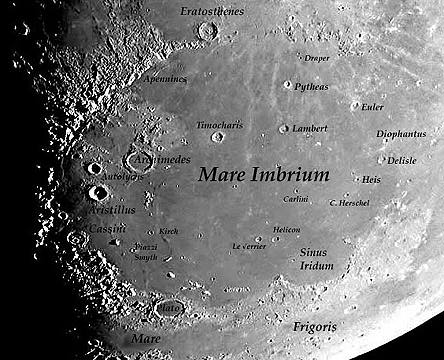
Thinking about locations on the Moon where humans should be exploring is nothing new. In the late 1950s, at the dawn of the Space Age (when Project Mercury was still getting off the ground), the United States Army proposed to establish a large lunar base to use for a variety of science, engineering, and military tasks. Despite the paucity of data about the lunar surface at that point in history, the Army team that proposed Project Horizon suggested several notional sites for this lunar outpost based on what was known at the time. One of these sites was located near this region in Sinus Aestuum, located southeast of Eratosthenes Crater just beyond the southern rim of the of the great Imbrium basin.

We know more about the Moon now than we did when this location was proposed over five decades ago. Knowing what we do now, it turns out that this would have been a fantastic location for an early lunar outpost. As you can see in the image above, this mare surface is relatively smooth, the near-equatorial location would have made for a dynamically favorable landing target, and the nearside location would enable continuous real-time communications with Earth. The location would have permitted sampling (and age-dating) the rays of Copernicus and direct exploration of Eratosthenes Crater, the foundations for the lunar stratigraphic time scale. This location is centrally located between several targets now known to have high scientific and exploration interest, including the aforementioned Eratosthenes Crater, Copernicus Crater, the rich ores of the Rima Bode regional dark mantling deposit, the Sinus Aestuum regional dark mantling deposit, and the southern rim of the Imbrium Basin, although an extended surface traverse would have been required to access those locations from this site. Future robotic and human lunar sortie missions will provide important new scientific insights into the lunar surface, but long-duration human lunar outposts will provide even more valuable benefits, including the flexibility to make exploration forays that last longer (or even repeat visits) to key scientific locations, as well as providing more infrastructure to leverage existing lunar resources.


LROC Wide Angle Camera [WAC] monochrome mosaic of the Sinus Aestuum region. Approximate location of the above image is shown by the small white arrow. Black rectangles are regions between individual WAC images that will be filled at a later date.

Photo credit: NASA/GSFC/Arizona State University

Monday, August 16, 2010

NGC 4911


A long-exposure Hubble Space Telescope image shows a majestic face-on spiral galaxy located deep within the Coma Cluster of galaxies, which lies 320 million light-years away in the northern constellation Coma Berenices.

The galaxy, known as NGC 4911, contains rich lanes of dust and gas near its center. These are silhouetted against glowing newborn star clusters and iridescent pink clouds of hydrogen, the existence of which indicates ongoing star formation. Hubble has also captured the outer spiral arms of NGC 4911, along with thousands of other galaxies of varying sizes. The high resolution of Hubble's cameras, paired with considerably long exposures, made it possible to observe these faint details.

NGC 4911 and other spirals near the center of the cluster are being transformed by the gravitational tug of their neighbors. In the case of NGC 4911, wispy arcs of the galaxy's outer spiral arms are being pulled and distorted by forces from a companion galaxy (NGC 4911A), to the upper right. The resultant stripped material will eventually be dispersed throughout the core of the Coma Cluster, where it will fuel the intergalactic populations of stars and star clusters.

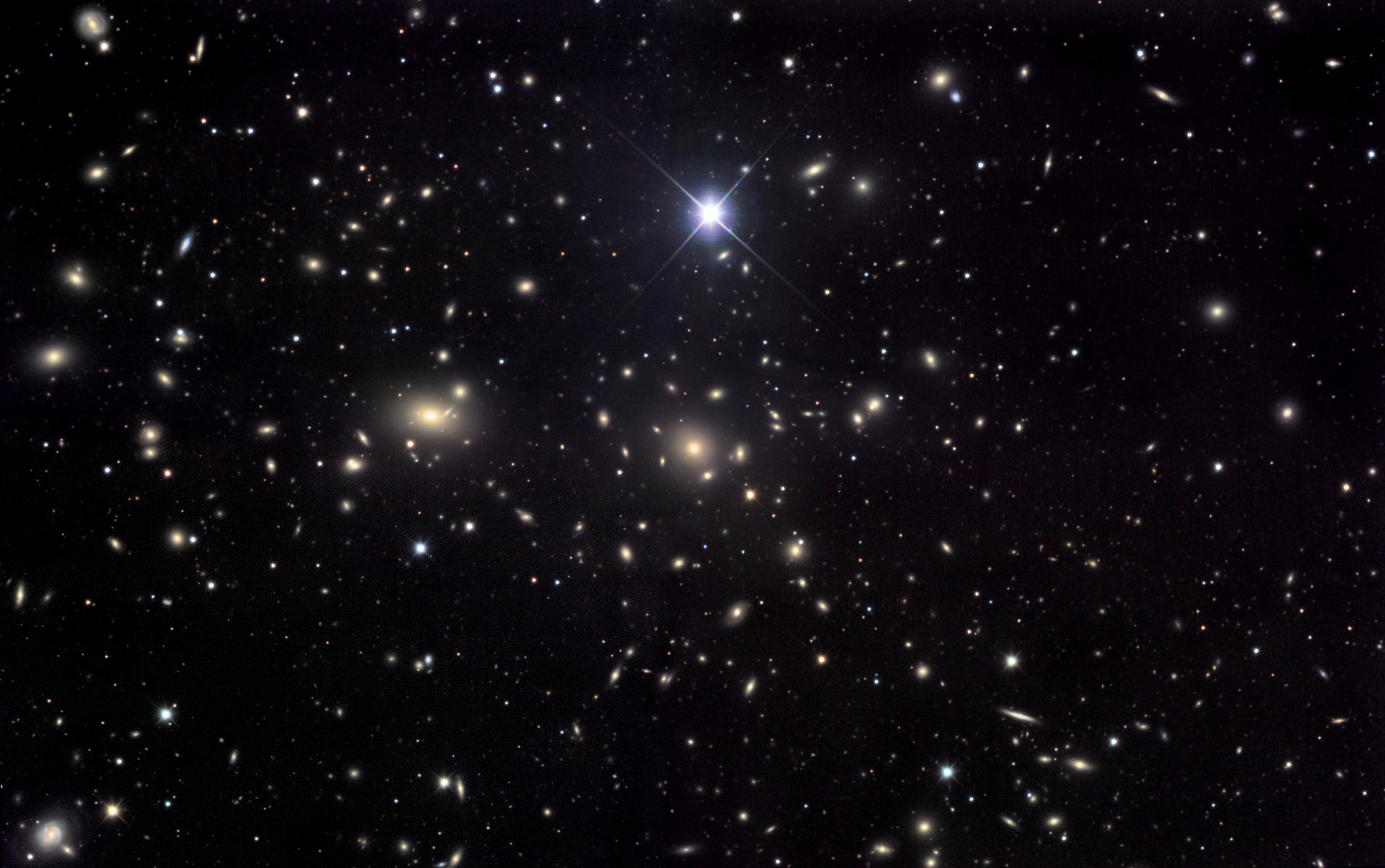
The Coma Cluster is home to almost 1,000 galaxies, making it one of the densest collections of galaxies in the nearby universe. It continues to transform galaxies at the present epoch, due to the interactions of close-proximity galaxy systems within the dense cluster. Vigorous star formation is triggered in such collisions.

Galaxies in this cluster are so densely packed that they undergo frequent interactions and collisions. When galaxies of nearly equal masses merge, they form elliptical galaxies. Merging is more likely to occur in the center of the cluster where the density of galaxies is higher, giving rise to more elliptical galaxies.

This natural-color Hubble image, which combines data obtained in 2006, 2007, and 2009 from the Wide Field Planetary Camera 2 and the Advanced Camera for Surveys, required 28 hours of exposure time.

Photo credit: NASA, ESA, and the Hubble Heritage Team (STScI/AURA)
Acknowledgment: K. Cook (Lawrence Livermore National Laboratory)

Sunday, August 15, 2010

NGC 4696: A Cosmic Question Mark


Curling around itself like a question mark, the unusual looking galaxy NGC 4696 itself begs many questions. Why is it such a strange shape? What are the odd, capillary-like filaments that stretch out of it? And what is the role of a large black hole in explaining its decidedly odd appearance?

This picture, taken by Hubble's Advanced Camera for Surveys, is not just a beautiful snapshot of NGC 4696, the largest galaxy in the Centaurus Cluster (galaxy cluster Abell 3526). It is also an illustration of the rich variety of objects that astronomers can see with the NASA/ESA Hubble Space Telescope.

NGC 4696 is an elliptical galaxy with a difference. Lacking the complex structure and active star formation of their spiral brethren, elliptical galaxies are usually little more than shapeless collections of aging stars.

Most likely formed by collisions between spiral galaxies, elliptical galaxies experience a brief burst of star formation triggered as the interstellar dust and gas crash into each other, but which quickly leaves the young elliptical galaxies exhausted. With no more gas to form new stars from, the galaxies gradually grow older and fainter.

But NGC 4696 is more interesting than most elliptical galaxies.

The huge dust lane, around 30,000 light-years across, that sweeps across the face of the galaxy is one way in which it looks different from most other elliptical galaxies. Viewed at certain wavelengths, strange thin filaments of ionized hydrogen are visible within it. In this picture, these structures are visible as a subtle marbling effect across the galaxy's bright center.

Looking at NGC 4696 in the optical and near-infrared wavelengths seen by Hubble gives a beautiful and dramatic view of the galaxy. But in fact, much of its inner turmoil is still hidden from view in this picture. At the heart of the galaxy, a supermassive black hole is blowing out jets of matter at nearly the speed of light. When looked at in X-ray wavelengths (see related links for a view of NGC 4696 by NASA's Chandra X-ray Observatory), huge voids within the galaxy become visible, telltale signs of these jets' enormous power.

The picture was created from images taken using the NASA/ESA Hubble Space Telescope's Advanced Camera for Surveys. A total of 5,440 seconds of exposure through a blue filter (F435W, shown in blue) were combined with 2,320 seconds of exposure through a near-infrared filter (F814W, shown in red). The field of view is 3.2 by 1.5 arcminutes.

Photo credit: ESA/Hubble and NASA

Saturday, August 14, 2010

The 30 Doradus/Tarantula Nebula Region


This VISTA image shows the spectacular 30 Doradus star-forming region, also called the Tarantula Nebula. At its core is a large cluster of stars known as R 136, in which some of the most massive stars known are located. This infrared image, made with ESO’s VISTA survey telescope, is from the VISTA Magellanic Cloud Survey. The project will scan a vast area — 184 square degrees of the sky (corresponding to almost one thousand times the apparent area of the full Moon), including our nearby neighboring galaxies, the Large and Small Magellanic Clouds. The end result will be a detailed study of the star formation history and three-dimensional geometry of the Magellanic system.

This image was created from images taken through Y, J and Ks filters in the near-infrared part of the spectrum (colored blue, green and red respectively). The exposure times were 40, 47 and 81 minutes per filter respectively. The image covers a region of sky about 52 by 70 arcminutes.


Photo credit: ESO/M.-R. Cioni/VISTA Magellanic Cloud survey. Acknowledgment: Cambridge Astronomical Survey Unit

Notes: For more information, see Ambitious Survey Spots Stellar Nurseries. The annotated photograph above points out several features in this particular region of space, including supernova remnant SN 1987A, globular star cluster NGC 2100, NGC 2080 (the Ghost Head Nebula), and open star cluster/emission nebulas NGC 2081 and NGC 2083.

Friday, August 13, 2010

Ultraviolet Rings and Arcs Around Galaxies


Astronomers have found unexpected rings and arcs of ultraviolet light around a selection of galaxies, four of which are shown here as viewed by NASA's and the European Space Agency's Hubble Space Telescope.

Observations from NASA's Galaxy Evolution Explorer (GALEX) picked out 30 elliptical and lens-shaped "early-type" galaxies with puzzlingly strong ultraviolet emissions but no signs of visible star formation. Early-type galaxies, so the scientists' thinking goes, have already made their stars and now lack the cold gas necessary to build new ones.

Hubble images captured the great, shining rings of ultraviolet light, with some ripples stretching 250,000 light-years.

In these Hubble images, ultraviolet light has been rendered in blue, while green and red light from the galaxies is shown in their natural colors.

The study detailing the findings appeared in the April 21 issue of the Astrophysical Journal.

Photo credit: NASA/ESA/JPL-Caltech/STScI/UCLA

Note: For more information, see Giant Ultraviolet Rings Found in Resurrected Galaxies

Thursday, August 12, 2010

INTEGRAL/IBIS 7-Year Map of the Galactic Bulge


This image shows a map of the Galactic Bulge region, reconstructed from data collected over seven years, from 2003 to 2010, with IBIS/ISGRI on board INTEGRAL, and covering the 17-60 keV energy band. The overlaid green contours are isophotes of the 4.9-micron surface brightness of the Galaxy as seen by COBE/DIRBE, revealing the bulge/disc structure of the inner Galaxy. The near-infrared brightness of the Galaxy traces also the hard X-ray Galactic Ridge emission.

Photo credit: Roman Krivonos (RSDC, Moscow, Russia, and MPA, Garching Germany), Astronomy Letters, 2010 in press; map of the Galactic Ridge emission from M. Revnivtsev et al., 2006

Note: For more information, see INTEGRAL Completes the Deepest All-Sky Survey in Hard X-Rays

Wednesday, August 11, 2010

The Small Magellanic Cloud


This image captured by NASA's Wide-field Infrared Survey Explorer (WISE) highlights the Small Magellanic Cloud. Also known as NGC 292, the Small Magellanic Cloud is a small galaxy about 200,000 light-years away.

The Small Magellanic Cloud is named after the Portuguese explorer Fernando de Magellan who observed it on his voyage around the world in 1519. Since it is visible to the naked eye in dark-sky conditions, it is likely that people in the southern hemisphere observed the galaxy long before Magellan recorded it.

Located in the constellation Tucana, the Small Magellanic Cloud looks like a wispy cloud that circles the south celestial pole. Nearby, but not visible in this image, is the Large Magellanic Cloud, a sister galaxy to the Small Magellanic Cloud. Astronomers originally thought that both galaxies were orbiting our Milky Way galaxy. But recent research suggests that they might be moving too fast to be bound by the Milky Way's gravity and are passing by for the first time.

This WISE image illustrates why the SMC is considered an irregular galaxy. Galaxies are classified according to their shape, such as spiral or elliptical. Irregular galaxies don't fit into any of these categories -- they are unique in shape.

The two streaks seen in the upper half of the image are satellites orbiting Earth, which happened to pass in front of the Small Magellanic Cloud when WISE captured this view.

This mosaic image was made from all four infrared detectors aboard WISE. The color in this image represents different wavelengths of infrared light. Blue and cyan represent light at wavelengths of 3.4 and 4.6 microns mostly emitted from stars. Green and red represent light at 12 and 22 microns, which is mostly light from warm dust.

Photo credit: NASA/JPL-Caltech/UCLA

Tuesday, August 10, 2010

Spokes on Saturn's B-Ring


Bright spokes can be seen on Saturn's B-ring just in front of the shadow cast on the rings on the night side of the planet in this Cassini spacecraft image.

The spokes are on the left of the image. See PIA12605 to learn more. Saturn's moon Tethys (1,062 kilometers, or 660 miles across) can be seen in the upper right of the image. The moon Enceladus (504 kilometers, or 313 miles across) is visible in the lower right. Both moons are overexposed.

This view looks toward the northern, sunlit side of the rings from about 8 degrees above the ringplane.

The image was taken in visible green light with the Cassini spacecraft wide-angle camera on May 30, 2010. The view was obtained at a distance of approximately 1.9 million kilometers (1.2 million miles) from Saturn and at a Sun-Saturn-spacecraft, or phase, angle of 104 degrees. Image scale is 110 kilometers (68 miles) per pixel.

Photo credit: NASA/JPL/Space Science Institute

Note: Today is another slow news day, with little to report. (Apparently the Minister is the only one working, while everyone else takes their vacations.) For similar stories about Saturn and its moons and rings, see Saturnology.

Monday, August 9, 2010

Beta Pictoris b


This story is a little old, having come out back in June, but there aren't any other new stories to report on at the moment.

For the first time, astronomers have been able to directly follow the motion of an exoplanet as it moves to the other side of its host star. The planet has the smallest orbit so far of all directly imaged exoplanets, lying as close to its host star as Saturn is to the Sun.

The team of astronomers used the NAOS-CONICA instrument (or NACO), mounted on one of the 8.2-meter Unit Telescopes of ESO's Very Large Telescope (VLT), to study the immediate surroundings of Beta Pictoris in 2003, 2008 and 2009. In 2003 a faint source inside the disc was seen, but it was not possible to exclude the remote possibility that it was a background star. In new images taken in 2008 and spring 2009 the source had disappeared! The most recent observations, taken during autumn 2009, revealed the object on the other side of the disc after having been hidden either behind or in front of the star. This confirmed that the source indeed was an exoplanet and that it was orbiting its host star. It also provided insights into the size of its orbit around the star.

The above composite shows the reflected light on the dust disc in the outer part, as observed in 1996 with the ADONIS instrument on ESO's 3.6-meter telescope. In the central part, the observations of the planet obtained in 2003 and autumn 2009 with NACO are shown. The possible orbit of the planet is also indicated, albeit with the inclination angle exaggerated.

Photo credit: ESO/A.-M. Lagrange

Sunday, August 8, 2010

NGC 1097


NASA's Spitzer Space Telescope has imaged a wild creature of the dark -- a coiled galaxy with an eye-like object at its center.

The galaxy, called NGC 1097, is located 50 million light-years away. It is spiral-shaped like our Milky Way, with long, spindly arms of stars. The "eye" at the center of the galaxy is actually a monstrous black hole surrounded by a ring of stars. In this color-coded infrared view from Spitzer, the area around the invisible black hole is blue and the ring of stars, white.

The black hole is huge, about 100 million times the mass of our sun, and is feeding off gas and dust along with the occasional unlucky star. Our Milky Way's central black hole is tame in comparison, with a mass of a few million suns.

The ring around the black hole is bursting with new star formation. An inflow of material toward the central bar of the galaxy is causing the ring to light up with new stars.

The galaxy's red spiral arms and the swirling spokes seen between the arms show dust heated by newborn stars. Older populations of stars scattered through the galaxy are blue. The fuzzy blue dot to the left, which appears to fit snuggly between the arms, is a companion galaxy. Astronomers say it is unclear whether this companion poked a hole in the larger galaxy, or just happens to be aligned in a gap in the arms.

Other dots in the picture are either nearby stars in our galaxy, or distant galaxies.

This image was taken during Spitzer's cold mission, before it ran out of liquid coolant. The observatory's warm mission is ongoing, with two infrared channels operating at about 30 Kelvin (minus 406 degrees Fahrenheit).

Infrared light with a wavelength of 3.6 microns is blue; 4.5-micron light is green and 8.0-micron light is red. The contribution from starlight measured at 3.6 microns has been subtracted from the 8.0-micron image to enhance the visibility of the dust features.

Photo credit: NASA/JPL-Caltech

Saturday, August 7, 2010

The Material Around SN 1987A


This artist’s impression of the material around a recently exploded star, known as Supernova 1987A (or SN 1987A), is based on observations which have for the first time revealed a three dimensional view of the distribution of the expelled material. The observations were made by astronomers using ESO’s Very Large Telescope. The original blast was not only powerful, according to the new results, it was also more concentrated in one particular direction. This is a strong indication that the supernova must have been very turbulent, supporting the most recent computer models. This image shows the different elements present in SN 1987A: two outer rings, one inner ring and the deformed, innermost expelled material.

Just how a supernova explodes is not very well understood, but the way the star exploded is imprinted on this inner material. The astronomers could deduce that this material was not ejected symmetrically in all directions, but rather seems to have had a preferred direction. Besides, this direction is different to what was expected from the position of the rings.

Image credit: ESO/L. Calçada

Note: For more information, see Seeing a Stellar Explosion in 3D

Friday, August 6, 2010

Star Cluster AFGL 490


The Wide-field Infrared Survey Explorer, or WISE, has seen a cluster of newborn stars enclosed in a cocoon of dust and gas in the constellation Camelopardalis. The cluster, AFGL 490, is hidden from view in visible light by the cloud. But WISE's infrared vision sees the glow of the dust itself, and penetrates this dust to see the infant stars within.

Not much is known about this stealthy star cluster. Its distance from Earth is estimated to be about 2,300 light-years. The portion of the star-forming nebula captured in this view stretches across about 62 light-years of space.

All four infrared detectors aboard WISE were used to make this mosaic. Color is representational: blue and cyan represent infrared light at wavelengths of 3.4 and 4.6 microns, which is dominated by light from stars. Green and red represent light at 12 and 22 microns, which is mostly light from warm dust.

Photo credit: NASA/JPL-Caltech/UCLA

Thursday, August 5, 2010

NGC 253 - The Sculptor Galaxy


A spectacular new image of the Sculptor Galaxy (NGC 253) has been taken with the ESO VISTA telescope at the Paranal Observatory in Chile as part of one of its first major observational campaigns. By observing in infrared light VISTA’s view is less affected by dust and reveals a myriad of cooler stars as well as a prominent bar of stars across the central region. The VISTA image provides much new information on the history and development of the galaxy.

The Sculptor Galaxy (NGC 253) lies in the constellation of the same name and is one of the brightest galaxies in the sky. It is prominent enough to be seen with good binoculars and was discovered by Caroline Herschel from England in 1783. NGC 253 is a spiral galaxy that lies about 13 million light-years away. It is the brightest member of a small collection of galaxies called the Sculptor Group, one of the closest such groupings to our own Local Group of galaxies. Part of its visual prominence comes from its status as a starburst galaxy, one in the throes of rapid star formation. NGC 253 is also very dusty, which obscures the view of many parts of the galaxy (eso0902). Seen from Earth, the galaxy is almost edge on, with the spiral arms clearly visible in the outer parts, along with a bright core at its center.

...

As VISTA, the Visible and Infrared Survey Telescope for Astronomy, works at infrared wavelengths it can see right through most of the dust that is such a prominent feature of the Sculptor Galaxy when viewed in visible light. Huge numbers of cooler stars that are barely detectable with visible-light telescopes are now also seen. The VISTA view reveals most of what was hidden by the thick dust clouds in the central part of the disc and allows a clear view of a prominent bar of stars across the nuclear region — a feature that is not seen in visible light pictures. The majestic spiral arms now spread over the whole disc of the galaxy.

Photo credit: ESO/J. Emerson/VISTA. Acknowledgment: Cambridge Astronomical Survey Unit

Wednesday, August 4, 2010

Bright Lights, Green City


Two extremely bright stars illuminate a greenish mist in this and other images from the new "GLIMPSE360" survey from NASA's Spitzer Space Telescope. This fog is comprised of hydrogen and carbon compounds called polycyclic aromatic hydrocarbons (PAHs), which are found right here on Earth in sooty vehicle exhaust and on charred grills. In space, PAHs form in the dark clouds that give rise to stars. These molecules provide astronomers a way to visualize the peripheries of gas clouds and study their structures in great detail. They are not actually "green;" but are color coded in these images to let scientists see their glow in infrared.

Strange streaks -- likely dust grains that lined up with magnetic fields -- distort the star in the top left. The fairly close, well-studied star GL 490 gleams in the middle right. The new observations have revealed several small, blobby outflows of gas from nearby forming stars, which indicate their youth. Such outflows are a great way to target really young, massive stars in their very earliest, hard-to-catch stages.

This image is a combination of data from Spitzer and the Two-Micron All-Sky Survey (2MASS). The Spitzer data was taken after Spitzer's liquid coolant ran dry in May 2009, marking the beginning of its "warm" mission. Light from Spitzer's remaining infrared channels at 3.6 and 4.5 microns has been represented in green and red, respectively. 2MASS observations at 2.2 microns are blue.

Photo credit: NASA/JPL-Caltech/2MASS/SSI/University of Wisconsin

Tuesday, August 3, 2010

Three Lunar Craters Named

The USGS Astrogeology Science Center has announced the naming of three craters on the Moon; the honorees are: Bi Sheng, Cai Lun, and Zhang Yuzhe.

Bi Sheng (990-1051) was the Chinese inventor of the first known movable type printing press technology, using type made out of porcelain. Bi Sheng Crater is located at 78.4° North, 148.6° East, northwest of Milankovic Crater on the far side of the Moon.

Cai Lun (50-121) was the Chinese inventor of paper and the paper-making process. His method for making paper, although revised many times over the centuries, is still the same basic process used to make paper today. Cai Lun Crater is located at 80.3° North, 113.5° East, near the lunar north pole and lying just east of Nansen Crater.

Zhang Yuzhe (1902-1986) was a Chinese astronomer; he received his PhD from the University of Chicago in 1929, but worked primarily in China. He was head of the astronomy research institute at the National Central University (1941-1950), and director of Purple Mountain Observatory (1950-1984) in Nanjing. He was also a member of the Chinese Academy of Sciences. Most of his research was devoted to asteroids, comets and variable stars. He discovered one asteroid, 3789 Zhongguo, and has one asteroid named after him, 2051 Chang. Zhang Yuzhe Crater is located at 69.1° South, 137.8° West, and lies north of Zeeman Crater on the moon's far side, near the lunar south pole.

Fleeing the Scene


Saturn's moon Prometheus, having perturbed the planet's thin F ring, moves away as it continues in its orbit.

The gravity of potato-shaped Prometheus (86 kilometers, 53 miles across) periodically creates streamer-channels in the F ring, and the moon's handiwork can be seen in the dark channels here. To learn more and to watch a movie of this process, see PIA08397.

This view looks toward the northern, sunlit side of the rings from about 10 degrees above the ringplane. A star is visible through the rings near the center right of the image.

The image was taken in visible light with the Cassini spacecraft narrow-angle camera on June 1, 2010. The view was acquired at a distance of approximately 1.3 million kilometers (808,000 miles) from Saturn. Image scale is 7 kilometers (5 miles) per pixel.

Photo credit: NASA/JPL/Space Science Institute

Note: For more information and photos, see Saturnology's Fan Structures in Saturn's F-Ring.

Monday, August 2, 2010

IRAS 21078+5211


This image shows an outflow of gas from a new star as it jets from a space object dubbed IRAS 21078+5211. The reddish blob in its center, as picked up by the 4.5-micron infrared band on NASA's Spitzer Space Telescope, contrasts nicely with the clouds, colored green here, that surround it. These so - called shocked outflows ram into the hydrogen gas around them and make it glow -- a bright beacon in the lonely outskirts of the Milky Way.

This image is a combination of data from Spitzer and the Two-Micron All-Sky Survey (2MASS). The Spitzer data was taken after Spitzer's liquid coolant ran dry in May 2009, marking the beginning of its "warm" mission. Light from Spitzer's remaining infrared channels at 3.6 and 4.5 microns has been represented in green and red, respectively. 2MASS observations at 2.2 microns are blue.

Photo credit: NASA/JPL-Caltech/2MASS/SSI/University of Wisconsin

Sunday, August 1, 2010

Nebula BG2107+49


A star-forming region called BG2107+49 shines from the considerable distance of more than 30,000 light-years away in the upper left of this image from NASA's Spitzer Space Telescope. With Spitzer's resolution and sensitivity, however, astronomers can "zoom in" on the action of star birth unfolding there, where behemoth stars ten to twenty times the mass of our sun are taking shape. To the right looms an expanding bubble of star formation likely triggered by powerful stellar winds blown from an earlier generation of stars that arose in the ring's center. The smattering of little red dots in the area and elsewhere are young forming stars still cocooned in gas and dust.

This image is a combination of data from Spitzer and the Two Micron All Sky Survey (2MASS). The Spitzer data was taken after Spitzer's liquid coolant ran dry in May 2009, marking the beginning of its "warm" mission. Light from Spitzer's remaining infrared channels at 3.6 and 4.5 microns has been represented in green and red, respectively. 2MASS observations at 2.2 microns are blue.

Photo credit: NASA/JPL-Caltech/2MASS/SSI/University of Wisconsin